Cathedral City’s first Festival of the Arts was not just a pleasant day of artist booths, music and family activity at the community amphitheater. It was also a test of whether the city can turn its long-running “where art lives” identity into something more economically durable.
By that measure, organizers say the inaugural event delivered enough early proof to justify bigger ambitions.
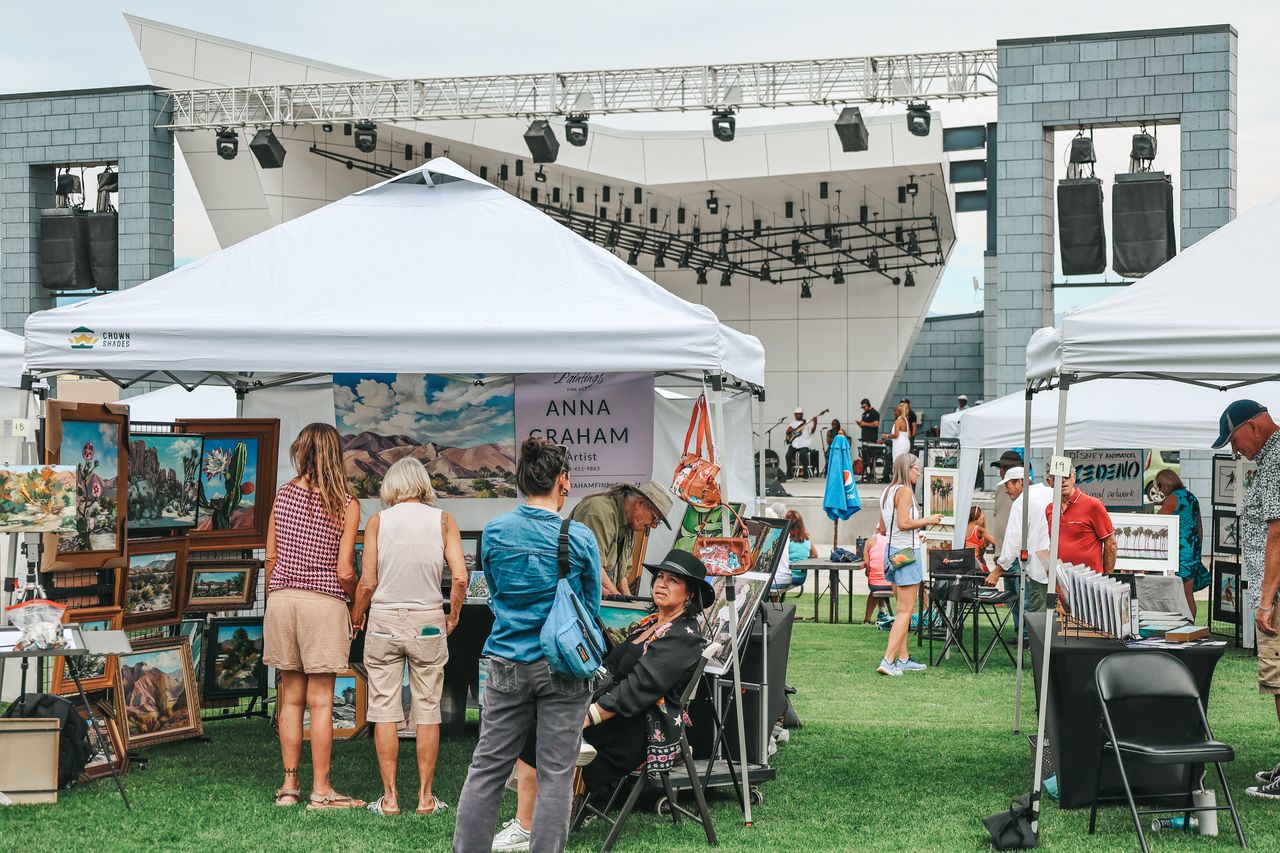
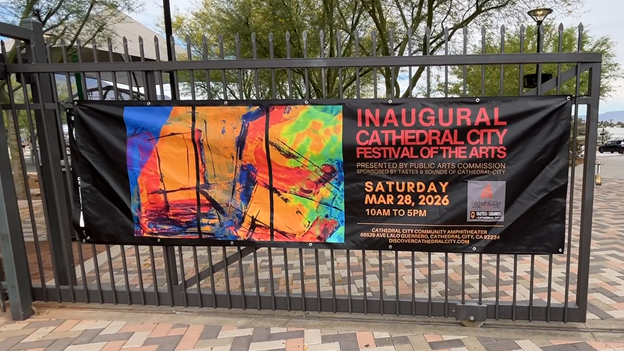
The March 28 festival brought together roughly 40 artists at the Cathedral City Community Amphitheater, according to organizers, with live jazz and blues, food vendors, and children’s activities added to create a broader downtown draw. City and public arts leaders said the most important result was not simply attendance, though they described hundreds of people moving through the venue, but that artists sold work across the board.
For a city that has spent years working to elevate its event calendar and strengthen its downtown destination appeal, that matters.
It suggests Cathedral City may have found another way to convert culture into commerce while reinforcing an identity that already includes the Perez Art District, public art programming, weekly concerts and a growing schedule of signature events.
Ryan Hunt, the city’s director of communications and engagement, said Cathedral City is increasingly growing into the arts-forward image it has long promoted.
“We’ve long been billed as ‘art lives here,’ and I think that we’re now meeting that moment,” Hunt said in an interview after the event. “Celebrating creative artists and making them feel like they really are where artists thrive and live.”
A festival built to help artists sell
Festival organizers deliberately chose to keep barriers low for participating artists.
According to city materials, the event was designed to promote artists and artisans by giving them a venue to display, sell and discuss handmade work. The goal was not merely to stage an attractive civic event, but to create real opportunity for artists while also enhancing downtown Cathedral City and supporting inclusive community participation.
Cathedral City resident Craig Liebelt, chair of Cathedral City’s Public Arts Commission, said that the focus on artist success shaped the event from the start.
He said the inaugural festival featured glass, ceramics, clothing, mixed media and other forms of visual art, and that several participating artists were showing in a festival setting for the first time.
“What I like about this opportunity is that there were several artists there. This was their first chance to be in a show, and every one of them sold art,” Liebelt said. “That is inspiring.”
That point could prove significant if the city wants the festival to become something larger over time.
In mature arts markets, organizers often must balance prestige with accessibility. Liebelt said Cathedral City may have an opening to do both by creating a platform that includes strong, established artists while also giving emerging artists a realistic place to break in, build confidence and reach buyers.
He framed that as one of Cathedral City’s advantages. Unlike longer-established high-end art environments that can feel exclusive, he said, Cathedral City has the chance to build an event that remains open and welcoming to a broader public.
More than an arts event
Hunt said the city increasingly sees events not as isolated attractions, but as part of a larger downtown ecosystem.
That was visible during the festival, he said, as people moved between the amphitheater and nearby businesses, including restaurants, breweries and other activities already underway in the area.
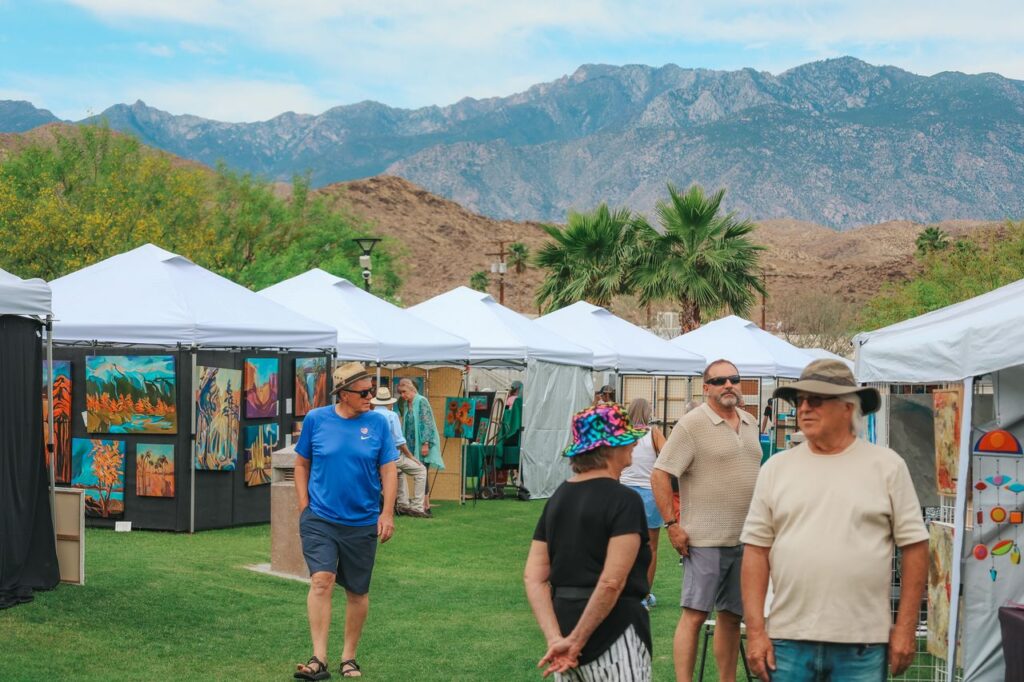
Cathedral City’s first Festival of the Arts captured the beauty of the artists’ creations and the setting.
For Cathedral City, that kind of foot traffic matters as much as any one-day attendance count. It helps validate the city’s broader argument that downtown is no longer simply a pass-through corridor but a place where residents and visitors can spend meaningful time and money.
“I think probably 10 years ago we were a pass-through town,” Hunt said. “I don’t think that anybody feels that way about Cathedral City anymore.”
That is a notable claim in a valley where cities often compete for attention through tourism branding, events and destination development. Cathedral City does not have the luxury image of some of its neighbors, but city leaders increasingly appear to view inclusivity, affordability and creativity as competitive strengths rather than limitations.
The arts festival fits squarely into that strategy.
The visual-arts component was paired with the city’s Tastes & Sounds concert programming, creating a hybrid event that used an existing music framework to broaden the day’s appeal. Hunt said that kind of internal coordination reflects a larger effort to unite city programming around a shared cultural and economic vision.
Cathedral City’s venue advantage
Part of what makes that strategy more plausible is the amphitheater itself.
The Cathedral City Community Amphitheater has become one of downtown’s most important civic assets, giving the city a modern outdoor venue that can host concerts, festivals and other large public gatherings at a scale many local communities cannot easily match.
Liebelt pointed to that repeatedly, arguing that the city’s amphitheater, park setting and sound system give Cathedral City an edge when it comes to mounting public events with real energy.
The city has already demonstrated that the venue can attract substantial crowds for music programming. That matters because it gives Cathedral City room to grow an arts festival well beyond its first-year footprint if city leaders choose to make it annual and invest more deeply in it.
Hunt said the city learned from the first edition and now has a foundation to refine and expand.
“The sky’s the limit for this event,” he said.
Tapping into a broader arts identity
The festival also arrives at a moment when Cathedral City’s arts identity appears more fully formed than in previous years.
Liebelt, who previously worked in the arts world while living in Santa Fe, New Mexico – which is considered one of the top art markets in the country, said he saw a convergence taking place in Cathedral City that finally made a festival like this viable: the growth of the amphitheater, the city’s event energy, public-art momentum, the regional influence of the Coachella Festival’s art installations and Desert X, and the presence of artists already working in and around Cathedral City.
He specifically pointed to the Perez Road area as having meaningful long-term potential.
That matters because Cathedral City is not trying to build an arts brand from nothing. The Perez Art District already has a notable concentration of artists and galleries and has become one of the city’s most recognizable creative assets. A successful annual festival could help connect that arts district more directly to downtown foot traffic, city branding and visitor discovery.
In that sense, the arts festival is not just a standalone event. It is another layer in a larger effort to turn cultural activity into a more visible and sustained part of Cathedral City’s economic identity.
The next question is scale
The most interesting question now is not whether the inaugural festival worked, but how ambitious Cathedral City wants to be with it.
Liebelt said he would like to see future editions expand to include more forms of art and possibly larger outdoor sculpture. He also suggested the event could eventually grow from one day to two.
That will depend on city priorities, budget choices and political support. Hunt stopped short of presuming future council action, but said the early feedback suggested city leaders see promise in making the festival an annual downtown fixture.
The early signs here are encouraging. Artists sold work. Organizers generated goodwill. The city strengthened its claim that arts programming can support economic development, not just civic image. And Cathedral City added another use case for an amphitheater that is steadily becoming central to its downtown identity.
Bob Marra is the CEO/Publisher of GPS Business Insider. He has been studying, writing and giving presentations about business and public affairs news and issues and the local economy in the Greater Palm Springs/Coachella Valley region for more than 20 years.