A divided Coachella City Council finally named a mayor, but the same meeting exposed deeper turmoil as the interim city manager withdrew from consideration and residents demanded answers about a major data center proposal.
The city of Coachella finally has a new mayor.
It does not yet have a stable governing majority, a permanent city manager or a clear public path forward on the proposed data center project tied to its proposed municipal power utility that has ignited a fast-growing backlash across the eastern Coachella Valley.
In a tense April 22 meeting that stretched across several of the city’s most consequential issues, the City Council appointed Mayor Pro Tem Frank Figueroa to finish the term of former Mayor Steven Hernandez, who resigned after pleading guilty to a felony conflict-of-interest charge. But the vote came only after council members again exposed a deep split over who should lead the city, how quickly key vacancies should be filled and whether the council can still move major decisions without falling into procedural and political stalemates amid ongoing surprise, last-minute directional changes and infighting.
The same night, the council delayed appointing Interim City Manager Gabriel Gonzalez as permanent city manager, even though his contract was on the agenda for approval after closed session discussion by the council the week prior.
For a city already facing public anger over the proposed data center now known as the Coachella Valley Technology Campus, Gonzalez’s statement was more than a personnel matter. It was a public vote of no confidence in the city’s political climate from the chief administrator that the council had been preparing to hire.
A Mayor Is Named, But Not Before Another Fight
Figueroa’s appointment ended one vacancy but immediately created another. Because he moved from a council seat into the mayor’s office, the city now has 60 days to fill his council seat.
The mayoral vacancy followed Hernandez’s resignation, leaving the council split 2-2. Councilmember Stephanie Virgen argued that the path should have been simple: the Mayor Pro Tem should become mayor and allow the city to move forward.
Virgen said the city was repeatedly stuck on matters that should not take so long.
“It’s embarrassing to be standing here and having these conversations over and over again,” she said.
Councilmembers Denise Delgado and Yadira Perez had favored a more open application process, arguing that the public deserved transparency and that the city should not simply elevate a sitting council member without a broader process.
Perez said the decision was not easy and that residents had called for accountability.
“People ask for transparency,” Perez said. “People want accountability, and we should allow the people to voice their opinions.”
That argument collided with the practical reality of a four-member council already struggling to reach consensus. Virgen suggested the council’s divisions were no longer about process, but about factions.
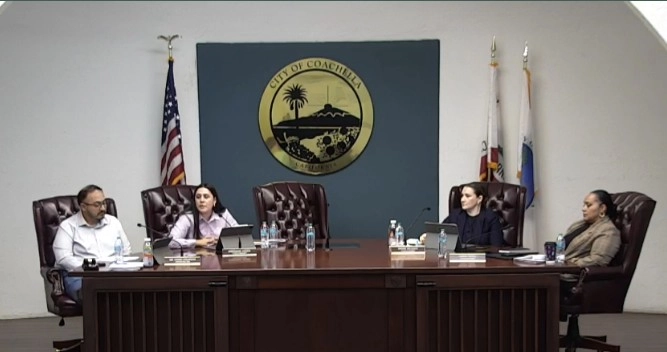
The “split” as described by council member Stephanie Virgen is symbolically illustrated at the city council’s April 22 meeting.
With the empty chair where former mayor Hernandez sat ominously separating two clearly dissenting factions among the council, Virgen said, “We’re split. This chair keeps us apart.”
Figueroa, who abstained from the vote to appoint him because of a conflict-of-interest concern, said the city needed to fill the seat, or Coachella could face months of stalemate.
“Moving things to the next meeting cannot be the normal in Coachella,” Figueroa said.
The council ultimately voted 3-0 to appoint him mayor. He was sworn in immediately.
City Manager Appointment Falls Apart
The city manager item should have been more straightforward.
The staff recommendation was to appoint Gonzalez, the interim city manager, to the permanent position under a three-year contract with a $300,000 annual salary, a 6 percent retirement contribution, a $500 monthly vehicle allowance, a $150 monthly technology allowance and up to $15,000 in relocation reimbursement.
Instead, Delgado asked to continue the item, saying “serious concerns” had been brought to her attention. She did not publicly identify the concerns, saying they were not related to the contract itself.
That explanation did not satisfy other council members.
Virgen said the city had already had opportunities to ask questions and discuss the matter. She said the delay undermined Coachella’s credibility at a time when residents and neighboring cities were watching.
“I’m in disbelief that we’re almost in May and we haven’t been able to resolve something like this that shouldn’t take that much time,” Virgen said.
Gonzalez later used his city manager update agenda item to announce that he no longer wanted the permanent job.
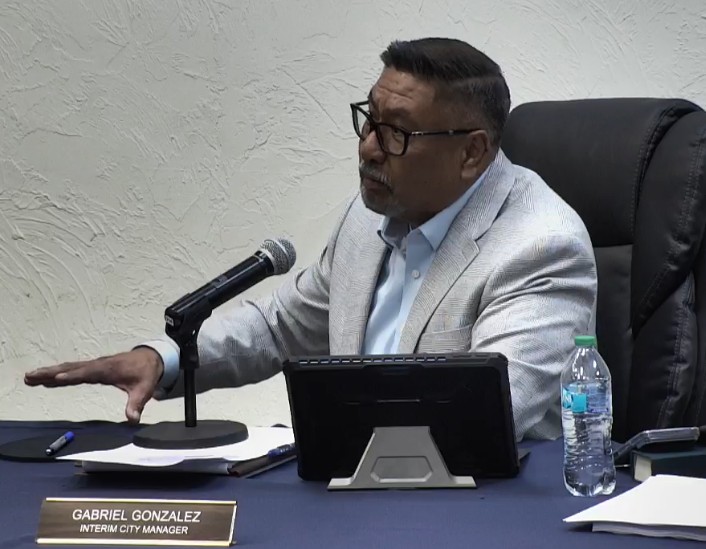
Coachella interim city manager Gabriel Gonzalez removed himself from consideration for the permanent city manager role.
“I’ve spent nearly 30 years as a city manager, including more than 20 years leading cities across California, and my integrity has never been questioned,” he said. “I came to Coachella as a retiree on a short-term interim assignment. I was not seeking to come out of retirement.”
He said he accepted the role after being contacted by a recruiter while finishing another interim assignment, viewing it as a limited engagement close enough to his home in the San Diego area.
“I’ve enjoyed a long career, and I’m content in retirement, spending time with my family,” Gonzalez said. “This was an opportunity to contribute on an interim basis, not to reenter full-time service.”
Gonzalez said the current political environment led him to step away.
“I’m not going to involve myself in the political dynamics that are playing out here,” he said. “As a professional city manager, I have choices. I can remain retired or pursue other opportunities.”
He added that his concern ultimately rests with city staff.
“This is a strong organization with a capable team, and I feel for them, given the level of political conflict,” Gonzalez said. “The city has significant potential, and I believe I could have contributed to that, but I am not willing to have my integrity questioned.”
Gonzalez said he will assist with a transition in the short term but confirmed his withdrawal from the position.
“I am formally withdrawing from consideration as city manager,” he said. “I will remain available during a transition period, but I will return to retirement and continue my consulting work.”
After Gonzalez’s move, Coachella must move forward with a new mayor following a contentious appointment, an open council seat and renewed uncertainty over who will run City Hall at the administrative level.
Coachella Data Center Backlash Reaches City Hall
The leadership conflict is unfolding as the proposed Coachella Valley Technology Campus becomes one of the most controversial economic development proposals in the region.
Dozens of residents and activists spoke against the project during public comment, even though the data center was not a formal agenda item. Speakers questioned the project’s impact on water, agricultural land, air quality, public health and the city’s transparency.
The proposed campus, as previously reported in depth by GPS Business Insider, is tied to the city’s broader municipal power strategy. The first phase has been described in public materials as a roughly 240-acre project that could include six data center buildings and require hundreds of megawatts of electrical capacity. The project is connected to the city’s effort to build a limited municipal electric utility in greenfield areas not already served by sufficient infrastructure.
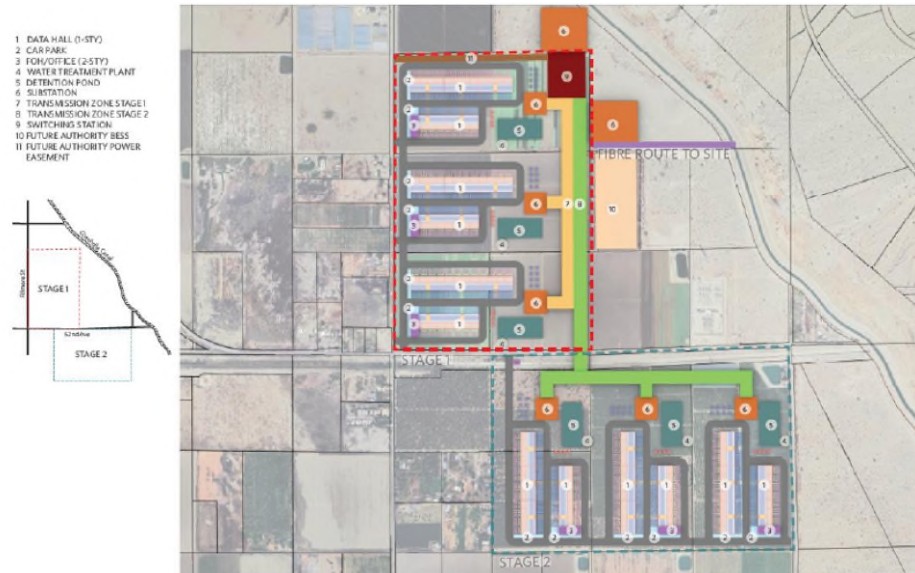
A site plan for the Coachella Technology Campus data center development.
That technical explanation has done little to slow public opposition.
Residents who spoke on April 22 framed the issue as a question of environmental justice, local control and trust in government. Some objected to the conversion of agricultural land. Others said the city had not been sufficiently transparent about how the project advanced or what residents could do to influence the process.
One speaker warned that agricultural land in the eastern Coachella Valley was not expendable.
“This has the opportunity to threaten our access to clean water and agricultural land,” the speaker said.
The public anger appears to have grown sharply after a viral social media video opposing the project circulated earlier this month. GPS Business Insider was the first media outlet to report in depth on the project and its connection to the city’s power strategy before the video was posted and widely distributed.
A Workshop, But Not A Moratorium
Gonzalez said city staff is planning a community informational workshop on May 11, two days before the council’s May 13 meeting. He said the workshop is intended to explain not only the data center proposal, but also the public-private partnership and the city’s utility strategy.
“Based on prior direction from the council, staff is organizing a community workshop on May 11 to explain not just the data center proposal, but the full P3 structure and the city’s efforts to develop its own power capacity,” Gonzalez said. “This initiative stems from the reality that existing infrastructure, particularly through IID, does not currently provide sufficient capacity for future growth.”
He said the workshop will include presentations from city staff, the city attorney’s office and the city’s private partner, Stronghold, with the goal of addressing what he described as widespread misinformation circulating online and in the community.
“We want to provide clear, factual information and give residents an opportunity to engage before the council takes further action,” he said.
Figueroa signaled that one of his first priorities as mayor would be to bring the moratorium question back to the council.
“If I’m appointed mayor, first thing I want to do is call for a moratorium,” he said during the meeting.
That statement could further sharpen the divide within the council. It also raises the question of whether the city’s new mayor will try to reset the public process on a project that had been advancing largely through technical presentations, utility agreements and development discussions before the wider public mobilized against it.
The City’s Political Divide Is Now The Story
Coachella’s data center debate is now about more than data centers.
It is about whether the city’s leadership can manage a high-stakes, extremely controversial new municipal utility and data center proposal while dealing with the fallout from a mayoral resignation, the loss of a permanent city manager, a divided council and a public that increasingly believes decisions are being made before residents fully understand them.
At several points during the April 22 meeting, council members spoke not only about policy differences but also about each other.
Virgen accused some colleagues of slowing down basic city business. Delgado defended her record, citing policies she said she had advanced on nepotism, grants, the code of conduct, procurement, Spanish-language notices, and conflict-of-interest rules. Perez said she wanted a leader willing to speak up when things are not right.
The result was a council meeting that seemed to confirm what residents and regional observers had already seen: Coachella’s governing body is divided into two camps, with little trust between them.
The question now is whether the appointment of Figueroa gives the council a path out of deadlock or simply moves the next fight to the vacant council seat, the city manager search and the proposed municipal power utility and data center campus.
For a city trying to sell itself as a place for major investment, the stakes are no longer abstract. A city can approve projects, create utility authorities and schedule workshops. But it also has to show residents, investors and neighboring cities that it can govern.
Right now, Coachella is struggling to do that in public.

Bob Marra is the CEO/Publisher of GPS Business Insider. He has been studying, writing and giving presentations about business and public affairs news and issues and the local economy in the Greater Palm Springs/Coachella Valley region for more than 20 years.