A planned June 3 joint meeting between the Palm Springs City Council and the Agua Caliente Band of Cahuilla Indians on one of the largest warehouse proposals ever contemplated in the Greater Palm Springs region has been postponed until later this fall, giving the project’s developer more time to respond to public comments and evaluate unresolved technical issues.
The delay does not end the debate over the proposed Desert Mountain View Business Park. It likely extends it.
The project, proposed for roughly 217 acres of Agua Caliente trust land west of Tipton Road between Interstate 10 and Highway 111, calls for four large warehouse and logistics buildings totaling about 2.85 million square feet. Individual buildings would range from roughly 248,000 square feet to more than 1.1 million square feet, placing the development among the largest industrial projects ever proposed in the Coachella Valley.
To put into perspective the size and scale of a 2.85 million-square-foot cluster of combined warehouse space, the buildings together would be the second-largest commercial development in Southern California, surpassed only by the six-story, 4.1 million-square-foot Amazon/Prologis fulfillment center in Ontario. The complex would be slightly larger than South Coast Plaza in Costa Mesa and nearly twice the size of Ontario Mills.
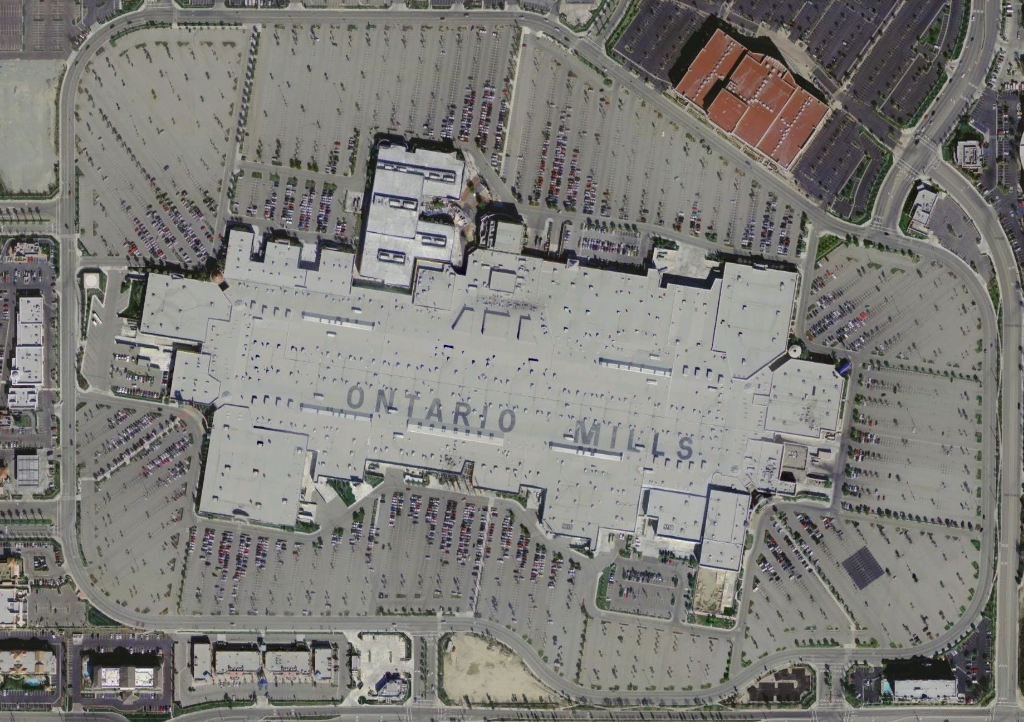
Current plans for the warehouse development reveal a cluster of buildings that comprise more than twice as much built space than Ontario Mills.
The City of Palm Springs and the Tribe said additional time is needed for the developer to address public comments submitted on the Draft Tribal Environmental Impact Statement and to further evaluate technical items tied to the proposal. The meeting is expected to be rescheduled for a mutually agreed-upon date later this fall.
For Palm Springs, the postponement leaves in place a complicated civic and legal reality: the city has no authority to approve or deny the project because it sits on tribal trust land. But the project’s location, scale and potential effects have made it a regional issue, drawing attention from residents, environmental advocates, business interests and public agencies that will have to live with its impacts if it is built.
A Project At The Region’s Front Door
The location is part of what makes the proposal so sensitive.
The site sits near one of the most visible gateways into Palm Springs and the western Coachella Valley, in a corridor where open desert, mountain views, wind energy infrastructure, highway traffic and emerging industrial uses all converge. For residents and tourism leaders, the area has long held symbolic weight as the first impression many visitors have when entering the desert resort region from the west.
The Desert Mountain View Business Park would place a large-scale logistics complex in that setting, adding truck bays, staging areas, employee parking, internal roads, utilities and warehouse buildings at a scale more commonly associated with Inland Empire logistics hubs than resort gateways.
Supporters of industrial development argue that the region needs a broader economic base, more year-round employment and less reliance on tourism, hospitality and seasonal spending. But critics contend that not every economic diversification project is suited to every location, particularly when it brings heavy truck traffic, air quality impacts and large-format industrial buildings to a highly visible desert corridor.
City’s Role Remains Advisory
The project is being considered under the Tribe’s authority as landowner and lead agency. Shopoff Realty Investments, operating as Desert Mountain View, LLC, is the developer under a long-term ground lease.
Under a 1998 coordination agreement between the City of Palm Springs and the Tribe, the city’s role is limited to preparing a conformity report and offering nonbinding recommendations. That report examines how the project aligns, or does not align, with city planning standards, infrastructure requirements, public safety needs, traffic conditions and other local concerns.
In December, the Palm Springs City Council voted to transmit its conformity report to the Tribe and request a joint public meeting. That decision followed a heavily attended public hearing in which more than 20 residents spoke, many raising concerns about air pollution, traffic congestion, emergency response, habitat loss and the project’s compatibility with the city’s General Plan.
City officials emphasized then that their action was not an approval of the project. It was a procedural step that preserved the city’s ability to communicate concerns formally and request direct dialogue with the Tribal Council.
Planning Director Chris Hadwin summarized the city’s role during that meeting. “The city council is not approving this project tonight,” he said. “Our role is advisory. The Tribe maintains sovereignty over decisions on their land.”
Councilmember Ron deHarte also warned that failing to transmit the report would weaken the city’s position. “If we did not submit the report, we would be waiving our right to a joint meeting,” he said. “We would also lose our chance to pass along any recommendations.”
That joint meeting was later scheduled for June 3. It is now postponed.
Air Quality, Traffic And Public Safety Remain Central Issues
The most persistent concern surrounding the project is air quality.
The Draft Tribal Environmental Impact Statement identified significant and unavoidable operational air quality impacts, even after mitigation. That finding has intensified public scrutiny because warehouse and logistics developments typically generate emissions from heavy-duty trucks, delivery vehicles, employee commutes and on-site equipment.
Traffic is another major point of contention.
The project site sits near Highway 111, Tipton Road and the I-10 corridor, an area already vulnerable to congestion, wind closures and regional traffic disruptions. Residents and city officials have raised concerns about truck routing, intersection performance, railroad crossing safety and the potential for traffic backups at a narrow entry point into Palm Springs.
Public safety agencies also have been asked to assess the effect of thousands of additional vehicle trips on police, fire and emergency medical response. The north end of Palm Springs already faces distance-related response challenges, and a major industrial project could increase calls for service, roadway incidents and demand on local infrastructure.
The city’s recommendations have included conditions related to street improvements, Caltrans coordination, Union Pacific Railroad approvals, stormwater systems, fire access, grading, dust control and other infrastructure issues. But those recommendations are advisory only.
A Larger Debate Over Industrial Growth
The warehouse proposal has also revived broader questions about the kind of economic development Greater Palm Springs wants to pursue.
The Coachella Valley has been working to broaden its economy beyond tourism, seasonal residency, construction, health care and public-sector employment. Regional economic development leaders have identified opportunities in clean energy, logistics, advanced manufacturing, health innovation, agriculture technology and other sectors that could create year-round jobs.
But the Desert Mountain View proposal illustrates the tension inside that strategy.

The proposed site plan of the Desert Mountain View Business Park warehouse complex.
A project of this size could generate construction activity, permanent jobs and private investment. The Draft Tribal Environmental Impact Statement previously estimated the industrial park could support more than 1,400 warehouse jobs and more than 200 office positions.
At the same time, because the property is tribal trust land, Palm Springs would not receive conventional property tax or sales tax revenue as it would from a similar project on nontribal land. City revenue would be more limited, potentially including development impact fees and possessory interest tax tied to the developer’s leasehold interest.
That creates a central question for the city and the region: whether the public costs and long-term impacts of the project are sufficiently offset by the employment and economic activity it may generate.
Community Pressure Has Already Changed The Process
The postponement itself reflects the intensity of public engagement.
When the proposal first drew wider attention late last year, critics argued that the process was moving too quickly for a project of such scale and consequence. Residents, environmental advocates and community leaders said the public needed more time to understand the environmental documents, technical reports and mitigation measures.
City Manager Scott Stiles acknowledged that concern during the December meeting.
“As staff, we missed the mark,” he said. “We should have given the public more time.”
The postponed June 3 meeting now gives the developer, city staff, the Tribe and the public several additional months to evaluate the proposal. It also gives opponents more time to organize, and supporters more time to make the case for why the project should proceed.
Environmental organizations, including Oswit Land Trust, have already been active in opposing or questioning the project. During the December hearing, former Palm Springs City Councilmember and Oswit board member Geoff Kors urged city leaders to use their advisory role forcefully while still acknowledging tribal sovereignty.
“We want to emphasize our deep respect for tribal sovereignty and make clear that the Tribe will make the final decision, not the City Council,” Kors said. “That said, the Council has an important role here. The fact that you do not have the final say does not mean your voice will not influence whether this project is built, or if it is, how it is built.”
A Familiar Palm Springs Pattern
The debate also echoes past fights over major projects at the western gateway to the Coachella Valley.
Nearly 15 years ago, Riverside County abandoned plans for a jail near Whitewater after sustained opposition from residents, hospitality leaders and public officials who argued that a large correctional facility near the region’s entrance would harm the area’s image and long-term economic positioning.
The warehouse proposal is different in purpose, jurisdiction and ownership. But the political and visual concerns are familiar: what belongs at the gateway to a resort region, who gets to decide, and how much weight should be given to scenic character, air quality and the visitor economy when large infrastructure or industrial projects are proposed.
Palm Springs has navigated similar jurisdictional constraints before. The city has not always had final authority over projects affecting its future, but public pressure and intergovernmental dialogue have sometimes influenced design, mitigation, timing and conditions.
The fall meeting, when it is rescheduled, will likely become the next test of that influence.
What Happens Next
The Tribe ultimately will decide whether the Desert Mountain View Business Park moves forward, moves forward with changes, or is rejected. The developer is now expected to use the additional time to respond to public comments on the Draft Tribal Environmental Impact Statement and to further evaluate unresolved technical questions.
For Palm Springs, the delay preserves a public forum that many residents and council members considered essential.
For the broader region, it extends the debate beyond one site and one project. The question is not only whether a 2.85 million-square-foot warehouse complex should be built on tribal land near Highway 111 and Tipton Road. It is whether Greater Palm Springs can pursue economic diversification without compromising the natural setting, public health considerations and gateway identity that remain central to its brand.
That question will return this fall, with more analysis, more public comment and likely even greater scrutiny.

Bob Marra is the CEO/Publisher of GPS Business Insider. He has been studying, writing and giving presentations about business, economic and public affairs news and issues and the local economy in the Greater Palm Springs/Coachella Valley region for more than 20 years.