When Americans hear about the office market, the story is usually told from the top floors of half-empty towers in Manhattan, San Francisco, downtown Los Angeles or Chicago.
It is a story of corporate downsizing, hybrid work, reduced footprints, distressed debt and large employers still trying to decide how much office space they really need.
But that is not the office market story in Greater Palm Springs.
In our region, the typical office tenant is not a technology company rethinking a headquarters lease or a Fortune 500 employer trying to consolidate thousands of workers. It is more likely to be a medical practice, dentist, attorney, CPA, wealth manager, insurance agency, nonprofit, government office or property management firm serving local residents, seasonal residents and business owners across the desert.
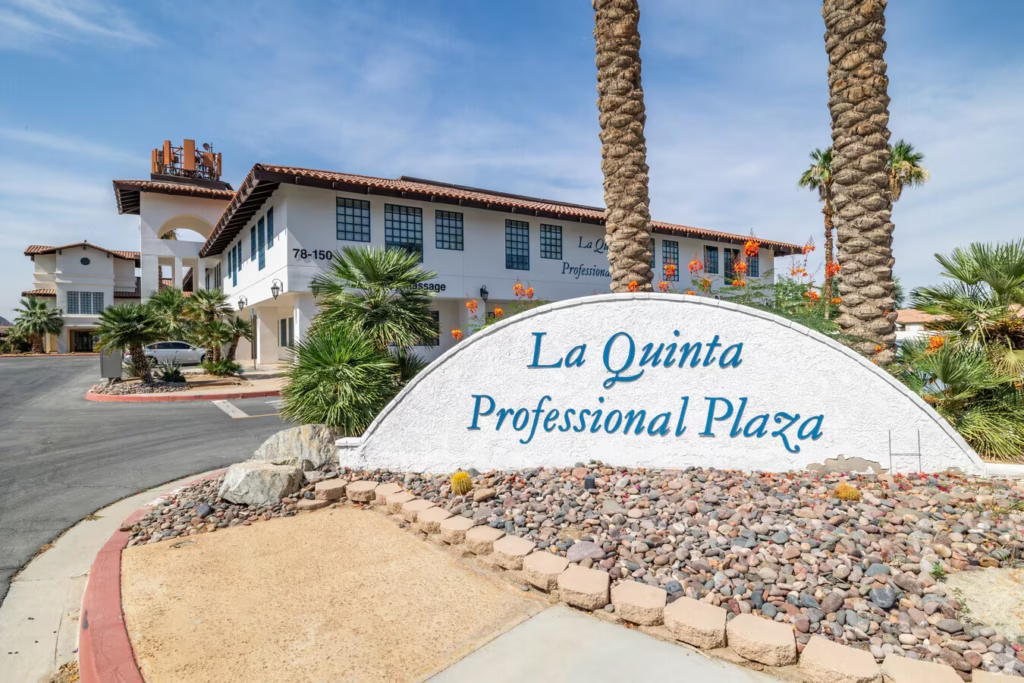
Professional office suites at 78150 Calle Tampico in La Quinta – the kind of small-tenant space that anchors the Coachella Valley’s office market. Photo courtesy of Meade Commercial.
That distinction matters. This is why the local office market continues to look far different from the troubled national narrative that has dominated commercial real estate coverage since the pandemic.
The national office narrative is largely being written by a handful of major metropolitan markets. Here in Greater Palm Springs, demand is driven by healthcare providers, attorneys, financial professionals, government agencies, and service businesses that still rely on in-person interaction. That’s why the local office story looks very different from what you’re seeing in Manhattan or San Francisco.
A Stable Market Behind the Headlines
A comprehensive report on the Coachella Valley office submarket, which I prepared recently, reveals a market that is not booming but remains fundamentally stable. The valley had roughly 8.5 million square feet of office space, a vacancy rate of 5.6 percent and an availability rate of 6.5 percent as of the second quarter of 2026. Twelve-month net absorption was modestly positive at 15,500 square feet, while no new office space was delivered over the prior 12 months.
Those are not the numbers of a market in distress. They describe a smaller, locally driven office market where demand moves incrementally and where the biggest forces are demographic rather than corporate.
Local Users, Not Corporate Retreat
The strongest dividing line between Greater Palm Springs and large urban office markets lies in the nature of their tenant bases. In major metropolitan areas, the pandemic accelerated major employers’ decisions to shrink office footprints as remote and hybrid work became embedded in corporate culture. In the desert, many office users never had the same practical option.
A dental office cannot become fully remote. A medical specialist cannot treat every patient from a home office. Estate planning attorneys, wealth managers, insurance agents and property managers still benefit from offices where clients can sit across a table, sign documents, ask questions and build trust.
In many cases, local office occupancy is less about housing employees and more about serving residents.
Healthcare as the Anchor
That is one reason healthcare has become the anchor of the valley’s office market. The Coachella Valley’s permanent population, large retiree base and seasonal resident population all create demand for medical offices, specialty clinics, physical therapy, behavioral health services and administrative healthcare space.
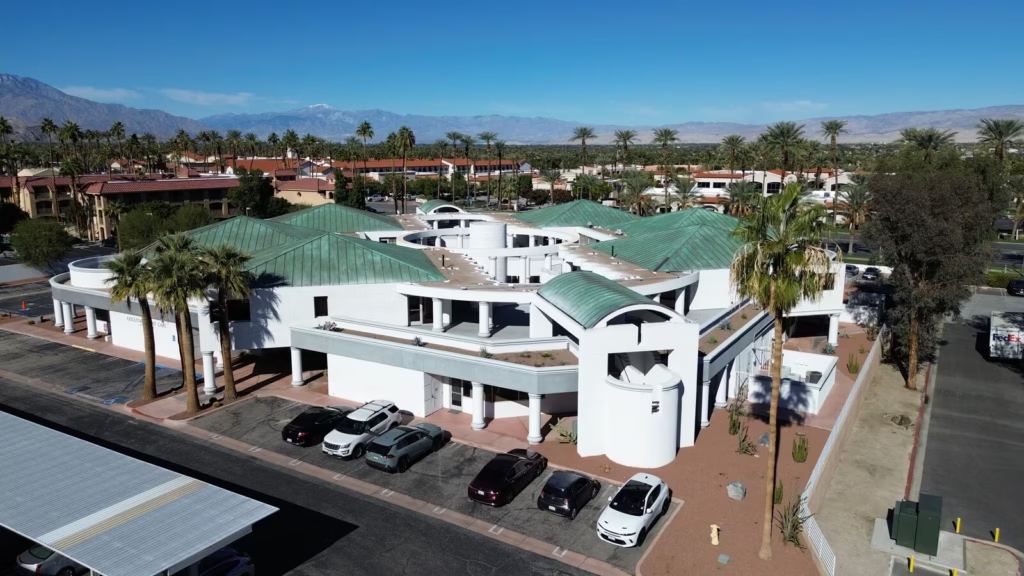
Indian Wells Medical & Professional Center at 74785 Highway 111 offers medical and professional office space with prominent corridor visibility, ample parking and tenants that include HALO Diagnostics and Charles Schwab. Photo courtesy of Meade Commercial.
Recent medical office development has reflected that demand. The medical office subsector has been the most active segment in recent years, citing the 35,000-square-foot Riverside University Health System medical building delivered in 2021 in Palm Springs and the 41,100-square-foot Coachella Valley Community Health Center completed in Coachella in 2022.
The healthcare base is especially important in Rancho Mirage, where proximity to major medical facilities reinforces demand for medical and professional space. Palm Desert remains the valley’s broader professional services hub, with financial, legal, insurance, consulting and regional business firms continuing to seek quality suites in accessible locations.
Small Suites and Client Access
The market also differs in scale. In Greater Palm Springs, the strongest leasing activity is often found in smaller suites, generally in the 1,000- to 5,000-square-foot range, rather than in large corporate blocks. These tenants care less about high-rise amenities and more about parking, visibility, access, convenience and proximity to clients.
That creates a very different kind of resilience.
A large downtown tower can be shaken by the decision of one major tenant to give back several floors. In Greater Palm Springs, demand is more fragmented and more closely tied to the daily service economy. A local attorney adding a partner, a medical group adding a specialty, a property management company expanding during peak season or a nonprofit taking modest administrative space can all matter in a market built on smaller transactions.
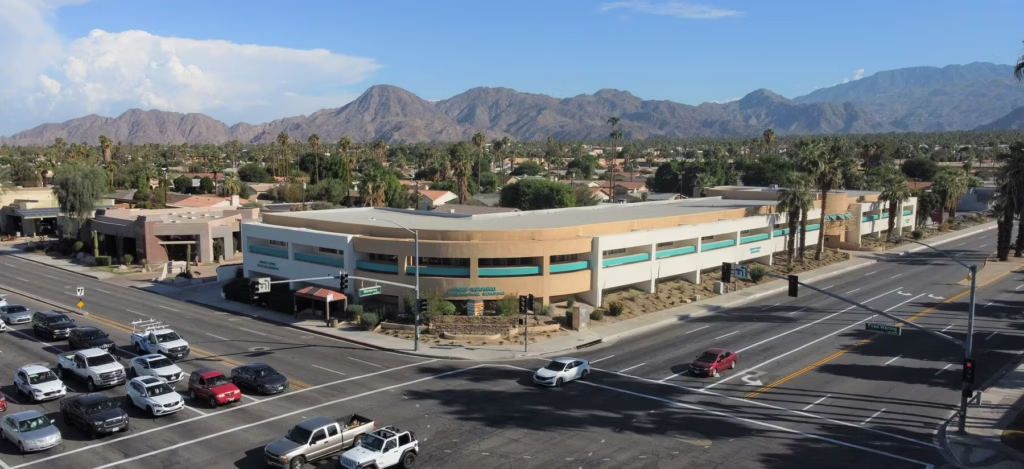
Multi-suite professional space on Monterey Avenue in Palm Desert, where leasing demand centers on smaller footprints. Photo courtesy of Meade Commercial.
Rents and Sales Show Normalization
My market report shows asking rents averaging about $2.52 per square foot per month, or roughly $30 per square foot annually on a full-service basis. Rent growth has cooled, slowing from nearly 6 percent in 2024 to 3 percent in 2025 and 2.2 percent over the trailing year. That moderation is important, but it suggests normalization and nothing near a collapse.
Sales activity tells a similar story. Investment activity remains steady but concentrated in medical office buildings and smaller office plaza transactions. The report notes that most local office investment is led by local buyers acquiring properties below $5 million, with relatively few sales above $10 million.
Even so, deal volume improved in 2025, with more than 40 transactions closing, up from just over 30 in each of the prior two years. Momentum carried into 2026, with first-quarter sales volume exceeding $25 million.
The highest-profile recent transactions also underscore the importance of the medical office subsector. A medical office building at 46805 Dune Palms Road in La Quinta sold in March 2026 for $13.25 million. In Indian Wells, the 40,750-square-foot Wall Street West Office Building at 74785 Highway 111 sold in October 2025 for $10.5 million. Boardwalk Plaza, a 41,000-square-foot medical office building in Palm Desert, sold in May 2025 for $5.5 million.
Those sales are not isolated from the larger story. They show investors continuing to value healthcare-oriented office assets in a region where patient demand is supported by age, population patterns and seasonal residency.
Limited Construction Helps Contain Vacancy
New construction remains limited, which also helps explain why vacancy has stayed contained. The report shows only 716 square feet delivered over the past eight quarters, no space scheduled for delivery over the next eight quarters and 62,000 square feet proposed. That proposed pipeline includes a 50,000-square-foot medical office building on JFK Court in Indio and the 12,000-square-foot Rosarita Professional Plaza on 6th Street in Coachella.
What It Means for Owners and Tenants
For landlords, the message is not that every office property is insulated from pressure. Older buildings still need investment. Poorly located space still faces challenges. Tenants still want efficient layouts, clean common areas, adequate parking and professional environments that justify the commute.
But the forces shaping the Coachella Valley office market are more local than national. The market is not being driven primarily by “return to office” mandates. It is being driven by the need for doctors, dentists, legal help, financial advice, insurance, government services and property management.
That makes Greater Palm Springs a distinct office market, not a smaller version of downtown Los Angeles or San Francisco.
For now, that difference is keeping the local office market steadier than the national headlines might suggest.

Cameron Rawlings joined Wilson Meade in October 2019, specializing in Investment Sales and Commercial Leasing. Despite launching his career during the challenges of the COVID-19 pandemic, Cameron quickly distinguished himself by earning Rookie of the Year and runner-up for Agent of the Year in 2020. His upward trajectory continued in 2021 when he was named Top Producer for Q1 and inducted into the firm’s Founder’s Circle, recognizing top-performing brokers.