The aggregate industry – sand, gravel, and crushed stone – doesn’t usually make front-page news. Yet, it’s the backbone of roads, housing, and infrastructure. And right now, the numbers are troubling.
According to the U.S. Geological Survey, U.S. aggregate production has declined for six straight quarters, with output in the first half of 2025 down nearly 5% from last year. California, the nation’s second-largest producer, has not been spared. This matters because aggregates are the sixth-largest industry in California, carrying an economic impact of $3.5 billion and are directly tied to construction, housing, and public works.
What’s Behind the Slowdown
High interest rates are suppressing housing demand. Trade uncertainty and tariffs are driving up costs. Underinvestment in infrastructure has stalled new projects, while demographic and workforce headwinds continue to limit long-term capacity. Taken together, the aggregate decline is a mirror of the broader economy’s cooling.
A Local Industry with Global Impact
What makes the aggregates industry unique is its intensely local nature. Because transportation costs can double delivered prices within just 25–40 miles, more than 90% of aggregates are consumed within 50 miles of where they are mined. That means when production falls, the effects ripple through nearby communities almost immediately – impacting jobs, tax revenues, and business activity at the local level.
Greater Palm Springs: Local Impact, Local Employers
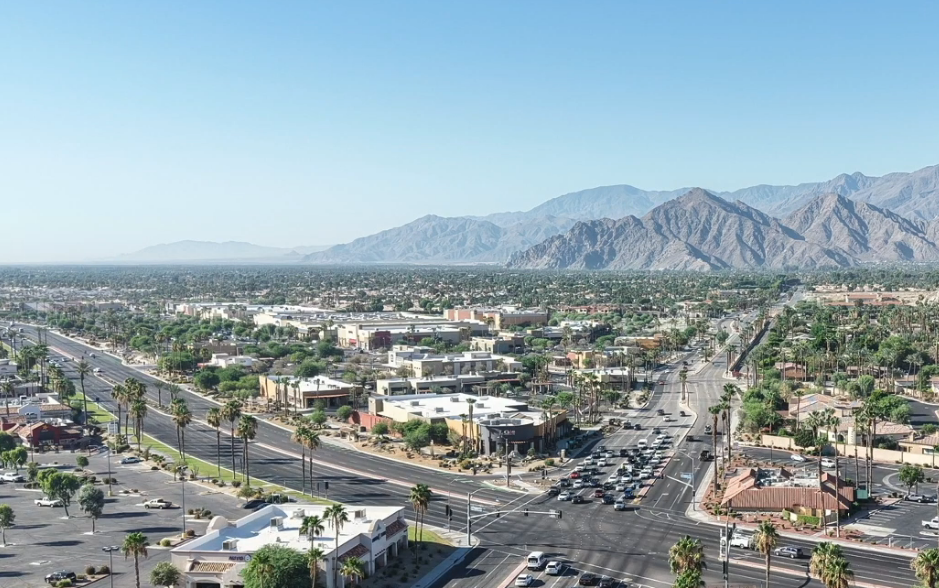
Nowhere is this more visible than in Greater Palm Springs, home to dozens of permitted surface mines. Beyond golf courses and hotels, aggregate producers rank among the valley’s largest private employers. With transport costs limiting delivery to within 50 miles of quarries, this is a truly local industry. When output falls, the economic pain is immediate – impacting jobs, small businesses, and city tax revenues.
Why It Matters
For business leaders, declining aggregate production is more than a quarry problem. It’s a leading indicator of economic health. Fewer aggregates mean fewer homes, fewer roads, fewer commercial projects – exactly the areas where California is under the most pressure.
Greater Palm Springs sits at the intersection of these pressures: rapid growth, housing demand, and infrastructure needs. If the aggregates industry falters here, the ripple effects extend to construction firms, logistics providers, and the broader regional economy.
The Takeaway
California can’t afford to let this foundational sector erode. Strengthening aggregate production means streamlining permitting, supporting recycling innovation, and reinvesting in infrastructure. The industry may be quiet, but its decline speaks volumes.
Key Aggregate Industry Data

California’s construction and material industry is the state’s 5th largest industry with a $3.5B impact.
According to the US Geological Survey, crushed stone, sand and gravel make up 94% of the materials used in US interstate highway construction. By volume, concrete is 60% to 75% aggregate.
Consumption by sector:
- Residential buildings: 33%
- Highways and streets: 31%
- Commercial buildings: 19%
- Government buildings: 5%
- Public works: 8%
- Railroads: 3%
- Private non-construction: 1%

Bob Marra is the CEO/Publisher of GPS Business Insider and GPS Market Intel. He has been studying, writing and giving presentations about business, economic and public affairs news and issues and the local economy in the Greater Palm Springs/Coachella Valley region for more than 20 years.