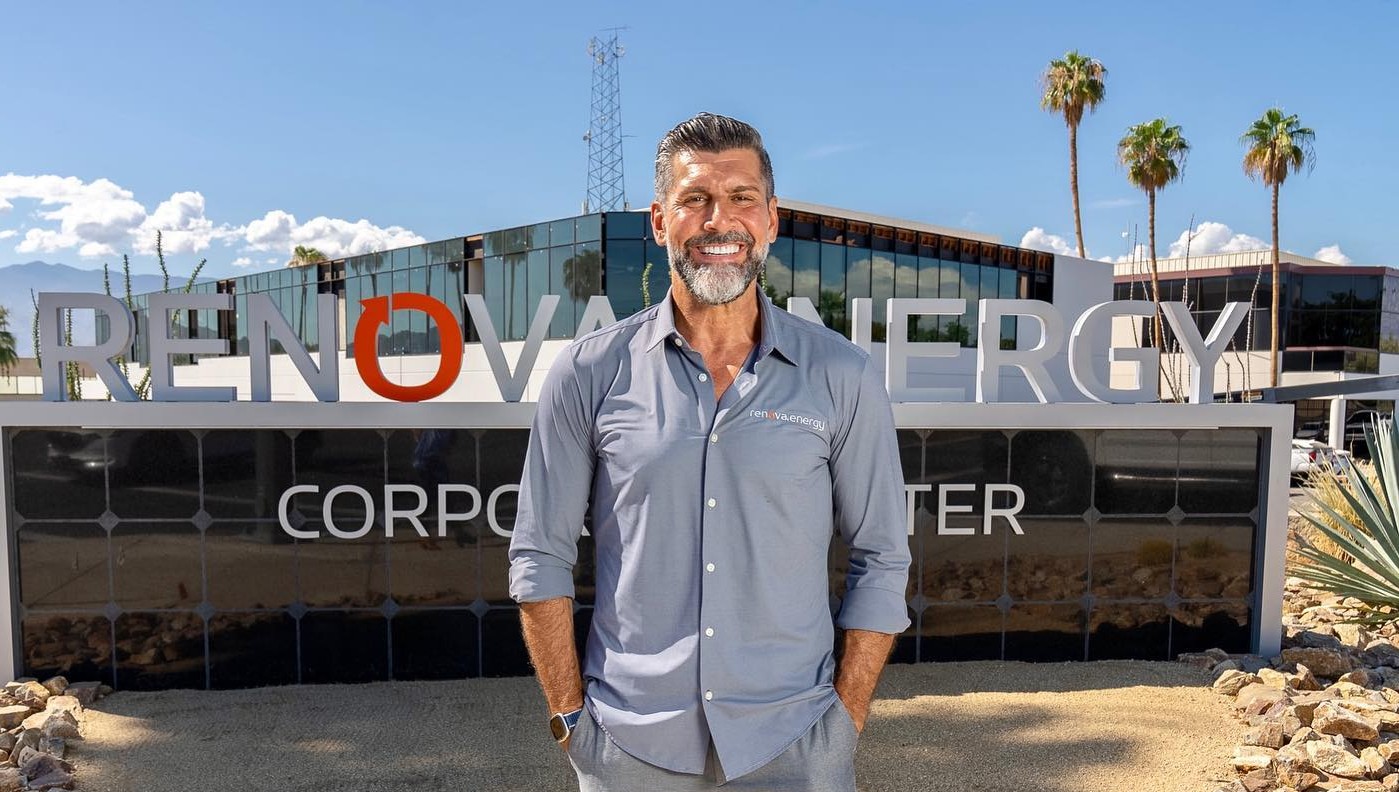
The One Big Beautiful Bill (OBBB), passed by Congress and signed on July 4, rewires the economics of rooftop solar just as California adapts to steep state-level changes. In Greater Palm Springs, Renova Energy founder and CEO Vincent Battaglia says the next phase is clear: make the battery the core asset, keep power at home, and use a different section of the tax code to preserve a 30% benefit after 2025.
Battaglia has built this strategy around Mycrogrid®, a concept he created and trademarked. “We’re rolling out Mycrogrid®, powered by Renova Energy,” he said, describing personalized, battery-first systems that run in non-export mode. Hence, the house uses its own solar and storage while the grid becomes a one-way backup. “The utility is now the backup to the 80% of the needed home power supply that can be created by today’s rooftop solar energy systems and stored in batteries,” he said. “With rapidly evolving battery technology, it won’t be long until that reaches 100%.”
A federal pivot and a local rooftop solar response
OBBB ends the homeowner credit most Californians know for expenditures as IRC §25D (the 30% Residential Clean Energy Credit) for expenditures after December 31, 2025. California, meanwhile, is operating under NEM 3.0 (net billing), which cuts export values for new customers and lengthens payback periods. A recent court order sends NEM 3.0 back for review, but the tariff remains in place for now, so homeowners must still plan under today’s rules.
Renova’s response is to stop treating “solar” as the product and emphasize the battery, the system’s “brain.” Set storage to non-export, feed the home first, and use the grid only when needed. In Battaglia’s view, this avoids interconnection waits, bidirectional meter fees, and utility scheduling bottlenecks that slow traditional, export-oriented projects.

A recent La Quinta home system installation illustrates the model. Because the system is closed and set not to export power, the city handled the permit, and no separate utility permission to operate was required.
Mycrogrid®: trademarked, battery-first, non-export
Renova frames Mycrogrid®, a break from utility-centric design, a “No Grid. No Exports. No Utility Permission” premise. Systems are engineered to avoid utility interaction, operate in non-export mode, and function independently when the grid is down, delivering what Renova calls “energy sovereignty” without additional applications or delays. In this design, the grid is Plan B.
Battaglia says he coined Mycrogrid more than a decade ago and secured trademark protection, noting registrations across several regions and countries. The mark is tied to battery-plus-solar systems that can be configured for export or non-export, with Renova pushing the latter as the default in today’s policy and market environment.
How the 30% savings lives on after 2025
With §25D ending after 2025, Battaglia points to IRC §48E, the clean-electricity investment credit for commercial entities that was created under the Infrastructure Investment and Jobs Act (IIJA), also known as the Bipartisan Infrastructure Law (BIL), stating that it preserves pricing for consumers through pass-through economics. Renova presents two practical routes that keep a 30% benefit in play:
- Homeowner-owned, battery-first systems under §48E. Renova’s materials say the 30% §48E credit remains through 2033 for individuals who own qualified clean-energy property, including batteries installed at a residence, and claim it on IRS Form 3468 (not Form 5695). When the solar array is configured primarily to serve the battery, the array is treated as incidental for credit purposes. Renova says it supports customers with a detailed invoice, a §48E tax letter, and (optionally) a memo from a tax partner.
- Third-party ownership (lease/power purchase agreement). Battaglia points out, “If you get a lease, the leasing company takes the 30% investment tax credit… all the way up to 2033.” As commercial owners, lessors claim the credit and pass the value through in pricing.
Together, these lanes – homeowner §48E claims on battery-first Mycrogrid® systems and lessor-claimed credits on leases – are the levers Renova says will keep monthly economics stable in 2026 and beyond. “If you lease, you’ll still be honored with the benefits of lower pricing,” Battaglia said.
“Make the grid Plan B” is how non-export changes the workflow
The case for non-export Mycrogrid® systems is as much about permitting and predictability as price. Keeping solar and storage behind the meter means no utility application, no bidirectional meter, no PTO delay. The La Quinta project, approved by the city and configured never to export, is Renova’s early proof point for faster timelines and fewer touchpoints.
The grid as backup inversion is core to Renova’s message. “The Future Is Not Grid-Tied,” the company declares, pitching Mycrogrid® as a scalable model for localized energy independence.
Technically, the aim isn’t to strand homes entirely. “We’re not creating off-grid systems,” Battaglia said. With current battery energy density, Renova targets about 80% of a home’s annual electricity from solar-plus-storage, with the grid covering the rest until storage improves. Pointing to EV range gains as a proxy for battery progress, he suggests 2028 as a reasonable horizon for mainstream “cut-the-cord” capability.
What changes for installers — and why Renova leans into leases
The OBBB deadline compresses project pipelines, and NEM 3.0 already raised the bar for payback math. Many contractors will see a Q4 surge followed by a 2026 trough, with more emphasis on batteries and time-of-use modeling to close deals.
Battaglia says Renova is positioned for this terrain because it has long favored third-party ownership. “I’ve always done 85 to 90% lease arrangements and then 10% are self-funded by property owners or they get their own loans if necessary,” he said. He argues leases bring operational clarity: the lessor manages long-term performance and service, channeling issues through a defined process. For consumers weighing options, he distills it simply: pay cash, use home equity, or sign a lease and buy the energy.
Renova’s footprint is unusually deep for a local firm. Over two decades, the company says it has built 12,100+ rooftop systems and is approaching 60 major commercial-grade arrays for dealerships, government buildings, and other complex projects – experience and capacity that Battaglia says residential-focused competitors can’t match.

Bob Marra is the CEO/Publisher of GPS Business Insider. He has been studying, writing and giving presentations about business, economic and public affairs news and issues and the local economy in the Greater Palm Springs/Coachella Valley region for more than 20 years.