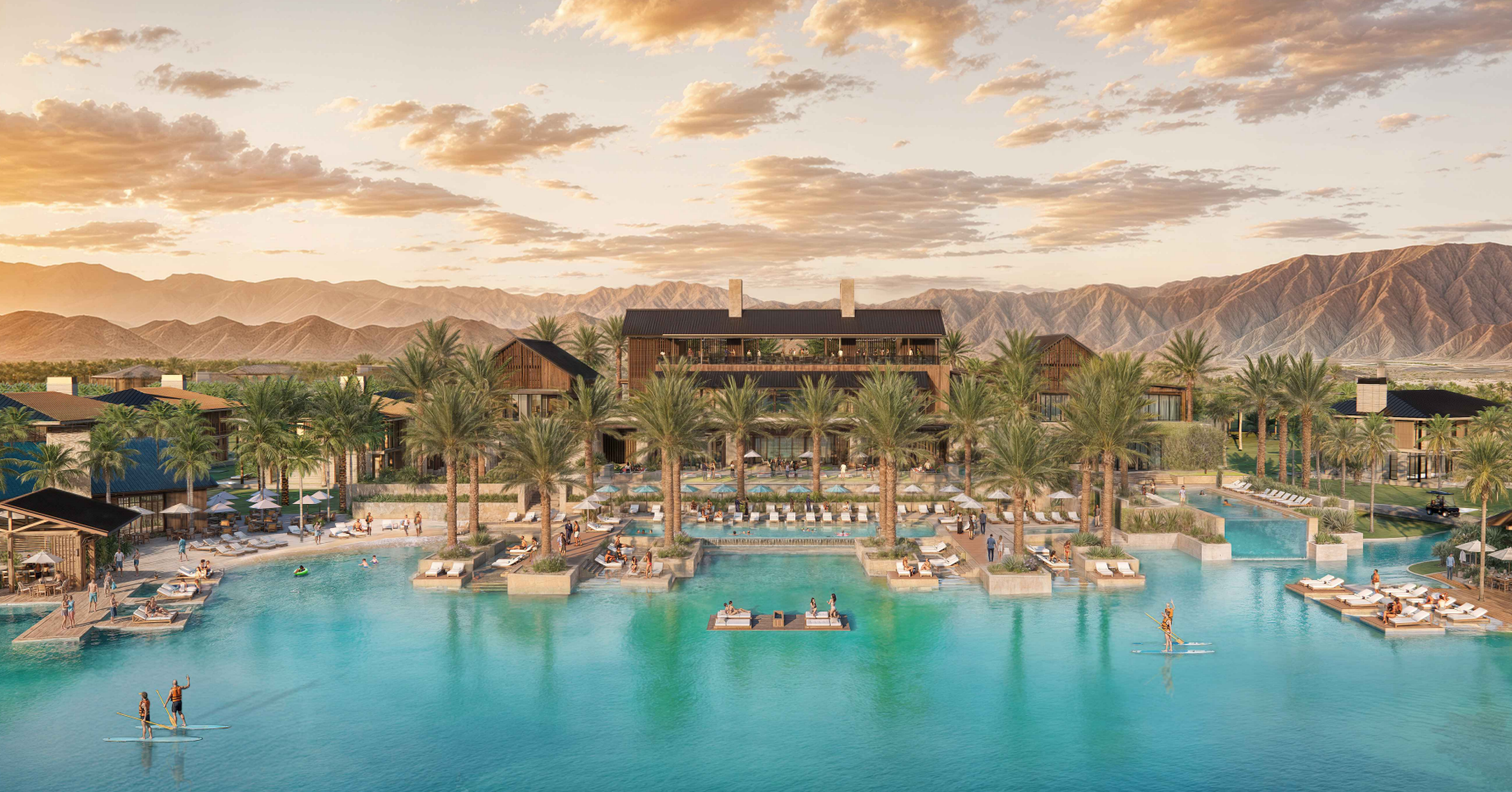
The proposed 87-acre development would combine lagoon-front residences, resort accommodations and a public beach club, creating a new opportunity for visitor spending and hospitality investment within the city.
On 87 acres along Avenue 52, the developers behind COVA envision a different kind of Coachella destination: waterfront residences, resort cottages, restaurants and a public beach club organized around a hospitality business designed to bring visitors back beyond the festival weekends.
The proposed development represents about $900 million in investment, according to Tony Fimbres, president of Statewide Services, Inc., which is leading entitlement and construction management. Its significance for Coachella extends beyond the scale of the buildings or the expanse of its lagoons. COVA would give the city a substantial new place for visitors to stay, dine and spend, while introducing exceptional, exciting recreational and dining amenities available to local residents.
For a city whose name carries international recognition, the project offers a way to translate that visibility into a larger hospitality economy within its own boundaries.
Fimbres said the developers were drawn by the location, views and growth of the valley’s entertainment industry. The festivals helped establish the appeal, but the concept grew into something broader: a resort environment with a public-facing component.
The applicant, Relevant Coachella Owner, LLC, is seeking approvals for the development south of Avenue 52, between Calhoun and Van Buren streets. Relevant Partners markets COVA as a residential resort combining ownership opportunities with hospitality, wellness and recreation.
A Coachella Resort Built Around Water and Recreation
The city’s October staff report describes 402 residences and accommodations: 240 condo cottages and another 162 units comprising estate properties, zero-lot-line homes, bungalow condominiums and VIP suites.
A 9.4-acre main lagoon would be the defining feature of the private resort, with accommodations and amenities arranged around a waterfront setting. Plans also include recreational courts, wellness facilities, pools, dining, entertainment areas and spaces for events.

The COVA complete site plan.
The technical site plan shows a range of activities intended to make the property a destination in itself, including padel, basketball, a children’s club and an amphitheater lawn. The mix suggests a resort designed for families and groups as well as individual travelers and couples.
The main lagoon would be distinct from the project’s public beach-club area. A separate 0.4-acre lagoon would serve that portion of the development, while a 2.5-acre lake in the southern part of the property would collect runoff and function as a detention basin, without water-contact sports.
That distinction matters to how COVA would operate. The private resort would serve its owners and guests, while the public component would let other visitors experience part of the property without purchasing a residence or booking an overnight stay.

The COVA residential owners club and VIP area.
Fimbres said the developers’ hospitality background is central to the concept, particularly the integration of restaurants with accommodations and recreation.
“They own restaurants, among their major commercial real estate portfolio, so that’s why they’re able to bring that high-end restaurant and overall hospitality element to the project,” he said.
A Public Beach Club for Residents and Visitors
The approximately six-acre public portion would occupy the northwest corner of the site. It would include an 11,950-square-foot beach club, a substantial outdoor lounging area, a 7,690-square-foot restaurant and a 6,048-square-foot sports bar.
Those uses could give local residents additional choices for an afternoon outing, dinner or an evening with friends, while creating another attraction for people staying elsewhere in the valley.
Public access would not mean unrestricted access to the entire private resort, nor would it necessarily mean free admission. Pricing and detailed operating arrangements remain important elements of the eventual offering. The staff report also anticipates additional approvals for public-area uses as specific operating plans are developed.
For Coachella, the opportunity is to add a concentration of hospitality and recreation businesses that can serve both visitors and the surrounding community. Restaurants and entertainment venues would have customers staying on the property, but their potential audience would extend well beyond it.
Ownership and Hospitality Under One Plan
COVA’s residential component would function differently from a conventional subdivision.
Under the proposal, a single entity would hold approximately 120 of the condo cottages and operate them as short-term rentals through a hotel operator or hotel brand. The remaining cottages and residential units could operate through fractional ownership, timeshares, second-home ownership or short-term rentals within an integrated resort community.
The model would allow different kinds of participation, from an overnight stay to ownership of a vacation property. It would also allow rental activity when participating owners are away.
Fimbres said potential purchasers could include local investors as well as buyers from Southern California, other states and abroad.
To accommodate that operating structure, the application includes changes to the city’s zoning and short-term rental rules. The proposed rental amendment would allow projects with approved development agreements to depart from certain limits on the number of units one owner may hold and the percentage permitted for short-term rentals.
The business premise is that accommodations, ownership and amenities would reinforce one another. The resort would provide services and activities that support the residences’ appeal, while participating residential properties would broaden the lodging offering.
A Tourism Market Beyond Festival Weekends
COVA’s location places it near several of the East Valley’s major visitor attractions. The development team sees the festivals as an important source of demand, but a project of this scale would need business across a much longer calendar.
The nearby Desert International Horse Park, for example, describes a competition season extending from October through March, bringing equestrians, families and accompanying visitors to the area for repeated and extended stays.
That illustrates the broader market COVA would seek to serve: travelers attending events, owners returning for seasonal visits, and guests choosing the property for its own amenities.
A November 2025 market study prepared for the applicant by HVS Consulting & Valuation evaluates the proposed lodging, ownership and membership components. Its forecasts position COVA in the highest levels of the lodging market, with the projected annual occupancy rate rising from 61 percent in the first operating year to 69 percent at stabilization.
The study projects an average daily lodging rate of approximately $1,532 initially, increasing to about $1,860 in the stabilized year. Thus, COVA would be seeking guests willing to pay for a distinctive resort experience, with enough demand beyond peak event dates to support an extensive hospitality operation.
What COVA Could Mean for Coachella’s Tax Base
The potential fiscal benefit is substantial, although it depends on construction, successful operations and actual taxable stays.
Using HVS’s room-revenue forecasts and a 13 percent transient occupancy tax rate, city staff calculated illustrative gross hotel-tax receipts of approximately $10.6 million in the first operating year and $19.37 million in the stabilized year.
Those are gross estimates before the proposed developer incentive and other adjustments. They do not reflect the city’s net fiscal benefit.
Under the proposed development agreement, the developer could receive a rebate equal to half of eligible annual hotel-tax collections above specified city retention thresholds. The incentive would last no more than 15 years after the resort opens at Phase 1 buildout and would be capped at $25 million in cumulative rebates.
The city would retain the first $1 million of actual annual collections at the initial development milestone, increasing to $1.5 million after the second milestone and $2 million at full buildout. It would also keep half of eligible collections above those amounts while the incentive remained in effect.
Once the cap or time limit was reached, the city would retain all project hotel-tax collections, subject to applicable tax requirements. The thresholds would not constitute guaranteed payments if collections fell short.
Food and beverage activity would provide another potential source of economic activity. HVS projects approximately $41.6 million in food and beverage revenue in the first operating year and $63.1 million at stabilization. The taxable portion could generate additional sales-tax receipts, alongside the city’s share of property taxes and other applicable revenues.
COVA Job Creation and Local Workforce Opportunities
The development team projects approximately 330 permanent jobs and 7,500 construction job-years over a six-year construction period, according to its October 7 presentation to the Planning Commission. Permanent positions would span hospitality, hotel and property management, restaurant kitchens and related resort operations.
Construction job-years measure employment over time: one job lasting one year represents one job-year. The projection therefore should not be read as 7,500 people employed simultaneously or 7,500 permanent positions. Both figures are developer estimates tied to the proposed project.
The team also described outreach to College of the Desert and other organizations to help recruit local residents for long-term employment. Those efforts could connect Coachella residents with careers in lodging, dining and recreation, although the presentation did not establish a finalized hiring agreement or guaranteed local employment quota.
Infrastructure Is Part of the Development
Delivering COVA would involve substantial work beyond the resort buildings.
The infrastructure work reflects a broader East Valley development challenge, also evident in Indio’s investment in electrical substations to support growth.
The proposed development agreement assigns the developer responsibility for required streets, sidewalks, drainage, water and sewer facilities, and participation in necessary electrical infrastructure, subject to financing and reimbursement provisions.
It also requires construction or funding of a portion of off-site sewer-main upsizing that would serve other planned housing developments. That provision creates a potential benefit beyond the resort property by helping address infrastructure needed for surrounding growth.
The proposed conditions identify service through the Coachella Water Authority and require approved water and sewer plans, applicable impact fees and necessary improvements. Infrastructure serving each phase would generally have to be completed before the first certificate of occupancy within that phase.
Fimbres described his company’s role as coordinating those practical requirements with the development team, public agencies and utilities.
“We’re the boots on the ground,” he said.
That work includes off-site infrastructure, utility coordination, permits and the local logistics needed to move from an approved plan to construction.
COVA’s Development Timeline

The 240 condo-hotel units would be developed in the first two phases of the project.
City staff recommended conditional approval of the project. The Planning Commission voted against recommending it to the City Council on October 7; the council retains the final entitlement decision. The City Council may consider the project at its Nov. 25 meeting.
The proposal would be developed in phases. The HVS study uses March 2030 as an assumed first opening, with stabilized lodging operations in 2033–34. Those dates are financial-model assumptions rather than a confirmed construction schedule.
The proposed development agreement provides a 20-year buildout period within a 50-year agreement term. Its hotel-tax framework identifies milestones of 167 units, 273 units and the full 402-unit development, allowing the financial terms to change as the resort grows.
Further operating details would also require approvals. City staff anticipates future permits for the public beach-club uses as their plans become more specific, while alcohol-related businesses would need to satisfy city requirements and applicable licensing rules.

Bob Marra is the CEO/Publisher of GPS Business Insider and GPS Market Intel. He has been studying, writing and giving presentations about business, economic and public affairs news and issues and the local economy in the Greater Palm Springs/Coachella Valley region for more than 20 years.