At first glance, the newly released 2025 Coachella Valley Community Health Survey reads like a public health report. Look closer, and it doubles as an economic stress test for Greater Palm Springs.

Released February 26 at UC Riverside Palm Desert, the latest triennial survey from HARC, Inc., paints a detailed picture of rising cost pressures, workforce strain, healthcare bottlenecks and climate-related constraints that are directly shaping the region’s business environment.
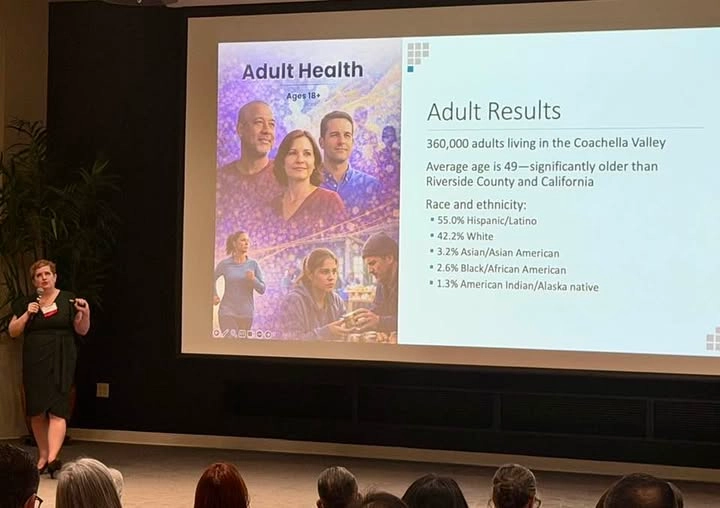
“This truly is a community-driven, community-owned data set,” said Dr. Jenna LeComte-Hinley, CEO of HARC, during the data release presentation. “It’s based on what you, the community, said you need to know.”
For employers, developers, healthcare systems and investors, the message is clear. Many of the headline health indicators are also labor market, consumer demand, and long-term competitiveness indicators.
Here are the top business, workforce and economic takeaways.
- Cost-of-Living Strain Is Now a Core Economic Issue
The most urgent red flag in the report is food insecurity.
According to the study findings, 25.2 percent of adults reported cutting meal sizes or skipping meals because they did not have enough money for food. Ten percent reported going an entire day without eating.
LeComte-Hinley did not soften the finding.
“This is of serious concern,” she said. “One in 10 of our local adults must go without eating for a whole day. This is not acceptable.”
Demand for assistance is broad. In the past year, 25.2 percent needed food assistance, 22.6 percent needed help paying for utilities and 20 percent needed financial assistance.
Business implications: This is a stressed economy. When households cut back on essentials, discretionary spending tightens. For a region built in large part on tourism, hospitality, dining and retail, that signals softer local demand and continued wage pressure in service-heavy sectors.
It also shows up inside companies. Financial strain is closely tied to employee stress, absenteeism and turnover risk.
- Workforce Participation Faces Structural Friction
The survey outlines working-family logistics challenges.
Among adult survey respondents, 36.7 percent are employed, 9.9 percent are self-employed, 9.3 percent are out of work, and 26.9 percent are retired. Even among those employed, benefits are far from universal. About 30.7 percent do not receive paid vacation days, 35.4 percent do not receive employer-provided health coverage, and 34.7 percent do not have a retirement plan through their employer.
Childcare is another pressure point. More than 12 percent of parents of children 12 and under reported a time in the last year when they could not find childcare for a week or longer, often due to affordability or a schedule mismatch.
Business implications: Retention challenges are not just about wages. They are about flexibility, scheduling, benefits design and childcare-adjacent solutions. Employers that adapt will almost certainly gain a competitive edge in employee recruitment and retention.
- Healthcare Coverage Is Up, Access Is the Bottleneck
One of the report’s bright spots is insurance coverage. Among adults ages 18 to 64, 89.3 percent are insured, the lowest uninsured rate HARC has recorded since its first triennial survey in 2007.
But coverage does not equal access.
“The number one barrier is the length of time it takes to get an appointment,” LeComte-Hinley said, attributing it to a shortage of providers.
One in three residents struggles with provider hours, and appointment delays are common.
Business implications: Long appointment wait times lead to more missed work and delayed treatment. For hourly employees with limited schedule control, that becomes a productivity issue.
One of the survey’s main conclusions calls for strengthening the healthcare workforce and expanding access to primary care, a well-known fact that continues to challenge our region. For the private sector, which intersects with workforce stability and long-term talent attraction.
- Mental Health Is a Workforce Stability Risk
More than one in four adults in Greater Palm Springs reports being diagnosed with a mental health condition. Among adults with a diagnosis or recent concern, about half received no treatment in the past year.
HARC estimates that more than 26,000 adults needed mental healthcare in the past year and could not get it.
“Mental health treatment is very real. We need to have more services available and accessible for our workforce,” LeComte-Hinley said during the presentation.
Business implications: Untreated mental health conditions manifest as burnout, turnover, inconsistent performance, and safety risks, particularly in hospitality, healthcare, and public-facing roles that anchor the Greater Palm Springs economy.
- Air Quality and Extreme Weather Affect Competitiveness
Air quality is more than an environmental talking point. It is a lifestyle and economic factor.
Roughly 33.9 percent of adults rate neighborhood air quality as fair or poor. About 23.1 percent report that poor air quality prevents them from engaging in outdoor activities at least several times a month.
In the past two years, 67.6 percent of residents experienced significant challenges due to extreme heat waves.
Business implications: Outdoor events, recreation, construction schedules and even tourism perception are increasingly sensitive to air and heat conditions. Climate resilience is now part of economic planning.
- Disaster Preparedness Gaps Raise Recovery Risks
Fewer than one in four adults have earthquake insurance.
“We live on top of the San Andreas Fault. It’s not an if, it’s a when,” LeComte-Hinley said.
Business implications: Underinsurance and uneven preparedness could slow recovery after a major event. For lenders, developers and employers, resilience is also a balance sheet issue.
- Local Data Is Driving Funding and Policy Decisions
Beyond the numbers, the event underscored how HARC’s localized data is shaping business and nonprofit strategy.
Gavin Nguyen, reporter for KESQ News Channel 3, said local stories often lack truly local data.
“A lot of the data that we see is national,” Wen said. “We went to HARC and saw the local version of that data we needed to help strengthen our report on senior falls, which is one of several examples of how we use their data.”
Jennifer Braun, a nonprofit and grant consultant who assists youth development nonprofits, said Coachella Valley-specific data has been critical in securing funding.
“Because of that, we’ve been able to secure funding. It helps to provide mental health support services,” she said, noting that Boys and Girls Club of the Coachella Valley sites now have mental health specialists on site.
Kraig Johnson, executive director of Jewish Family Service of the Desert, called HARC data “instrumental” in obtaining grants.
“With HARC’s data, we have the proof of what our community needs,” Johnson said.
Indio City Councilmember Oscar Ortiz described how data helped him specifically demonstrate the local need for affordable housing in his district.
“We were able to show people through the data that half of our community here qualifies for those affordable housing projects,” Ortiz said. “That really shifted the conversation.”
A Strategic Moment for Greater Palm Springs
The survey was based on 2,807 responses, including 2,313 adult responses, the largest sample HARC has collected to date. Invitations were mailed to 25,000 randomly selected households, with participation offered in English and Spanish.
HARC’s conclusion calls for strengthening the healthcare workforce, expanding access to mental health services, protecting nutrition support systems, investing in culturally responsive health education, building climate resilience, and promoting economic opportunity through higher-wage jobs and affordable housing.
For the Greater Palm Springs business community, the takeaway is straightforward.
Health data is economic data. Food insecurity signals constrained spending. Mental health gaps signal workforce instability. Air quality and heat affect the region’s brand and livability. Insurance gaps affect recovery timelines.
The numbers are local. The implications are regional. And the decisions that follow will shape the valley’s competitiveness for years to come.

Bob Marra is the CEO/Publisher of GPS Business Insider and GPS Market Intel. He has been studying, writing and giving presentations about business, economic and public affairs news and issues and the local economy in the Greater Palm Springs/Coachella Valley region for more than 20 years.