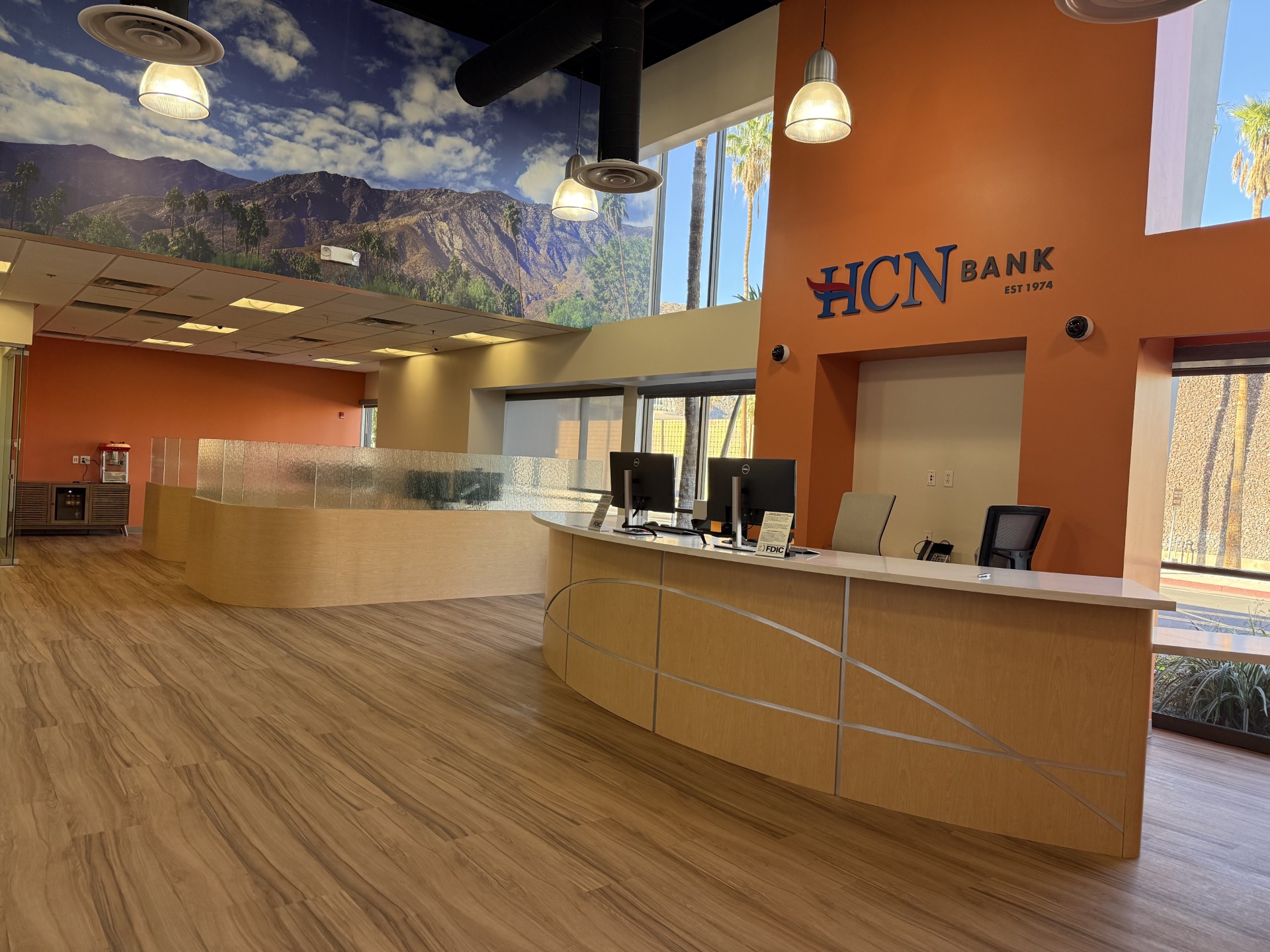
HCN Bank, the venerable community bank based in Hemet, has crossed the mountain and officially entered the Coachella Valley with the opening of its new Palm Springs financial center, located in the historic “500 Building,” at 500 S. Palm Canyon Drive. The expansion marks a significant shift in the local banking landscape, which has seen decades of consolidation and a sharp decline in true community-banking institutions.
The privately held bank, founded in 1974, has spent nearly 50 years building a reputation for stability, profitability, and hands-on customer service in Riverside County. Its leadership says the Palm Springs move is a response to a regional void left by local institutions absorbed by national brands.
A Market Seeking Local Connection

HCN Bank CEO, Kevin Farrenkopf
HCN Bank CEO Kevin Farrenkopf said a basic market reality drove the bank’s decision to expand: Palm Springs and the broader Coachella Valley are “under community-banked.” As larger institutions absorbed local banks or shifted decision making to the big coastal cities or out of state, many small and mid-sized businesses were left without accessible relationship-based banking.
“We really want to work closely with our clients. Their relationship is very important to us,” Farrenkopf said, noting that major banks prioritize ultra-high-net-worth customers while smaller commercial clients compete for attention. “That’s not really our lane. Our lane is small business owners – banking their business, banking them as principals, and banking their friends and family. That’s our DNA.”
Farrenkopf said the bank’s entry into Palm Springs is not a short-term play. HCN Bank has a long track record of staying anchored in the communities it serves.
A Boutique Model in a Mega-Bank World
Leading the bank’s expansion is Leo Macias, Market President – Coachella Valley, and a local native who has spent more than two decades working in banking.
Macias said the shift toward mega-banking left a gap in the valley. “Over the last 24 years, all the community-based banks have gone. They were taken over by larger institutions that are all based out of state,” he said. “That boutique banking experience is gone.”
HCN, he argues, is stepping into that gap with a relationship-first model. “We’re trying to bring back what was lost. Palm Springs isn’t just a market to us; it’s a place full of people who want more than transactional banking. They want relationships.”

HCN Bank Market President – Coachella Valley, Leo Macias
Macias contrasts HCN Bank’s approach with the impersonal structure common in large banks. “Try to do that with Wells or BofA or Chase,” he said. “You’re going to call the number, go through hoops, then get an appointment two weeks later. We’re streamlining that process. I come to you. I sit down with you in your office, or we meet over breakfast, coffee, or even what I call a ‘beer with your banker’.”
A Hands-On Banking Experience
HCN’s model pairs a small, modern financial center with robust remote-banking tools. Businesses can process deposits from their offices, use treasury-management tools, and receive on-demand support without navigating a call center.
One example Macias offered involved a new customer whose debit card was compromised over a weekend. “He texted me Sunday. By Monday morning, the operations manager had the claim filed and the card closed. Within two hours, he was at the bank and had a new card printed on the spot.”
For business clients with daily deposits, Macias said the bank sets up full remote teller stations. “If you’re going to the bank once a day for an hour round trip, we’re giving you five to six hours back every week. That’s real time a business owner can put back into their company.”
This relationship-driven style, he said, reflects the banking culture he grew up with. “People don’t bank with a bank. They bank with people. If a client ever has to call an 800 number, that means I’ve failed as their banker.”
A Strategy Grounded in Long-Term Stability
HCN Bank’s financial performance underpins its expansion. The bank has posted 20 straight years in the top 10 percent of U.S. banks in profitability, recorded 60 consecutive quarters as a Bauer Financial Five-Star Superior rated bank, and maintained steady growth even during national banking crises.
“We do things with long-term sustainability in mind,” Farrenkopf said. “A lot of banks got over their skis at times because they got really aggressive or greedy. We know our lane, we do things well, and we stay in that lane.”
He added that community investment is central to the bank’s identity. “We’re going to be part of the community, like we are in Hemet and San Jacinto. If you ask who’s cutting ribbons and writing checks, we’re on that list.”
According to Macias, the founding of HCN Bank was a grassroots movement. “Local business owners and community leaders came together to build something they felt was missing: a bank created by the community, for the community. We knew our customers by name, we celebrated their milestones, and we stood by them through every season. That ‘friends and family’ spirit isn’t just part of our history, it’s the foundation of everything we do.”
He added that the bank has always specialized in commercial real estate (CRE) lending. “One of the key reasons for our name change from The Bank of Hemet to HCN Bank was our nationwide focus on CRE. We wanted to remove any geographic barriers in our name. CRE will always be a core product for the bank, but so is helping local businesses with operating lines and other business-related loans. Typical loan clients are investors who want to purchase or refinance companies and/or real estate, and businesses that need expansion capital.”
“We’ve also been in the treasury management business for well over three decades,” added Macias. “These tools allow a business to better manage their cash flow, liquidity, and risk, especially given the increased level of fraud. Some of the services include ACH origination, positive pay, remote deposit capture, zero balance accounts, and lockbox services. The bank has also catered to school districts, cities, and other municipalities, in addition to the medical sector and nonprofit organizations.”
Why Palm Springs and Why Now
Farrenkopf said Palm Springs has been long considered for expansion. The bank evaluated the market as far back as 2008 but waited for the right conditions. Those conditions emerged as local banks disappeared and regional economic activity strengthened.
“We plan to grow as part of the process to fund more loans, and to do that, we will secure a higher level of deposits,” he said. While digital channels matter, he believes physical presence still has a high value. “It’s different to have a place to walk into and talk to a human being when you run into a problem. Cybersecurity and fraud are proliferating right now. People still value having four walls to go to.”
Macias emphasized that Palm Springs’ distinct character was also part of the draw. “Palm Springs is not the same as the cities a couple of miles east. This city is its own ecosystem. The entrepreneurs, creatives, retirees, investors – and I believe that they want a bank that knows them.”
The First of Potentially Several Desert Locations
HCN’s Palm Springs financial center is the first step in what the bank expects will become a multi-location desert strategy.
“In five years, I see us with two or three locations in the region, maybe even a microbranch on the east end,” Macias said. “But success isn’t just buildings. It’s being out at school events, supporting nonprofits, and knowing our clients by name.”
Macias said his leadership in Palm Springs is personal. “Palm Springs raised me. It educated me. It gave me a career,” he said. “Now it’s my turn to give back by helping build a community bank that truly belongs to this valley.”
A Return to Local Banking
For Farrenkopf, the Palm Springs opening reflects the same principle that guided the bank’s founding in 1974: banking is strongest when it is local.
“Community banks are the lifeblood of small businesses,” he said. “And this valley deserves a bank that treats people the way banking used to. We think we can fill that role.”

Bob Marra is the CEO/Publisher of GPS Business Insider. He has been studying, writing and giving presentations about business, economic and public affairs news and issues and the local economy in the Greater Palm Springs/Coachella Valley region for more than 20 years.