Palm Springs city leaders are moving forward with plans to expand affordable housing options for older residents through a proposed 72-unit senior housing development on land owned by the United Methodist Church of Palm Springs.
At its March 11 meeting, the Palm Springs City Council considered approving a $3 million funding commitment to support the project, which would be developed by Wakeland Housing and Development Corporation at 1555 E. Alejo Road. The funding would help finance the construction of a community intended for seniors aged 55 and older with incomes at or below 60 percent of the area median income.
City officials say the project represents another step in Palm Springs’ broader effort to address a persistent shortage of affordable housing, particularly for residents living on fixed incomes.
A partnership between church and developer
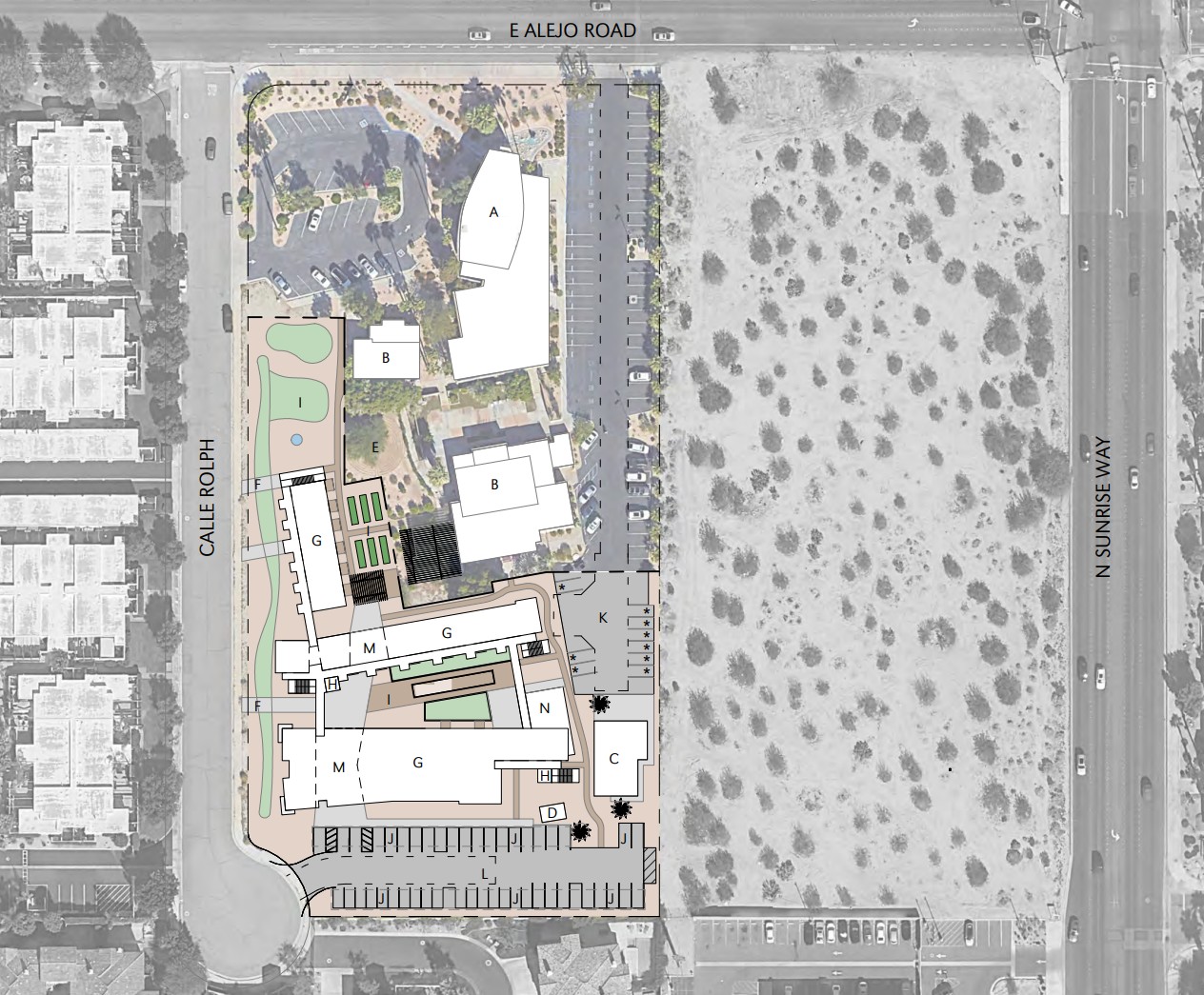
The site is located at the southeast corner of the intersection of E. Alejo Road and Calle Rolph. Building “A” is the existing church and Building B is an existing multi-purpose facility owned by the church.
The project stems from an initiative launched in April 2024 by the United Methodist Church of Palm Springs, which issued a request for proposals seeking a qualified development partner to transform roughly two acres of unused church land into affordable housing.
Wakeland Housing and Development Corporation was selected in February 2025 to lead the project. The nonprofit developer has built and managed affordable housing communities throughout Southern California and will ground-lease the church-owned land for the development. According to Wakeland’s website, the firm has created 9,000 affordable homes across 69 properties throughout the state since it was founded in 1998.
The partnership reflects the church’s longstanding community service mission, according to project documents, which state that the goal is to ensure the land continues serving a public purpose while addressing a pressing housing need in Palm Springs.
Affordable homes targeted to seniors
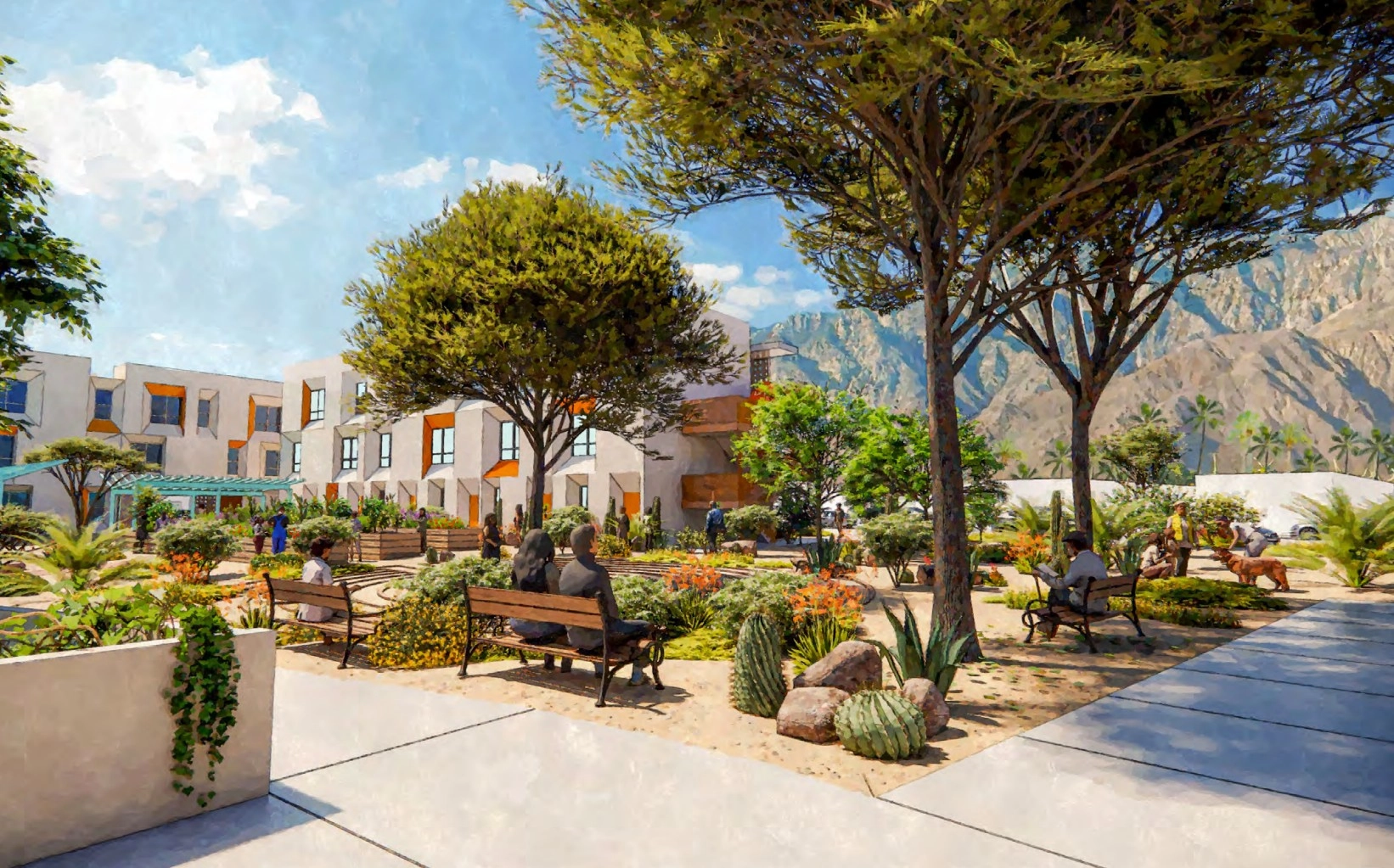
The proposed development would consist of three-story residential buildings arranged around landscaped courtyards and shared community spaces. The project would include a mix of studio and one-bedroom apartments, along with one manager unit, for a total of 72 units.
Rents would be restricted for households earning between 30 percent and 60 percent of the area’s median income. The development is expected to provide deeper affordability for some residents, with units reserved for seniors exiting homelessness, depending on the availability of rental subsidies from Riverside County.
Plans call for 36 units to be set aside for seniors transitioning out of homelessness, while additional units may give preference to veterans.
Supportive amenities are planned as well. Project materials show a multi-purpose community room, fitness and computer rooms, laundry facilities, landscaped walking paths, and outdoor gathering areas designed to encourage social interaction among residents.
The buildings will incorporate desert-sensitive design strategies, including solar orientation, shade structures, and drought-tolerant landscaping to reduce energy and water consumption.
Financing structure and city contribution
The development is estimated to cost about $43.9 million, with funding expected from a combination of low-income housing tax credit equity, state housing loans, construction financing, and local contributions.
Palm Springs’ proposed $3 million loan would serve as permanent financing and help close the remaining funding gap needed to secure state and federal housing subsidies.
Under the terms outlined by city staff, the loan would carry a 3 percent simple annual interest rate and a 57-year term, including a 55-year affordability covenant to ensure the housing remains restricted to low-income tenants.
Repayment would be based on residual receipts from the project rather than fixed annual payments, a structure commonly used in affordable housing financing.
The city also plans to waive certain development-related fees through its Affordable and Multi-Family Housing Incentive Program, which supports projects that deliver fully affordable housing units.
Timeline points to 2029 completion
If financing and approvals proceed as planned, construction could begin in 2027 and conclude in early 2029, with the property converting to permanent financing later that year.
The current development timeline includes entitlement approvals in 2026, tax credit applications later that year, and building permits issued in mid-2027.
Part of Palm Springs’ broader housing strategy
City officials say the senior housing proposal is one of several projects helping Palm Springs meet state-mandated housing production targets under California’s Regional Housing Needs Assessment.
Palm Springs must plan for additional housing across multiple income categories through 2029. The city has assembled a pipeline of approximately 470 affordable housing units through projects such as the Juniper Mission development, the San Rafael Apartments project, and other affordable communities currently in planning or early construction phases.
The Alejo Road development would contribute 72 units toward that total while targeting a demographic that city leaders say faces particular challenges finding housing in the region.
With Palm Springs home prices and rents continuing to rise alongside strong tourism-driven demand, seniors on fixed incomes are increasingly vulnerable to displacement or housing instability.
City officials argue that projects like the Wakeland proposal are essential to ensuring longtime residents can remain in the community as they age.
If completed as planned, the development would provide dozens of new homes for low-income seniors in central Palm Springs while advancing the city’s long-term strategy to expand affordable housing opportunities across the Coachella Valley.