Palm Springs approved a sharply downsized logistics project on Oct. 27, replacing an approved warehouse proposal previously associated with millions of dollars in potential annual sales tax revenue with a last-mile delivery station expected to generate none from its operations. Where have we seen this happen already? Next door in Desert Hot Springs. More on that similar project scope flip later in this article.
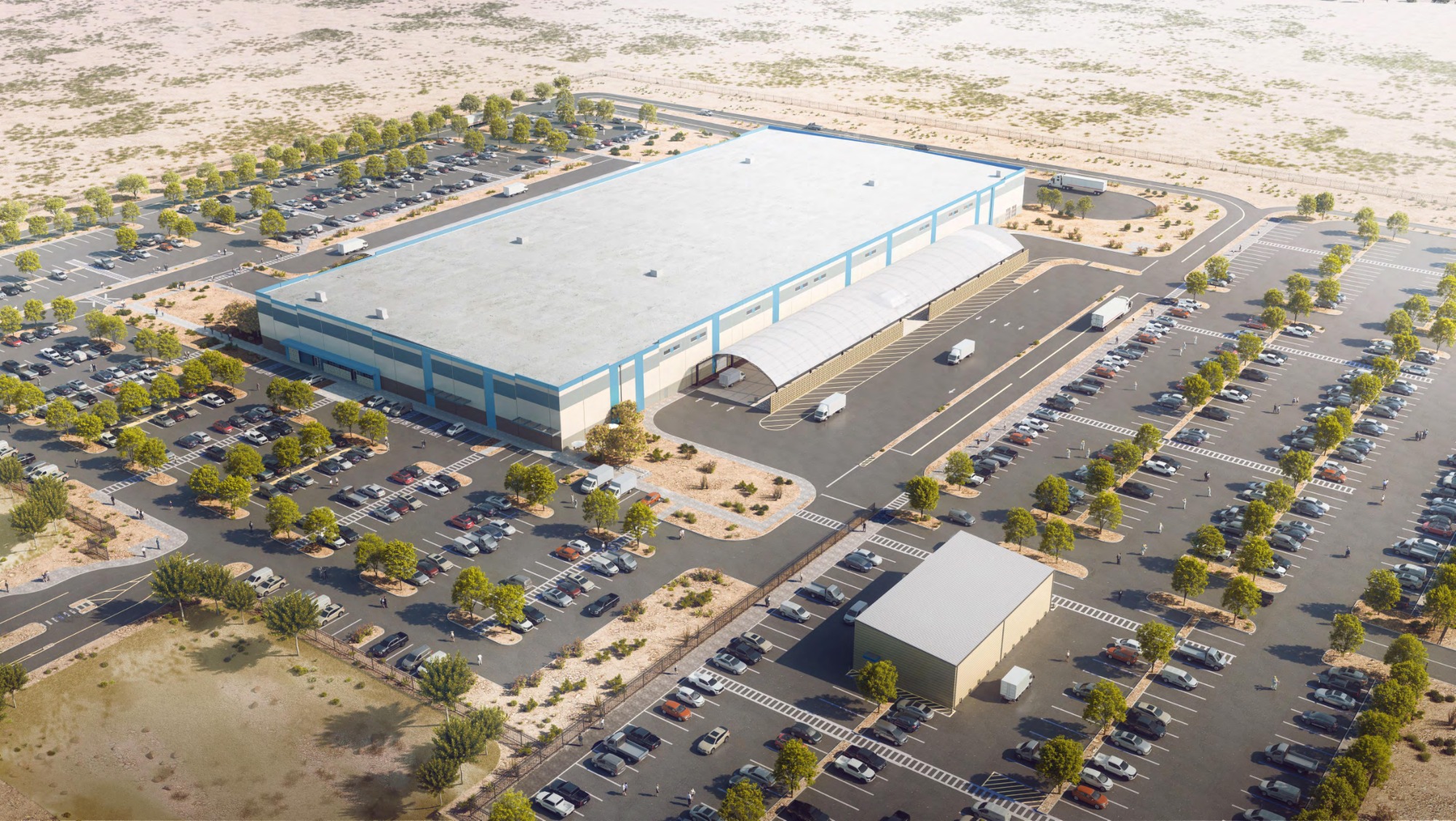
The city’s Planning Commission approved a 174,891-square-foot facility on 38 acres at North Indian Canyon Drive and 19th Avenue, north of Interstate 10. It replaces a 739,360-square-foot warehouse/fulfillment center approved in December 2024 and upheld by the City Council in January 2025.

The 38-acre project site, highlighted in yellow, occupies the northwest corner of North Indian Canyon Drive and 19th Avenue, just north of Interstate 10 in Palm Springs. Map from the city’s Oct. 27 Planning Commission presentation.
The redesign reduces heavy-truck traffic and building size. It also massively reduces projected jobs and revenue for the city, especially recurring revenue. Yet the commission approved it through an addendum to the earlier, larger project’s environmental impact report, carrying forward its determination that the project’s benefits outweighed unavoidable environmental harm. See below for the changes in projected city revenue and jobs and decide for yourself.
“This project does not have sales tax,” Michael DiSano, representative for NorthPoint Development, the project construction manager, told commissioners. “The previous project did.” He also said that his client, David Snider of PS Canyon Development LLC, brought the prior, much larger project forward “looking for a tenant, looking for an opportunity, but this is a project that’s real.” In other words, the company could not secure a tenant for the massive facility. Meanwhile, several other massive logistics facilities are moving through the entitlement and development pipeline in the West Valley. It’s interesting to ponder whether those will all fail too because of lack of demand by logistics companies, or maybe they have secured the last prospective tenants while Snider’s company could not.
Though the earlier revenue estimates were never guaranteed, the approval raises a question the process did not fully resolve: How do comparatively minimal economic benefits still justify the environmental tradeoff the city previously accepted? The answer to the question, “Is it worth it?” has become less obvious.
Palm Springs Warehouse Revenue Projections Fall Sharply in Every Way
The applicant, PS Canyon Development LLC, is owned by David Snider and Steve Disse. NorthPoint presented the revised project as its design-build developer. The facility would receive packages from upstream fulfillment centers and dispatch vans directly to customers. Neither the hearing materials nor the developer identified the operator.
The applicant’s economic comparison shows the change:

These are applicant estimates, not independently verified revenues. The earlier warehouse and fulfillment-center figures represented different possible uses of a project that could not secure a tenant, according to the developer’s presentation. One of the large gaps between the city revenue projections for the earlier scenarios and the one that was approved pertains to construction permits and fees. The estimated difference to the city in this revenue category is a reduction of $4.77 million.
The roughly $20 million employment-related estimate reflects preliminary estimates of wages and broader induced economic effects, not city revenue. Much of the spending could occur outside Palm Springs, where employees live. But the difference in the economic impact of the lower earlier warehouse scenario and the approved last-mile facility is roughly $56 million.
The revised project would still generate property taxes (estimated at $130,350), construction-related taxes and fees, but zero projected operating sales tax stream ($0) compared to the estimated annual recurring sales tax revenue of $1.53 million for the cancelled warehouse and $7.7 million for the cancelled fulfillment center.
The Tax Upside Was Part of the Public Pitch
Planning Director Christopher Hadwin told commissioners the earlier fiscal analysis relied on assumptions the city could not verify. He said the adopted statement of overriding considerations did not rely on specific sales tax amounts.
Nevertheless, revenue was part of the city’s public explanation for the development. In a December 2024 statement published by KESQ, Hadwin said it could bring “several million dollars of additional property and sales tax revenue annually,” along with more than 700 jobs.
GPS Business Insider’s coverage of the January 2025 appeal documented the dispute over whether anticipated benefits justified the environmental consequences.
At the October hearing, Kathy Weremiuk said the updated economic information would have helped commissioners arrive better prepared. Staff described it as information for commissioners and the public, explaining that the earlier statement of overriding considerations was not before them for readoption.
The revised operating plan received a new environmental comparison. The diminished economic return was considered within a framework that treated the earlier benefits determination as still applicable.
And no one mentioned that the more products local residents purchase online for which the point-of-sale taxation is allocated to a warehouse outside our region, the fewer dollars are spent at physical retail establishments in our region and the less overall taxation accrues here.
Other than the massive change in the financial benefits, it’s a wonderful deal for the city.
Why the City Relied on the Earlier EIR
The city’s 2022 zoning changes allow warehouse and logistics uses by right in this industrial area. Staff said the revision required no zoning amendment, conditional use permit or variance, although a major development permit and environmental review remained necessary.
Under California’s CEQA guidelines, an addendum can address changes when the conditions requiring a subsequent EIR are absent. Relevant questions include whether changes create new significant environmental effects or substantially worsen previously identified effects. A smaller building or diminished tax return does not, by itself, require a new EIR.
An addendum also does not require the public circulation process applicable to a new draft EIR. Staff said the revised project’s impacts remained within those previously analyzed.
The more consequential question is how the city justified carrying forward its earlier finding that the benefits outweighed unavoidable harm. The staff report called the revised benefits “similar,” citing jobs, property taxes, infrastructure, industrial development and fees.
The categories remain, but their magnitude has changed substantially. The applicant projects 243 permanent jobs, compared with 819 or 1,004 under the earlier scenarios, and no operating sales tax.
Meanwhile, the city’s environmental consultant said vehicle-miles-traveled impacts remained significant because of long-haul trucking, although reduced. The city’s new approval filing likewise acknowledges significant environmental impacts. The record warrants a clearer explanation of why the reduced benefits still outweigh them.
Less Heavy-Truck Traffic, but Substantial Vehicle Activity
The written transportation summary projects 68 daily long-haul truck trips, down from 280. That represents 34 trucks arriving and leaving. Delivery vans would depart in groups of 64 every 15 minutes after the morning traffic peak and return after evening peak hours.
The staff report estimates 2,132 net daily vehicle trips. It also identifies an existing traffic problem at the Interstate 10 eastbound ramps at Garnet Road. The project must make frontage improvements and/or pay fair-share contributions toward required intersection improvements.
The smaller building and fewer semitruck trips offer environmental advantages, but the operation still brings substantial delivery-vehicle and employee traffic.
“We’re taking a desert site which has absolutely no economic benefit, and we’re putting in a last mile delivery station that is going to serve the surrounding community,” Commissioner Scott Miller summarized.
But is anyone currently having trouble getting timely delivery of products they buy online such that this new last-mile facility is a savior needed to mitigate delays?
Air-Quality Conditions Draw Questions
Staff said the conditions largely mirrored the earlier approval, including mitigation obligations and commitments to the Sierra Club and other organizations.
Some depend on feasibility or future decisions. The draft requires a zero-emissions fleet when technology permits, it is practical and it complies with state law. It directs the applicant to endeavor to use carbon-free power for demand rooftop solar cannot meet, subject to feasibility and the settlement agreement. Neither provision establishes an unconditional opening-day requirement.
NorthPoint also described a LEED Silver design, rooftop solar, increased battery storage and additional vehicle charging. Commissioners asked how those features would become enforceable commitments.
More pointed questions surround the air-quality study the City Council added to the original approval. The draft carries forward a study requirement within five years or after completion and operation, with additional mitigation if it finds increases above CEQA thresholds. Staff connected that safeguard to council concerns about cumulative effects from multiple large projects.
The applicant requested wording changes so the review would address the project’s impacts rather than baseline or cumulative impacts. The hearing transcript does not establish the final wording, so it would be premature to say the commission eliminated cumulative-impact scrutiny. It does document a request to narrow or clarify a safeguard staff described in broader terms.
A Familiar Tradeoff in Desert Hot Springs
As GPS Business Insider reported in February, Amazon’s Desert Hot Springs development changed from a roughly 3.4-million-square-foot fulfillment-center proposal to an approximately 635,000-square-foot inbound cross-dock operation. It brought substantial employment, but the anticipated general-fund windfall did not materialize.
That facility moves inventory through Amazon’s network; the Palm Springs proposal would deliver to final customers. The parallel is the gap between the touted economic possibilities associated with an entitlement presented in formal documents and hearings and the operation that ultimately advances.
A warehouse label does not guarantee local sales tax. The California Department of Tax and Fee Administration distinguishes businesses selling goods from fulfillment operations providing services for sellers. Tax treatment depends on the transactions and business arrangements.
The Palm Springs record does not establish that the applicant deliberately overstated the original possibilities or planned the redesign from the outset.
NorthPoint’s argument was that the revised project could actually be built. Michael DiSano contrasted the specific operating plan with speculative developments awaiting tenants and pointed to sewer and power extensions, landscaping and reduced heavy-truck traffic.
DiSano called the 243-job estimate conservative. Higher staffing and site-activity figures appear elsewhere in the materials, but they are not interchangeable job guarantees. The draft conditions reviewed identified no minimum employment guarantee.
The start of construction is anticipated in early 2027 and finishing in 2028.

Bob Marra is the CEO/Publisher of GPS Business Insider and GPS Market Intel. He has been studying, writing and giving presentations about business, economic and public affairs news and issues and the local economy in the Greater Palm Springs/Coachella Valley region for more than 20 years.