Palm Springs International Airport entered late spring with a clearer picture of what 2026 is becoming: not a downturn in the broad sense, but a more selective, more uneven phase of the post-boom cycle, one in which Canadian air travel softness, airline schedule discipline and shifting route economics are shaping the numbers month by month.
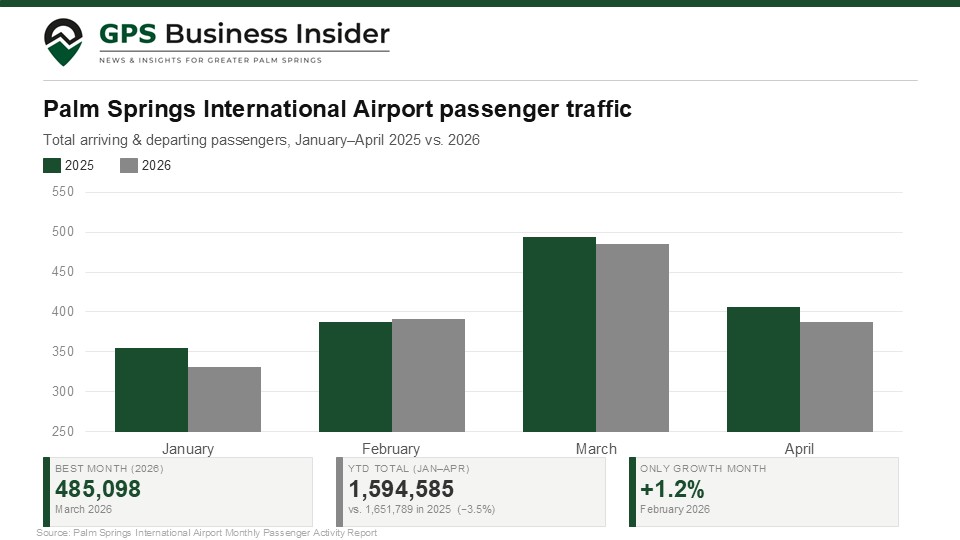
In April, PSP handled 387,225 total passengers, down 4.7 percent from 406,506 in April 2025. That was a more pronounced year-over-year decline than the airport posted in March, when traffic slipped 1.7 percent. It also represented a sharp month-to-month drop from March’s 485,098 passengers, a difference of nearly 98,000 travelers, which is substantial but not surprising for an airport that moves from high season, spring break and festival-fueled spring demand toward the shoulder season.
Canada remains the clearest pressure point
The Canadian segment remains one of the most important pressure points. Passengers arriving on Canadian airlines totaled 17,540 in April, down 11.4 percent from 19,785 a year earlier. That was also down more than 10,000 passengers from March, when the comparable figure stood at 27,747. For an airport and a valley economy long supported by Canadian seasonal demand, the softness is no longer anecdotal. It is plainly embedded in the operating data.
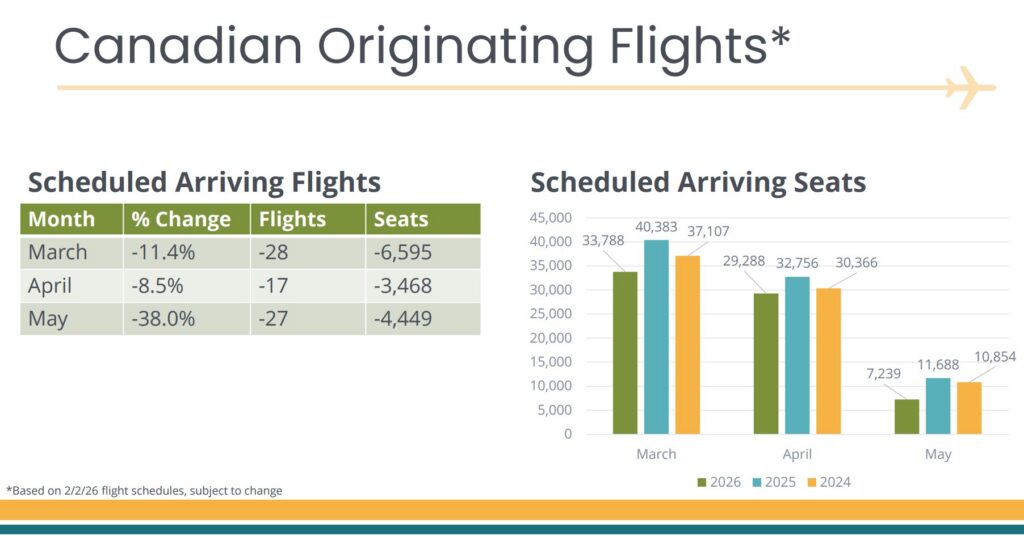
Still, the latest airport presentation suggests PSP officials do not see the Canadian issue as a collapse. They see it as a persistent drag that is being managed, watched carefully and, at least for now, contained.
Based on flight schedules as of May 12, the airport expects Canadian-originating arriving flights to be down by 32 in May, or about one fewer flight per day, with scheduled arriving seats down 45 percent year over year. Canadian flights in June are projected to be down modestly in flight count and 20.5 percent in seats. July, however, is projected to turn positive, with three more arriving flights than a year earlier and a 44.2 percent increase in seats, before August softens again. Airport staff described those changes as modest adjustments rather than the dramatic air-service retrenchment some had feared.
That matters because PSP’s Canadian challenge is unfolding at the same time as a broader shift in Canadian travel patterns to the United States. The airport’s staff said PSP continues to fare better than the U.S. overall, even as schedules are being adjusted across the industry. In other words, Palm Springs is not immune, but it may be outperforming a softer national trend.
Airline results show a more uneven market
The April airline breakdown shows how uneven the market has become.
Alaska remained the airport’s largest carrier in April with 91,761 total passengers, up 8.5 percent year over year and accounting for 23.7 percent of the market. United also turned in a strong month, rising 22.8 percent to 55,410 passengers. Delta was up 2.8 percent to 31,151.
But other major carriers moved in the opposite direction. American fell 16.2 percent to 55,330 passengers. Southwest dropped 9 percent to 58,544. WestJet declined 11.8 percent to 28,080. Air Canada slipped 3.4 percent to 12,055. Allegiant fell 22.7 percent, while Porter, which is tied to the Toronto market, dropped 44.2 percent. Avelo and Frontier, both of which had April traffic last year, showed none this April.
Those airline-level shifts help explain why the overall number softened more in April than in March. The April report reflects both weaker Canadian-related demand and a deliberate pullback by some carriers that had overestimated demand around the Coachella and Stagecoach period last year. In the attached May transcript, Jake Ingrassia, PSP’s communications and marketing coordinator, said American and United had told the airport back in March that they would be correcting excess capacity over the festival period after bringing on too much last season. He described April traffic as coming in generally within the range the airport expected.
That is an important distinction. The airport is not presenting the April decline as a surprise shock. It is presenting it as a planned right-sizing layered on top of a softer Canadian market.
Still down, but from very high levels
Even with the April slowdown, the airport remains historically elevated. Through the first four months of 2026, PSP processed 1,594,585 passengers. That is down about 2.9 percent from the same January-through-April period in 2025, but it still reflects an airport operating at a scale that would have been difficult to imagine before the pandemic-era growth surge. PSP’s official 2025 total exceeded 3.3 million passengers, another annual record, which means 2026 is being measured against an unusually high base.
That base effect is part of the story, but not the whole story.
The more revealing takeaway may be what comes next.
Summer schedules still suggest resilience
PSP’s summer schedule outlook remains notably resilient. Domestic seats were projected down slightly in May, by 2.6 percent, but then up 6.9 percent in June, 10 percent in July and 7 percent in August. Total seats, including domestic and international service, were projected down 4.2 percent in May, then up 1.7 percent in June, 8.3 percent in July and 3.5 percent in August.
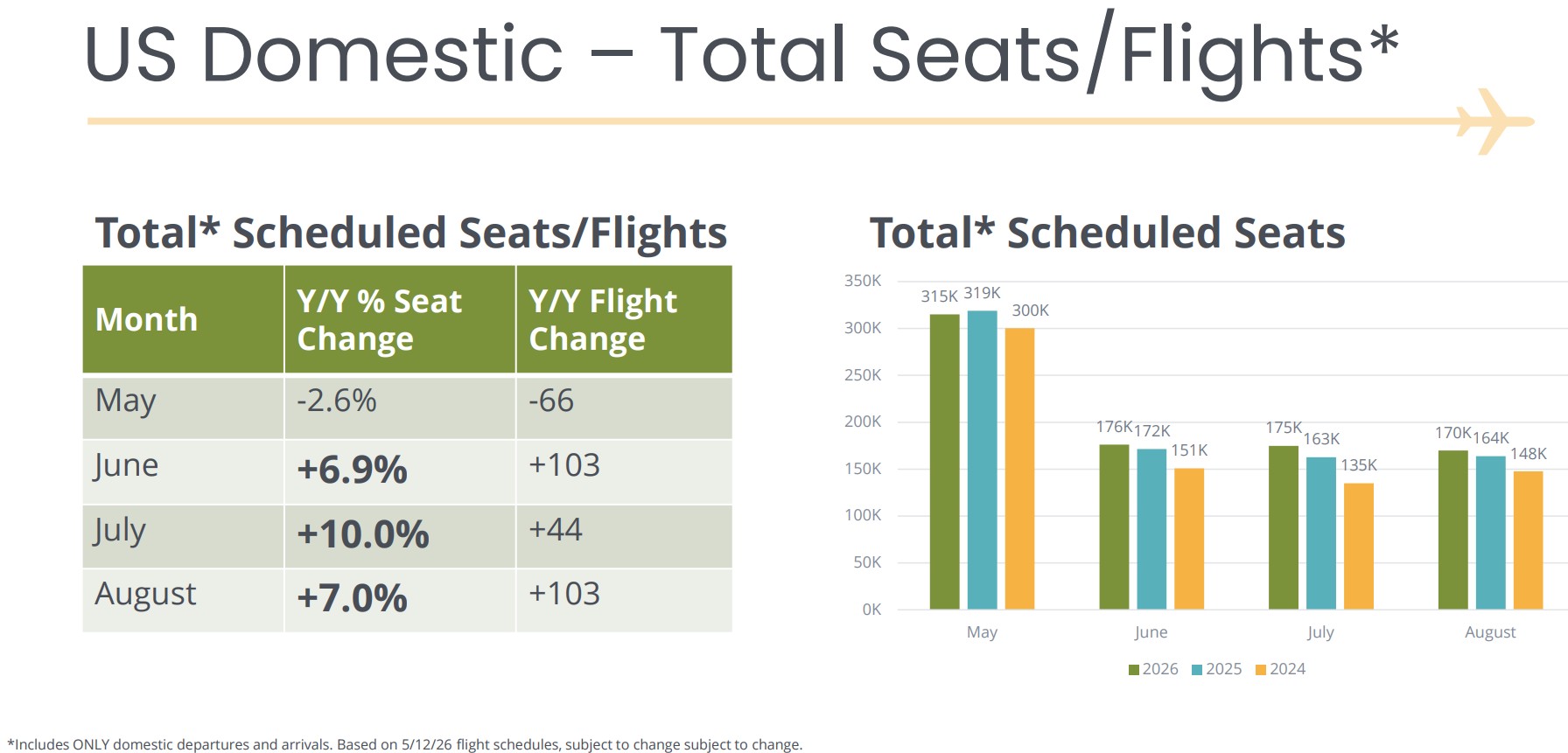
Airport staff have been emphasizing that point for months, and with reason. Last year’s record performance was driven not only by the winter peak but also by unusually strong shoulder-season and summer demand. The latest presentation suggests airlines still see Palm Springs as capable of supporting more summer capacity than it had a year ago, even with the Canadian segment under stress.
That gives the 2026 story a more complicated texture than a simple down-or-up narrative.
Route cuts reinforce the Canadian challenge
Canada remains the biggest external headwind. Porter will not return its Toronto route next season, though airport staff have emphasized that the service represented less than 1 percent of PSP’s market and that Air Canada continues to serve Toronto. PSP said it plans to keep talking with Air Canada about possible aircraft upgrades and other opportunities to help meet demand.
Allegiant also will not bring back its Bellingham route next season, a move the airport tied largely to the closure of Allegiant’s crew base there. Staff also linked that market’s weakness to reduced cross-border Canadian demand, noting that Bellingham has long depended heavily on travelers coming south from Canada. Like Porter’s Toronto service, the Bellingham route accounted for less than 1 percent of PSP’s market. But together the two changes still reinforce the same message: the Canada-related pressure is now shaping real air-service decisions, not just monthly passenger counts.
And yet, PSP’s core network remains intact. The airport’s year-round routes continue to include Denver, Dallas-Fort Worth, Las Vegas, Los Angeles, Oakland, Portland, Phoenix, Seattle, San Francisco, Salt Lake City, Sacramento, Vancouver and Calgary. United’s move earlier this year to extend Los Angeles service through the summer added another layer of stability to the airport’s year-round profile and strengthened the connecting value of PSP for local travelers.
Why the latest PSP data matters to the valley
For the Coachella Valley, this matters well beyond the terminal.
PSP is one of the clearest operating indicators of the region’s visitor economy. Airline traffic is not a perfect proxy for hotel demand, restaurant traffic, retail spending or second-home use, but it is closely related to all of them. A weaker Canadian presence has implications for businesses across the valley, especially in communities and sectors that have long relied on seasonal visitors from that market. At the same time, gains by airlines such as Alaska and United suggest other parts of the network are still strengthening and may be offsetting some of that weakness.
The April data, taken together with the summer schedules, suggest Palm Springs International Airport is moving into a more mature phase of its growth cycle. The volume of the pandemic rebound years, when nearly every comparison seemed to set a record, is seemingly over. What replaces it may be more valuable analytically: a period in which the airport’s true strengths and vulnerabilities are easier to see.
The next phase will be more strategic
For now, those strengths remain substantial. PSP still has a large and diversified base of domestic service, a growing year-round utility for local travelers, and a summer schedule that in many cases is stronger than last year’s. Its vulnerabilities are also becoming harder to ignore, especially for Canada, where some airlines may continue to trim capacity more aggressively if demand signals remain mixed.
That is the real significance of the latest report. April was softer. Canada is still a problem. Some routes are being cut. But the airport is not pulling back across the board, and neither are the airlines. Instead, PSP appears to be entering a phase where performance will be shaped less by broad recovery momentum and more by route strategy, market mix and the durability of summer demand.
That may not make for the easy headline of another record. But for the airport, and for the Greater Palm Springs economy that depends on it, it may be the more important story.