Greater Palm Springs renters are seeing signs of relief in parts of the market, but a closer look at the numbers shows that the region’s housing affordability problem remains firmly in place.
Fresh rental data from Zillow Market Trends show that asking rents have declined from last year’s levels in several desert cities, especially for two-bedroom apartments and condominiums. But even after that cooling, the typical two-bedroom unit in Greater Palm Springs remains near or above $2,000 a month in most cities with available data.
For workers in hospitality, restaurants, retail, health care support, personal services and other lower- and middle-wage occupations, that is still a difficult number to absorb.
The picture becomes more complicated when looking at three-bedroom houses. In a resort region where April listings can include furnished homes, seasonal rentals, 30-day stays, 60-day stays and other temporary arrangements, the broad Zillow figure for single-family house rentals can overstate the cost of a traditional long-term lease.
That caveat matters. A three-bedroom house listed at $7,000 or $10,000 a month may tell a story about the resort rental market, but it does not necessarily represent what a family seeking a conventional year-long lease would encounter.
Yet the broader conclusion does not change. Even when the analysis focuses more narrowly on long-term rental signals, the cost of renting in Greater Palm Springs remains far above what many local workers can afford.
The valley is not simply facing high rents. It is facing a structural mismatch between the housing available in the market and the wages generated by much of the region’s economy.
The Clearest Signal Comes From Apartments And Condos
The most reliable workforce-housing indicator in the April Zillow data is the two-bedroom apartment market. Unlike the single-family house category, those listings are less likely to be distorted by seasonal resort homes, luxury vacation rentals or monthly stays tied to the high season.
By that measure, the region remains expensive.
In April 2026, the typical two-bedroom apartment or condominium listed for about $2,254 across Greater Palm Springs, based on the figures in the local dataset. City-level numbers ranged from $1,895 in Desert Hot Springs to $2,808 in La Quinta. Cathedral City and Indio were just under $2,000. Palm Springs and Palm Desert were above $2,100. Rancho Mirage was $2,800.
Several of those figures were down from a year earlier. Palm Springs fell 9.6 percent. Rancho Mirage dropped 11.6 percent. Palm Desert declined 6.2 percent. Cathedral City was down 5.1 percent.
But the decline is relative. A rent that falls from very expensive to somewhat less expensive can still be out of reach.
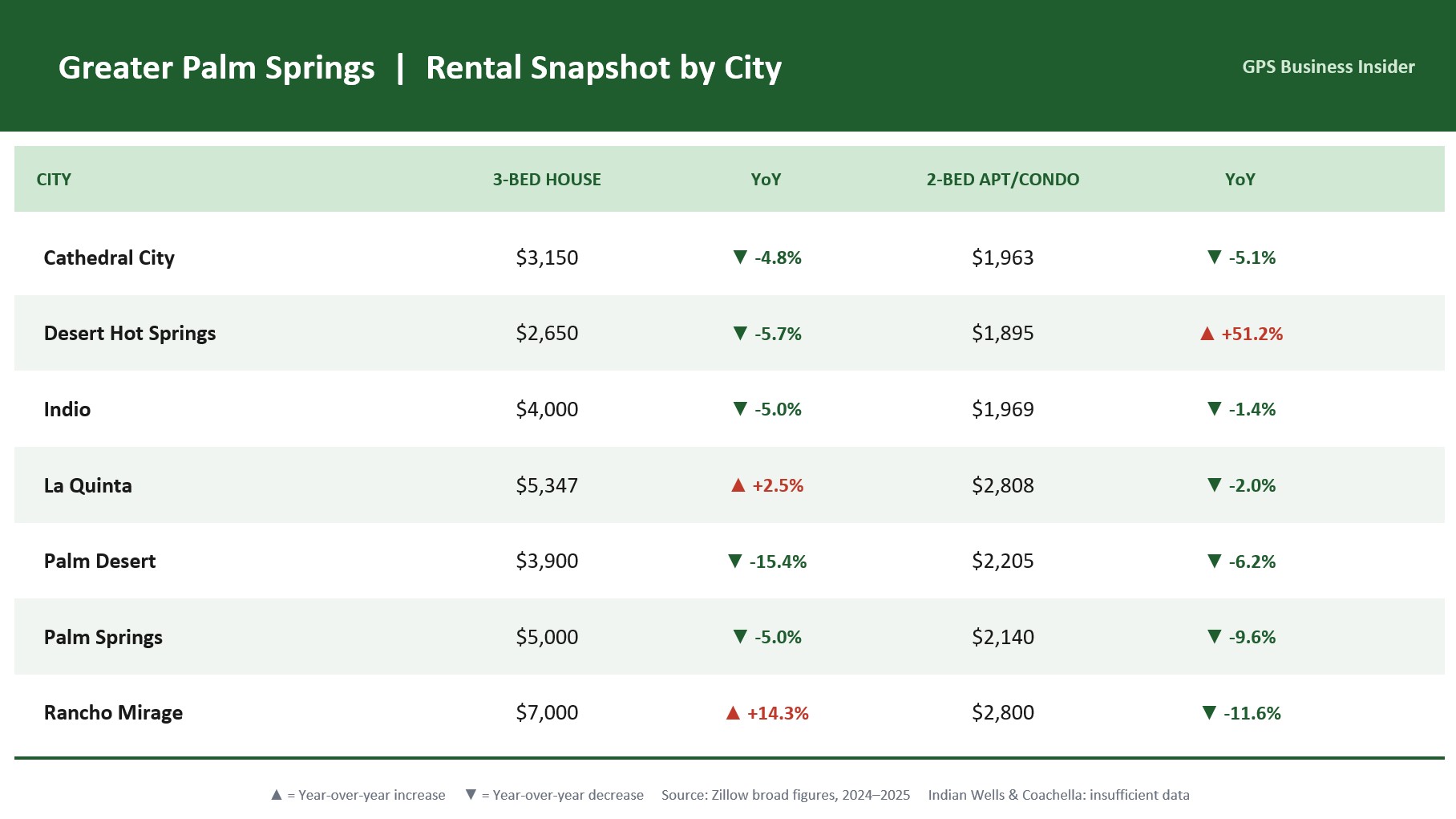
Figures reflect April 2026 medians from active Zillow listings. In Greater Palm Springs, three-bedroom house listings may include furnished, seasonal, monthly or short-duration rentals, which can push the broad single-family figure higher than the cost of a traditional long-term lease.
Why The Three-Bedroom House Numbers Need Context
The broad Zillow figures for three-bedroom houses show how expensive the visible single-family rental market can be. But in Greater Palm Springs, they should be interpreted with caution.
April is still a period when many resort-oriented listings are active. Homes marketed to seasonal visitors, short-term renters, remote workers, snowbirds or temporary residents can remain in the Zillow rental inventory. Some may be available for 30 days, 60 days or a limited seasonal window rather than as conventional long-term housing.
Those homes can skew the median upward, especially in Palm Springs, La Quinta, Rancho Mirage and parts of Palm Desert, where the single-family rental market overlaps heavily with the vacation and seasonal housing market.
A Zillow connector review focused on exactly three-bedroom single-family homes using long-term search terms produced a more nuanced picture. In several cities, the long-term-focused sample came in below the broad April figure. Palm Desert, Palm Springs and Rancho Mirage all showed evidence that conventional long-term listings may be lower than the broad market snapshot. Indio was closer to the original figure. La Quinta remained high, largely because its rental inventory is shaped by resort, golf course and luxury seasonal housing.
The sample was not complete enough to replace Zillow’s official market figures. Zillow does not provide a clean public filter that fully separates long-term leases from seasonal or monthly listings. But the review confirms an important point for readers: the three-bedroom house number is best viewed as an indicator of the broader single-family rental market, not a clean measure of workforce-oriented long-term housing.
Even with that adjustment, the affordability problem remains. Long-term three-bedroom house listings across the region still generally appear to fall in the mid-$3,000s to $5,000s in many cities, with resort-oriented cities showing much higher prices.
That means a family looking for more space faces a sharp jump in cost, even before considering utilities, deposits, application fees, insurance and the higher transportation costs that often come with living farther from work.
A Market That Has Cooled, But Not Enough
The latest data show that rents are not rising at the pace seen during the most overheated period of the housing market. In several cities, they have moved down from last year’s levels.
Palm Desert’s broad three-bedroom house figure fell 15.4 percent from a year earlier. Palm Springs’ two-bedroom apartment and condominium figure fell 9.6 percent. Rancho Mirage’s two-bedroom figure dropped 11.6 percent. Cathedral City posted declines in both categories.
Those declines matter. They suggest that some landlords are encountering more price resistance and that renters may have slightly more leverage than they did during the peak of the post-pandemic housing surge.
But the region is nowhere near a low-cost rental environment. It has moved from extremely strained to still strained.
A two-bedroom apartment at $2,140 in Palm Springs, $2,205 in Palm Desert or $1,969 in Indio remains a major burden for workers earning service-sector wages. A family-sized single-family home in the $3,500 to $5,000 range remains out of reach for many households that support the local economy.
The result is a market where cooling does not necessarily mean affordability.
The Workforce Math Is Still Difficult
The local economy depends heavily on jobs that do not support local rents.
Greater Palm Springs is built around tourism, hospitality, restaurants, retail, golf, health care, small businesses, public agencies and personal services. Those sectors employ thousands of workers who keep the region functioning every day.
Many of those jobs do not produce household incomes high enough to support current market rents without cost burdens.
At $18 an hour, a full-time worker earns about $37,440 a year before taxes. At $20 an hour, the gross annual figure is about $41,600. Even two workers earning $20 an hour each would have combined gross income of about $83,200, enough to afford roughly $2,080 a month under the 30 percent rule.
That would still fall short of the typical two-bedroom apartment or condominium rent in Palm Springs, Palm Desert, La Quinta and Rancho Mirage, and it would be far below the cost of most three-bedroom single-family rentals.
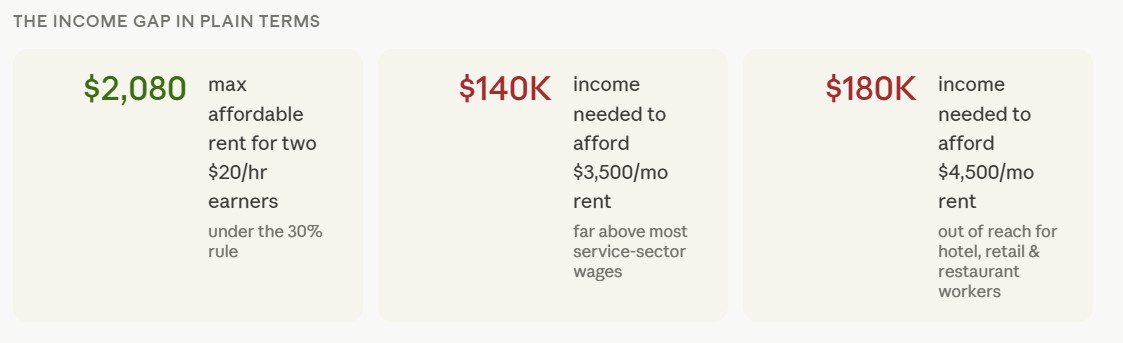
For a household to afford a $3,500 monthly rent, it would need annual gross income of about $140,000. To afford $4,500 a month, it would need about $180,000. Those income levels are not typical of the workers staffing hotels, restaurants, retail counters, medical offices, landscaping crews and many public-facing service jobs.
That is why the rent issue is also a labor issue.
When workers cannot afford to live near their jobs, employers face a tighter labor pool, longer recruitment times and higher turnover. Workers who remain in the region often absorb longer commutes, more crowded housing arrangements or heavier household debt.
A Regional Economic Issue
The housing squeeze is felt most directly by renters, but its consequences extend across the regional economy.
For employers, high rents can make it harder to fill positions and retain experienced employees. A hotel, restaurant, medical office, retail shop or small business cannot operate at full strength if its workers are pushed farther away from the communities where the jobs are located.
For workers, the choices can be punishing. Some move east or outside the valley in search of lower rents. Some double up with family members or roommates. Some accept longer drives and higher transportation costs. Some leave the local labor market entirely.
For cities, the issue touches nearly every policy priority. Housing affordability affects traffic, homelessness prevention, economic development, public safety recruitment, school staffing, health care access and the ability to sustain year-round local businesses.
The challenge is especially acute because Greater Palm Springs is both a place where people work and a place where people come to vacation, retire, invest and own second homes. Those competing roles put unusual pressure on the housing market.
In a traditional employment center, housing demand is driven mainly by local households and job growth. In Greater Palm Springs, the market is also shaped by seasonal residents, short-term rental demand, second-home ownership, remote workers and higher-income households drawn by the region’s lifestyle.
That makes the rental market more complex and, for many local workers, less forgiving.
Supply Remains The Long-Term Question
The region’s housing affordability problem cannot be solved by rent declines alone.
Greater Palm Springs needs more housing that is priced for the people who work here. That includes apartments, townhomes, smaller units, mixed-income projects, infill housing, accessory dwelling units and family-sized rentals that are not primarily aimed at seasonal or luxury demand.
Cities across the valley have been discussing housing production, state housing mandates, affordable housing requirements, downtown infill, mixed-use projects and redevelopment opportunities. Those efforts are important. But the latest rent data show how large the gap remains.
The market is not producing enough naturally affordable rental housing to meet the needs of the workforce. And the housing that does exist is often competing with households and property owners whose income profiles are far above the local service-sector wage base.
That means the affordability challenge is unlikely to be solved by market cooling alone.
Even if rents soften modestly, the gap between wages and housing costs remains too wide.
The market has cooled. The affordability crisis has not.

Bob Marra is the CEO/Publisher of GPS Business Insider and GPS Market Intel. He has been studying, writing and giving presentations about business, economic and public affairs news and issues and the local economy in the Greater Palm Springs/Coachella Valley region for more than 20 years.