The Coachella Valley has abundant land for development. What it increasingly lacks is the electrical capacity, infrastructure financing and affordable housing needed to turn that land into functioning communities.
Those challenges dominated a town hall organized by the Desert Valleys Builders Association, where county officials, homebuilders and land-use professionals examined why some projects that appear feasible on paper can take years to reach construction, if they proceed at all.
The event at Agua Caliente Resort Casino Spa featured presentations by Riverside County Chief Operating Officer Juan C. Perez and GPS Business Insider and GPS Market Intel publisher Bob Marra, followed by a panel with D.R. Horton executive Douglas Stowell, Fennemore land-use attorney Brent McManigal and Coachella Valley Housing Coalition construction manager Slawomir Rutkowski. DVBA Executive Officer James Brownyard moderated.
The recurring concern was uncertainty. Developers must make long-term financial commitments while facing unpredictable utility schedules, government fees, interest rates and construction costs. Those pressures ultimately reach homebuyers, including workers whose incomes are already insufficient to purchase most of the homes being built locally.
Electrical power is now a prerequisite for growth

Riverside County Chief Operating Officer Juan Perez provided an overview of the power challenges in the region.
“Electrical power is our number one issue dealing with growth now in the Coachella Valley,” Perez told the audience.
The constraint is often less about the overall availability of electricity than whether enough distribution capacity exists where construction is proposed. New substations, transformers and related equipment require substantial upfront investment and can take years to deliver.
Perez cited the planned Cook Street Substation near Interstate 10 in Thousand Palms as an example of the financing partnerships needed to overcome that obstacle. The roughly $40 million Imperial Irrigation District project involves Riverside County, Palm Desert, Rancho Mirage, the Berger Foundation and private development interests. It is expected to serve about 8,000 residential and commercial customers, with construction expected to begin in 2027 and completion in 2028.
For its part, the county is advancing about $7 million through an electrical power fund, with plans to recover its investment as development benefits from the new capacity. That approach addresses a recurring dilemma: An individual project may need additional power, but cannot economically finance an entire substation.
Perez also pointed to the Avenue 58 electrical infrastructure improvements near La Quinta, where a city-led funding agreement is intended to support expanded capacity for eastern valley development.
Regional cooperation is growing through the Coachella Valley Power Authority, a joint powers organization involving Riverside County, Indio and La Quinta. Perez said the Twenty-Nine Palms Band of Mission Indians had joined the effort.
A developer can secure land-use approvals and still be unable to proceed if the utility cannot establish a dependable date for delivering power. That disconnect complicates the timing of construction loans, contractor commitments and eventual home sales.
But advancing public money cannot become the permanent answer, Perez cautioned.
“We have to come up with other ways to fund this growth beyond just the public agencies fronting money. That’s not a long-term sustainable model for us.”
County looks to future tax increment revenue to finance infrastructure
Perez described unincorporated Riverside County as “land rich and infrastructure poor,” particularly in the eastern Coachella Valley, which he expects to remain a major growth area for decades.
To pay for roads, utilities and other improvements, the county is expanding its use of enhanced infrastructure financing districts, or EIFDs. The districts dedicate a share of future growth in property-tax revenue within designated boundaries to public infrastructure. They do not impose a new property tax.
The Eastern Coachella Valley EIFD, covering roughly 9,000 parcels from the edges of Indio, La Quinta and Coachella toward the Imperial County line, is projected to generate approximately $228 million over several decades.
Revenue will accumulate gradually as assessed property values rise. Perez said the district has only begun receiving its initial tax increment, but the money can eventually help finance regional improvements and attract matching funds from other agencies.
A similar district is being pursued in Thousand Palms, where planned development around Acrisure Arena has increased attention on electrical capacity, flood control and other infrastructure needs.
The strategy reflects a broader shift: Rather than waiting for projects to generate revenue before providing essential services, the county is seeking financing mechanisms that can help prepare land for development.
Affordable homes can take years to reach construction
For the Coachella Valley Housing Coalition, the costs associated with extending infrastructure can make an otherwise promising property unusable.
Rutkowski described the nonprofit’s proposed Nuestro Orgullo development in Mecca, a 291-home project that illustrates how long development can take. From early planning to the start of construction, he said, the process can extend five to seven years.

CVHC has been helping families fulfill their dream of homeownership through the Mutual Self-Help Housing model by helping them reach economic stability and improving their quality of life and their livelihoods.
During that period, interest rates, material prices, government requirements and labor costs can change substantially, undermining the original budget. Some sites are simply too expensive to serve with electricity or water.
“There are some sites that we won’t even look at, that we won’t buy, because the cost to develop or bring power is prohibitive,” he said.
A second project underscored the problem. Stowell said D.R. Horton had dedicated approximately 24 lots within its Mariposa development in Coachella to the housing coalition. Rutkowski said construction on those homes was being targeted for January 2027.
But developers can face another dilemma: Obtain entitlements too early, and they may expire before utility improvements are ready, or wait for infrastructure and continue carrying land and planning costs.
Stowell emphasized that delays affect not only builders but also lenders and the people waiting for homes. Financing and credit conditions can change dramatically between a land commitment and the arrival of construction crews.
“Time is money. Markets change,” he said.
McManigal, whose practice includes land-use and development matters, said entitlement approvals on large projects can take seven or eight years. Environmental review, legal challenges, changes in agency personnel and shifting requirements make it difficult to predict when a project can begin.
Government fees compound the affordability challenge
Public agencies, meanwhile, face rising costs of their own. Perez said Riverside County is examining fee adjustments and financing tools for public safety and other services needed to accommodate growth.
Brownyard highlighted the accumulation of charges from cities, special districts and regional programs. He singled out a potential fee increase under the Coachella Valley Multiple Species Habitat Conservation Plan, saying a proposal under consideration could add about $8,000 per acre to some projects, nearly doubling the current rate.
McManigal said higher fees are increasingly built into development budgets. Some projects can absorb them. Others become too expensive for the market they are meant to serve.
For affordable homeownership programs, the effects can be immediate. Rutkowski said incremental increases in fees, materials, financing and labor can ultimately add tens of thousands of dollars to a home’s price, pushing qualifying families beyond mortgage limits.
“We have to pass those increases to the sales price,” he said. “And unfortunately, we’re losing families. Families can’t qualify anymore for the house.”
The coalition relies heavily on the federal USDA Section 502 Direct Loan Program to help eligible buyers finance homes. Higher borrowing costs affect both the organization’s development financing and families’ purchasing power at the end of the process.
Home prices and local wages no longer line up

GPS Market Intel CEO, Bob Marra.
Marra described two overlapping economies in Greater Palm Springs: one sustained by visitors, seasonal homeowners and outside wealth, and another supported by approximately 420,000 permanent residents and their employers.
According to Visit Greater Palm Springs, the visitor economy produced roughly $9.6 billion in total economic impact in 2025. That activity supports jobs and public revenue, but it does not necessarily give year-round workers the income needed to buy increasingly expensive homes.
Marra cited a regional median detached-home price near $625,000 and used a $570,000 new home in Indio or Coachella to illustrate the problem. Depending on mortgage terms and other expenses, he estimated that buying the lower-priced home could require a household income of about $150,000 to $170,000 and close to $150,000 in cash for a substantial down payment and closing costs.
Those figures exceed the means of most local working households. Buyers arriving with proceeds from more expensive coastal housing markets can compete for homes that local wages alone cannot support.
Marra also cited figures showing 2,159 housing units added in the valley in 2025, compared with an increase of 891 permanent residents. He argued that the contrast reflects the unusual importance of seasonal ownership and other housing demand not directly tied to local population growth.
Rutkowski described the geographic consequences: Many families served by his coalition live in the eastern valley but commute to jobs in communities farther west.
“We provide housing for the people that work on the west end of the valley, and we usually build on the east end,” he said.
Builders remain committed, but need more predictability
Despite those obstacles, Stowell said D.R. Horton sees long-term opportunity in the Coachella Valley. The national homebuilder established a local office within the past year and anticipates bringing three additional projects online within approximately six or seven months, he said.
Corporate leaders have examined the region’s broader economy, including healthcare, educational investment and employment growth, rather than evaluating housing demand in isolation.
“We believe in the Coachella Valley long term,” Stowell said.
He also advocated better coordination with utilities, public agencies and suppliers so project schedules can be forecast with greater confidence. Local supply-chain capacity, including lumber and framing services, can help projects move more efficiently and keep more development spending within the region.
Skilled workers are another development bottleneck
The town hall also examined whether the local workforce can support anticipated construction.

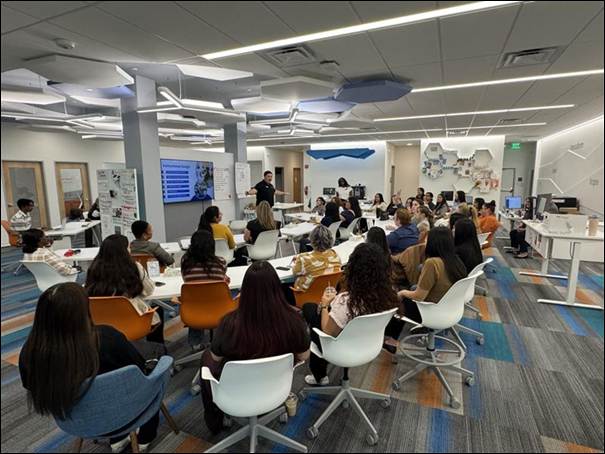
Professional Women in Building chair Jill Weiss addresses the DVBA Town Hall.
Marra cited shortages across skilled trades and other industries, as well as declining local school enrollment, as warning signs for the region’s future labor supply. He urged builders to partner with College of the Desert and its Partnership and Community Education program to develop customized training for electricians, carpenters and other trades.
He identified the college’s new Palm Springs campus, a roughly $406 million investment scheduled to open in fall 2027, and the college’s thriving Indio campus as important new sources of workforce development and economic diversification, along with the main campus in Palm Desert and its comprehensive resources.
Earlier, Jill Weiss, chair of DVBA’s Professional Women in Building Council, described efforts to introduce students, especially girls, to construction careers through schools and community organizations.
Stowell stressed the value of building a stronger local trades workforce, both to support development and to give younger residents access to careers that can sustain a household in the region.
“We really need to support trades,” he said. “I think it’s a worthwhile industry to support.”