Federal officials have established a new framework for managing the Colorado River through 2036, but the most consequential decisions are still ahead. Greater Palm Springs has significant protections, yet the river remains deeply embedded in the region’s agriculture, groundwater replenishment, golf industry, Salton Sea and long-term capacity for growth.
The crisis on the Colorado River can seem far removed from Greater Palm Springs.
Lake Powell is hundreds of miles away. Lake Mead lies beyond the California border. And when most Coachella Valley residents turn on a faucet, the water comes from the vast aquifer beneath the desert, not directly from the Colorado River.
But that distance is deceptive.
Colorado River water irrigates much of the eastern Coachella Valley’s farmland. It supplies golf courses and other large landscapes so they do not have to pump as much groundwater. It is placed into recharge basins to replenish the aquifer that supplies nearly all of the region’s drinking water. And in the western valley, State Water Project supplies are effectively exchanged for Colorado River water delivered through the Colorado River Aqueduct.
That makes the federal government’s new post-2026 framework for managing the Colorado River far more than an interstate water dispute.
For Greater Palm Springs, it is a long-term economic, infrastructure, environmental and growth issue.
The U.S. Bureau of Reclamation on July 31 released its long-awaited Final Environmental Impact Statement (EIS) for operations at Lake Powell and Lake Mead after the current rules expire at the end of this year.
The most important thing to understand is what the new framework is not.
It is not a fixed set of water allocations extending through 2036. It does not determine exactly how much water California, Arizona, or Nevada will receive each year. And it does not settle the increasingly contentious question of how much responsibility the Upper Basin and Lower Basin states should bear for stabilizing a river that is producing less water than the system built around it expects.
Instead, the federal government has created a 10-year decision framework, with specific operating guidelines expected to be issued in roughly two-year increments.

IID Board Member and Chairman of the Colorado River Board of California, J.B. Hamby.
That distinction was emphasized by JB Hamby, chairman of the Colorado River Board of California and California’s Colorado River commissioner, who is also an Imperial Irrigation District board member.
“This is an important milestone, but it is not the finish line,” Hamby said after the Final EIS was released. “The framework establishes sideboards on operations for the next ten years. It does not conclude the Basin States’ negotiations, predetermine specific operating decisions, including Lake Powell releases or shortages, or serve as the operating plan itself.”
That means the West is moving away from the relative certainty of a long-duration rulebook and toward a rolling management system in which reservoir levels, runoff, conservation, negotiations and federal decisions will repeatedly reshape the outlook.
For water agencies, farmers, cities, developers and businesses, uncertainty itself is becoming part of water planning.
A river producing less than the system expects
The framework responds to an increasingly difficult arithmetic problem.
The Colorado River Compact and subsequent agreements created a system around expectations of a substantially more productive river.
But from 2000 through 2024, Colorado River inflows averaged about 12.9 million acre-feet annually. Average consumptive use from 2020 through 2024 was approximately 13.1 million acre-feet when Upper Basin use, Lower Basin use, Mexico and evaporation are combined.
The near-term hydrology is considerably worse. As of July, Reclamation estimated water-year 2026 unregulated inflow into Lake Powell at only about 3.5 million acre-feet.
Lake Powell and Lake Mead, the system’s two enormous savings accounts, remain at historically low levels.
Hamby described the fundamental problem more directly.
“The Colorado River no longer reliably produces enough water to support all the uses and expectations built around it,” he said. “That challenge is shared across the Basin, and addressing it requires specific, measurable reductions in water use by every state.”
Against that backdrop, Reclamation’s preferred framework establishes wide operational boundaries.
Annual Lake Powell releases could range from 5 million to 12 million acre-feet. Domestic Lower Basin shortages could reach as much as 3 million acre-feet under dry conditions. The framework allows significant amounts of conserved water to be stored in Lake Mead and Lake Powell and provides an opportunity for voluntary Upper Basin conservation of as much as 200,000 acre-feet annually, depending on hydrology.
Those numbers describe the outer boundaries within which future decisions can be made. They should not be interpreted as automatic cuts.
But the scale of those boundaries signals how much the operating environment has changed.
The first big decision comes quickly
The immediate focus is 2027 and 2028.
California, Arizona and Nevada submitted a Lower Basin proposal in May calling for 1.25 million acre-feet of binding annual reductions during those two years.
Under that proposal, California would account for 440,000 acre-feet, Arizona 760,000 acre-feet and Nevada 50,000 acre-feet. The plan also calls for substantial additional system conservation.
Hamby said the three states remain actively engaged in trying to carry that approach into the first federal operating plan.
The Lower Basin proposal, he said, includes 3.2 million acre-feet of conservation through 2028, including the binding annual reductions plus at least 700,000 acre-feet of additional conservation.
California’s experience, Hamby argues, demonstrates that reductions in river use do not necessarily preclude economic growth.
California’s Colorado River use has fallen to its lowest level since 1949, he said, even as the population served by the river in Southern California has grown to about 19 million people and the regional economy has expanded to roughly $1.6 trillion.
“This did not happen by accident,” Hamby said. “It took investment, conservation, and hard decisions.”
That is a relevant lesson for Greater Palm Springs.
The challenge is not simply whether water will be available. It is what combination of conservation, storage, infrastructure investment and operational changes will be required to keep it available reliably.
California has protection, but not immunity
California enters the new era with one of its most important advantages still intact: senior Colorado River water rights.
That is particularly significant for the Imperial Irrigation District and the Coachella Valley Water District.
CVWD’s Colorado River supply includes a 330,000 acre-foot Priority 3(a) base allocation, supplemented by transfer and exchange arrangements. Under CVWD’s existing canal-water shortage planning structure, groundwater replenishment would be reduced before agricultural deliveries within its irrigation service area.
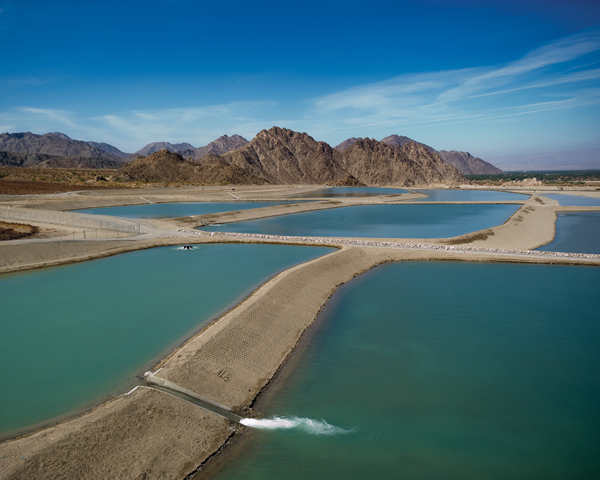
The Thomas E. Levy Groundwater Replenishment Facility operated by CVWD. It’s a key asset in the district’s ongoing effort to provide a reliable supply of groundwater across the entire valley.
Nothing in the Final EIS means CVWD suddenly loses a specified amount of Colorado River water.
The proposed 440,000 acre-foot California reduction for 2027 and 2028 is a statewide Lower Basin figure, not a cut assigned to the Coachella Valley.
But legal priority does not make the region immune from the river’s long-term decline.
That is why IID leaders have taken an increasingly forceful position that senior rights must be protected while conservation remains voluntary, compensated and shared across the basin.
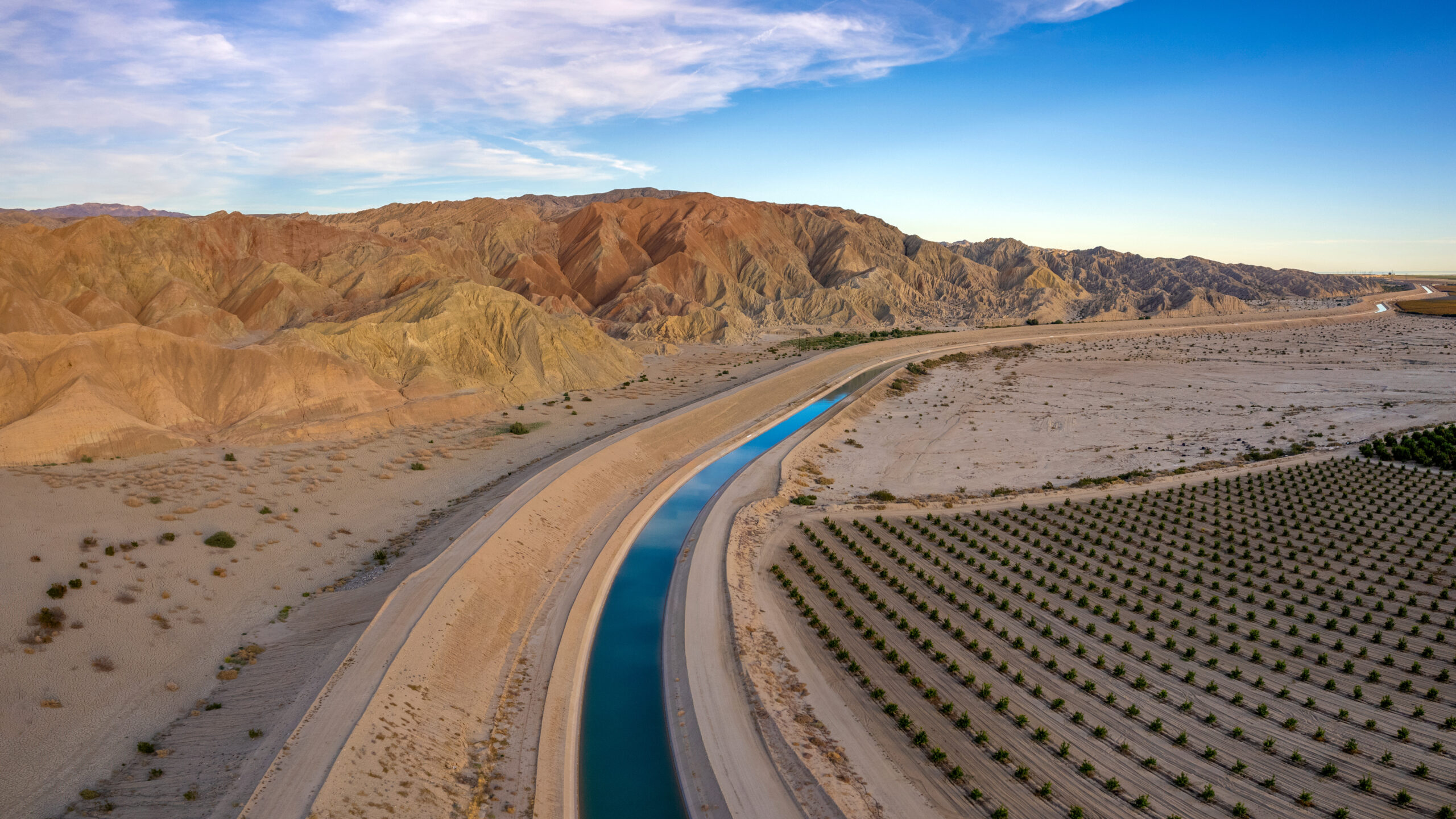
A water canal in Mecca Hills is a key part of the regional infrastructure serving Imperial County and the eastern Coachella Valley.
“Protecting the Imperial Valley and the Colorado River, our only water supply, is IID’s top priority during this process,” IID Board Chairwoman Karin Eugenio said.
She said the Final EIS recognizes that changes in how shortages are distributed must come through voluntary agreements.

IID Board Chair, Karin Eugenio.
“That respects senior water rights while allowing the states to work together voluntarily when the system needs help,” Eugenio said.
The issue could become even more consequential after 2028. Federal modeling of the preferred framework assumes that shortages would generally be distributed according to water-right priority after that point unless the states reach new agreements.
For California and local senior-rights holders, that could be highly significant.
But water rights determine who is legally entitled to use water. They cannot manufacture water that does not exist.
The fight over Lake Powell and Lake Mead
One of the most consequential disputes now involves the relationship between Lake Powell and Lake Mead.
IID argues that federal operations should not protect Lake Powell by allowing too much of the burden to fall on Lake Mead, the reservoir from which Lower Basin users depend.
“A reasonable release from Lake Powell is essential to preventing Lake Mead from bearing a disproportionate share of the system’s decline,” IID General Manager Jamie Asbury said.
“Protecting one reservoir by placing unacceptable risk on the other is not a sustainable operating strategy, particularly given the 1.25 million acre-feet of reductions being proposed by the Lower Basin.”
IID’s position also goes directly to the longstanding disagreement between the Upper Basin states of Colorado, Wyoming, Utah and New Mexico and the Lower Basin states of California, Arizona and Nevada.
IID contends that water stored upstream of Lake Powell, and conservation in the Upper Basin itself, must be part of any durable solution.
“The entire basin has to contribute to the Colorado River’s stability,” Asbury said. “Upper reservoirs, some constructed specifically by Reclamation to help meet Compact release obligations, cannot be prioritized or separated from the challenges facing Lake Mead.”

Lake Mead and Lake Powell water levels are alarming for all involved.
“A durable plan must protect the system as a whole and preserve accountability across both basins.”
Eugenio was equally direct.
“The Lower Basin cannot stabilize the river alone,” she said. “A shared river requires a shared commitment, and every part of the basin must be actively involved.”
Why a groundwater valley still depends on the Colorado
For residents of Greater Palm Springs, the most important local question may be the least obvious: If the Coachella Valley gets almost all of its drinking water from groundwater, why does the Colorado River matter so much?
Because groundwater is only one part of the system.
The Coachella Valley receives only a few inches of rain in a typical year. Without imported water, withdrawals from the aquifer can exceed natural replenishment.
For decades, water agencies have therefore used imported supplies to recharge groundwater and offset pumping.
CVWD says more than 5.1 million acre-feet of imported water has been placed into the aquifer at its recharge facilities since 1973.
Colorado River water also moves through the Coachella Canal to more than 1,200 farms and 36 golf courses in CVWD’s service area.
Those deliveries provide an additional groundwater benefit because every acre-foot supplied directly to a farm or golf course is an acre-foot that does not have to be pumped from beneath the valley.
The western Coachella Valley is connected differently but no less significantly. CVWD and Desert Water Agency have State Water Project entitlements, but there is no State Water Project aqueduct running into Palm Springs.
Instead, the agencies exchange those supplies with Metropolitan Water District and receive Colorado River water through the Colorado River Aqueduct for groundwater replenishment.
The practical result is a deeply interconnected regional water portfolio.
A Colorado River shortage therefore does not necessarily mean residential taps begin running dry.
The effect could appear first as less groundwater recharge, increased reliance on stored groundwater, reductions in nonpotable deliveries, additional conservation programs, more recycled-water investment or higher costs.
The danger is less about a single dramatic event than about accumulated pressure over many years.
IID says it has already contributed heavily
IID’s position carries particular weight because the Imperial Valley holds enormous senior Colorado River entitlements and because conservation there can directly affect both Lake Mead and the Salton Sea.
The district says its conservation programs have generated more than 9.2 million acre-feet of conserved Colorado River water since 2003 through agricultural efficiency, system improvements and voluntary agreements.
Its recent system conservation contributions are expected to total roughly 900,000 acre-feet over four years, according to IID, enough to add more than 13 feet of elevation to Lake Mead.
“Imperial Valley has stepped up again and again,” Eugenio said.
“For decades our farmers have helped protect the system and other Colorado River water users while continuing to grow food to feed the nation and sustain our rural communities.”
She said IID remains willing to participate, but only if its water rights are protected, terms are fair and participation remains voluntary.
That position is particularly important for the Coachella Valley because what happens in Imperial County rarely stays there.
Agricultural conservation can reduce runoff flowing toward the Salton Sea. A shrinking Salton Sea can expose additional playa. Airborne dust and environmental impacts can affect communities throughout the eastern Coachella Valley and beyond.
IID therefore continues to advocate voluntary, compensated conservation that also protects agricultural productivity, local economies and the Salton Sea.
The regional business issue is reliability, not panic
For Greater Palm Springs, the appropriate conclusion is neither that a water crisis is imminent nor that senior rights make the issue irrelevant.
The region has substantial strengths.
It sits above one of Southern California’s major groundwater basins. It has decades of experience replenishing that basin. Its agencies have significant Colorado River rights and State Water Project entitlements. It has built recycled-water infrastructure, conservation programs and groundwater-management systems over many years.
A recently adopted regional urban water plan by six Coachella Valley water suppliers concludes that projected urban demand can be met through 2050, including through a modeled five-year dry period.
That is significant evidence of resilience.
But the same planning framework makes clear that future reliability depends on continued replenishment, conservation and diversification.
That is where the new federal framework matters.
Two-year Colorado River operating cycles can put major water decisions on nearly the same timetable as city budgets, development projects, agricultural planting decisions, golf-course investments and public infrastructure planning.
A developer financing a project over decades may now operate in a water-management system capable of materially changing every two years.
Cities seeking housing and economic development will increasingly need confidence not simply that water exists today, but that agencies have the portfolios, storage, infrastructure and financial resources to keep supplies reliable under multiple future scenarios.
Water security will increasingly be something the region manages, rather than something it assumes.
The Salton Sea is part of the same equation
The Colorado River negotiations also cannot be separated from the Salton Sea.

Agricultural runoff has sustained the sea for decades, particularly drainage from Imperial Valley farming.
When agricultural water use falls, inflows to the Salton Sea can fall as well.
That means conservation that benefits Lake Mead can carry consequences hundreds of miles downstream, including additional exposed lakebed, air-quality concerns and economic impacts affecting communities in both Imperial and Riverside counties.
IID has repeatedly said future conservation agreements must account for the Salton Sea and local communities.
The federal framework does not solve that issue.
Nor does it settle the larger dispute between the Upper and Lower basins. It does not guarantee that the states will agree. It does not eliminate litigation risk. And it does not answer what happens if the river becomes even drier than today’s difficult assumptions.
What it does is establish the arena in which those questions will be answered, repeatedly, through 2036.
A decade that will test the desert’s advantages
Greater Palm Springs enters that period from a stronger position than many communities in the Southwest.
Its senior water rights matter. Its groundwater basin matters. Decades of imported-water recharge matter. Recycled water, conservation and the ability to shift among different parts of the regional portfolio all matter.
But none of those advantages make the Coachella Valley independent of the Colorado River.
The river remains woven through agriculture, groundwater management, golf, development, environmental policy and ultimately the economic capacity of Greater Palm Springs to continue growing.
Hamby’s description of what California has already accomplished may ultimately capture the challenge ahead for the region as well.
Growth and declining Colorado River use, he said, have existed simultaneously because of “investment, conservation, and hard decisions.”
More of each may be required.
The new federal framework does not tell Greater Palm Springs that it is running out of water.
It says something more consequential for the long term: The Colorado River can no longer be treated as a fixed resource governed by predictable rules. Managing scarcity is becoming a permanent part of doing business in the Southwest.
For the Coachella Valley, the question through 2036 will be whether its legal advantages, groundwater reserves, infrastructure and capacity to adapt can stay ahead of a river system that is becoming increasingly difficult to divide.

Bob Marra is the CEO/Publisher of GPS Business Insider. He has been studying, writing and giving presentations about business, economic and public affairs news and issues and the local economy in the Greater Palm Springs/Coachella Valley region for more than 20 years.