An elderly man recently contacted my law firm because he believed I was helping someone he had met online obtain an inheritance.
The person communicating with him through WhatsApp used my name, professional credentials and publicly available information about my legal practice. The supposed attorney told him that money had to be paid before the inheritance could be released.
There was one critical problem. I had never communicated with this man. I did not represent the person seeking money, and I knew nothing about the inheritance.
Then, my own client, also elderly, contacted me to report that someone impersonating me was trying to get her to pay her bill with the firm.
In both cases, the scammers had stolen my identity and professional reputation to make a fraudulent demand appear legitimate.
Fortunately, both victims did exactly what everyone should do when someone requests money while claiming to represent a professional or an institution. Both victims independently called me to verify the messages.
Neither sent the money.
That decision may have saved everything he had worked a lifetime to build.
For me, the incident transformed an alarming professional concern into something personal. I represent people who have suffered financial elder abuse and exploitation. I also represent families seeking conservatorships when a vulnerable person genuinely requires court-supervised protection.
I have seen what happens after the money is gone. Retirement savings disappear, families become adversaries, and a previously independent older adult may become dependent on relatives.
The latest FBI data shows that these cases are part of a rapidly expanding national crisis.
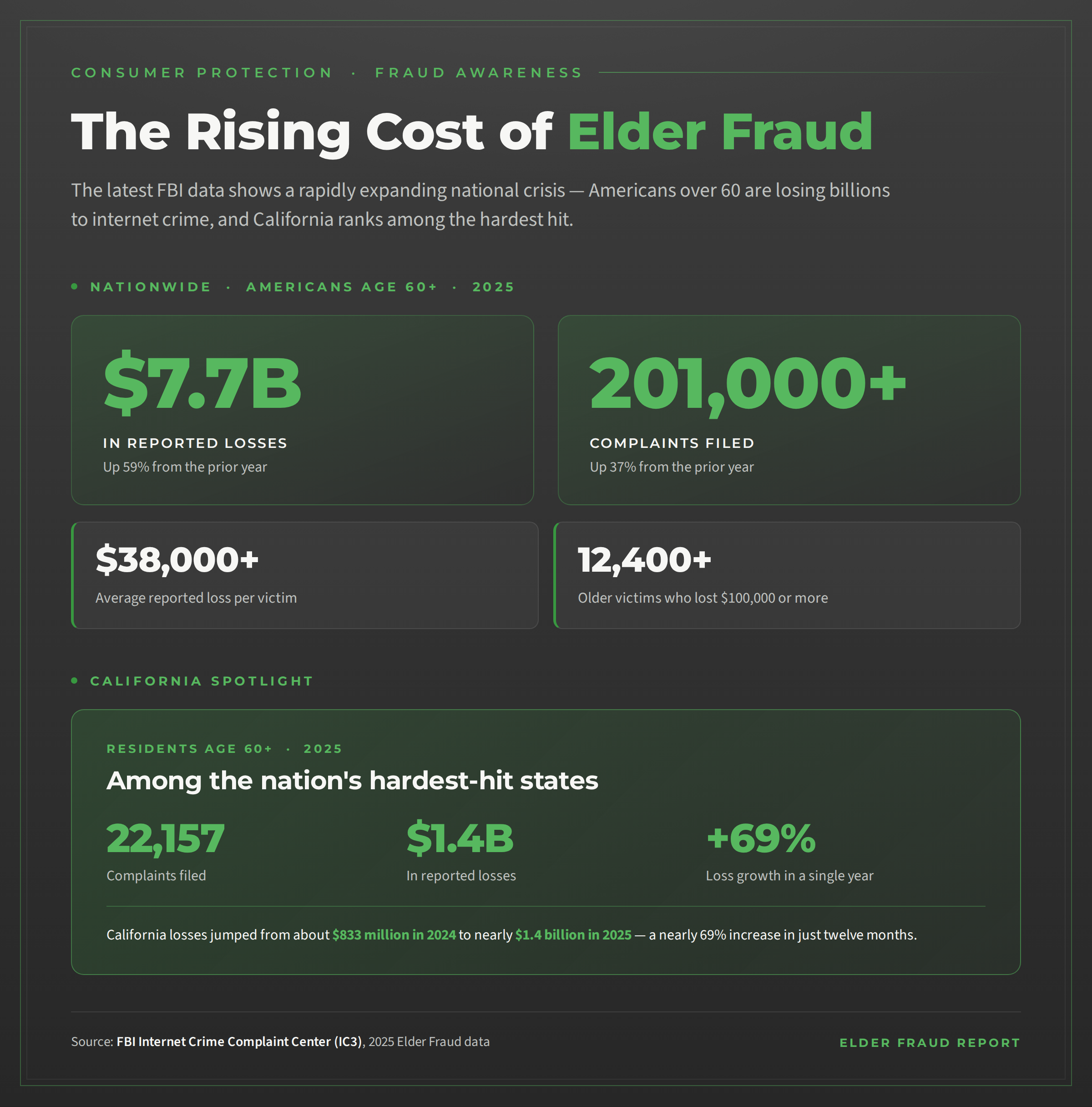
In 2025, Americans over 60 filed more than 201,000 internet-crime complaints and reported losses exceeding $7.7 billion. Complaints increased 37 percent, and losses increased 59 percent in one year. The average reported loss exceeded $38,000, and at least 12,400 older victims reported losing $100,000 or more.
California’s numbers are especially sobering. Residents over age 60 filed 22,157 complaints and reported nearly $1.4 billion in internet-crime losses in 2025. That was nearly 69 percent more than the approximately $833 million reported in 2024.
These figures cover reported internet crimes, not every form of elder financial abuse. Many victims remain silent because of embarrassment or fear of losing their independence.
Scammers Build Trust Before They Ask for Money
Modern scams are not always crude or easy to recognize. Criminals may spend weeks or months building a relationship. They study a victim’s interests, loneliness, fears and desire to help. They pose as romantic partners, attorneys, doctors, investment advisers, government officials or people facing a medical or humanitarian emergency. They search public records to gain credibility.
The first request may be modest. Once the victim pays, the demands escalate, and their schemes become more elaborate. A fee is followed by a tax. A tax is followed by a legal expense. Then comes an emergency that supposedly must be resolved immediately.
Victims are not necessarily unintelligent or legally incapacitated. Many are educated, accomplished and able to discuss most subjects clearly. Yet they may be extraordinarily susceptible to one relationship, an emotional appeal or a fabricated emergency when perpetrated against them across various social media and messaging platforms.
That creates a difficult legal problem. Adults have the right to make their own decisions, including unwise ones. Autonomy should not be taken away merely because relatives disapprove of how money is being spent.
But scammers exploit the space between independence and obvious incapacity. A person may appear lucid during a brief evaluation yet remain unable to resist a particular campaign of undue influence. Powers of attorney and other planning documents can help, but they may be revoked or challenged. A conservatorship may become necessary, but it is a serious restriction of rights and should not be the first response.
The better outcome is to prevent the exploitation before a court must intervene.
Isolation and Technology Increase the Risk
Isolation is one of the scammer’s most effective tools. The victim may be told that family members are jealous or controlling. Advisers who raise concerns are portrayed as obstacles. Secrecy becomes proof of loyalty.
By the time relatives intervene, the scammer may have prepared the victim to distrust them.
COVID-19 isolation increased these risks. Many seniors became less connected to friends, activities and trusted professionals as they moved more of their social lives onto unfamiliar platforms.
Artificial intelligence is making deception more convincing. The FBI received 22,364 AI-related complaints in 2025, involving nearly $893 million in reported losses across all age groups. Scammers use fake profiles, voice clones, fraudulent identification documents and believable fabricated videos.
The warning signs we once relied upon are no longer sufficient. A message may be polished. A photograph may show a real person. A voice may sound familiar. A supposed professional may have a legitimate website and credentials because the scammer has stolen that identity.
That is precisely what happened to me.
Greater Palm Springs Must Treat This as a Public-Safety Priority
Our region has a substantial older population and many retirement communities. Fraud prevention should be treated as an ongoing regional public-safety priority, not an occasional seminar.
Senior communities, banks, financial advisers, attorneys, health care providers and civic organizations should offer recurring education about emerging scams. Families should discuss unusual financial requests before a crisis develops. Older adults should identify trusted people they can call before transferring large sums or sharing confidential information.
Financial institutions also play a critical role. Employees should be trained to recognize abrupt changes in account activity, repeated international transfers, cryptocurrency purchases and customers who appear to be acting under pressure. Once money is wired overseas or moved through certain digital channels, recovery may be extremely difficult.
Law enforcement needs the staffing, technology and coordination to investigate networks involving stolen identities, encrypted communications and perpetrators operating outside the United States. Complexity cannot become a reason to accept the loss as inevitable.
Most importantly, victims must be treated with dignity.
Shame helps scammers. A senior who expects ridicule may conceal the relationship and continue sending money. Families should not begin with, “How could you fall for this?” They should begin with, “You did the right thing by telling us. We will work through this together.”
Stop, Disconnect and Verify
Everyone should remember one rule: stop, disconnect and verify.
If someone claims to represent a bank, law firm, government agency or other institution, end the communication. Find the official telephone number independently and call directly. Do not use a number, link or email address supplied by the person asking for money.
Never provide a Social Security number, account number, password or verification code in response to an unsolicited message. Be especially suspicious when someone demands urgency, secrecy or payment by wire transfer, cryptocurrency, gift card or unfamiliar service.
The man who contacted my office protected himself because he paused and checked. So, too, did my client.
Their experience should become our model.
The scammers are organized, patient and increasingly sophisticated. Protecting older adults will require families, professionals, financial institutions, community organizations and law enforcement to become equally vigilant.
We must act before another senior loses a lifetime of savings and another family is left trying to repair damage that awareness and early intervention might have prevented.

Valerie Powers Smith is a Partner at SBEMP Attorneys and Chair of the firm’s Trust, Estate, and Probate Litigation and Special Needs & Elder Law Departments. For over 28 years, Valerie has focused her practice in the areas of estate planning, trust administration, trust and estate litigation, special needs law, and elder law.