The Greater Palm Springs commercial real estate – in the industrial and office sectors – is telling a two-track story this summer: industrial buildings are trading briskly at steady valuations, while office assets are fetching much higher prices per square foot, yet taking far longer to close.
That’s the snapshot of local sales over the last three months, according to data compiled by CoStar Market Analytics. An analysis shows that industrial property continues to show strong demand while office sales are primarily relegated to the very best-located, high-quality properties.
Local commercial real estate: the industrial and office scoreboard
The numbers suggest two takeaways for investors and owners. First, industrial deals are moving fast at mainstream Inland-Southern California pricing. Second, office deals are occurring, but buyers are selective, underwriting for yield (hence the higher cap rates) and taking their time to validate tenancy, location, and building quality.

Source: CoStar
Interpreting the numbers
Industrial: priced to move, positioned for use
At $125/SF and a 5.1% cap rate, the Valley’s recent industrial trades look in line with a normalized, late-cycle market, especially for functional shallow-bay buildings and service-oriented industrial. The 3.5-month sale cycle speaks to liquidity: when sellers price to the market and buildings are turn-key, local users and 1031 buyers step up.
What to watch:
- Spec vs. user demand. User-buyers (contractors, distributors, building trades) often transact fastest; speculative investors may underwrite more cautiously until interest rates settle.
- Vintage and clear heights. Newer product can siphon demand from older buildings; a trend national researchers expect to continue in 2025 as occupiers emphasize efficiency.
Office: fewer trades, higher scrutiny, and premiums for winners
The $523/SF average and 8.4% average cap rate are two sides of the same coin. Per-square-foot pricing is elevated because the properties that do trade tend to be best-in-class: medical-office, walkable professional space, or uniquely positioned buildings with durable tenancy. The cap rates, meanwhile, price the risk and the timeline: due diligence runs long, debt is choosy, and buyers demand yield for uncertainty.
What to watch:
- Return-To-Office trajectory. Office visits nationally are rising (with the best post-2020 utilization to date), but still ~20% below 2019 on average; momentum is uneven by city and sector.
- Medical demand. An aging and growing population, coupled with specialty care migration from hospitals to outpatient settings, continues to support the medical office sector across suburban markets.
- Tenant improvement (TI) math. Higher TI allowances and longer free-rent periods can affect buyer underwriting and, ultimately, sale timing.
Financing and deal structure: how transactions are getting done
- Debt costs: With cap rates largely stable and the 10-year Treasury still volatile, debt sizing and rate-locks remain the key swing factors. Many buyers are using lower leverage, shorter rate locks, or bridge-to-perm strategies while waiting for a clearer rate direction.
- 1031 exchanges: The Valley continues to attract exchange buyers seeking lifestyle adjacency and simple, durable income streams in single-tenant retail, small industrial, and medical-office.
- SBA/owner-user loans: For local businesses, SBA financing (with lower down payments and fixed rates) remains a path to ownership, particularly in industrial and small professional office.
- Seller creativity: Where debt is stubborn, seller carrybacks, price-to-close concessions, and timed rent bumps show up more frequently to bridge bid-ask gaps.
Submarket notes (what’s moving where)
- I-10 corridor (Thousand Palms to North Palm Springs/Desert Hot Springs): The mix of industrial service yards, flex, and newer shallow-bay buildings benefits from freeway visibility and access. Expect ongoing user demand and infill competition as IE tenants look east for options.
- Downtown Palm Springs & Uptown: Street retail and boutique office piggyback on tourism and event calendars. Buildings with character, parking, and signage command premiums; older inventory competes via rent or creative reuse.
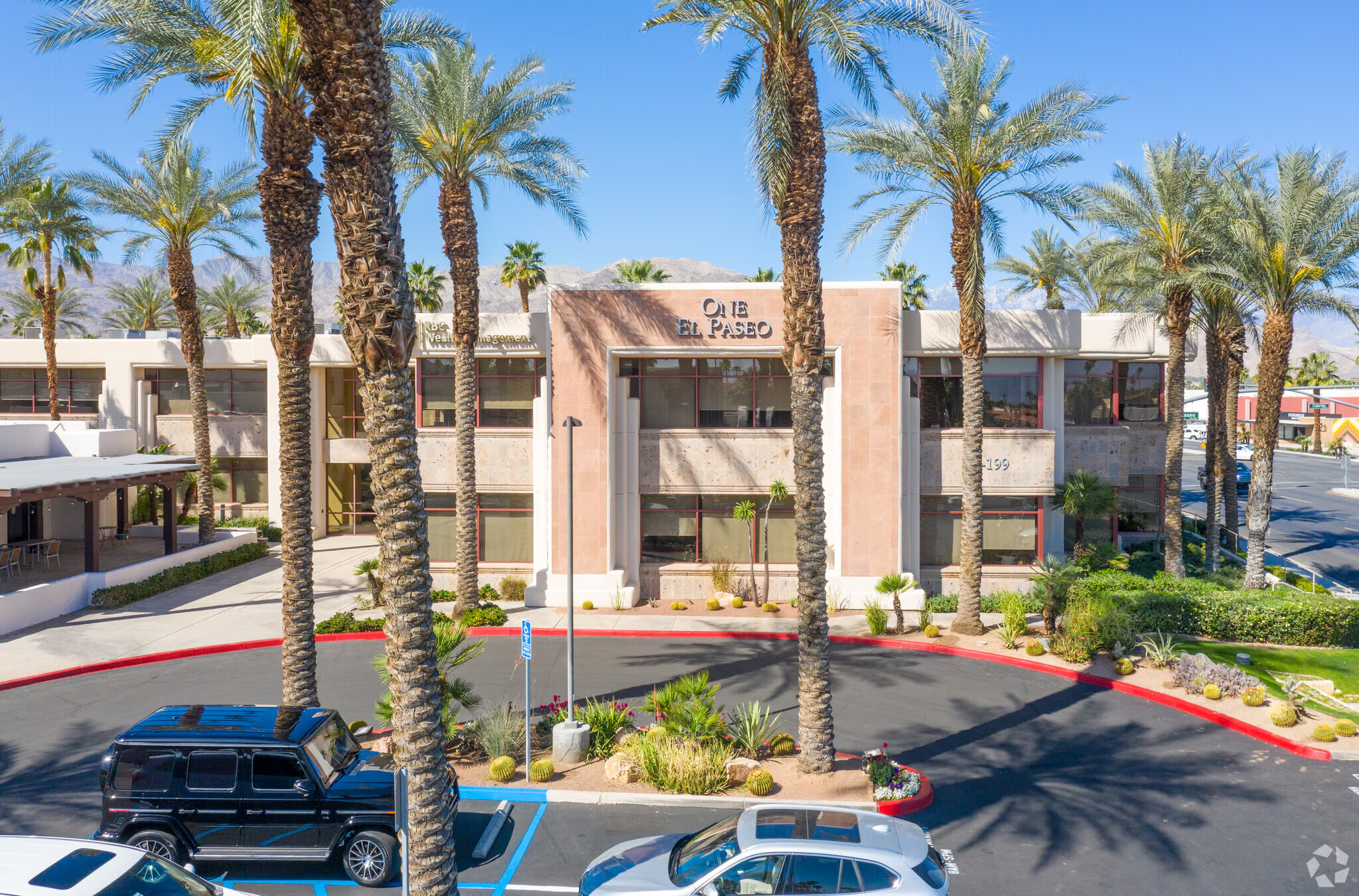
- El Paseo and Palm Desert: High-street retail dynamics, luxury positioning, and medical/professional adjacencies underpin stable fundamentals; back-office space competes on efficiency and TI.
- La Quinta / Indio: Neighborhood centers and service retail tied to housing growth continue to draw tenants; newer construction and pad sites benefit from population shifts and school district expansions.
Practical takeaways for buyers and sellers
If you’re buying
- Industrial: Move quickly on functional, well-located product; expect competition on clean buildings priced near $125/SF with straightforward specs. Underwrite modest rent growth and realistic downtime between tenants; national reports suggest a more balanced supply-demand picture, not the frenzy of 2021–22.
- Office: Focus on tenant durability, TI exposure, and exit liquidity. If the building’s story is compelling, including its walkability, medical adjacency, and strong sponsor history, then a higher per-square-foot price can still pencil given the 8%-plus going-in yields Rawlings’ snapshot implies.
- All asset classes: Build rate flexibility into your models and assume elongated closings where third-party approvals, TI work, or debt covenants are involved.
If you’re selling
- Industrial: Properly priced deals can still close in ~90–120 days. Package clean environmental, roof/HVAC reports, and recent capital improvements to widen the buyer pool and keep the clock moving.
- Office: Expect longer marketing windows and intensive buyer diligence, but don’t undersell a good story. Location, tenancy quality, and parking are commanding real premiums in the Valley even as the broader office market remains selective.
- All asset classes: Offer flexible terms (credits in lieu of repairs, partial carry, or lease-up guarantees) to expand the pool of financeable buyers.
Outlook: what the next 6–12 months could bring for local commercial real estate
- Rates and cap rates: Most national houses see cap rates holding roughly flat near-term, with only gradual compression if Treasury volatility calms. In the Valley, that likely means industrial pricing remains near current prints and office pricing stays lumpy—strong for top-tier assets, opportunistic for everything else.
- Industrial fundamentals: Expect continued absorption at a moderated pace as occupiers refocus on efficiency and resiliency, a pattern national researchers expect to define 2025’s next leg.
- Retail and service space: With retail vacancy the lowest among major sectors nationally, the Valley’s service-oriented, experience-driven centers should remain resilient – particularly those tied to tourism and affluent second-home neighborhoods.
- Office utilization: The return-to-office trend is slowly rising but remains hybrid; local office leasing should reflect that pragmatism, tight for prime suites, value-seeking elsewhere, with sales timelines continuing to run long.
Bottom line
The summer data captures a market that’s healthy but discerning. Industrial remains the workhorse – quick sales, mainstream pricing, reliable users. Office is back in the game – but only for the right buildings, with buyers demanding both yield and conviction and taking the time to get there.
For owners and investors, that means the Valley is offering two distinct playbooks right now. If you can tell a clear operational story – about location, tenants, and how a property fits the Valley’s durable demand engines of tourism, logistics adjacency, and household growth – there’s liquidity on the other side of the diligence. If not, plan for time, flexibility, and creativity to bridge today’s capital and underwriting reality.
Source note: Local figures are from CoStar. The broader state and national context draws on current publications and outlooks from CBRE, NAIOP, MSCI/Real Capital Analytics, and recent office-utilization data from Kastle Systems and other coverage.