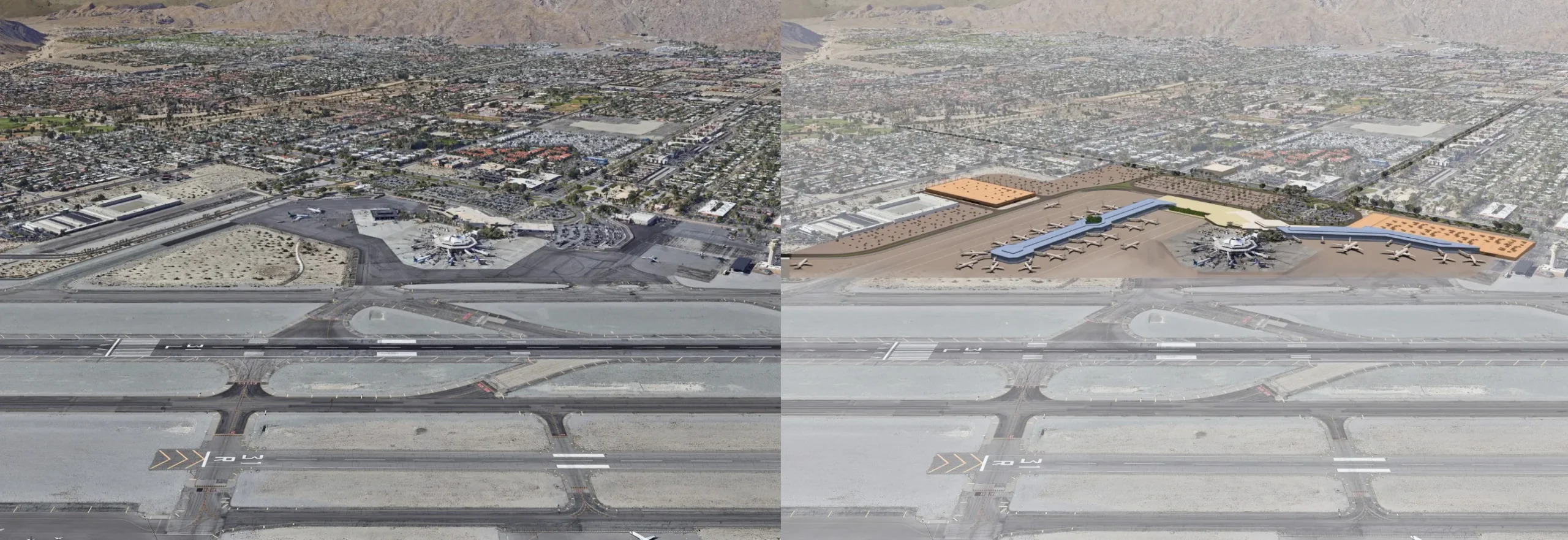
Just a little more than a year ago, Palm Springs International Airport’s Master Plan was described as a sweeping, long-range expansion that would add many gates, expand terminal capacity, reshape and greatly increase the scale of rental car operations, and position the airport for a much larger future.
Airport officials have described the Master Plan as a federally required document that helps the airport plan strategically for future demand, preserve flexibility, identify projects needed for long-term growth and safety, and support future funding requests to the FAA. The airport also said the plan was needed because PSP had to prepare for continued growth while preserving key historic elements, improving the passenger experience, meeting updated safety requirements and beginning new sustainability initiatives.
Today, the picture is far less clear and far more revealing.
What has emerged over the past couple of months from Airport Commission meetings, media reports, and discussions and other public comments is not a neatly defined new Master Plan, but something much more uncertain and potentially more consequential: a growing public reexamination of the passenger growth forecast that helped justify the plan approved by the Palm Springs City Council in January 2025. And, of course, a sober consideration of the realities of financing even the early phases of the plan is emerging as a major challenge.
Both of these core points raise the common-sense question of how the massive $2.2 billion plan was approved roughly 15 months ago, when the information available then was essentially the same as it is now.
A Forecast That Now Looks Increasingly Vulnerable
The passenger traffic forecast within the Master Plan covered a 20-year period from 2023 through 2042 and relied on historical airport records, federal data and multiple forecasting methods according to the documents and presentations. The total passenger count (enplanements and deplanements combined) for the full year 2025 was 3.3 million. The Master Plan projects four million passengers in 2027, 4.71 million in 2032, 5.57 million in 2037 and 6.43 million in 2042, up from about 3.00 million in 2022.
These are assumptions for unprecedented increases, simply unmoored from reality. It’s not a close call, either. For the consultants, applying a 3% linear growth assumption is not acceptable. For example, placing a 3% linear growth assumption on the population of the Greater Palm Springs/Coachella Valley region in 2010, when there were 372,000 permanent residents, yields a 2026 population of 579,000. The population at the beginning of 2026 was roughly 419,000, which includes a net loss of residents last year.
Think of it in the following terms as well. If Palm Springs International Airport were truly to more than double its annual passenger traffic over the next two decades, what would that mean for the region’s broader physical capacity to absorb it?
The airport forecast has largely been discussed in terms of aviation and tourism issues. But the implications stretch beyond the airport fence line. A region handling that level of increased passenger throughput would need corresponding growth in hospitality capacity, workforce housing, road capacity, ground transportation, visitor-serving infrastructure and other support systems. Yet one of the obvious elephants in the room is whether the Coachella Valley is on track to add anything close to the lodging capacity and housing stock necessary to support such a dramatic escalation in airport activity.
That does not precisely prove the airport forecast is wrong. But it does highlight why GPS Business Insider and some commissioners are now questioning whether the projection may have been more optimistic than common regional conditions would suggest.
How the Master Plan Took Shape
For much of the Master Plan process, the growth forecast served as the central rationale for a large-scale expansion that contemplated increasing the airport’s gate count from 18 to 32, expanding terminal and baggage areas, building a major rental car center strategy and remaking key parts of the airport over time.
The original planning process began in conventional fashion. In 2022, the Palm Springs City Council authorized work on a new airport Master Plan, and in early 2023, the city hired Mead & Hunt – a major national architectural, engineering, planning, and construction services firm – to lead it. A broader consultant team was assembled to handle architecture, forecasting, parking, outreach and other specialties. Public presentations in 2023 and 2024 gradually introduced a very large vision for how the airport could grow over the next two decades.
That vision was ambitious from the start. It was also built on the idea that Palm Springs and the broader Coachella Valley would continue to attract enough residents and visitors to justify a dramatic increase in airport traffic.
Even before financing became the dominant concern, the plan had already evolved under public pressure. The most visible debate centered on the proposed rental car structure near the Donald Wexler-designed terminal, where residents and preservation advocates argued that the earlier version was too large and too intrusive for one of the city’s most recognizable civic spaces. That resistance forced the city to broaden outreach, revisit key design assumptions and move toward the hybrid rental car concept that eventually became part of the conceptual development plan approved in January 2025.
But, again, the design debate is now giving way to a larger and more fundamental question: Was the airport planning for a level of growth that may not materialize, at least not on the timetable and scale first implied?
Airport Commissioner Raises the Central Question
The question of population and visitor growth surfaced unusually clearly in recent public remarks by Airport Commissioner Tracy Martin during the March 18 Airport Commission meeting, who said it was his sense that airport passenger traffic has “relatively plateaued over the last few years at about 3.3 million plus or minus 100,000 here or there.” He then posed the key question that now hangs over the airport’s long-range planning: “How does the potential risk factor of a plateau or decline in passenger traffic (like what was experienced during past recessions and the COVID pandemic) affect our strategic plan as well as the airport Master Plan? What is the threshold to say, okay, now we have to reconsider the airport Master Plan?”
He made the point even more bluntly moments later.
“I think we just need to kind of watch the projections, because we’re going to invest a lot of money in that Master Plan, and so far, the last few years, I haven’t seen the growth that we were hoping for in the Master Plan,” Martin said.
That is a striking statement, not least because it comes from within the commission itself. The concern is no longer confined to outside skeptics or residents worried about aesthetics. It now includes commissioners openly asking whether the airport risks overbuilding or overcommitting itself, based on projections that may have overshot reality.
Martin went further still, saying, “The demand signal has always been my concern in terms of the Master Plan. And I just want to make sure that we are not overbuilding or overcommitting the airport to infrastructure if, like many other airports in the country, they’re seeing declining traffic year over year since the pandemic.”
That language matters because it reframes the current issue. The debate is no longer only about what Palm Springs airport should look like and how to finance growth. It is increasingly about whether the airport’s approved Master Plan was built on a growth curve that may have been too aggressive in the first place.
Commission Chairman Corcoran Signals a More Conditional Outlook
Airport Commission Chairman Kevin Corcoran has not gone that far, but his public comments show a more cautious posture than the airport’s earlier expansion outlook suggested. In the commission discussion, Corcoran acknowledged the need to keep tracking the forecast over time even as he argued that the airport remains operationally strained in the short term.
“I traveled this weekend. I was out on the concourse. There were like 12 or 14 jets over there,” he said. “We are busting at the seams.”
Corcoran suggested that short-term capacity pressure still supports parts of the early expansion logic, especially the first phase, but he also agreed that the long-range projections need continued scrutiny. He noted that while he feels “pretty solid about phase one,” the longer-term buildout is a separate question.
He has been even clearer in public comments reported elsewhere. In an April 6 article in The Desert Sun, Corcoran said, “We’re going to grow when the demand proves it’s necessary. Before anybody pulls the trigger on building new gates or building the car rental piece, we will test those forecasts again.”
That is an important statement because it suggests that what was once presented as a broad, long-range roadmap is now being treated more conditionally, with future phases dependent not just on conceptual approval but on a revalidation of the airport’s own demand assumptions.
In the same article, Corcoran also underscored the financial stakes of that reassessment. “What’s changed, at least in my perspective, is we’ve learned a lot in this process,” he said. “You’ve got to be able to finance this stuff, and also you have to keep an eye on, ‘is this forecast correct?’”
He added, “These are big, big, capital projects. And for a city of 49,000, it may be challenging from a funding perspective.”
Those comments reinforce the sense that the airport’s Master Plan is no longer being discussed simply as an infrastructure vision. It is increasingly being discussed as a question of risk: forecast risk, financing risk and sequencing risk.
The Airport’s New Public Posture
That shift is also evident in how the airport and its consultants now talk about the project publicly.
Trevor Daley, president of Daley Strategies, the airport’s public affairs consultant, emphasized at the March 18 Airport Commission meeting during the public comment period, that “everything is linked to money,” tying the airport’s future infrastructure, federal support and international service ambitions directly to the availability of funding. He also signaled a new round of public outreach, saying the airport wants to return to the community after a period in which “it kind of went quiet because of CEQA, and people are wondering what’s going on.”
That comment is revealing in itself. It suggests an airport leadership team aware that public understanding of the project has become clouded and that the airport needs to explain where things stand.
Daley’s remarks also showed how the airport is now framing the story less as a march toward one giant expansion and more as a connected set of funding, infrastructure, air service and community-relations challenges. In that framework, growth is no longer treated as a self-executing trend. It depends on money, timing, airline interest and infrastructure readiness, all coming together.
That is a much more cautious and contingent public posture than the one that dominated the earlier Master Plan rollout and its approval.
A Transitional Moment, Not a Settled One
To be clear, none of this means the airport has abandoned growth planning. Corcoran remains publicly bullish on Palm Springs tourism and business, and he has indicated that the airport still hopes to add a smaller number of gates and a Federal Inspection Station that could support flights to Mexico in the next three to five years. But the public conversation has plainly changed.
The airport has not yet produced a fully articulated replacement vision. It may still move ahead with selected parts of the broader framework. It may continue to phase the program, retest the forecasts and narrow the first wave of improvements. But what has become increasingly visible is that the original premise behind the plan, that traffic would rise from 3 million to more than 6.2 million and justify a far larger airport, is no longer passing through public discussion unchallenged.
PSP is a Success Story of Great Magnitude
With all of the talk of the PSP Master Plan challenges, something that must be noted is that for the Palm Springs International Airport has an extremely successful track record and is one of the bright stars within the most important sector of the Greater Palm Springs economy, which is so driven by tourism and by a growing permanent and seasonal resident base that relies on it.
The long list of performance milestones, seemingly impossible additions of new and expanded flights and new airlines, infrastructure improvements and enhancement of in-airport amenities is absolutely outstanding. We have covered all of them during the past couple of years.
Especially noteworthy is how the airport was effectively managed coming out of the pandemic to handle an incredible surge in traffic, and has accommodated increased passenger traffic ever since, even as many airports throughout the country have dealt with lower demand during 2025 and into this year.

Bob Marra is the CEO/Publisher of GPS Business Insider. He has been studying, writing and giving presentations about business, economic and public affairs news and issues and the local economy in the Greater Palm Springs/Coachella Valley region for more than 20 years.