It’s a political map envisioning new lines in the sand, so to speak, with potential major cash-flow consequences. California’s fast-moving plan to redraw its congressional districts, being pitched by Gov. Gavin Newsom as a direct response to new GOP-friendly congressional maps moving forward in Texas, has cleared an early legal hurdle and is headed toward a statewide vote on November 4, 2025. If voters approve it, the new lines would be “triggered” to take effect if Republican-led states proceed with their own mid-decade redraws.
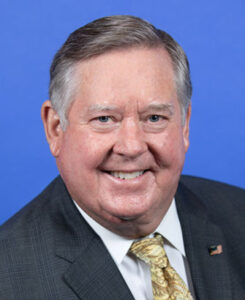
Congressman Ken Calvert (CA-41)
For Greater Palm Springs, this scenario may mean less of a theoretical fight over shapes on paper and more of a practical question: would a new Congressperson, especially someone who is a neophyte when it comes to national politics, have the clout and capability necessary to deliver a stream of major federal funding matching what Representative Ken Calvert (CA-41) has consistently delivered for critical local projects such as airport upgrades, flood-resilience projects, public safety initiatives, healthcare facilities, and transportation improvements that underpin the region’s economy?
Rep. Calvert currently serves on the House Appropriations Committee, where he serves as the Chairman of the Defense Appropriations Subcommittee. He also sits on the Energy and Water Appropriations Subcommittee. These are impactful positions gained over many years that are not easy to replicate, especially in the near term.
Beneath the rhetoric lies some things the growing Greater Palm Springs region dearly needs: money, project momentum, and market confidence. In July, Calvert announced more than $67 million advanced in the FY2026 Transportation-HUD bill for district infrastructure – funding that, notably, would flow to project sponsors regardless of how district lines are later drawn. The bill was approved by the House Appropriations Committee last week and now advances to the House floor for consideration.
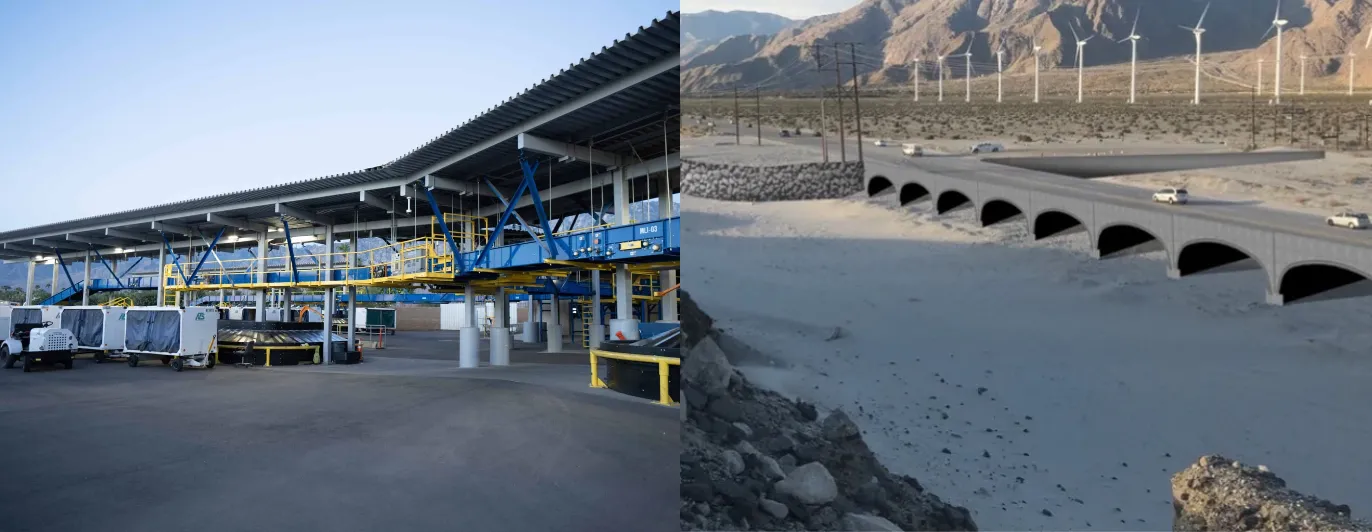
The Valley’s list is unusually tangible: $5.6 million for the Cook Street Bridge in Palm Desert, $5 million for a new bridge at the northern end of Indian Canyon Drive in Palm Springs (a key link too often knocked out by storms and seasonal high winds), $3 million for the Palm Springs airport outbound baggage system, $5 million for Rancho Mirage’s Via Vail improvements to help facilitate much-needed multi-family housing development, $5 million to resurface Washington Street in La Quinta, and $5 million to line the Whitewater Channel in Indian Wells. The package also includes out-of-region improvements – French Valley Airport, I-10 at Singleton, I-15 express lane work, and Lake Elsinore water quality – that nonetheless affect regional logistics, worker commutes, and visitor flows.
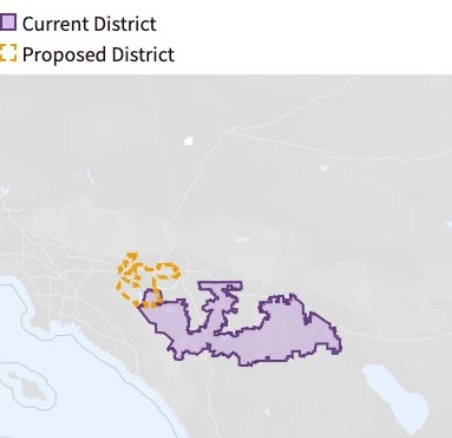
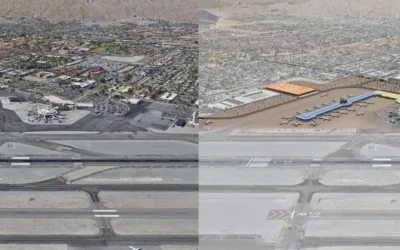
The current CA-41 congressional district and the newly proposed version.
The first draft map, released last week, would upend some familiar labels. California’s 41st District, which is long associated with Rep. Ken Calvert and a swath that stretches from Corona through the Valley, would shift west to a new footprint running from Downey to Brea and into Lakewood. In the desert, Greater Palm Springs would be recast and renumbered as a 48th District that keeps most Valley communities while extending farther west and south. In short, the district anchored in the Valley remains, but its number changes, and the “CA-41” label migrates toward southeast L.A./north Orange County.
For Greater Palm Springs residents, that reads as an imminent change in congressional representation. The political intent is not subtle; the map’s authors openly target five GOP-held seats, including those of Calvert and Darrell Issa, to secure a net Democratic gain.
Sacramento’s argument is simple: match Texas’ mid-cycle redraw with one of California’s own. National outlets have tallied the stakes – Democrats could push their edge from 43 to 48 of California’s 52 House seats, if the map and trigger survive voter scrutiny and legal challenges. The University of Virginia’s Crystal Ball labeled it the “Gavinmander,” a wry nod to the hardball politics at work. Critics, including former Gov. Arnold Schwarzenegger and state Republicans, warn it undermines the voter-approved independent commission and invites endless map wars. Supporters have their surrogates, too – President Barack Obama among them – arguing a defensive redraw is justified if other states press ahead.
Local leaders laud the value of federal appropriations for projects in our district. Statements of support are glowing in Calvert’s press release about the local funding earmarks heading to Congress:
“The City of Palm Desert is deeply grateful to Congressman Calvert for his effort to include $5.67 million for the Cook Street Bridge Project in the federal budget,” said Palm Desert Mayor Jan Harnik. “This funding moves us one step closer to upgrading a stretch of roadway that is flood-prone, with a safer and more dependable connection for everyone. It’s an investment in public safety, economic vitality, and the future of our region.”
“I appreciate Congressman Calvert’s leadership in securing funding for critical infrastructure projects in the Coachella Valley portion of his district,” said CVAG Executive Director Tom Kirk. “The Indian Canyon Drive project is a vital investment that will help address persistent flooding and blow sand-related road closures – issues that have long disrupted access to essential destinations, including the region’s Level I Trauma Center at Desert Regional Medical Center. This project will enhance public safety, improve the movement of people and goods, and strengthen the reliability of our regional transportation network. I’m thrilled to see the Indian Canyon Drive project included in the appropriations bill, and I look forward to continuing to work with Congressman Calvert to secure federal investments that improve transportation safety for the traveling public.”
“We sincerely thank Congressman Calvert for securing this critical funding to upgrade our outbound baggage system,” said Harry Barrett, Jr., Executive Director of Aviation at Palm Springs International Airport. “As PSP continues to experience record growth, this investment will enhance operational efficiency and ensure the smooth, welcoming experience travelers associate with Palm Springs.”
That slate of projects matters because it signals continuity of federal attention that local governments and businesses can bank on. Air service reliability at PSP is a tourism lifeline; the baggage-system investment supports peak-season throughput and reduces the kind of bottlenecks that ripple into hotel check-ins, event schedules, and rental-car turnover. Flood-resilience fixes like Cook Street and Indian Canyon aren’t just about convenience; every closure severs labor mobility and dampens weekend occupancy when the weather turns. The city has six bridge projects in various stages, a $226 million multi-year effort that will need consistent advocacy in Washington as it moves from design to construction. Whether Greater Palm Springs’s House voice is Calvert or a new representative post-map, those projects will demand an office that understands desert hydrology and seasonal demand swings.
Politics, of course, will color how that advocacy is delivered. The draft map is designed to make Calvert’s path harder and reshape the desert’s congressional relationships. He’s said as much himself: “They can’t get me at the election box, so they want to do it through gerrymandering,” he said in an interview broadcast on KESQ TV recently, adding he intends to run on the current number if the initiative fails. If the plan succeeds, local priorities could share a member’s attention with new communities to the west and south; if it fails, the region returns to a status quo ante with a veteran appropriator. In either case, the smart play for city managers, CVAG, and the business community is the same: keep projects “grant-ready,” align asks across jurisdictions, and brief both scenarios so momentum doesn’t depend on the shape of a line.
There’s also a softer, but no less real, economic signal embedded in redistricting: investor psychology. For developers, hoteliers, and major employers weighing capital plans, the presence of a senior member engaged on transportation, water, and airport issues reduces risk. A competitive new district might bring a different style, but more importantly, a wider geographic lens – but it will still respond to well-organized coalitions and shovel-ready applications. The region’s advantage is its clarity: tourism, mobility, flood resilience, and housing-supporting infrastructure sit at the top of a widely shared priority list. Translate that into a one-page brief for each project, add match dollars and permitting status, and you’ve done most of what any congressional staff – old or new – needs to fight for you.
California lawmakers voted mostly along party lines on August 21 to approve the legislation necessary for establishing the special election. Democratic Gov. Gavin Newsom, who has led the campaign in favor of the map, then quickly signed it – the latest step in a tit-for-tat gerrymandering battle. The calendar is tight for California Lawmakers. They have an August deadline to finalize ballot language; the special election is set for November 4; and the trigger mechanism means Californians could vote months before it’s certain which other states beyond Texas will finalize their own new partisan maps.
“This is not something six weeks ago that I ever imagined that I’d be doing,” Newsom said at a press conference, pledging a campaign for the measure that would reach out to Democrats, Republicans and independent voters. “This is a reaction to an assault on our democracy in Texas.”
Meanwhile, the House will keep grinding through appropriations. If the $67 million Greater Palm Springs projects survive the full process to gain House of Representatives approval, the money will land on the merits of those projects, not the numbering of a district.
And suppose the Valley does end up in a renumbered 48th District. In that case, the work on FY2027 earmarks begins almost immediately with a fresh tour of city halls, treatment plants, and airfield projects to name just a few – an invitation for local leaders to make the case, again, that what’s good for the Greater Palm Springs’s infrastructure is good for Southern California’s economy writ large.