The Racquet Club property in Palm Springs – once a glittering playground for Hollywood’s elite – is back on the market.
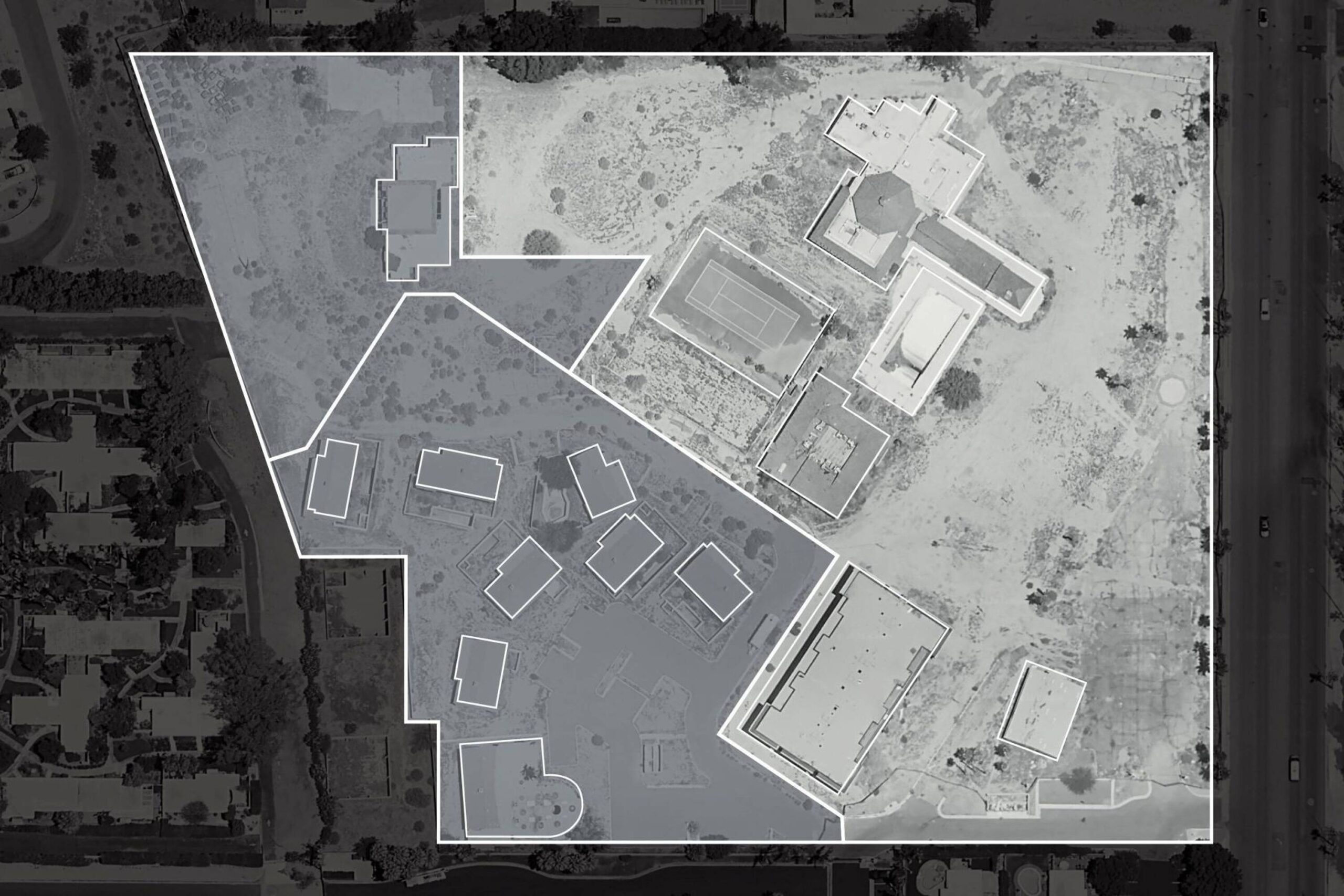
Listed recently for $16 million by David DeSantis of Desert Sotheby’s International Realty – Indian Wells, the 10.08-acre property at 2743 N. Indian Canyon Drive is being marketed not as a revival of its storied past, but as a redevelopment opportunity.
For Palm Springs, the sale represents more than another commercial listing. It reopens long-running questions about preservation, growth, stalled development plans and the fate of a site that helped define the city’s mid-century identity.
DeSantis acknowledges the complexity.
“This would be a much easier prospect if we were talking about a completely vacant piece of land in downtown Palm Springs with no historic restrictions,” he said. “But this is the situation we find ourselves in.”
A Legendary Past
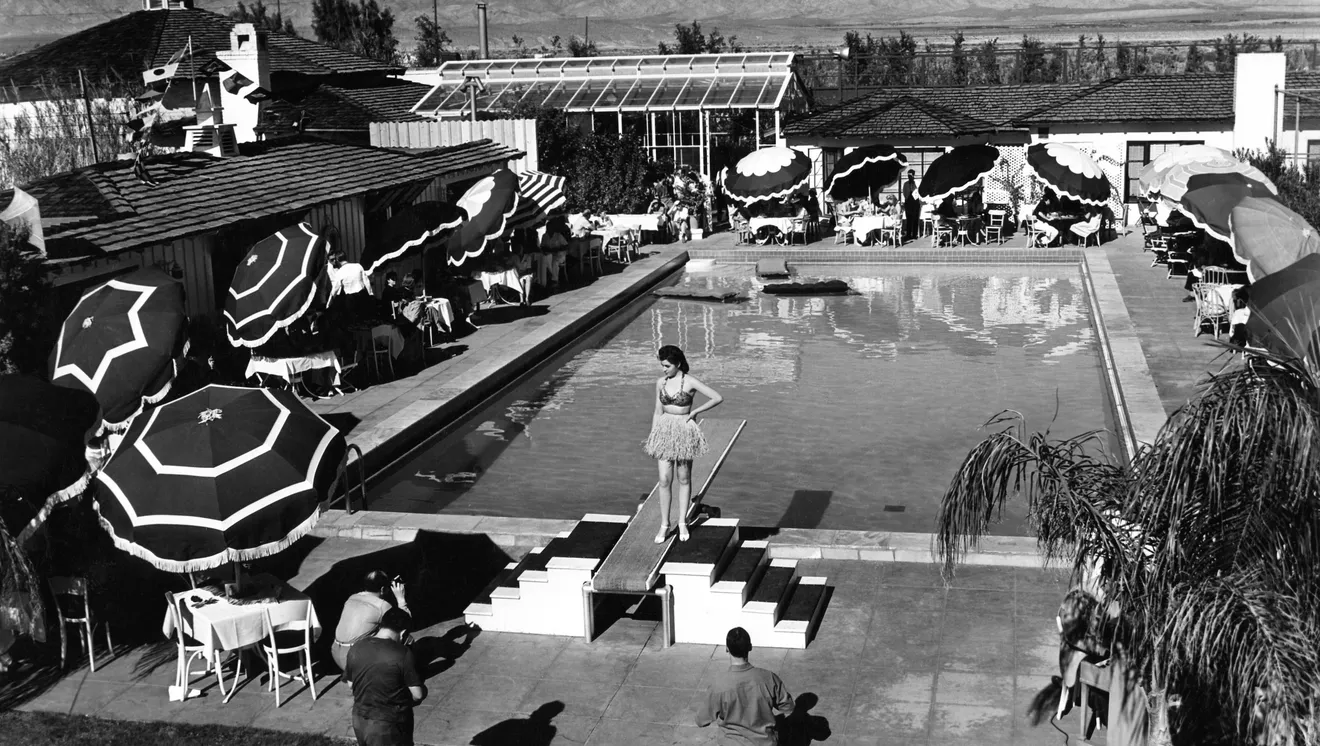
The Racquet Club in its heyday in the 1950s.
Opened in 1934 by actors Charles Farrell and Ralph Bellamy, the Racquet Club of Palm Springs quickly became a magnet for movie stars seeking privacy in the desert. It started modestly, with two tennis courts and a snack bar, and later expanded to include a swimming pool, a clubhouse and bungalows. Over time, it evolved into a social hub synonymous with Old Hollywood.
By the mid-20th century, the club was part of the city’s mythology. Stories of stars slipping away from Los Angeles for weekends of sun and tennis cemented its reputation as a private escape with public allure.
Today, little of that glamour remains intact. Years of vacancy, failed redevelopment attempts and a 2014 fire left much of the property in disrepair.
The Current Offering
The new listing frames the site in strictly forward-looking terms.
The marketing materials describe a “premier Palm Springs parcel” with flat terrain, flexible commercial zoning, and “impressive frontage, dramatic mountain views, and effortless connectivity to downtown.”
The property spans just over 10 acres and is categorized as retail/commercial, though the sales brochure suggests a range of possibilities: a boutique resort enclave, a luxury wellness retreat, a mixed-use development, or a sophisticated residential concept.
DeSantis says the approach is intentional.
“The good thing about this is that it’s not just another 10-acre parcel in the middle of Palm Springs,” he said. “At the end of the day, we live in the desert. There’s plenty of land. What makes this different is the provenance.”
Rather than viewing the site’s history as an obstacle, he sees it as an asset.
“We’re hoping to find somebody who wants to build on the history and the provenance of what was there,” DeSantis said. “That’s one of the great appeals of Palm Springs. People don’t just come here because the weather is great. They love the history and the stories.”
He pointed to the city’s thriving architectural tourism scene as evidence. “I saw people out on one of those open double-decker buses this week during Modernism Week in the pouring rain looking at historic properties,” he said. “You really have to be committed to wander around like that in the rain. But people are. It’s a worldwide audience.”
The message is clear. This is not being sold as a simple teardown. It is being offered as land with both challenges and narrative value.
Historic Protections Complicate the Picture
Yet any developer eyeing the site will inherit more than mountain views.
In 2021, the Palm Springs City Council designated the property as a Class 2 historic site. That designation protects specific contributing features, including the main pool, tennis court, Schiff residence and elements of the clubhouse. While Class 2 protection is less restrictive than the city’s highest historic classification, it still places limits on demolition and alteration.
The Palm Springs Preservation Foundation has repeatedly identified the Racquet Club as one of the city’s most endangered historic resources. Preservationists argue that the site is central to the city’s architectural and cultural heritage.
DeSantis does not take a public stance in that debate.
“I don’t see my job as having a public opinion one way or the other,” he said. “I was hired by the owners to sell what’s there.”
What he does emphasize is a shift in tone.
“I’ve spent a great deal of time talking to people in city government, and I find them to be incredibly helpful and cooperative,” he said. “I really sense a spirit that people want that property to be developed. They do not want to be an impediment.”
He added, “They want it to be protected and respected, but they also want to be helpful. And I think that’s great.”
A Troubled Development History
The Racquet Club’s recent history is marked by financial strain and legal disputes. In the early 2000s, a redevelopment plan envisioned residential units alongside preserved historic elements. The project was financed with a construction loan that ultimately defaulted, triggering foreclosure proceedings. Ownership changed hands more than once over the following decade.
The 2014 fire further complicated matters, damaging structures and deepening concerns about demolition by neglect.
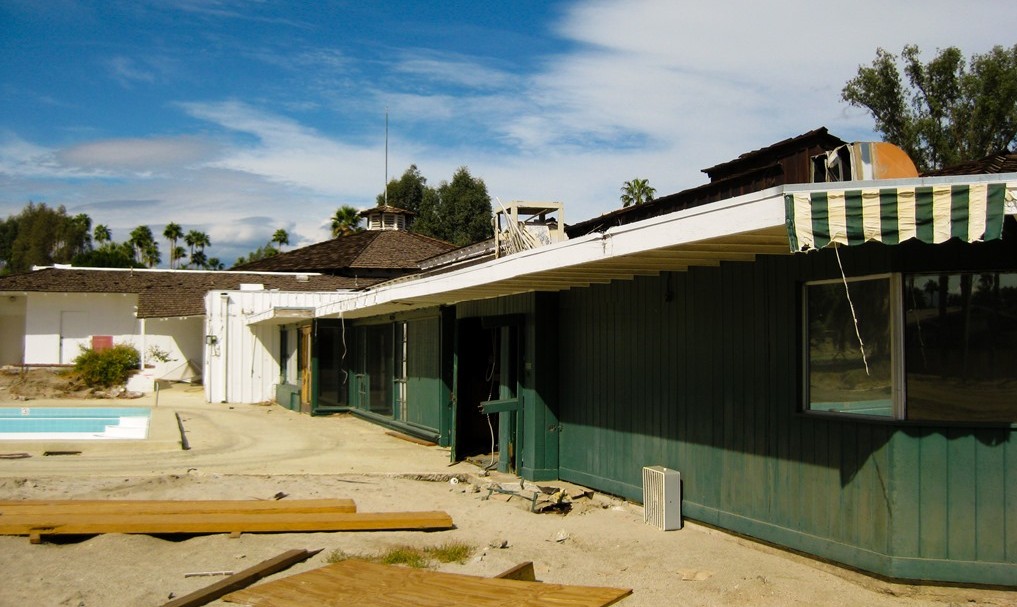
The Racquet Club is a tear down project today.
Despite sporadic proposals and public discussions, no comprehensive redevelopment has moved forward. Now that the property is actively listed again, the site returns to the open market as a clean slate, at least from a marketing standpoint.
“It is a challenging property,” DeSantis said. “It’s going to require somebody who has patience, who has a lot of resources, and who has a vision. It’s hard to find a buyer who has all three in sufficient quantities.”
What $16 Million Buys in Today’s Market
Palm Springs remains one of California’s most resilient luxury second-home markets. Boutique hotels and wellness-focused resorts have flourished in recent years, fueled by steady tourism and renewed interest in mid-century design.
A 10-acre parcel with commercial zoning in North Palm Springs is rare. That scarcity likely underpins the $16 million asking price. DeSantis said the valuation reflects multiple factors.
“One way to do it is to look at the value of vacant, unencumbered land in Palm Springs and multiply by 10 acres,” he said. “But there’s a lot going on here.”
The historic constraints could suppress value, he acknowledged. “On the other hand, the provenance adds value.” He added that the price point is grounded in prior market activity. “There have been offers in this range in the past that didn’t happen, not because people couldn’t afford it, but because factors intervened. Recessions, COVID, you name it.”
Ultimately, he said, “It will sell for what somebody thinks it’s worth. But it’s got a number on it, and it hasn’t stopped people from calling.”
According to DeSantis, inquiries are already coming in from a broad range of potential buyers, including hospitality groups and residential developers. He has even floated more creative concepts. “I’ve pitched it as a pickleball resort,” he said with a laugh. “It was the Racquet Club, right? There are a lot of ways you could maintain the name and enhance the history while making it something really dynamic.”
Community Stakes
For long-time residents, the Racquet Club is more than a development opportunity. It represents a chapter in Palm Springs’ identity, a symbol of its rise as a desert refuge for the entertainment industry and a cornerstone of its mid-century brand.
For others, particularly in the business community, the site represents unrealized economic activity: tax revenue, jobs, housing supply and renewed vitality in the northern portion of Palm Springs.
DeSantis, a part-time Greater Palm Springs resident originally from the East Coast, said he feels that tension personally. “I love Palm Springs. I love the Coachella Valley,” he said. “I would just personally love to see this property brought back to life and re-energize the neighborhood.”
He noted that much recent development has occurred on the south side of town or further down valley. “Less seems to be happening up there,” he said of North Palm Springs. “I think this is a real opportunity.”
The listing could signal a reset, or simply another turn in a long cycle of ownership changes without ground being broken.
What Happens Next
Commercial listings at this scale can sit for months or years, especially when layered with regulatory and preservation constraints.
Several outcomes are possible: a hospitality developer could attempt to resurrect the resort concept in a modern form; a residential developer might pursue luxury townhomes or condominiums, incorporating preserved structures; and/or a mixed-use concept blending retail, dining and boutique lodging could align with the city’s tourism-driven economy. Or the property could trade hands again without immediate construction, continuing a pattern seen over the past 15 years.
What is unlikely is a simple return to its former life as a private racquet club. The economics of land in Palm Springs have changed dramatically. Still, DeSantis says there is renewed energy.
“We’ve only had the listing a relatively short time, and we’re getting a lot of inquiries,” he said. “The owners very much want to see this property given a new life. They care deeply about it. They want to find a good steward.”
A Defining Moment for Palm Springs
At $16 million, the Racquet Club site is both a bargain compared to coastal California land prices and a substantial bet on Palm Springs’ continued ascent as a lifestyle destination.
More than that, it is a test case. Can a city built on mid-century mystique balance preservation with growth? Can a site so closely tied to Hollywood’s golden age find a future that respects its past?
The new listing does not answer those questions. It simply reopens them. For now, the gates to the property on North Indian Canyon Drive remain closed. The desert wind moves through a property that once echoed with tennis serves and poolside fun for Hollywood celebrities.
What comes next will shape not just 10 acres of land, but a piece of Palm Springs’ identity.

Bob Marra is the CEO/Publisher of GPS Business Insider and GPS Market Intel. He has been studying, writing and giving presentations about business, economic and public affairs news and issues and the local economy in the Greater Palm Springs/Coachella Valley region for more than 20 years.