Palm Springs International Airport entered the spring shoulder season with a result softer than last year’s record pace, but far from a collapse.
In March, the airport handled 485,098 total passengers, down 1.7 percent from March 2025, according to the latest airline activity report presented to the Airport Commission at their April 15 meeting. That followed a strong February, when PSP set a new monthly high for that month at 391,601 passengers, up 1.2 percent year over year. Through the first three months of 2026, the airport had processed 1,207,360 passengers, compared with 1,235,233 in the same period last year, a decline of about 2.3 percent.
For an airport that has built its recent identity in part on repeated records, even a modest decline stands out. PSP closed 2025 at more than 3.3 million passengers, its second consecutive annual record, up about 2.4 percent from 2024. That elevated comparison matters. The airport is no longer measuring against a couple of recovery years. It is measuring against its own impressive high-water mark.
That helps explain why the March numbers feel more like a recalibration than a warning sign, especially given the significant drop in Canadian travel here and at every U.S. travel-destination airport since spring 2025.
PSP’s March report shows the change was not broad-based across every airline. The biggest single winner was Alaska, which carried 109,730 total March passengers, up 19.5 percent from a year earlier and good for a market-leading 22.6 percent share. American also gained, up 7.5 percent to 73,977 passengers. United was essentially flat at 72,718. But Southwest fell 15 percent to 70,936 passengers, while WestJet dropped 13.2 percent to 39,388, Delta declined 4.3 percent to 38,778, and Air Canada slipped 11.5 percent to 14,020. Avelo and Frontier, both of which had March traffic last year, did not offer flights in March this year.
The shift is important because it suggests PSP’s 2026 story is less about aggregate demand alone and more about the changing composition of that demand.
Again, one part of that story is Canada. The Airport Commission’s meeting packet shows that passengers arriving on Canadian airlines in March fell 14.3 percent, from 32,392 to 27,747. The forward schedule data in the same presentation points to continued softness.
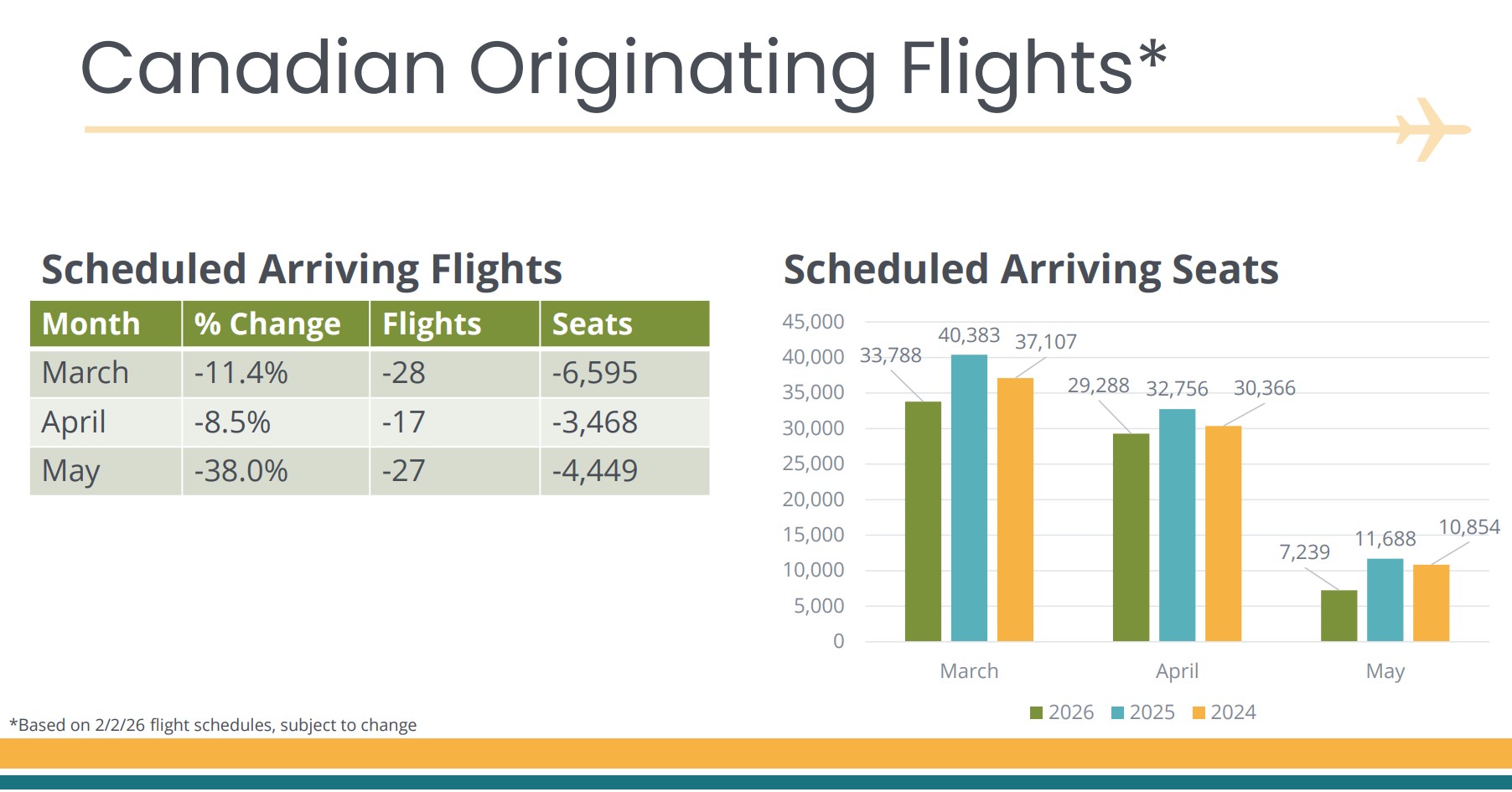
Based on schedules as of April 7, PSP expected Canadian-originating arriving flights to be down 45.8 percent in May and 19.8 percent in June before turning positive in July. Scheduled Canadian arriving seats were shown at 6,339 in May 2026 versus 11,688 in May 2025, a large seasonal drop. The airport’s year-round route map still includes Vancouver and Calgary, but the seasonal calendar shows a series of spring service cessations across Canadian markets.
That decline is not happening in a vacuum. Statistics Canada reported that Canadian resident return trips from the United States by air fell 13.8 percent year over year in March 2026. For Palm Springs, where Canadian travelers have long been a foundational winter and spring customer base, that national shift is showing up here.
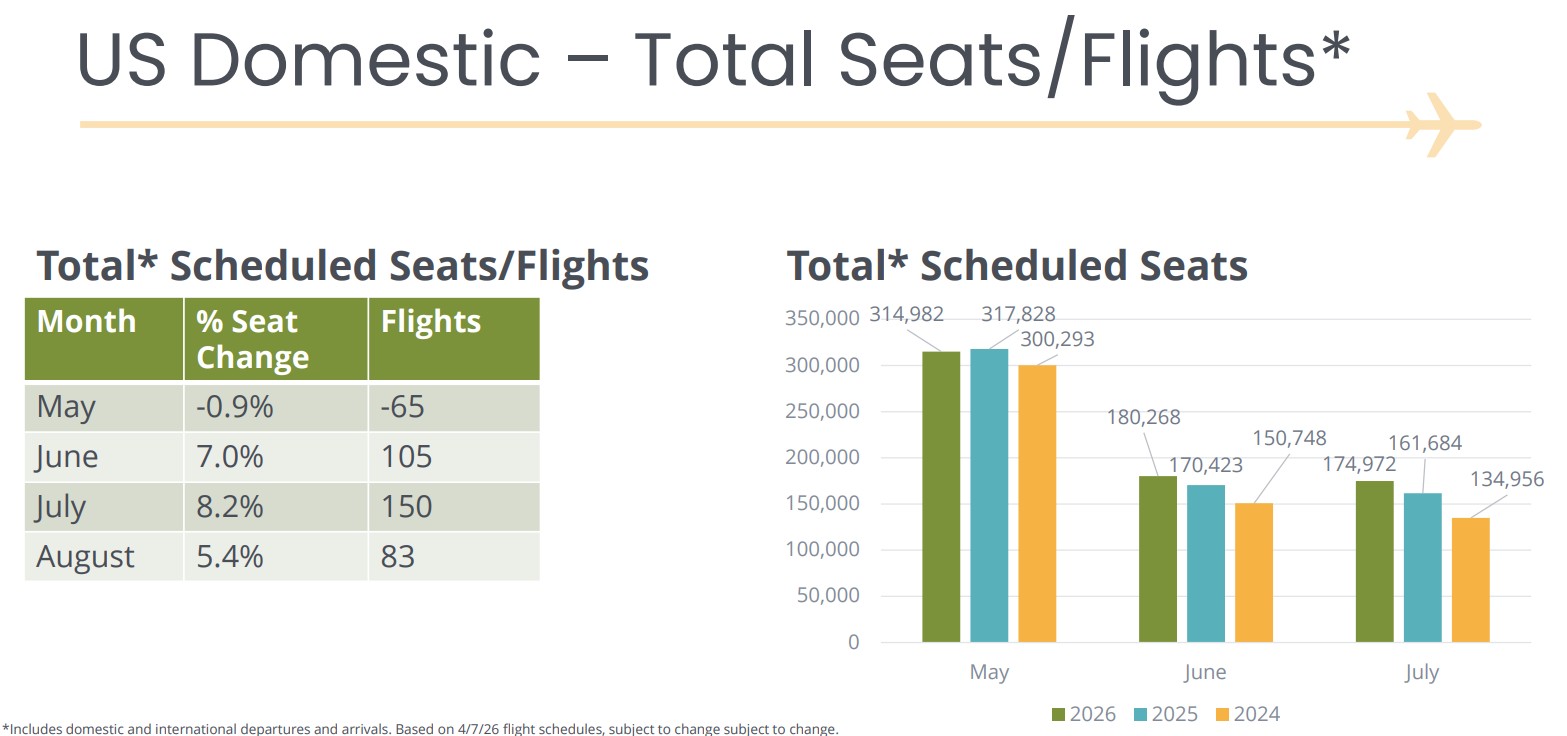
But the same commission packet also shows why the airport is not likely to interpret the March result as a simple weakening of the market. Domestic and total scheduled seat counts for the summer are still projected above last year in most months. Based on April 7 schedules, U.S. domestic seat counts were projected to rise 7 percent in June, 8.2 percent in July and 5.4 percent in August. Total seats, including international service, were projected to rise 6.2 percent in June, 9.1 percent in July and 5.2 percent in August, even though May was expected to be down. That suggests carriers still see Palm Springs as a market capable of absorbing more summer demand, or, at a minimum, as one worthy of holding more capacity than they did a year ago.
The route map helps explain why. PSP’s year-round network now includes Denver, Dallas-Fort Worth, Las Vegas, Los Angeles, Oakland, Portland, Phoenix, Seattle, San Francisco, Salt Lake City, Sacramento, Vancouver and Calgary. In January, the airport also announced that United would extend its Los Angeles service year-round, a small route on paper but an important strategic one because it links Palm Springs more consistently into a major global hub.
There is also a timing issue in the data. March is one of PSP’s most important months, but it is also one in which airline schedule changes can heavily influence results. The seasonal end-date chart in the airport presentation shows multiple routes winding down between early April and early June, including flights to and from Chicago O’Hare, Austin, San Jose and Minneapolis-St. Paul, Newark, Washington Dulles, Atlanta, Seattle, Boise, Paine Field, Bellingham, Winnipeg and Edmonton, depending on carrier. That is the normal cadence of a seasonal desert airport. The more significant question is whether enough routes now remain in place long enough to flatten the old sharp summer trough.
The fiscal-year comparison data offers a clue. March 2026 was below March 2025, but still above March 2024 and March 2023. February 2026 exceeded both 2025 and 2024. January was down from 2025, but that comparison came against a very strong prior year. In other words, PSP is not giving back the post-pandemic expansion that transformed it into a more than 3-million-passenger airport. It is operating at a level that remains historically elevated, even as growth becomes harder to sustain month after month.
That context matters for the Greater Palm Springs economy.
PSP is not just a transportation asset. It is one of the region’s clearest real-time indicators of visitation, second-home movement, hospitality demand and business connectivity. When Canadian traffic weakens, hotels, vacation rentals, restaurants and retailers feel it. When airlines like Alaska and American grow share, they are effectively placing a larger bet on the valley’s ability to pull travelers from the West Coast, the Midwest and the broader connecting system. The airport’s 2025 economic impact study underscored just how central aviation activity has become to the region’s visitor economy and business base.
The most useful way to read the March report, then, is not as a verdict but as a snapshot of transition.
PSP appears to be moving from a period driven primarily by rebound and record-breaking momentum into one shaped more by route strategy, geographic mix and seasonality. Canada is softer. Some airlines are retrenching or absent. But other carriers are expanding, and the scheduled summer seat base remains well above last year in most key months.
All of this proves that the latest data does not present a profile of an airport in retreat. It is the profile of an airport entering a more mature phase, where future growth will depend less on broad market recovery and more on winning the right flights, in the right seasons, from the right carriers, based primarily on the exceptionally successful demand-side stimulation that continues through the promotion led by Visit Greater Palm Springs, Visit Palm Springs and others constantly pushing the region’s appeal throughout the country and internationally.
Future growth in passenger traffic at PSP will also depend, in part, on local residents and part-time residents, choosing PSP first by taking advantage of the expanded flight options that airport staff and public agencies have recruited in recent years. We should all default to PSP first for our air travel, with the selection considering more than just the price of the flights; the calculation should include the value of time and the reduction in the aggravation of driving to alternative airports by using PSP.