The city of Coachella’s emerging strategy for expanding power capacity is not a single plan. It is two.
On one track, city leaders are moving ahead with a limited municipal electric utility in the city’s eastern areas, where development is sparse, and major electrical infrastructure does not yet exist. That plan is now closely tied to a very large, proposed data center campus that officials and project backers say would generate the demand needed to justify building an entirely new system. In February, the city approved a municipal utility development agreement with Coachella Valley Power Services, LLC, for implementation of the city’s municipal electric utility.
On the other track, the city of Coachella is partnering with Imperial Irrigation District on a newly formed financing authority designed to fund substations and related electric improvements in more developed parts of the city, where IID would remain the utility operator.
Taken together, the two efforts reveal a more targeted strategy than the broader public debate over municipal power might suggest. The city is not moving to displace IID citywide. Instead, it is pursuing one model for greenfield areas lacking infrastructure and another for neighborhoods and growth corridors already connected to IID’s system.
That distinction is becoming more important as the city’s proposed municipal utility draws scrutiny over its first major use case: a large east-side data center project that officials say would anchor the utility’s initial buildout.
A utility built for undeveloped land
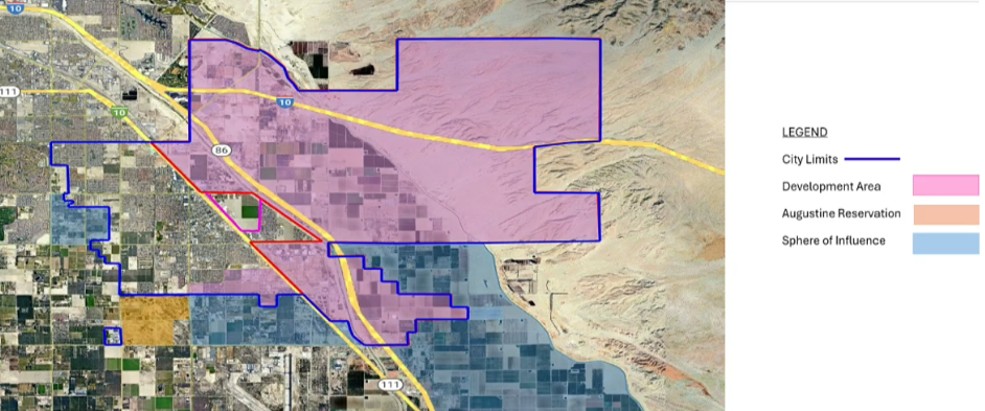
The Coachella municipal electric power area.
Coachella’s municipal utility effort has been in motion for years. The City Council established a limited utility structure in 2019, with the focus on undeveloped or underserved areas rather than existing IID-served neighborhoods.
That approach reflected both economics and practicality. Acquiring or condemning an existing electric system in built-out areas would be costly and politically difficult. City planning documents and later feasibility work instead focused on eastern development areas where new infrastructure could be built from the ground up.
In those areas, the challenge is straightforward. There is little existing distribution capacity, and new substations, feeders and transmission connections are expensive to build for speculative growth alone. The city’s own municipal utility solicitation described the development area as one where future demand could require new substations and a scalable delivery system, while also noting the city was not proposing to take over service for most existing IID customers.
That helps explain why the city’s current utility strategy is centered on a single, very large customer class.
Why the data center matters
At recent public meetings, city representatives and Stronghold Power Systems, the city’s selected private partner, described the proposed Coachella Valley Technology Campus as the first customer for the municipal utility’s phase one buildout.
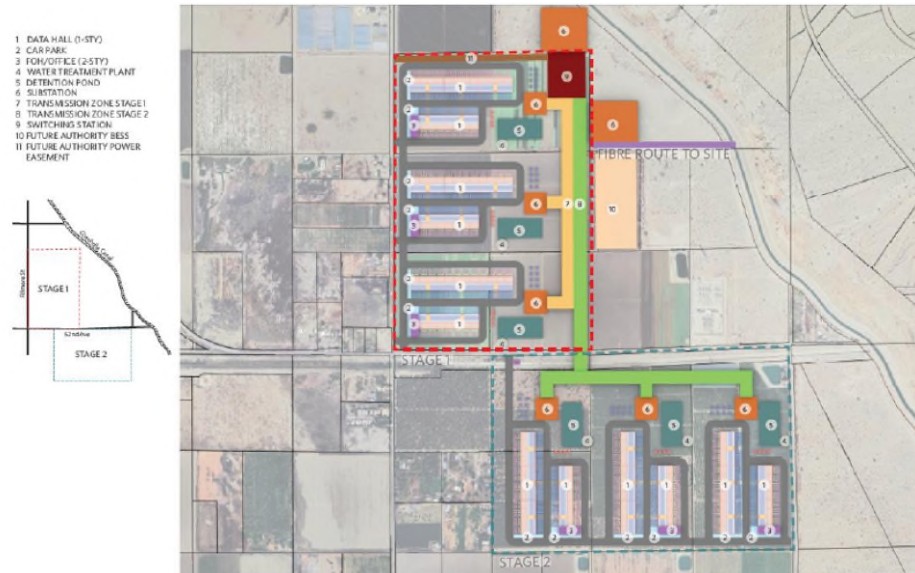
A site plan for the Coachella Technology Campus data center development including the expansion plan to the south.
According to project materials presented to the council, phase one would cover roughly 240 acres and include six data center buildings, with a minimum of 270 megawatts of capacity and up to 300 megawatts of electricity demand, along with three backup microgrids using fuel cells, battery storage and related resources. The same presentations described the data centers as the anchor tenant for the utility’s first stage.
That scale is far beyond the more modest load ranges discussed in earlier city planning documents, which contemplated much smaller near-term demand in the eastern development zone. The implication is hard to miss: the data center is not simply one possible customer for the municipal utility. It is the customer that makes the initial buildout financially plausible.
Recently, Stronghold executives told the council that the first phase would be more limited than some earlier visions of citywide service. Rather than attempting to serve a broad territory from the outset, the initial utility would effectively be structured around a high-voltage interconnection and a handful of large meters serving the data center campus. From there, officials say, the infrastructure could eventually support future commercial and industrial expansion in eastern Coachella.
That narrower starting point also appears designed to avoid burdening existing IID infrastructure or existing local ratepayers with the cost of a major new load.
The other half of the plan keeps IID in place
While attention has focused on the east-side utility proposal, Coachella and IID have quietly advanced a separate framework for the rest of the city.
In mid-March, IID announced that its board had approved a Joint Exercise of Powers Agreement with Coachella establishing the Coachella Electric Financing Authority. IID said the authority is intended to support electrical infrastructure investments that strengthen service and accommodate continued growth, with projects financed through bonds or similar tools while IID continues to own, operate and maintain the facilities as part of its electric system. IID placed the initial infrastructure investment at about $42 million.
That arrangement addresses a different problem in a different geography.
In western and southern Coachella, the issue is not whether a utility is in place. IID already serves those areas. The challenge is how to pay for the substations and system upgrades needed to keep pace with growth, and how to assemble financing soon enough to avoid long delays and rising construction costs.
So, while the east-side proposal has been described as a municipal utility initiative, the financing authority is not municipalization. It is a cooperative financing tool designed to accelerate infrastructure delivery while keeping operations within IID’s public power system.
Seen together, the two tracks are less contradictory than they first appear. They are separate responses to separate infrastructure realities.
Rates and risk are still unresolved
What remains unanswered, at least publicly, is one of the most important questions: what power from the municipal utility would actually cost.
At the recent council presentation, Stronghold Chief Executive Scott Bailey said IID’s newer tariff structure for interconnection and transmission added significant cost, which in turn affected projected rates. He said those rates would later return to the council for consideration. City legal counsel also told elected officials that rate decisions would come back because the council remains the governing and rate-setting body of the utility.
Council members also pressed city staff and advisers about financial exposure. In response, officials said the city’s direct risk would be limited largely to internal and advisory costs during the development stage, while the project’s energy market risk would be managed through procurement contracts and borne initially by the turnkey provider. Even so, advisers acknowledged that if project economics deteriorated, rate adjustments could eventually enter the discussion.
That means the broad outline of the strategy is clearer than the final financial picture.
GPS Business Insider will continue to monitor and report on this important matter.

Bob Marra is the CEO/Publisher of GPS Business Insider. He has been studying, writing and giving presentations about business, economic and public affairs news and issues and the local economy in the Greater Palm Springs/Coachella Valley region for more than 20 years.