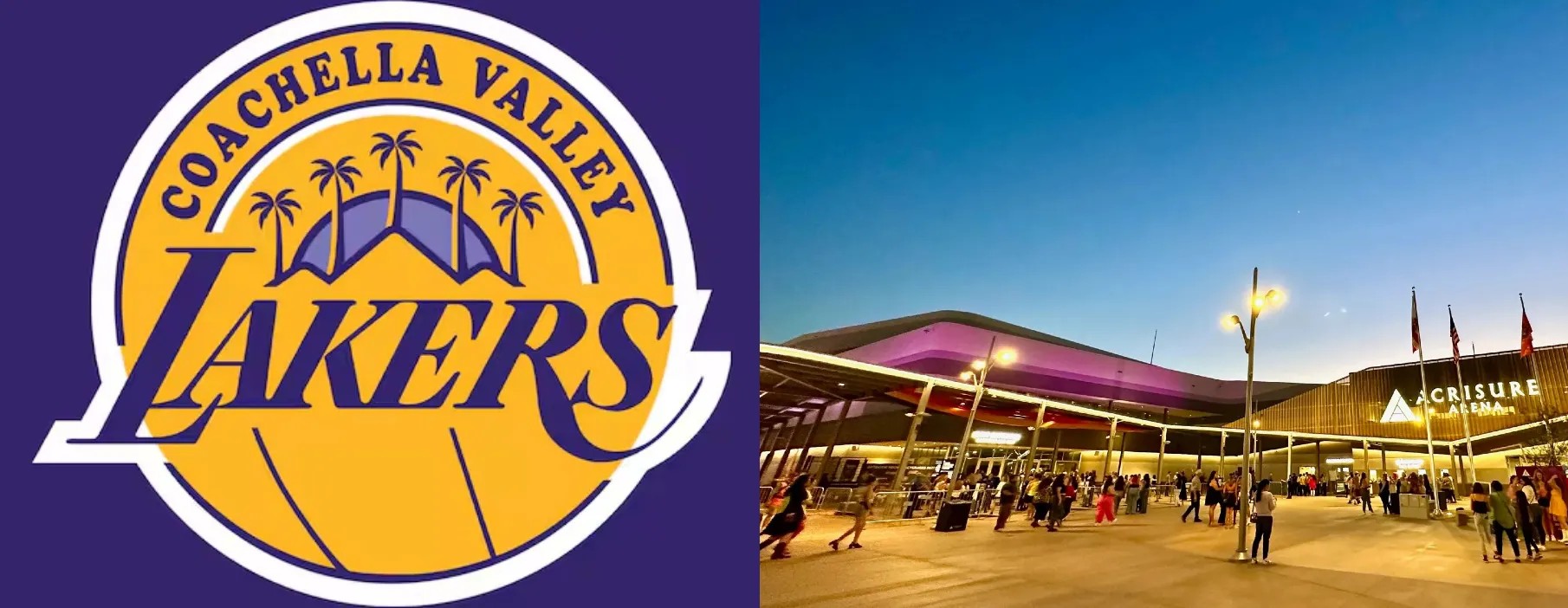
By now, you have likely heard that the Los Angeles Lakers are moving their NBA G League developmental league affiliate to Greater Palm Springs, a decision that brings one of the most recognizable brands in American sports into the region’s year-round entertainment economy and gives Acrisure Arena another recurring tenant with the potential to deepen the valley’s sports tourism base.
For Greater Palm Springs, the news is more than a sports story. It is another test of whether the region can continue converting its reputation as a resort and festival destination into a broader sports and entertainment economy, one built around repeat visitation, local spending, brand exposure and a more diversified calendar of events.
Beginning with the 2026-27 NBA G League season, the team now known as the South Bay Lakers will become the Coachella Valley Lakers and play their home games at Acrisure Arena in Palm Desert. The move adds professional basketball to a building that has already reshaped the local entertainment landscape since opening in December 2022 as the home of the Coachella Valley Firebirds, concerts, comedy shows, family programming and special events.
“I have enjoyed a long-time relationship with Jerry and Jeanie Buss, Lon Rosen and Linda Rambis,” said Oak View Group Senior Partner Irving Azoff. “And I am beyond thrilled to have the Coachella Valley Lakers call OVG’s Acrisure Arena their home. Go Lakers.”
The Lakers’ decision gives Acrisure Arena a second professional sports identity, pairing the Firebirds’ rapid rise in the American Hockey League with a developmental basketball franchise tied directly to one of the NBA’s marquee organizations. It also gives the Coachella Valley something it has rarely had: a recurring, branded connection to the Los Angeles sports market that is strong enough to attract local fans, second-home owners, visiting Lakers loyalists and corporate partners.
A Second Pro Sports Anchor for the Arena
Acrisure Arena’s economic impact was already significant before the Lakers’ arrival.

A June 2024 analysis by Tourism Economics found that Acrisure Arena welcomed 850,400 attendees across 117 events in 2023, its first full year of operation. Those events generated $99.2 million in direct spending from non-local attendees in the Greater Palm Springs economy, including spending at hotels, restaurants, retailers, transportation providers and recreation businesses.
The report estimated that the direct visitor spending translated into $138.6 million in total business sales, supported 1,867 full-time and part-time jobs, generated $40.9 million in labor income and produced $29.9 million in total federal, state and local tax revenue. State and local governments received $19.9 million of that tax impact.
The new Lakers affiliate is not likely to replicate the scale of a full Firebirds season on its own, nor should it be evaluated that way. Its importance is incremental. The G League team adds more event nights to the calendar, more reasons for fans to travel to Palm Desert, more opportunities for local dining and hospitality spending, and more regular exposure for Acrisure Arena as a regional venue.
In 2023, the Firebirds accounted for 59 of Acrisure Arena’s 117 events and 483,600 attendees, making hockey the largest single driver of the arena’s attendance base. Professional and collegiate sports, beyond the Firebirds, accounted for five events and 36,300 attendees. The Coachella Valley Lakers should substantially expand that sports category.
That matters because the arena economic impact report found that sports events can pull from beyond the local market. For professional and collegiate sports, 59 percent of attendees came from outside Greater Palm Springs, including 19 percent from within 100 miles but outside the region and 38 percent from domestic markets more than 100 miles away.
If the Lakers’ affiliate can draw even a modest share of fans from Orange County, the Inland Empire, and perhaps beyond, as well as local second-home communities, the economic impacts would extend beyond ticket sales.
It would show up in pregame dinners, postgame drinks, hotel stays, rideshare trips, gasoline purchases, retail spending and repeat exposure to the region.
The Lakers Brand Carries Unusual Weight
The Lakers’ G League team has been based in the Los Angeles area since its founding as the Los Angeles D-Fenders in 2006. The team later became the South Bay Lakers and played at the UCLA Health Training Center in El Segundo. The Lakers were the first NBA franchise to own and operate an affiliate in the developmental league.
“Moving the Lakers G League team to the Coachella Valley is an incredible opportunity for the organization,” said Los Angeles Lakers President of Business Operations Lon Rosen. “The Lakers have had a strong presence in the region for decades, from the Showtime Lakers holding training camp in the 1980s to more recent preseason games. We are looking forward to extending that experience and becoming a staple for Coachella Valley sports and entertainment. Acrisure Arena is the perfect modern venue that provides an incredible fan-first experience, while ensuring players have the premium facilities and space they need on game day.”
For Acrisure Arena and Oak View Group, the team adds programming inventory. For Visit Greater Palm Springs and regional economic development leaders, it strengthens the case that the valley can compete for sports assets beyond golf, tennis, festivals and youth tournaments. For restaurants, hotels and retailers, it creates more nights when the building can function as an economic generator.
The Economics of More Event Nights
The economic argument for the Coachella Valley Lakers is not simply that the team will sell tickets. Recurring sporting events are a powerful use of an arena because they create predictable demand throughout the season.
Concerts and major one-night events often produce larger individual spikes. But sports franchises build habits. They create a schedule. They support sponsorship packages, premium seating, local broadcast and social media content, youth programs, merchandise, recurring food and beverage demand, and cross-promotion with tourism and hospitality partners.
The Tourism Economics report found that non-local Acrisure Arena attendees spent $29.6 million on lodging in 2023, $23.8 million on food and beverage, $23.8 million on retail, $14.1 million on recreation and entertainment, and $7.9 million on local transportation.
Those categories are where an additional team can make a difference.
A Saturday night G League game against a recognizable opponent may not become a major tourism event on its own. But when paired with a weekend getaway, a hotel package, a golf trip, a family visit, a restaurant reservation or a Lakers-themed promotional night, it becomes part of a larger visitor economy.
The opportunity is particularly meaningful because the Coachella Valley continues to seek ways to mitigate seasonality. A professional basketball schedule running through the fall, winter and spring aligns with the region’s strongest tourism months, but it also adds more programming during periods when hotels, restaurants and entertainment venues benefit from midweek activity.
The arena’s existing impact also shows how spending circulates. The $99.2 million in direct attendee spending generated $20.9 million in indirect business sales through supplier purchases and $18.5 million in induced sales through household spending by workers supported by that activity.
That is the multiplier the Coachella Valley Lakers will now have the chance to contribute to.
A Bigger Sports Economy Taking Shape

Riverside County Supervisor V. Manuel Perez – District 4
The Coachella Valley’s sports economy has been broadening for years. The region has long had global recognition through the BNP Paribas Open in Indian Wells, The American Express PGA Tour event in La Quinta, major youth and amateur sports activity, golf tourism, tennis tourism and large-scale endurance and recreational events.
“It’s a big boost to the Coachella Valley to have first hockey and now our own basketball team, with the Coachella Valley Lakers,” said Supervisor V. Manuel Perez. “The economic impact of the Acrisure Arena, which we processed in the county in record time to make sure it happened, has already been significant, and now it will be even greater. Thank you to Irving Azoff for his bold vision and tenacious action in ensuring that we all win with our very own Coachella Valley Lakers in the Heart of the CV-Thousand Palms.”
Acrisure Arena gave the region something different: a modern indoor venue capable of hosting major concerts and professional sports events regularly. The Firebirds quickly proved that the valley could support a professional team at scale. The Lakers’ arrival suggests that outside sports organizations now see the market differently.
“Opportunities like this are simply not possible without the support and assistance of incredible partners,” said Acrisure Arena Senior Vice President John Page. “We would like to recognize the efforts put forth by Supervisor V. Manuel Perez and Visit Greater Palm Springs, who have worked in conjunction with Oak View Group, the Lakers organization and many others in order to welcome the G League to our town. We look forward to expanding upon our growing connection to the sports community with the addition of this storied franchise.”
The reference to regional partners is important. Sports relocations do not happen only because a venue exists. They happen because ownership groups, league operators, public officials, tourism agencies and venue managers see a business case.
Player Development Meets Regional Branding
The G League has become increasingly important to NBA franchises as a platform for player development, scouting and roster flexibility. The Lakers’ affiliate has produced or developed professional talent over the past two decades, including current Los Angeles Lakers guard Austin Reaves. According to the team announcement, the franchise has recorded 60 NBA call-ups across 38 players.
During the 2025-26 season, the team posted a 26-10 regular season record and secured the No. 1 seed in the Western Conference.
That competitive profile lends more weight to the relocation. The Coachella Valley is not merely receiving a dormant minor league asset. It is receiving a franchise connected to an NBA brand, a development system and a winning recent season.
The question now is how much the region can build around it.
The strongest version of this move would not treat the Coachella Valley Lakers as a secondary tenant operating in the shadow of hockey. It would position them as another pillar in a regional sports platform: Firebirds hockey, Lakers basketball, major golf, major tennis, youth sports, sports medicine, hospitality, sponsorship, tourism and business development.
That platform could benefit restaurants in Palm Desert, Rancho Mirage, Indian Wells and La Quinta. It could support hotel packages across the valley. It could give sponsors another local sports property to activate around. It could give families another affordable option for professional sports. It could also provide Greater Palm Springs with greater national-brand adjacency through one of the strongest names in basketball.
Season ticket deposits opened to the public, with deposits starting at $100 per account and fully refundable at the time of seat selection.
This opening step will provide an early measure of local demand. But the larger measurement will come over several seasons: attendance, sponsorship sales, non-local ticket purchases, hotel partnerships, community engagement and whether the Lakers brand can become a regular part of the valley’s sports culture.
The arrival of the Coachella Valley Lakers does not, by itself, transform the regional economy. But it adds another engine to a venue that has already demonstrated measurable economic impact.

Bob Marra is the CEO/Publisher of GPS Business Insider. He has been studying, writing and giving presentations about business, economic and public affairs news and issues and the local economy in the Greater Palm Springs/Coachella Valley region for more than 20 years.