New economic development strategy aims to move the region beyond seasonal tourism by targeting clean energy, advanced manufacturing, biotech, creative media, agtech and hospitality
The Coachella Valley has long sold itself to the world as a place to escape, relax, recover and be inspired.
Now, regional leaders are trying to convert that global identity into something more durable: a business recruitment strategy.
A newly launched Coachella Valley Subregional Economic Development Strategy lays out a multi-year roadmap for diversifying the region’s economy, attracting private investment and creating more year-round, higher-wage jobs across Greater Palm Springs. The plan, commissioned and led by the Riverside County Office of Economic Development, is part of the countywide Economic Development Strategic Plan but is tailored specifically to the valley’s assets and constraints.
Its central argument is straightforward: the same qualities that make the Coachella Valley internationally recognizable as a visitor destination can also make it more competitive as a place to build companies, recruit talent and invest in emerging industries.
The strategy identifies six high-potential sectors for targeted growth: clean energy and climate technology, advanced manufacturing, biotechnology, creative media, agtech, and hospitality and tourism. It also points to the region’s available land, renewable energy resources, cultural brand, proximity to major Southern California markets and quality of life as competitive advantages.
“Greater Palm Springs has long been known as a place people choose for lifestyle, creativity and opportunity,” said Scott White, President and CEO of Visit Greater Palm Springs (VGPS), the organization that worked in conjunction with the county to create the plan. “This new strategy ensures we are equally competitive as a place to invest and grow a business. By aligning our cities, workforce partners and infrastructure priorities, we are creating a coordinated pathway that gives companies clarity and confidence.”

Scott White, President/CEO, Visit Greater Palm Springs
The vision is ambitious. The plan describes a future in which Greater Palm Springs evolves from its tourism and agricultural roots into a diversified economic hub known for clean energy, healthcare, entertainment and technology. It frames the region as a potential “new mecca” for wellness, energy innovation and creative industries.
A Regional Economy With Uneven Strengths
The plan is not only a promotional document. It also makes clear why diversification matters.
The Coachella Valley has a lower labor force participation rate than Riverside County as a whole. The strategy reports a 55.4% labor force participation rate for the subregion, compared with 60.9% countywide. The subregion’s jobs-to-housing ratio is 0.79, below the countywide ratio of 0.95, suggesting the area still has fewer local jobs relative to its housing base than Riverside County overall.
At the same time, the valley has a relatively strong local employment retention pattern. The plan reports that 59.7% of employed residents in the Coachella Valley live and work within the subregion, the highest share among Riverside County subregions. That suggests that while the region needs more jobs, its employment market is already more self-contained than commuter-heavy areas of western Riverside County.
The tourism imprint is also unmistakable. The arts, entertainment, recreation, accommodation and food services sector accounts for 16.7% of resident employment in the Coachella Valley and Blythe area, compared with 10.7% countywide. That concentration reflects the economic power of hospitality, resorts, restaurants, festivals, events and visitor services.
It also reveals the vulnerability. A region with a major share of employment tied to tourism is more exposed to seasonality, travel trends and shifts in consumer spending.
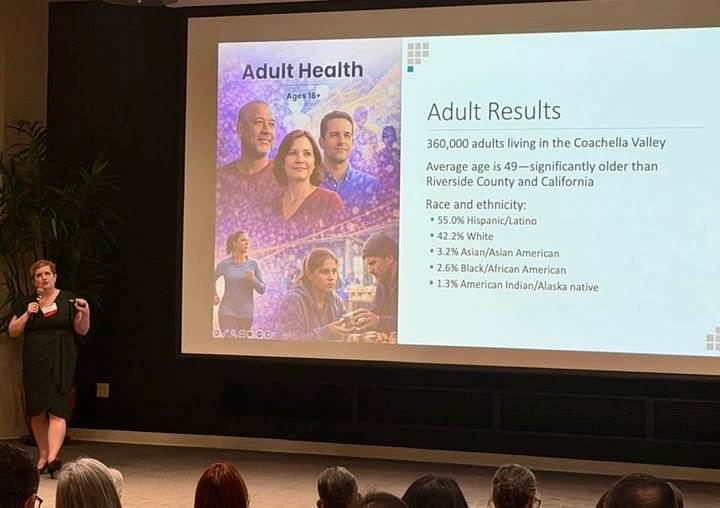
In a featured presentation at the Coachella Valley Business Conference & Economic Forecast on April 30, Davis Meyer, Vice President of Government and Industry Relations for VGPS, described the organization’s mission as having evolved beyond destination marketing. She gave a comprehensive presentation on the strategic plan and the role of the VGPS affiliate, Greater Palm Springs Economic Development, which is leading implementation.
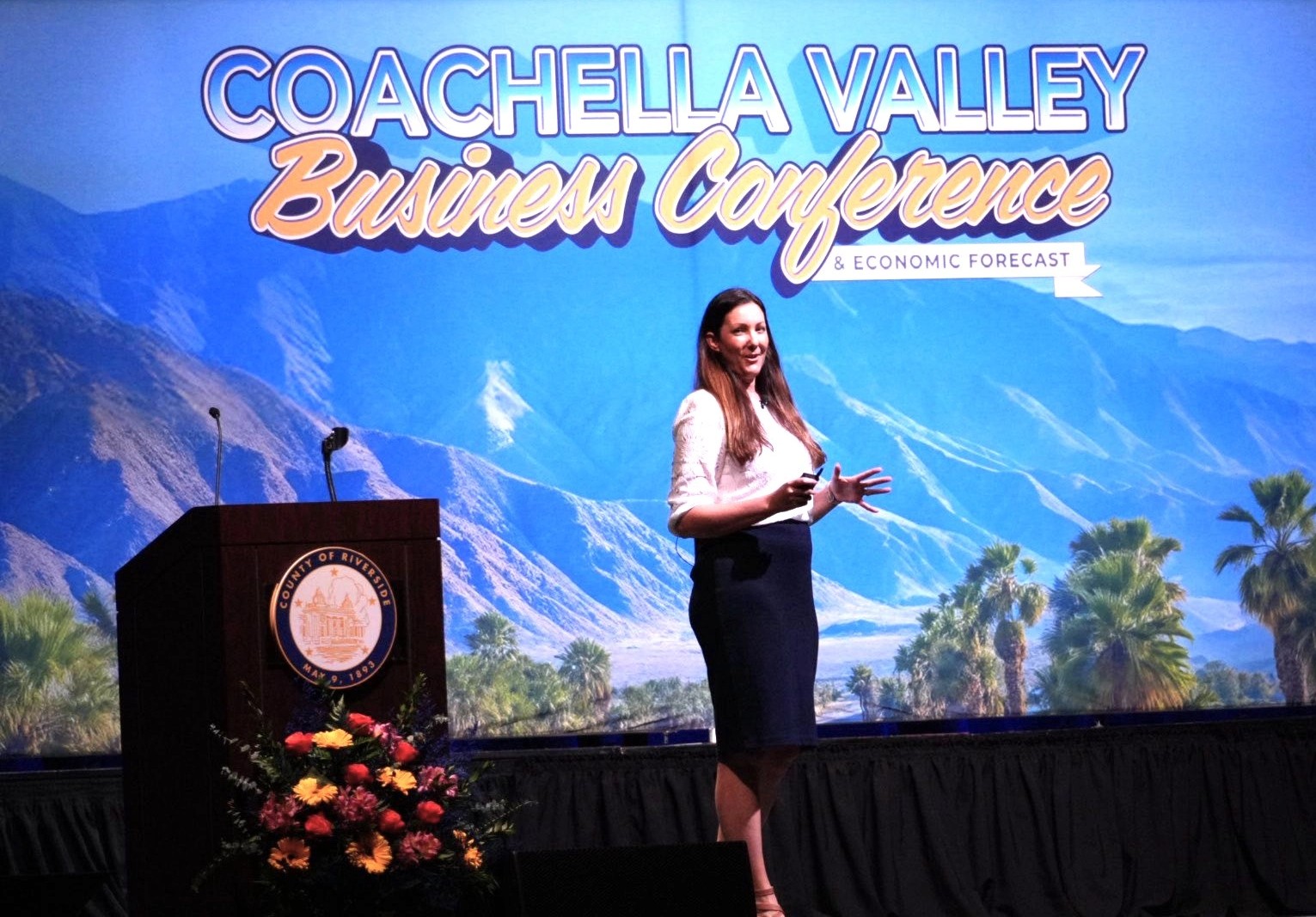
Davis Meyer, Vice President of Government and Industry Relations at Visit Greater Palm Springs, delivered a compelling and exciting presentation to the 700-plus person audience.
Visit Greater Palm Springs is a joint powers authority representing the nine cities of the Coachella Valley and Riverside County, originally established to grow the tourism economy, which it has done exceptionally well during the past 15 years. Over time, she said, that mission has evolved into “growing this region into a year-round destination, into diversifying our economy and creating a more resilient economy for all of us by strengthening other industries.”
The Strategy Behind Thrive And Shine
One of the more notable elements of the plan is its effort to turn the valley’s brand into an economic development tool.
The Coachella name already has global reach through music, festivals, design, architecture and desert lifestyle. Greater Palm Springs has an established reputation for hospitality, wellness, golf, outdoor recreation and culture. The strategy argues that those assets can help recruit companies and workers, especially in sectors where place identity matters.
The region has completed an economic development branding process resulting in the Thrive and Shine platform. The messaging positions Greater Palm Springs as more than a destination, describing it as a place to live, work and invest.
For creative media, the plan’s message is “Create. Connect. Captivate.” For advanced manufacturing, it is “Precision Built. Future Ready.” For biotech, “Innovating Health at the Edge of Discovery.” For health and wellness, “Wellness Starts Here.” For clean energy, “Powering Progress with Clean Energy.”
Meyer said VGPS was asked about two years ago to take the same model it uses to market the region for tourism and apply it to economic development.
“Let’s create a brand and a strategy to grow these other industries, to attract new investments and business to the region,” Meyer said, describing the direction given by the organization’s executive committee.
Since its inception last summer, Greater Palm Springs Economic Development has launched a comprehensive website, a newsletter, a LinkedIn channel and marketing campaigns focused on the region’s business climate and lifestyle appeal. Along with Meyer, Sean Smith, the organization’s director of economic development for the organization, has been out in the community identifying successful and fledgling local companies in the target sectors to highlight them and provide support they may need in various important ways – from helping them grow their local networks of potential customers, partners and workforce to shining a light on their local operations and why Greater Palm Springs was their region of choice for doing business.
During her presentation, Meyer said the effort is designed, in part, to tell “authentic stories” of companies already operating and growing in the valley.
Why These Six Industries
The six target industries are not random. Each reflects either an existing economic base or a potential growth lane.
Clean energy and climate technology build on the valley’s proximity to the Salton Sea, geothermal resources, lithium potential and renewable energy infrastructure. The plan describes the region as having an opportunity to position itself as a center for clean energy innovation, including battery storage and green hydrogen.
Advanced manufacturing is tied to the valley’s available land, lower density, proximity to logistics routes and potential to support clean, high-tech production. The strategy argues that companies looking to expand or reshore production need “space, speed and sustainability.”
Agtech grows out of the valley’s agricultural legacy, particularly in the eastern Coachella Valley, where water, heat, labor, automation and climate adaptation are already central economic issues.
Creative media is built on the region’s cultural brand. The plan points to opportunities in music, film, digital media, fashion, visual arts and creative enterprise development. It also calls for considering a creative industries incubator and a Coachella Valley Creative Summit.
Biotechnology and health innovation are newer elements, but the strategy connects them to the region’s wellness identity, healthcare needs and quality-of-life appeal. Meyer said biotechnology was initially less obvious than agriculture, creative media or clean energy, but regional leaders are seeing “the beginnings of some biotechnology already happening here in the Coachella Valley.”
Hospitality and tourism remain central, not as a fallback but as a platform. The plan treats tourism infrastructure as an economic asset that can support meetings, conferences, talent attraction, quality-of-life messaging and year-round visitation.
County leadership emphasized the valley’s growing importance in the broader Riverside County economy.
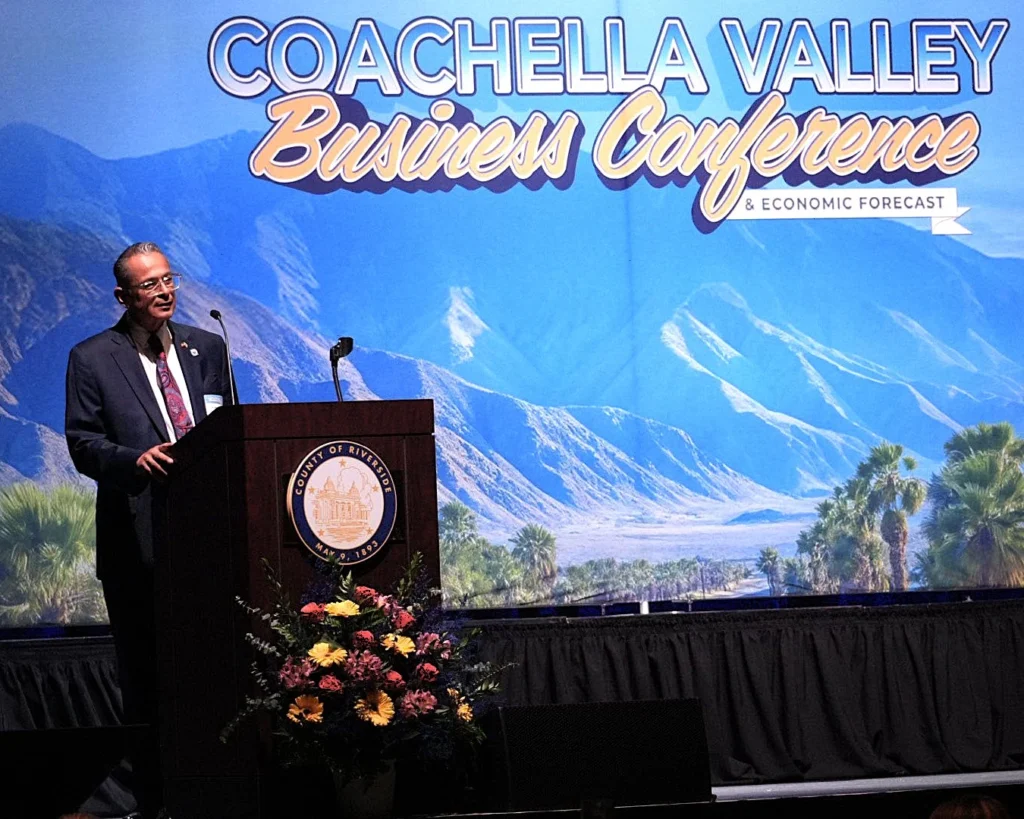
Riverside County Supervisor V. Manuel Perez – District 4 opened the conference with remarks about what has been accomplished in recent years and how bright region’s economic future looks to him.
“The economic development strategic plan has a lot in store for the region’s and county’s economic future,” said Supervisor V. Manuel Perez. “This plan examines the Coachella Valley, which is increasingly considered for its unique economic role and as a key employment center for Riverside County.
Workforce Is The First Test
For the strategy to work, the region must demonstrate to employers that it can supply trained workers.
The plan points to career pathways, employer-aligned training, local colleges, workforce boards and tribal communities as essential partners. Meyer made the same point in her presentation, naming College of the Desert, OneFuture Coachella Valley, Riverside County Workforce Development, CSU San Bernardino Palm Desert Campus, UCR, local school district career technical education programs and the Center for Employment Training as part of the valley’s workforce ecosystem.
“This is something that we hear from businesses and site selectors,” Meyer said. “They want to make sure that we have the workforce, the trained and skilled workforce that they need if they’re going to move their business here or start their business here.”
She urged employers to connect more directly with local education systems, including Handshake, the platform colleges use to post jobs and internships.
“There are great, motivated students in our valley getting degrees and training that they need to fill your positions,” Meyer said.
The plan’s workforce challenge is made sharper by the valley’s demographic contrasts. Some cities have high shares of residents with bachelor’s degrees, while others lag substantially. Some communities have younger workforces, while others are older and more retirement-oriented. That unevenness means the valley’s talent strategy will have to be local, targeted and tied directly to industry needs.
Infrastructure May Decide The Outcome
The plan also makes clear that marketing alone will not determine whether the valley can attract new investment.
Infrastructure is a major focus. The strategy calls for improved mobility, expanded public transit connectivity, shaded pedestrian corridors, protected bike lanes, safe routes to schools and transit, mobility hubs, and continued advancement of the Coachella Valley-San Gorgonio Rail Corridor Project.
Digital infrastructure is another priority. The plan calls for high-speed broadband expansion, fiber and 5G deployment in underserved and rural areas, public Wi-Fi zones and remote work or innovation hubs in vacant retail or office space.
Power availability may be the most immediate business constraint. Meyer described electricity capacity as one of the region’s biggest economic development issues, especially for businesses trying to open or expand.
“We know power is one of the biggest issues in terms of getting new businesses out here, getting new businesses open,” Meyer said.
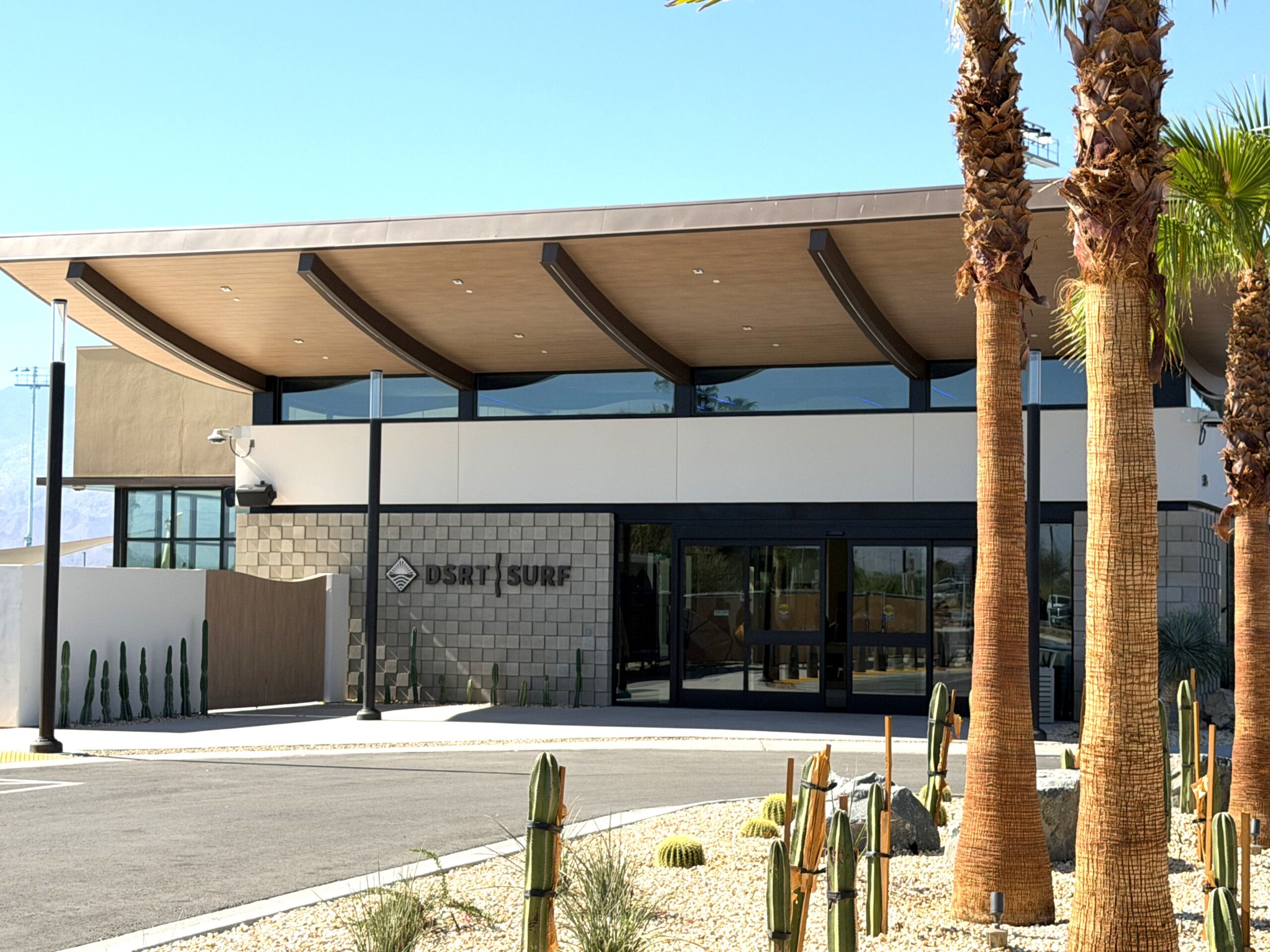
Air service is another competitive factor. Meyer said VGPS has worked with Palm Springs International Airport on air service development for more than 20 years. She pointed to 3.3 million passengers in 2025 as a record year for the airport, helped by new routes and expanded service, including additional East Coast connections.
The plan also includes broader priorities such as housing, environmental revitalization and Salton Sea restoration. These are not peripheral concerns. For companies, site selectors and workers, housing affordability, mobility, environmental conditions and reliable infrastructure are part of the investment decision.
Turning Tourism Into A Year-Round Platform
Tourism remains the valley’s strongest economic engine, and the strategy does not pretend otherwise.
Meyer said the region attracts an estimated 14.5 million visitors annually and that one in every four jobs is dependent on tourism. Visit Greater Palm Springs reaches visitors through traditional media, social media, digital campaigns, public relations, activations and strategic partnerships.
But the emphasis is shifting from tourism alone to tourism as a platform for broader economic resilience.
Conventions and meetings are part of that strategy because they can bring visitors midweek, in summer and during the shoulder seasons. Restaurant Week and Spa Month are designed to drive visitation during slower periods while elevating the region’s culinary and wellness brands. Short-term vacation rentals are also a vital part of the region’s lodging mix, with Meyer saying about 20% of overnight visitors stay in them.
Visit Greater Palm Springs is also working on longer-range destination stewardship planning with individual cities and continues to support the concept of an amateur indoor sports complex. Meyer said a feasibility study found that such a complex for indoor sports such as basketball, volleyball, wrestling and cheerleading could draw summer and shoulder-season visitation.
That idea connects directly to the larger strategy. The valley is not slowing down in any way when it comes to promoting tourism. It aims to make tourism less seasonal, more integrated with economic development, and more effective as a tool for attracting investment and talent.
The Hard Part Begins Now
For investors and site selectors, the strategy is intended to provide more transparency around priority industries, workforce development, infrastructure needs and development-ready sites.
“Implementation is where strategy becomes impact. By working closely with our regional partners, including Visit Greater Palm Springs, local jurisdictions, tribal communities, and industry leaders, we are focused on advancing the priority action items identified in this plan and ensuring real, measurable progress for the Coachella Valley’s economy,” said Suzanne Holland, Director, County of Riverside Office of Economic Development.
Initial implementation efforts are already well underway, including targeted industry outreach, streamlined development standards and collaboration with education partners on employer-aligned training programs.
The plan’s advantage is that it builds on the assets the valley already has. Its challenge is equally clear. The Coachella Valley is not a single city with a single economic development office. It is a regional economy spread across nine cities, tribal nations, unincorporated communities and county government. Its communities vary widely in income, education, housing, age, workforce profile and development capacity.
That makes coordination more than a talking point. It is the strategy.
The valley’s next economic chapter will depend on whether those partners can turn a shared brand into shared execution: more competitive sites, better infrastructure, faster approvals, stronger talent pipelines and clearer industry targets.
Meyer ended her presentation with a practical call for local involvement, urging businesses and civic leaders to use available tools, connect with educational partners, advocate for regional needs and support the local economy.
“Show up, go out, shop local, dine local, attend events, network like this with your community,” Meyer said. “All of this really helps us drive these strategies forward.”
For Greater Palm Springs, the question is no longer whether the region has a desirable and powerful brand. It does.
The question is whether that brand can now be converted into a broader economy. With Visit Greater Palm Springs and Greater Palm Springs Economic Development leading the way, along with their numerous public- and private-sector partners, we have the best chance ever of doing so.

Bob Marra is the CEO/Publisher of GPS Business Insider and GPS Market Intel. He has been studying, writing and giving presentations about business, economic and public affairs news and issues and the local economy in the Greater Palm Springs/Coachella Valley region for more than 20 years.