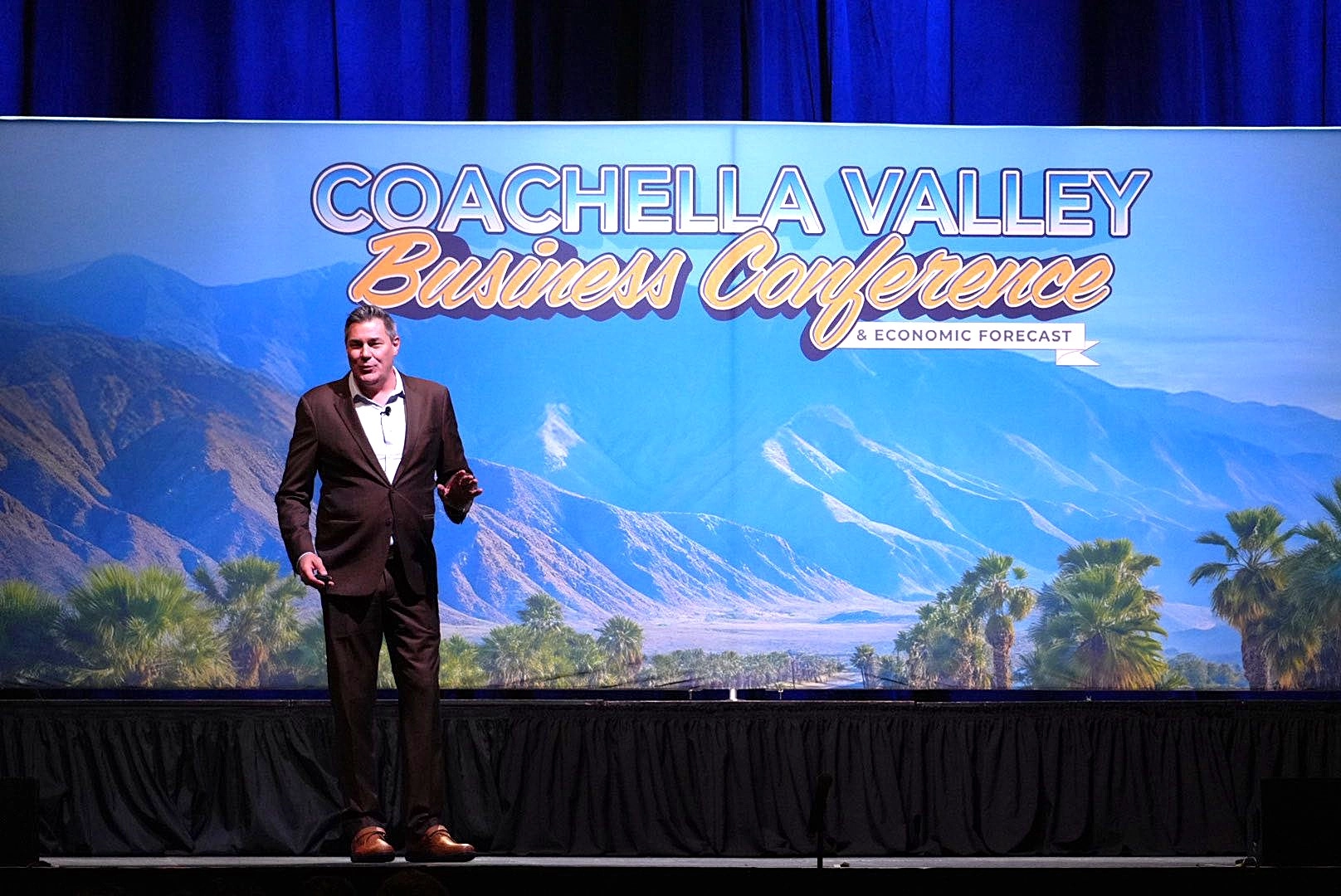
Christopher Thornberg came to Greater Palm Springs with a message that was both reassuring and uncomfortable.
In his keynote presentation at the Coachella Valley Business Conference & Economic Forecast, he said the U.S. economy is not on the verge of recession. Consumers are not collapsing. Businesses are not buckling. The labor market is not in free fall. Inflation, while still a source of anxiety for many households, is not the runaway force it was portrayed to be in the peak pandemic recovery period.
The larger problem, Thornberg argued, is that much of the country is making decisions based on a story that does not match the data.
“We have a tale of two economies,” Thornberg told a regional audience Thursday, describing the divide not as rich versus poor or red states versus blue states, but “the economy we think we have versus the economy we actually have.”
That gap, he said, has become one of the country’s most consequential economic risks.

Palm Springs International Airport set its annual record for passengers served in 2025. Southwest Airline flight additions were a big part of the reason why.
For Greater Palm Springs, the message landed in familiar but important local terms. The region is performing better than many people might assume, Thornberg said, with tourism holding up, Palm Springs International Airport posting record passenger traffic, hotels remaining among the stronger performers in California, logistics activity continuing to grow, and workers moving into higher wage categories.
But he also warned that the valley’s long-term growth model is being constrained by the same forces pressuring much of California: not enough housing, not enough labor force growth and not enough younger families moving into the region.
The result is a local economy that remains healthy but is not guaranteed to keep expanding unless the region changes what it builds, whom it attracts and how it talks about its own future.
A Data-Driven Rebuttal to Economic Gloom
Thornberg, founding partner of Beacon Economics, has built a career challenging consensus narratives, including as one of the economists who warned ahead of the subprime mortgage collapse. His current argument is pointed in the opposite direction: the pessimism surrounding the economy, he said, has run well ahead of the evidence.
The national expansion is continuing, he said, because household and business finances remain strong. Consumer spending remains high. Business profits remain solid. Job losses are not surging. And first-quarter GDP growth, released the same day as his remarks, came in at about 2 percent, roughly consistent with the prior year’s pace.
That does not mean the economy is free of risk. Thornberg identified two major imbalances that could eventually create real trouble: a large financial market bubble, particularly tied to technology and artificial intelligence stocks, and a federal deficit he described as unsustainable.
But those are future risks, he argued, not evidence of a present recession.
“There is no sign of an imminent recession in our economy today,” he said, pointing to strong household and business balance sheets as the reason.
His critique was not that people are imagining all hardship. Rather, it was that the public conversation too often turns real challenges into distorted conclusions. Thornberg pushed back especially hard on the idea of a “K-shaped recovery,” the now-common claim that only higher-income households are driving the economy while everyone else is falling behind.
He said the data show a more complicated and less dire picture, including broad income gains over the past decade and substantial public transfers that are often left out of inequality debates.
That distinction matters for local leaders, Thornberg said, because policy choices begin with the story a community believes.
“Good choices and smart policies start with the correct narrative,” he said.
The Local Economy Is Not Just Tourism
For Greater Palm Springs, Thornberg described an economy that is broader and stronger than its public image.
Tourism remains essential, but not the only driver. He noted the strength of Palm Springs International Airport, which handled a record 3.3 million passengers in 2025. The airport has become one of the Inland Empire’s clearest signs of regional demand, alongside Ontario International Airport.
Hotel performance also remains a bright spot. Thornberg said Palm Springs revenue per available room is up about 41 percent since December 2019, making it one of the better-performing hotel markets, even as overall tourism has been relatively flat in recent years.
The valley’s major festival season added to that picture. Thornberg referenced the back-to-back Coachella and Stagecoach weekends as evidence that consumers are still spending on travel, entertainment and experiences.
“People are having fun,” he said.
That point is particularly important in a region where softness in sales tax can be misread as a broader consumer slowdown. Thornberg argued that taxable sales data no longer capture the full picture of spending because consumers have shifted back toward services after the pandemic-era surge in goods purchases. In Greater Palm Springs, he said, taxable sales spiked in 2021 and have since drifted down, but that does not mean households have stopped spending.
Food and beverage stores remain healthy, motor vehicle sales are strong and the weakness is more concentrated in categories such as building materials and gasoline, he said.
In other words, the region is not simply seeing consumers retreat. It is seeing consumer behavior change.
Workers Are Earning More, But There Are Not Enough of Them
Thornberg’s most important local distinction was between growth on the “extensive margin” and growth on the “intensive margin.”
The valley is not adding people or workers rapidly, he said. But the workers already here are generally earning more, and the local wage distribution has improved.
He pointed to a local shift between 2014 and 2024 in which the number of lower-paid workers declined while higher-paid worker categories expanded. He also said workers with less than a high school degree have seen especially strong wage growth over the past decade.
“This is not a bifurcated distribution,” he said. “Everybody is doing better, and the overall number of low-pay workers is falling.”
That is one of the more important economic takeaways for local business and civic leaders. The valley’s economy is not merely producing more low-wage service employment. Health care is growing. Arts and entertainment are growing. Logistics is growing. Office vacancy is not facing the same crisis as Los Angeles or San Francisco. Industrial real estate, Thornberg said, remains an essential part of the local economy, even if the broader Inland Empire built too much of it during the pandemic-era boom.
“Industrial is not office,” he said, arguing that warehouses, light manufacturing and distribution space remain the skeleton of a functioning regional economy.
For Greater Palm Springs, that means the local economy should not be described as tourism-only. Tourism is central. But logistics, health care, entertainment and business services are increasingly part of the story.
The Housing Problem Is a Supply Problem
Thornberg was blunt on housing.

More housing is necessary to grow the local economy with an injection of a younger workforce base.
He rejected the phrase “affordability crisis” as incomplete and argued that the real issue is a supply crisis. Housing is expensive because there is not enough of it, he said, and the solution is to build more.
“The solution to making housing available for more people is to build more of it,” he said.
That matters acutely in the Coachella Valley, where population growth has flattened and, according to Thornberg, technically declined last year for the first time in a long period. He tied that directly to the region’s ability to grow its labor force.
If the valley wants more jobs, he said, it needs more workers. If it wants more workers, it needs housing they can occupy. And if it wants a more balanced economy, it needs to attract more young families, not only retirees and second-home buyers.
That may be the most consequential local challenge he raised.
Greater Palm Springs has been highly successful at attracting older residents, Thornberg noted. But future growth requires a broader demographic strategy.
“This region has been very good at attracting older folks,” he said. “But region’s leaders need to turn and get their focus on attracting families and good young folks to move out here.”
He framed that not as a marketing slogan, but as an economic development imperative. Younger families bring workers, students, school enrollment, local spending, entrepreneurship and long-term civic stability. Without them, the valley risks becoming wealthier but less dynamic, more desirable but less productive.
A Region With an Image Opportunity
Thornberg’s local prescription was not pessimistic. In fact, much of his talk suggested the valley has advantages that many regions would envy: natural beauty, a high quality of life, a globally recognized tourism brand, expanding air service, major events, available land and a growing economic base beyond hospitality.
But he suggested the valley has not fully communicated that value proposition to the people it most needs to attract.
The region’s quality of life, he said, should not be marketed only to people over 50. It should be made clear to younger families that the Coachella Valley can offer a strong place to live, work, raise children and build a career.
That message aligns with the region’s broader economic development ambitions, including efforts to expand business attraction, improve workforce development and develop a more complete year-round economy. But Thornberg’s analysis added a sharper point: none of those efforts can reach their full potential without housing production and labor force growth.
The valley’s challenge is not that its economy is failing. It is that its growth could be capped by a shortage of people.
The Wrong Narrative Can Produce the Wrong Policy
The deeper warning in Thornberg’s remarks was that bad narratives can become self-fulfilling.
If leaders believe consumers are collapsing, they may misread local sales tax data. If they believe housing prices are high because of greed rather than scarcity, they may pursue policies that discourage construction. If they believe industrial real estate is nothing but low-value warehousing, they may overlook one of the region’s emerging business sectors. If they believe young people cannot afford or do not want the California lifestyle, they may fail to compete for the very families the valley needs.
Thornberg’s point was that data do not eliminate hard choices. They make the right choices clearer.
The national economy still faces serious long-term risks. Federal borrowing, inflated asset markets, constrained immigration and weak labor force growth could all create future problems. California still has high costs and regulatory barriers. Greater Palm Springs still needs more housing, more workers and a stronger strategy for attracting families.
But the current picture, he argued, is better than the prevailing mood suggests.
As Thornberg put it, the biggest imbalance in the economy may not be in the data itself. It may be “the imbalance between the narrative of what’s happening in our world versus the reality of it.”
For Greater Palm Springs, that is more than an economic observation. It is a strategic challenge.

Bob Marra is the CEO/Publisher of GPS Business Insider. He has been studying, writing and giving presentations about business, economic and public affairs news and issues and the local economy in the Greater Palm Springs/Coachella Valley region for more than 20 years.