A proposed 183-acre mixed-use development that could reshape one of North Indio’s most visible freeway gateways was slowed by the Indio Planning Commission on May 27, but the project remains far from finished.
After a lengthy public hearing, commissioners voted 3-2 against recommending The Oasis at Indio as proposed, directing staff to return with findings to support the commission’s action. The decision does not end the project. The matter can still move to the City Council, be appealed, or return in a revised form designed to address concerns raised by commissioners and a small group of nearby retirees.
The proposal, advanced by BH Properties, would transform vacant land near Avenue 42, Monroe Street and Interstate 10 into a mixed-use district with housing, retail, hotel space and modern employment-generating industrial uses. The site sits near the Monroe Street interchange, one of the city’s most important northern gateways, and within the Avenue 42 corridor identified in Indio’s “General Plan 2040” for master-planned mixed-use growth.
The commission’s vote makes clear that the project will need more work to win final approval. But it also underscored a larger planning question facing Indio: how to convert a major undeveloped freeway site into a productive district that supports housing, jobs, infrastructure and long-term city revenue while addressing traffic and design concerns.
A Major Proposal For A Strategic Site
The Oasis at Indio site is bounded generally by Avenue 42 to the north, Monroe Street to the east, I-10 to the south, and the Thousand Palms stormwater channel to the west. City staff described the land as vacant, flat and part of a corridor already expected to develop.
The proposal before the commission included a specific plan, general plan amendments, zone changes, a development agreement and a finance-oriented tentative map. Existing entitlements on the property, including older specific plans, would be rescinded to allow the new plan to proceed.
City staff emphasized that the action under review was not approval of a final building plan or a specific tenant. Instead, the specific plan would establish the land-use framework, development standards, infrastructure obligations and allowable uses. Future residential, commercial, hotel and industrial projects would still require additional review.
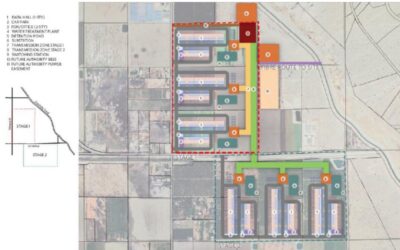
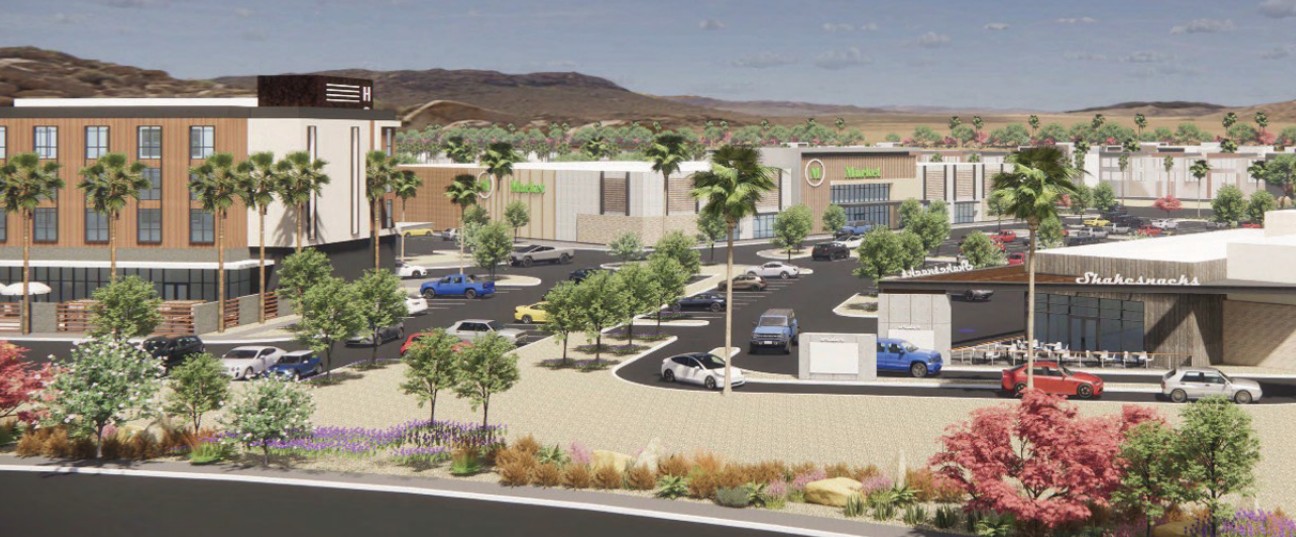
Conceptual plans show housing along Avenue 42, retail and hotel uses near Monroe Street, and employment-generating uses closer to I-10. One concept includes two large industrial buildings. Another divides the industrial space into several smaller buildings, illustrating how the final plan could shift depending on future design and tenant demand.
The environmental analysis studied a maximum buildout scenario of up to 3,240 multifamily units, about 20,000 square feet of commercial space and approximately 1.8 million square feet of industrial space. A second scenario included fewer housing units, more commercial space and the same industrial square footage.
The industrial component became the central issue of the hearing.
BH Properties Makes Its Case
BH Properties is a Los Angeles-based commercial real estate investment firm with more than three decades of experience acquiring, operating and repositioning real estate assets. The company’s portfolio includes multifamily, office, industrial and retail properties across multiple states.
At the hearing, the applicant’s representative described BH Properties as a family-owned, California-based company with a long-term ownership approach, not a short-term investment fund looking to quickly sell the property. That point was meant to frame The Oasis as a long-range development plan rather than a speculative warehouse play.
Jim Brooks, president of BH Properties, has said the company’s approach has been shaped by years of outreach.
“We have been engaged with the community from the inception of this project almost four years ago,” Brooks said. “That has meant listening to residents, meeting with stakeholders, working through concerns and trying to shape a plan that responds to what we heard, particularly the need for more housing, more local jobs, a growing need in the supply of industrial space for a robust regional economy and infrastructure that supports long-term growth.”
The company noted that during the extensive community outreach process, which included several public meetings, more than 700 Indio residents participated. The applicant’s team said that outreach influenced the plan, particularly the inclusion of housing and the package of public benefits.
Housing, Jobs And Public Benefits
The project’s strongest argument is that it would deliver several city priorities at once.
The plan includes a housing component along Avenue 42 and a 5 percent commitment to moderate-income or workforce housing, intended to create attainable opportunities for first-time buyers and working families. Project representatives said housing became a more substantial part of the plan after outreach with residents and city stakeholders.
The employment case is also significant. Project plans estimate 1,272 permanent jobs across the completed development, 2,151 construction jobs at peak activity, and at least 968 construction jobs annually during a projected five-and-a-half-year buildout. The developer has also proposed an Indio-resident hiring goal and annual job fairs.
The industrial and employment-generating portion is central to those job estimates. The applicant’s team emphasized that the plan is not intended for heavy industrial uses. The specific plan would allow a broader range of modern light-industrial and employment-oriented uses, including research and development, business park uses, manufacturing, biomedical operations, food and beverage-related uses, logistics, operations, equipment maintenance and automation.
That distinction matters in Greater Palm Springs, where economic development leaders have long sought more year-round employment, more private-sector diversification and more jobs that can support local households. The developer has positioned the site as a place where Indio could compete for companies in clean energy, advanced manufacturing, innovation-based industries and other modern employment sectors that need freeway access and large sites.
The public benefit package was also central to the presentation. The project would provide land for an IID electrical substation, widen Avenue 42 along the project frontage, add bike and pedestrian improvements, provide enhanced lighting and streetscape upgrades, construct storm drain improvements, reserve space for a future police substation, provide public safety contributions, dedicate roughly three acres of parkland and contribute funding toward the Monroe Street interchange.
Project representatives said the development agreement would require certain infrastructure to be completed before the project opens. In response to concerns about traffic, the applicant’s representative said, “Monroe will be built before the project,” adding that the timing had been analyzed and planned for.
The fiscal impact is also substantial. At the hearing, the applicant said the project could generate an estimated $613 million in economic output and $20 million to $43 million in impact fees, depending on what is built, including about $9 million for schools and roughly $11 million to $20 million for the city.
For a growing city with continuing needs for roads, drainage, utilities, public safety and parks, those commitments are meaningful. They also represent the developer’s central case: that The Oasis at Indio would not simply consume infrastructure, but help pay for and build it.
The Industrial Question
The project’s industrial component drew the most scrutiny from commissioners and public speakers.
City staff and the applicant emphasized that the site along the freeway is already planned for development and should not be viewed as a choice between The Oasis at Indio and permanent open space. The applicant’s team said the existing Indio General Plan buildout could generate more daily traffic than the proposal for The Oasis at Indio would.
According to the presentation, the current General Plan assumptions could generate more than 57,000 daily trips, compared with about 31,500 under even the more intensive scenario analyzed for The Oasis at Indio specific plan. The applicant also said about 69 percent of the trips would be residential, about 28 percent industrial and about 3 percent commercial.
That comparison was important because it suggested that rejection of the current proposal does not necessarily reduce future development intensity. It could leave older development assumptions in place without the same negotiated public benefits.
Still, commissioners focused on the size and permanence of the industrial entitlement.
Indio Planning Commissioner Michael Slater offered the most pointed critique, saying the city was being asked to make a long-term decision about one of its primary gateway corridors.
“This is not just another development site,” Slater said. “This is one of the primary corridors into the city of Indio.”
He said the request to allow 1.8 million square feet of industrial entitlement was “not a small adjustment” but “a permanent identity decision.”
“I do not believe the long-term vision for Monroe north of the I-10 should be defined by warehouse-scale industrial development,” Slater said. “This corridor has the potential to become a destination gateway with regional commercial, hospitality, housing, medical, entertainment, technology and community-serving uses.”
Public Concerns, Narrowed To Core Issues
Public comments largely focused on traffic, air quality, emergency response, building scale and whether the industrial component fits the North Indio setting.
Several speakers, almost all from the nearby Del Webb Sun City Shadow Hills 55+ age-restricted, luxury gated community, said they supported housing and smaller commercial uses but opposed the industrial square footage.
It was hard not to come away with the quintessential NIMBY vibe from the retirees speaking against the project. So much of the complaining focused on traffic. Meanwhile, their gated community of 3,450 homes, which was built from 2003 to 2016, has generated an incredible number of vehicle trips. For example, if each household averaged just two trips out of the community per day, they generate roughly 7,000 one-way trips per day. Going back home doubles that number. That’s approximately 5,000,000 trips per year they have added to local roads since the buildout in 2016. And now they are complaining about traffic.
Meanwhile, Del Webb’s Desert Retreat, another 55+ age-restricted gated community that will consume most of the open land in the northwest portion shown in the image below which is now in development sailed through the entitlement process. What are they doing to improve Monroe Street or Jefferson Street or Avenue 40?
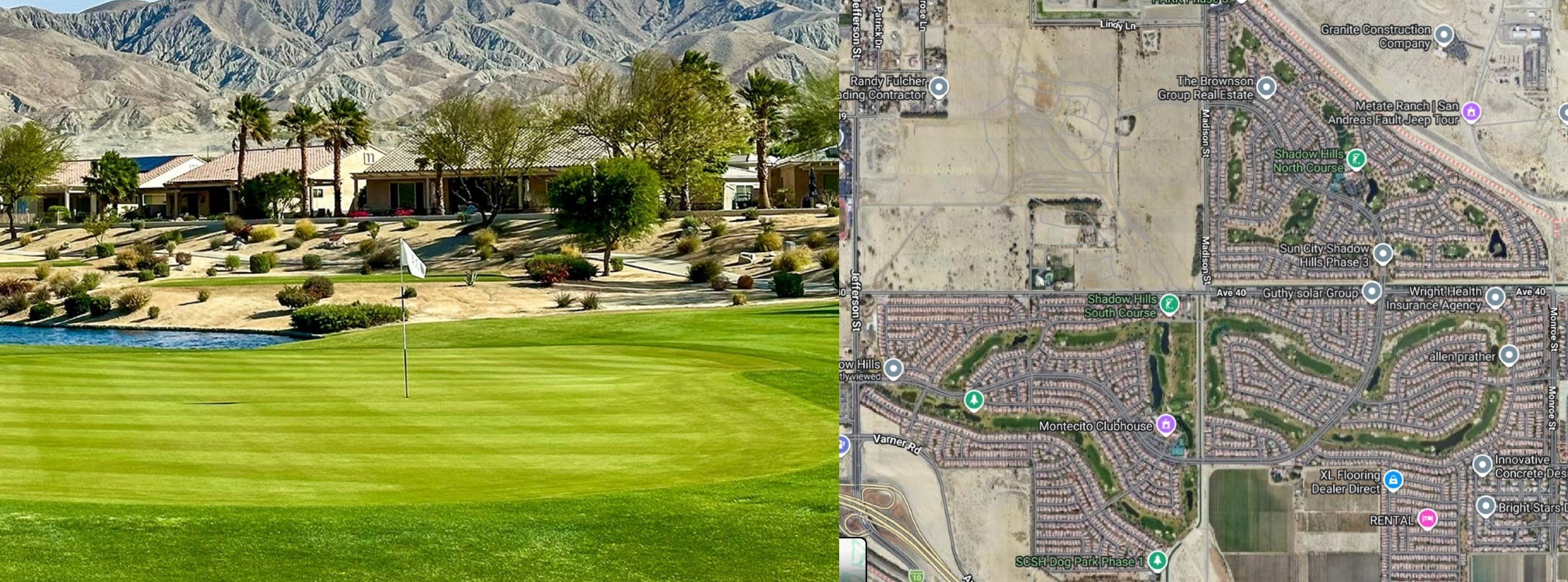
Vast open space, numerous massive lakes, two golf courses, multiple clubhouses and 3,450 55+ age-restricted homes comprise the guard-gated Del Webb Shadow Hills, home to most of those aggressively opposing a development that could provide attainably-priced housing in Indio to thousands of full-time local residents in our regional workforce.
Another angle to consider is that their staunch opposition to the development could hurt the opportunity for full-time local residents in our workforce to secure reasonably priced housing near where they work. While they are occupying 1,000+ square feet of housing per person with yards and pools consuming large loads of energy and water, and many are part-time residents only, they are opposing people living in housing where they would roughly have 250 square feet per person and even less.
A Split Commission
Commissioners were divided over whether the project should advance as proposed.
Commissioner Megan Scarborough-Eckel said the city needs to ensure that growth benefits residents who already live in Indio.
“While I support thoughtful growth, I also want to ensure that we’re building an Indio that existing residents can still recognize, afford and benefit from,” she said.
The commission chair, Gloria Franz, raised a different concern: if The Oasis at Indio does not proceed, the site could still develop under existing or future specific plans that may generate more traffic or place too much housing near I-10.
“I understand that we don’t want warehouses. I get that,” Franz said. “What I’m concerned about is that the traffic impacts of the current approved plan are actually greater, according to all the professionals, than what is being proposed today.”
She said the city and community may need to think more clearly about what should replace the current plan if it is not approved.
Commissioner Felipe Ortiz said he supports investment in Indio, but believes the commission must evaluate long-term consequences.
“I support economic development and investment in Indio,” Ortiz said. “But I also think it’s appropriate for the commission to carefully evaluate long-term land use balance, infrastructure capacity, traffic impacts and the future identity of this corridor, because these are decisions that will shape the city for decades.”
Slater then made a motion “to not recommend this plan as proposed to City Council.” The motion passed 3-2 with Slater, Ortiz and Scarborough-Eckel voting against it and Franz and Jose Santos voting in favor.
The city attorney advised that staff must return with findings to support the commission’s action. Staff indicated that it could happen at the June 10 meeting.
A Setback, Not An Ending
The Planning Commission’s vote is a setback for BH Properties, but not a final defeat.
The underlying issue remains unresolved. The site is too visible, too large and too strategically located to remain undeveloped indefinitely. The question is what kind of development should define it.
The Oasis at Indio, as proposed, offers Indio a large package of housing, jobs, infrastructure, parkland, public safety support and long-term revenue.
The Planning Commission slowed The Oasis at Indio. It did not close the door.