Greater Palm Springs’ next source of talent may already be here – in second acts, remote offices, overlooked résumés and experienced residents ready to contribute.
When employers in Greater Palm Springs say they cannot find workers, the usual response is to widen the search: recruit from farther away, import specialized talent or wait for a new cohort of graduates. Those strategies have a place. But they begin with an assumption worth challenging – that the region’s available workforce is limited to the people already visible in conventional recruiting channels.
A different possibility is hiding in plain sight. Greater Palm Springs may have a talent visibility problem as much as a talent shortage.
The hidden workforce is not one demographic. It includes experienced residents seeking a second act, part-time residents with portable careers and deep networks, remote professionals who are economically present but institutionally disconnected, caregivers who need flexible on-ramps, people with disabilities whose talent is screened out by inflexible job design, veterans, career changers, underemployed service workers and incumbent employees whose next level is trapped behind a missing credential or an outdated job description.
The late-bloomer advantage
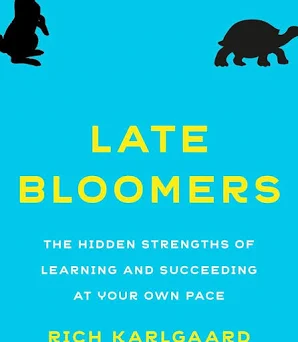
In his book Late Bloomers, author Rich Karlgaard argues that American culture has confused early achievement with lasting potential. We celebrate youthful speed and novelty, he says, while overlooking capacities that often deepen across adulthood: pattern recognition, communication, judgment, executive skill and the ability to remain composed when the obvious plan breaks down.
That is not an argument for replacing younger workers with older ones. It is an argument for age diversity as an operating advantage. Younger workers often bring fluency with emerging technology, new cultural patterns and the urgency to test what is possible. Experienced workers bring context: they recognize the trap before the team steps into it, understand how systems behave under pressure and can distinguish an interesting idea from one that will produce value.
“As a partner, not as a lecturer.”
Rich Karlgaard, on how experienced people can mentor emerging talent
The phrase matters. A hidden-workforce strategy should not be built around nostalgia or hierarchy. It should create reciprocal teams in which experience and emerging skill compound each other.
The local numbers make the case
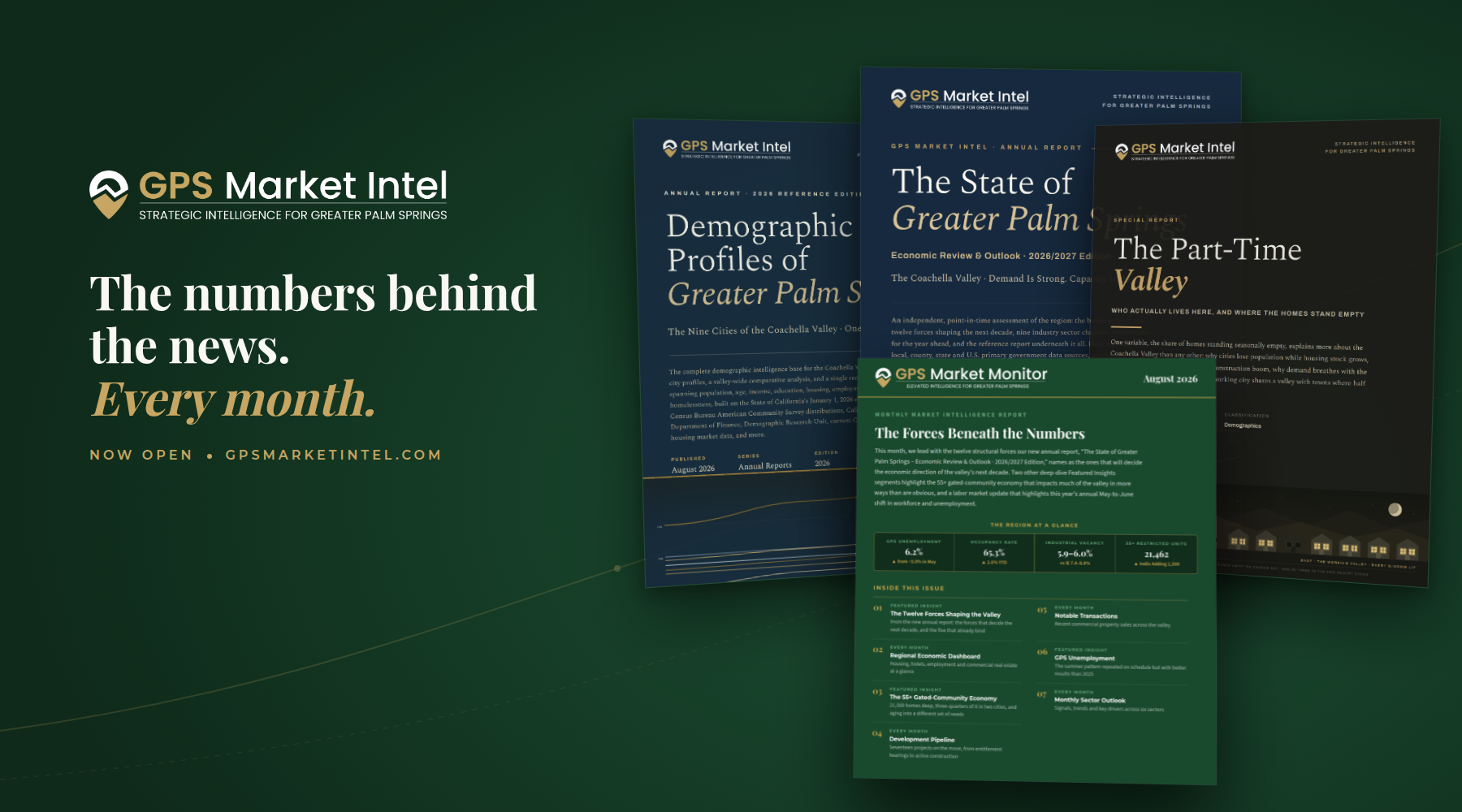
GPS Market Intel’s latest GPS Market Monitor monthly report tracks the region’s labor force and unemployment alongside the sectors and projects shaping demand. Read with the 2026 annual economic outlook, the signal is structural: the valley is expanding its healthcare, hospitality, entertainment, energy and technical-workforce needs just as artificial intelligence and automation begin to reshape many of the service occupations on which the current economy depends.
The city profiles show why a single regional recruiting strategy will miss much of the available talent. Palm Springs is the clearest example. Its January 2026 population estimate is 43,893, its median age is 58.5, and 35.3 percent of residents are 65 or older. Yet the city contains 28,553 jobs compared with roughly 19,200 employed residents, about 1.5 jobs for every employed resident. This is not simply an aging city or a tourism city. It is a city whose employment base and resident base do not line up.
Other Palm Springs indicators point directly toward hidden capacity. Twenty-six percent of working residents work from home, suggesting a substantial pool of professional knowledge that rarely enters local employer networks. Two in five residents were born in another state, and 12.1 percent moved within the previous year; evidence of a population that often arrives with careers, contacts and expertise built elsewhere. At the same time, 15 percent of jobs located in the city pay $1,250 a month or less, while the income needed to carry the median-priced home is estimated near $160,000. Talent is present, but the pathways between people, employers, wages and advancement are weak.
The regional picture is broader still. GPS Market Intel’s demographic work describes an east valley that is younger and growing, a central resort core with concentrated assets, and western cities with distinct combinations of working families, retirees and service-sector employment. The forthcoming workforce question is therefore not ‘Where do the workers live?’ It is ‘Which people are being missed in each community, and what keeps them from participating more fully?’
The 55+ and part-time economies are also talent economies
GPS Market Intel’s special reports on the 55-plus economy and the part-time economy should be read as workforce documents, not only as studies of spending and service demand. The region’s roughly 75,000 part-time residents represent more than purchasing power. Among them are executives, entrepreneurs, health professionals, technologists, designers, educators and skilled operators who may not want a conventional full-time job but could teach, advise, mentor, consult, serve on a project team or help a local business solve a defined problem.
Likewise, an older population should not be treated only as a healthcare market or a fiscal cost. Many residents want purposeful, flexible work; others want to convert what they know into a class, credential, business or community contribution. Karlgaard’s late-bloomer lens reframes longevity as productive capacity – if institutions make it easy to enter.
What employers should do differently
Finding the hidden workforce requires more than a new advertising campaign. It requires redesigning the doorway.
- Hire for demonstrated capability, not résumé chronology. Remove degree requirements that are not essential, use work samples and skills demonstrations, and audit screening systems for age-coded assumptions and unexplained employment gaps.
- Create smaller ways to say yes. Project contracts, seasonal leadership roles, fractional assignments, paid returnships and short consulting engagements can reconnect people who will not enter through a standard 40-hour position.
- Build advancement routes for the workforce already on payroll. A frontline employee who understands the customer, the operation and the culture may be a stronger supervisory candidate than an external hire if the employer supplies the missing digital, financial or management skill.
- Pair generations around real work. Mentoring is most valuable when younger and experienced participants share responsibility for an outcome: a product launch, process redesign, AI adoption, customer-experience project or new venture.
- Design for access. Predictable scheduling, hybrid options, ergonomic adjustments, accessible technology and benefits that work for part-time or phased participation can convert nominal availability into actual labor supply.
The regional opportunity
Greater Palm Springs can turn this dispersed capacity into a regional advantage, but only if employers, industry groups, cities and training providers treat participation as something they can design. Employers can define specific skill gaps and open shorter routes into work. Industry associations can organize project exchanges, peer networks and cross-generational mentoring. Cities can use their convening power to connect resident expertise with local business needs. Education and training providers can translate recurring market gaps into short, stackable learning pathways.
GPS Market Intel has a role as well: use the Market Monitor and city profiles to identify where labor demand, resident skills, wages and participation are out of alignment—and then track whether regional responses are closing the gap. A useful workforce dashboard should measure more than unemployment. It should watch participation by age, internal promotion, part-time-to-full-time movement, return-to-work pathways, flexible and project-based roles, training completion and the share of employers removing unnecessary barriers from job descriptions.
The annual outlook calls the coming workforce disruption one of the forces that will shape the valley’s next decade. The region can endure that disruption as a shortage, or manage it as a transition. The difference will depend on whether businesses and institutions continue counting only the workers they can already see.
Greater Palm Springs does need to grow talent. But first, it should recognize the talent it already has.
NOTE: This draft draws on GPS Market Intel’s State of Greater Palm Springs Economic Review and Outlook 2026/2027 Edition, its August 2026 Demographic Profiles of Greater Palm Springs, the GPS Market Monitor framework, special-report research on the 55-plus and part-time economies, and insights from author Rich Karlgaard and his book Late Bloomers.

Bob Marra is the CEO/Publisher of GPS Business Insider and GPS Market Intel. He has been studying, writing and giving presentations about business, economic and public affairs news and issues and the local economy in the Greater Palm Springs/Coachella Valley region for more than 20 years.