A Sept. 22 Planning Commission vote could open a path to housing on the 35-acre former course, but no subdivision is yet before the city.
The first formal test of Palm Springs’ golf course conversion rules arrives Tuesday, with a decision that could move a long-abandoned course closer to housing while leaving nearly every detail of an actual development unsettled.
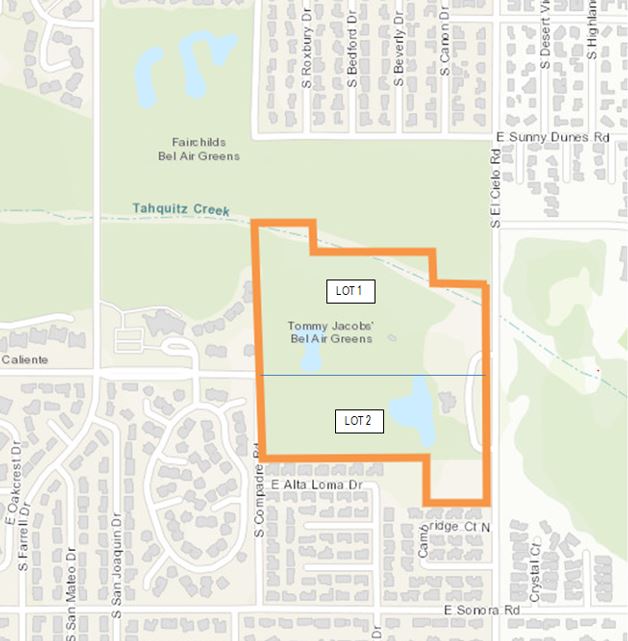
The Palm Springs Planning Commission is scheduled to consider a General Plan amendment for the 35.13-acre former Tommy Jacobs Bel Air Greens course at its Sept. 22 meeting. The amendment would change the land-use designation from Open Space – Parks and Recreation to Very Low Density Residential, which allows 2.1 to four dwelling units per acre.
Planning staff recommends approval, but with a condition that changes the practical meaning of the vote. The amendment would not take effect until the city approves a later tract map, development permit, specific plan or other zoning action that complies with the city’s Golf Course Conversion Ordinance.
No tract map, site plan, home design or subdivision approval is before the commission. The commission is being asked to recommend a land-use change to the City Council and to adopt a mitigated negative declaration for that change. The City Council would hold its own public hearing before taking final city action.
That limited action is important because several housing counts appear in public records, even though none represents a project now eligible for approval.
Three Housing Counts and No Tract Map
The city’s project page still describes a proposal for 71 single-family lots. The 2022 intent-to-convert application and the current staff report refer to a 74-lot concept. The 2025 environmental review also modeled 74 homes, along with 11 open-space lots, for 85 total lots on its conceptual plan.
The latest staff analysis says the ordinance produces a different ceiling. Because at least half of a converted golf course must remain open space, only 17.5 acres could be used for housing. At the maximum of four homes per acre, that would yield no more than 70 homes. Staff says the actual count would probably be lower because part of the northern parcel lies within the Tahquitz Creek floodplain and the required open-space buffer must be placed between new homes and existing residential neighborhoods.
The distinction is more than a math problem. The earlier 74-lot concept reserved about 5.5 acres, or roughly 16 percent of the site, as a desert greenway along the northern edge. The Golf Course Conversion Ordinance, adopted in 2019, requires at least 50 percent open space and generally places the greenway along the perimeter next to existing residential properties. At Bel Air Greens, the closest existing homes are primarily along the south side of the former course.
Staff concluded in 2022 that the concept failed both tests. It provided too little open space and put much of the greenway on the north side near the wash rather than between the proposed lots and established homes. The concept also placed some new lots directly against existing residential parcels, while the ordinance generally requires one-story structures to maintain an average 50-foot setback and no less than 35 feet at any point.
Palm Springs’ current recommendation avoids deciding whether a revised plan can satisfy those standards. Instead, it would make the General Plan amendment effective only when a conforming development application wins approval. The approach gives the leaseholder a route forward while preserving the city’s ability to reject a later subdivision that does not meet the ordinance.
The First Application Under a 2019 Law
Palm Springs adopted the conversion ordinance after closed and financially troubled golf courses raised recurring questions about blight, development rights and the loss of open space. The law created a two-step process that begins with an intent-to-convert application and mandatory community meetings, followed by a formal conversion application and public hearings.
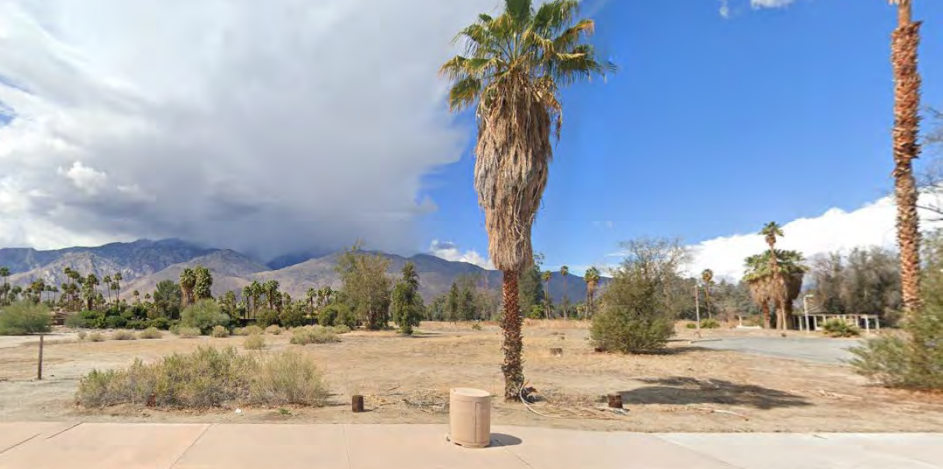
Bel Air Greens is the first application to reach this stage under the ordinance. The nine-hole course opened in the 1970s and closed in 2014. A new 65-year ground lease was negotiated around 1993, according to the staff report, and the leaseholder is Tommy Jacobs Bel Air Greens LP. The land itself is held in federal trust for five individual allottees who are members of the Agua Caliente Band of Cahuilla Indians.
The ownership structure adds another layer to the process. Under the city-tribal land-use agreement cited in the 2022 staff report, final action by the Palm Springs City Council may be appealed to the Tribal Council. The city therefore controls the municipal General Plan and zoning review, but its council decision is not necessarily the last administrative step.
The earlier public process showed how difficult the conversion will be. Roughly 180 people joined two online outreach meetings in 2022. In the applicant’s own summary, the vast majority of participants wanted the property preserved entirely as open space, and many opposed extending Mesquite Avenue through the site from Compadre Road to El Cielo Road.
The debate also unfolds next to a prominent local example of the conservation alternative. The former Mesquite Golf and Country Club property to the west and north was acquired by Oswit Land Trust in 2022 and became the 120-acre Prescott Preserve, which is now undergoing ecological restoration. During the Bel Air Greens outreach, supporters of preservation urged a similar outcome for the smaller course.
Environmental Review Looks Beyond the Vote
Although Tuesday’s hearing does not include a development plan, the environmental document looks well beyond a map amendment. The 2025 initial study modeled the 74-home concept and estimated 698 daily vehicle trips, 147 residents, annual water demand of 44.68 acre-feet and about 22 school-age students.
The study found that potential effects could be reduced below significant levels through mitigation. Those measures include preconstruction surveys and protections for burrowing owls and nesting birds, archaeological and tribal monitoring, geotechnical requirements and controls for contaminated soil or old fuel and oil materials. The city’s CEQA documents page posts the initial study and supporting technical reports.
The city received 147 comments during the 20-day public review in August 2025. Staff says the comments did not produce new information requiring the study to be revised or recirculated and recommends that the commission adopt the mitigated negative declaration.
The environmental work does not resolve the lot-count conflict. The study evaluated 74 homes because that was the conceptual plan supplied for analysis. The current planning report says the conversion ordinance would allow no more than 70 homes and likely fewer. A future applicant would still have to submit a plan that establishes the actual number of lots, the placement and maintenance of at least 17.5 acres of open space, the Mesquite Avenue connection, drainage and floodplain treatment, setbacks, utilities and access.
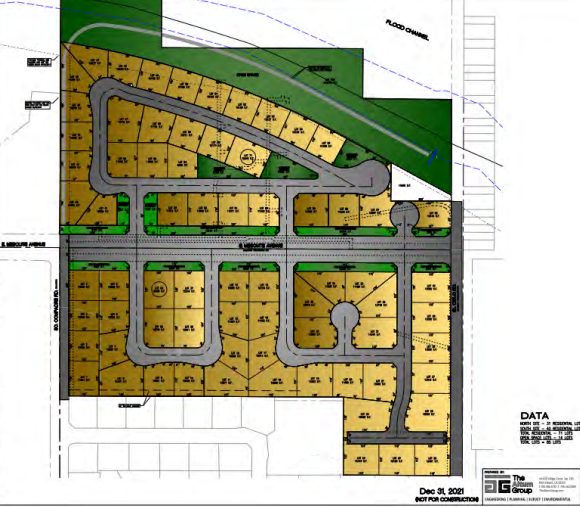
The conceptual site plan presented to the city as part of the notice of intent for a golf course conversion.
What the Sept. 22 Vote Would Do
The commission’s formal assignment is to decide whether the proposed map amendment meets the findings required for a General Plan change under California Government Code section 65358. Staff says it does, citing consistency with the site’s existing single-family zoning, surrounding low-density neighborhoods and the city’s stated goal of expanding housing opportunities.
Staff also acknowledges that the General Plan amendment alone cannot establish compliance with the conversion ordinance. Its recommended condition is designed to keep the residential designation dormant until a later project proves that compliance.
A favorable recommendation would therefore advance the entitlement process without creating buildable lots. A denial would interrupt the first formal effort to use the conversion ordinance on a closed Palm Springs golf course. Either outcome will influence how owners, leaseholders, neighbors and conservation groups approach other golf properties that lose their original use.
Whatever number appears on a future tract map, the controlling figure is the ordinance’s 50 percent open-space floor. Tuesday’s vote will determine whether negotiations over the remaining half can continue under a residential General Plan designation.