How the federal government set the Colorado River’s rules for the next decade without analyzing what they would do to California’s largest lake
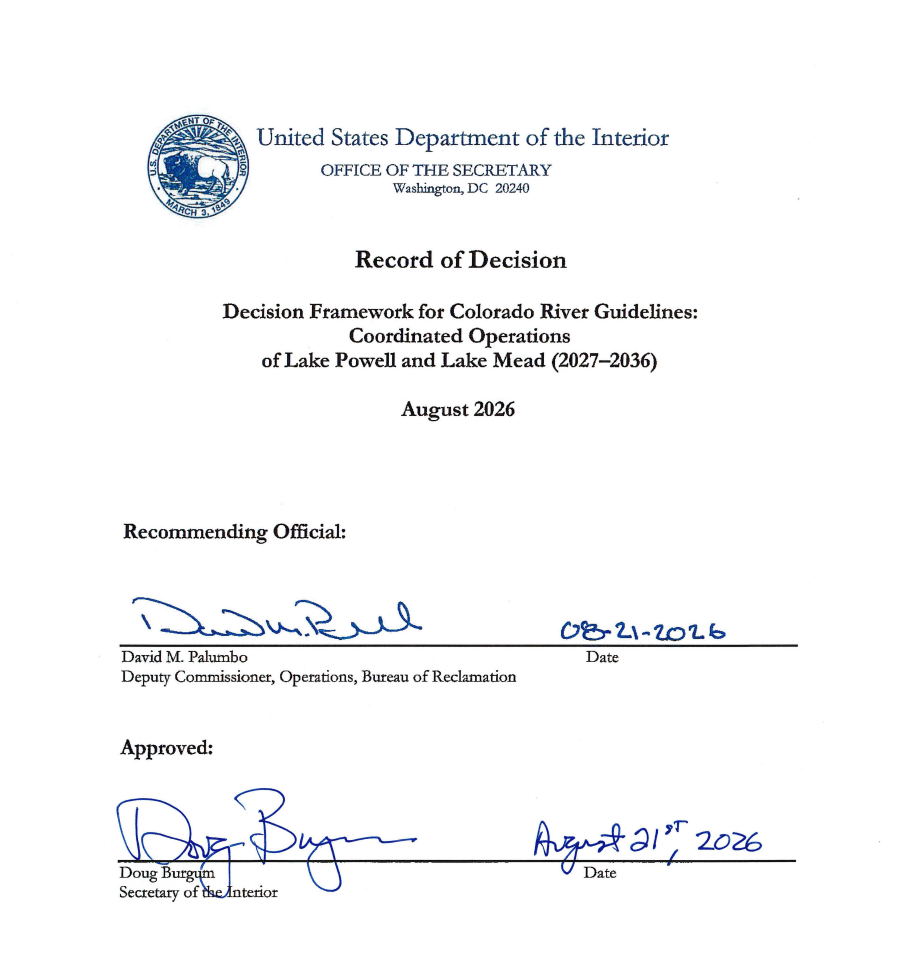
On July 31, the Bureau of Reclamation (Reclamation) released the Final Environmental Impact Statement for post-2026 Colorado River reservoir operations. On August 21, it signed the Record of Decision.
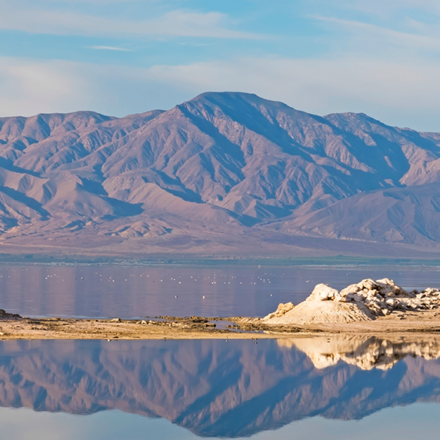
They govern Lake Powell and Lake Mead, which is to say they govern how much water reaches the Imperial Valley, which is also to say they govern the Salton Sea. California’s largest lake sits at the end of the largest single delivery on the river and receives roughly nine-tenths of its inflow as farm drainage from that valley.
The Final Environmental Impact Statement does not analyze what the new rules will do to it. The document says so directly.
The reasoning had shown up two years earlier, in miniature, and it runs the same way in both places. Federal action brings the harm sooner. The years that acceleration adds are then set aside, because a program run by someone else is said to cover them. Nobody examined the program.
The smaller version
In 2024, Reclamation approved an agreement paying the Imperial Irrigation District to leave water in Lake Mead: 700,000 acre-feet over three years, an acre-foot being enough to cover an acre a foot deep. It reduced the district’s Colorado River deliveries by as much as roughly 300,000 acre-feet in a single year, and Reclamation’s own analysis projected an average 11.9 percent reduction in the drain flows that keep the Sea alive.
Reclamation approved it with a Finding of No Significant Impact, the determination that an action does not warrant a full environmental impact statement.
The finding does not conceal what the action would do. It states that the project “will accelerate the lowering elevation of the Salton Sea, thereby accelerating the exposure of the shoreline,” and that this will bring an earlier increase in windblown dust, in hazardous air pollutants, and in “exposure to communities surrounding the Salton Sea.”
Then it explains why that does not count. “However, while it is possible that these events may occur earlier, they will still occur without the Proposed Action.” The acceleration tapers off to projected baseline levels by 2045, and “no net increase in the exposure of the playa results in no increase of overall potential dust emissions through 2045.” As for the dust in the meantime, the exposed acreage “will be addressed by the IID’s Salton Sea Air Quality Mitigation Program Plan.“
The dust arrives sooner. It arrives over communities the same document identifies as having a higher share of Latino residents and a higher poverty rate than California as a whole. It is not significant, because by 2045 the lines on the graph meet, and because a state program covers the interval.
Twenty-one years is not a rounding error. It is a childhood. It is the span in which a kindergartner in Mecca or Niland becomes a parent.
The program Reclamation pointed to is real and careful work, and not quite what the finding implies. Published by the district in 2016 to address mitigation owed for the original transfer of Imperial Valley water to the coast, it describes its purpose as to “detect, locate, assess and identify options to mitigate dust emissions,” and states that it “is not intended to make predetermined decisions regarding the implementation of air quality mitigation.” It is also reactive by design: until playa is exposed, it says, “the location, frequency and magnitude of future emissions are unknown.” A program built for one action, on a projected schedule, was assumed to absorb another that pulls the schedule forward. Reclamation asserted it would without examining whether it could.
What the finding offers in the meantime is monitoring: drain flows measured, shoreline vegetation watched by satellite. When a drain runs dry, IID is to send a water truck, and to keep sending one each day until flows return.
Water trucks, against 700,000 acre-feet.
The larger version
Two years later, the same reasoning was applied to the operating rules for an entire river.
Section 3.2.7 of the Final Environmental Impact Statement is titled “Salton Sea.” It exists because the public asked for it: “During scoping and public review of the Draft EIS, Reclamation received comments requesting analysis of impacts to the Salton Sea.” Its fourth sentence reads, “As explained below, analysis of impacts to the Salton Sea is not included in this EIS.”
Two reasons follow.
First, any impacts fall within a range California is already using. Reclamation notes that the state’s long-range plan projects future conditions across three inflow assumptions, from 889,000 acre-feet down to 444,000, and concludes that “while any resultant impacts to the Salton Sea may be accelerated by Post-2026 policies, the overall magnitude of impacts would not change.”
There is a circle inside that sentence. Reclamation’s own text explains why California used a range: the long-range plan “specifically acknowledges the uncertainty around policy decisions on this Colorado River Post-2026 process.” California planned across a range of futures because it did not know what Washington would decide. Washington then declined to analyze its decision because the result falls inside California’s range.
The Final Environmental Impact Statement also omits a figure. The January draft included it.
The draft worked the problem through. It identified the alternative producing the largest shortage for the Imperial and Coachella Valley districts, modeled that shortage distributed proportionally, and arrived at a number: “the resultant inflow to the Salton Sea would be about 783,000 acre-feet, which is within the range used by the SSMP long-range plan.” It was a hypothetical maximum under one alternative, and the agency said so. It was also the only place in either document where anyone calculated what these rules could mean for the Sea.
In the final document, that paragraph is gone. The sentence it supported is not.
Two other words changed. Where the draft called California’s inflow figures a range being considered, the final calls them a baseline. California’s plan also does not treat those figures as interchangeable points within a neutral range. It labels them High, Low and Very Low Probability scenarios and identifies the highest, 889,000 acre-feet, as “the most reasonably foreseeable average annual future inflow.” The draft’s own number falls more than 100,000 acre-feet below it.
That paragraph was the only attempt in the document to say how deep the added years could run.
The second reason is jurisdictional. “Reclamation does not manage or control the end use of water after the point of delivery.” And: “The State of California oversees management of the Salton Sea, and Reclamation has no management or enforcement authority over inputs to the Sea.”
That is an accurate statement about legal authority. It is also a handoff, and a handoff depends on the condition of the hands receiving it.
The promise
Everything turns on the program said to cover those years. Reclamation describes it in the same section. The state’s management program, it writes, “is working with local, state, tribal, and federal partners to implement the first phase of habitat restoration projects to establish at least 14,900 acres of aquatic habitat and up to 14,900 acres of vegetated habitat by the year 2028.”
That is the assurance Reclamation placed beside its decision not to analyze what the new rules would do to California’s largest lake.
It is checkable. California files a report on it every year.
The obligation comes from a 2017 order of the State Water Resources Control Board setting a year-by-year schedule of acres of exposed lakebed the state would cover with habitat and dust-suppression projects. Shortfalls carry forward. Where a year’s shortfall exceeds twenty percent, the order requires a plan to “cure the deficiency” against “a year’s annual obligation.” Those are the Board’s words, and they are the words of compliance, not aspiration.
Against a cumulative obligation of 17,600 acres through 2025, the state reports 3,896 acres completed. Twenty-two percent. Nothing at all in the first two years.
The composition matters more than the total. At least half the acreage had to provide habitat benefits for fish and wildlife, and the Board wrote out what would not count as habitat, including vegetation enhancement and surface stabilization. One half is ecosystem restoration, the other protection of human lungs. The order was equally specific about what counted toward the schedule at all: the scheduled acreage had to be “in addition to currently planned and funded habitat projects,” including Species Conservation Habitat, the large project at the south end.
Of the 2,177 habitat acres the state reports as completed, all but fifteen are at Species Conservation Habitat. The state counts those acres toward the order.
If that “in addition to” language is applied as written, those acres come out of the compliance tally, and eight years of work comes to roughly 1,700 acres of vegetation enhancement, the precise category the order says is not habitat. Against 17,600 acres. Against a federal document citing 14,900 acres of aquatic habitat by 2028.
California has reasons, and some are good. The Sea receded more slowly than projected, leaving fewer exposed acres to treat, and more than 8,000 acres are under construction now. The state says delivery is coming.
That may be so. It is not the point. A federal decision structuring river operations for the next decade invoked California’s program, yet the Final Environmental Impact Statement gives no indication that Reclamation examined its delivery. The number is filed annually and publicly with a state board.
Reclamation cited the promise. It did not check the delivery. The years it declined to examine are the years that program was named to cover.
One door
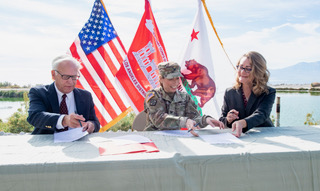
Salton Sea Authority, executive director/GM, Patrick O’Dowd formalizes the SSA partnership in the Army Corps of Engineers Feasibility Study with representatives of the Corps and the California Department of Water Resources.
Across two documents and two years, the reasoning holds steady: the harm described accurately, the acceleration conceded, both set aside because the endpoint is unchanged and another institution has it in hand.
One door identified in the same section remains open. The Army Corps of Engineers is preparing a feasibility study for restoration of the Imperial Streams and the Salton Sea ecosystem, and once that is complete, Reclamation notes, “state and federal funding will be pursued to support the resultant design and construction of restoration projects, beginning around 2028.”
That is a real pathway and deserves to be said plainly. It is also a study that has not concluded, for funding that will be pursued, toward construction that might begin two years from now, in a place where eight years produced fifteen acres of habitat against a schedule requiring thousands.
It will meet the same wall unless someone first answers the question none of these documents has ever asked. Not whether the next action makes things measurably worse than they already are. Against decades of decline, the answer is almost built in: no.
The question is what condition the Salton Sea and the people who live beside it are supposed to reach, and whether anyone intends to get them there.

Bob Marra is the CEO/Publisher of GPS Business Insider and GPS Market Intel. He has been studying, writing and giving presentations about business, economic and public affairs news and issues and the local economy in the Greater Palm Springs/Coachella Valley region for more than 20 years.