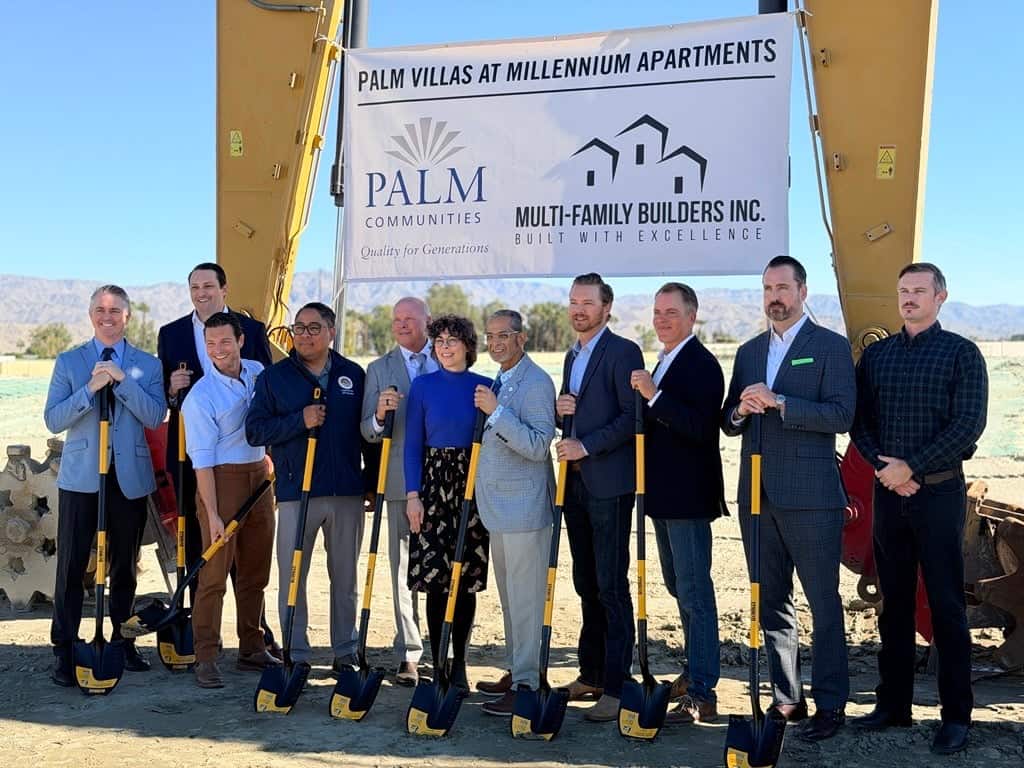
Four newly covered Coachella Valley tracts open another route for investment in rental housing, manufacturing facilities and building rehabilitation, with stronger incentives in designated rural areas.
The Coachella Valley’s new Opportunity Zone map could give developers another way to finance apartments for local workers, space for growing businesses and the rehabilitation of underused buildings, provided those projects meet federal investment rules and attract investors willing to stay long term.
Four census tracts are gaining coverage within a 12-tract regional map that takes effect Jan. 1, 2027. The additions include portions of Desert Hot Springs, Palm Springs and Indio, along with a larger area crossing several municipal boundaries and unincorporated Riverside County.
The Treasury Department and Internal Revenue Service announced the final designations on Nov. 5. California received 620 zones statewide under the renewed program.
For the region, the central opportunity is what can be built within those boundaries. Qualifying investments can include newly constructed rental housing, industrial buildings and substantial renovations that return older properties to productive use. The incentive can improve an investor’s after-tax return, potentially making it easier to assemble the equity a project needs alongside construction financing.
What Types of Real Estate Can Qualify?
Opportunity Zone benefits are available through investments in Qualified Opportunity Funds, which deploy capital into qualifying businesses or property. An investor cannot obtain the benefits simply by buying a parcel with an Opportunity Zone label.
For purchased real estate, two important routes are new construction that meets the program’s original-use requirement and the substantial improvement of an existing building. Acquisition timing, ownership, business use and ongoing compliance also matter.
Within that framework, potential investments include:
Rental housing. Newly built apartment communities, mixed-income developments and rental townhomes can qualify when properly structured and operated. A buyer’s personal residence does not qualify merely because it is inside a zone.
Industrial and flex space. Manufacturing buildings, warehouses, distribution facilities and properties combining workshops, storage and offices can be candidates. Both the real estate investment and any separate investment in an operating business must satisfy the applicable rules.
Mixed-use and commercial buildings. Apartments above shops, medical offices, neighborhood retail and other qualifying commercial uses can fit the program. The incentive is not limited to one property type.
Rehabilitation and adaptive reuse. A qualifying project could renovate an aging apartment property, modernize an industrial building or convert an obsolete building to a new business use. Local zoning, building codes and the economics of the conversion remain separate requirements.
The federal real estate regulations distinguish active business property from passive land speculation. Holding vacant land while waiting for prices to rise is not, by itself, the development activity the incentive is designed to support.
A Potential Source of Equity for Workforce Housing
Rental housing is a particularly relevant application in a region where the ability to live near work greatly affects employees in hospitality, health care, education, agriculture and the skilled trades.
Opportunity Zone investment could provide another source of equity for a qualifying apartment project. That equity is ownership capital exposed to the project’s risks, rather than a conventional loan requiring scheduled repayment.
Consider a proposed apartment community designed for year-round workers. A construction lender may finance only part of its cost, leaving the developer to raise the remaining equity. Investors attracted by the federal tax treatment could help fill that requirement. The possibility of excluding eligible appreciation after a long holding period may also make a completed rental property more attractive to investors prepared to own it through years of operation.
That mechanism can help a project compete for capital. It does not automatically make its apartments affordable.
“Workforce housing” is not a special eligibility category under the Opportunity Zone program, and the federal incentive does not itself require below-market rents. A market-rate apartment development can qualify without reserving units for lower-income tenants.
If a community wants housing affordable at specific wages, the development must be designed and financed around those rents. Public land, local assistance, other compatible financing sources or enforceable affordability agreements may still be needed. The tax benefit improves the investment proposition; it does not erase the difference between what construction costs and what residents can pay.
Industrial Space for Local Employers
The same financing approach could support buildings that give local companies room to operate and expand.
Potential applications extend beyond large distribution warehouses. Smaller industrial suites could accommodate contractors and repair businesses. Flex buildings could combine offices with fabrication or storage. Properly equipped facilities could serve food processors, agricultural businesses and manufacturers.
The distinction matters for economic development. A building designed around a local employer’s operations can support a different mix of jobs and business activity than a speculative warehouse awaiting a tenant.
GPS Business Insider’s reporting on a new steel-fabrication facility in Thousand Palms illustrates the type of industrial activity being considered in the region. That project is not identified here as an Opportunity Zone investment or a beneficiary of the new map.
For a qualifying industrial development, fund equity could help finance construction or a substantial overhaul of an existing facility. But investors still need evidence that businesses want the space at rents high enough to cover its cost. Available power, truck access, building configuration and compatibility with nearby neighborhoods can be as consequential as the tax treatment.
Lease structure also deserves attention. Under federal rules governing Opportunity Zone businesses, owning and operating rental real estate can constitute an active business. Merely entering into a triple-net lease, with the tenant responsible for taxes, insurance and maintenance, does not by itself satisfy the active-business requirement. The regulations distinguish that arrangement from leasing businesses with meaningful management and operating activity.
Existing Buildings Usually Need More Than Cosmetic Work
The rehabilitation rules help explain why the program is more useful for some properties than others.
For an existing building relying on the substantial-improvement route, qualifying additions to its tax basis generally must exceed the building’s adjusted basis at the beginning of a 30-month improvement period. Land value generally is excluded from that calculation.
For example, if a property’s acquisition cost is allocated as $1 million to the building and $500,000 to the land, the standard test generally requires more than $1 million of qualifying improvements within the applicable period. It is not a requirement to spend more than the entire $1.5 million purchase price.
The IRS has illustrated this distinction with a factory building acquired for conversion to residential rental property. Its treatment of land and buildings is relevant to investors considering conversions as well as major renovations.
Simply acquiring a fully leased building, repainting it and continuing to collect rent generally will not satisfy the substantial-improvement test. Special rules can apply to certain vacant properties, but a vacant-building listing alone does not establish qualification.
Rural Incentives Could Make Rehabilitation More Feasible
Treasury classifies five of the valley’s selected tracts as rural, including four overlapping Desert Hot Springs and one in the unincorporated eastern valley.
That classification brings a potentially important advantage for existing buildings. Federal law reduces the substantial-improvement threshold in qualifying rural zones from 100 percent to 50 percent of the relevant adjusted basis.
For a building with a $1 million adjusted basis, the rural test generally requires qualifying improvements exceeding $500,000, compared with more than $1 million under the standard test. A rehabilitation project that cannot justify doubling the building’s basis may therefore have a more practical route to qualification in a rural zone.
The program also gives investors in qualifying rural opportunity funds a larger five-year basis increase on their deferred gain: 30 percent instead of the standard 10 percent. That investor benefit is separate from the reduced building-improvement threshold.
Where the New Coverage Applies
The four newly covered tracts are 445.15 in Desert Hot Springs and unincorporated county territory; 445.24, which overlaps parts of Cathedral City, Desert Hot Springs, Palm Springs and unincorporated land; 452.07 in Indio; and 9414 in Palm Springs.
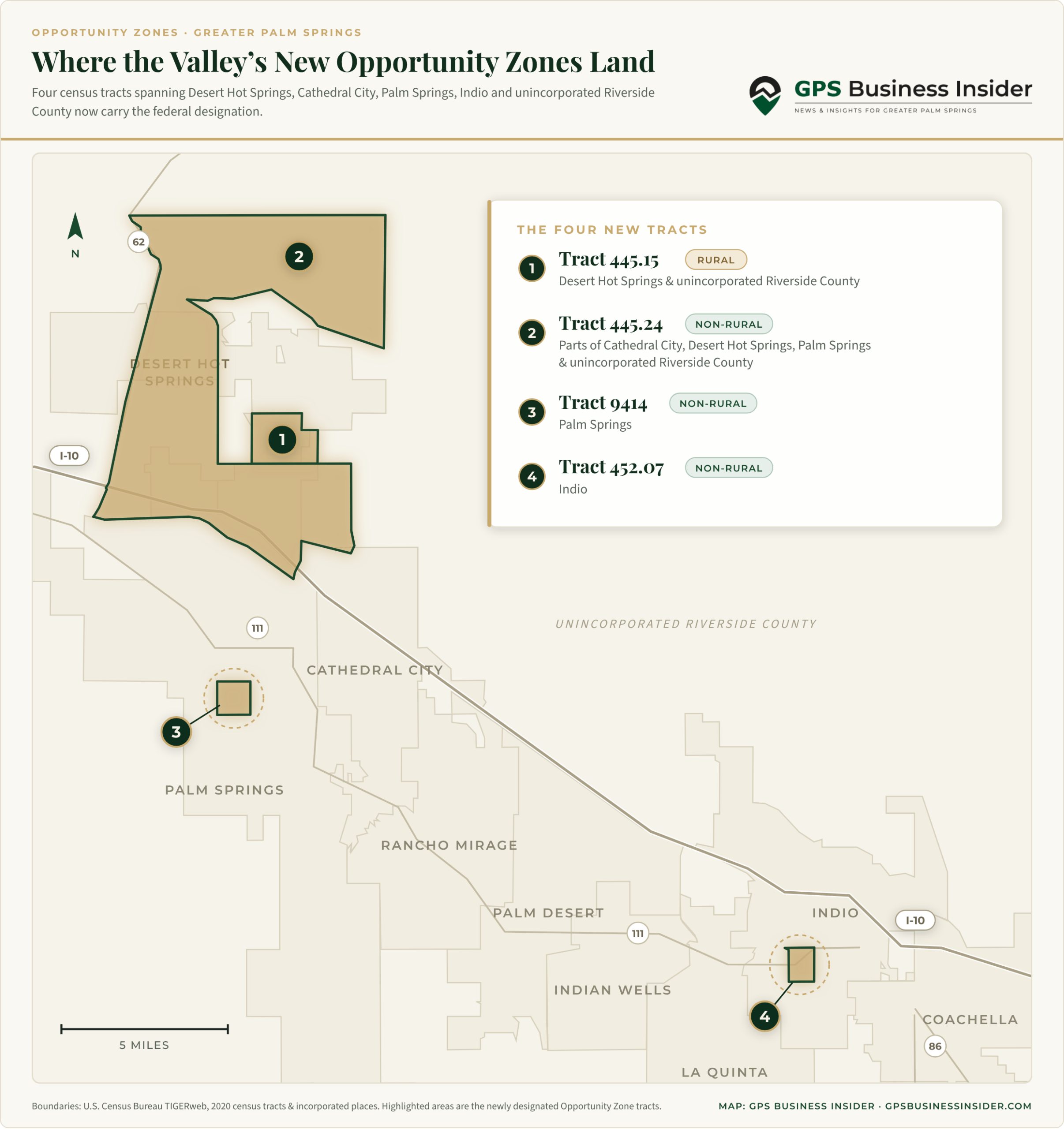
The Coachella Valley’s new Opportunity Zone map includes 12 census tracts, with four newly covered areas. Qualifying investments can support rental housing, industrial development and substantial building rehabilitation beginning in 2027.
The broader 12-tract map also includes portions of Coachella and La Quinta. These are specific geographic areas, not citywide designations. The state’s interactive map allows property owners to examine the boundaries without relying on a mailing address or a broker’s description.
The new designations run through Dec. 31, 2036. Projects using older designations face separate federal transition requirements, so continued appearance on an older map does not establish that a new acquisition will qualify.
What Investors Receive, and What California Does Not Offer
For qualifying investments made beginning in 2027, recognition of an eligible original gain generally can be deferred for up to five years, unless a sale or another inclusion event occurs sooner. A five-year holding period can produce a basis increase that reduces the deferred gain subject to tax.
The longer-term attraction is separate: after at least 10 years, investors may be able to exclude eligible appreciation on the qualifying investment, subject to the program’s rules. That helps explain the program’s relevance to rental housing and industrial properties intended for extended ownership. It does not make rental income tax-free.
California does not provide matching treatment. The Franchise Tax Board says the state does not conform to the federal Opportunity Zone capital-gains deferral and exclusion provisions, including the 2025 changes.

Bob Marra is the CEO/Publisher of GPS Business Insider and GPS Market Intel. He has been studying, writing and giving presentations about business, economic and public affairs news and issues and the local economy in the Greater Palm Springs/Coachella Valley region for more than 20 years.