The price of a new home starts accumulating long before a foundation is poured.
Before a builder buys lumber, hires a plumber or schedules an electrician, a project has already been shaped by land-use rules, permit requirements, infrastructure obligations, utility capacity, development-impact fees, school fees and decisions made by multiple public agencies. Any one of those requirements may have a legitimate purpose. Taken together, they can determine whether a project is financeable, how quickly it can move and what buyers ultimately must pay.
That largely unseen part of development is where much of the Desert Valleys Builders Association’s work takes place.
DVBA has begun a new blog and video series to explain that work more directly, not only to builders, but also to business leaders, public officials and residents who may see the finished homes and commercial projects without seeing the years of policy, entitlement and cost decisions that came first.
That distinction is especially important now, when housing supply and affordability remain central concerns across California, and especially in the Coachella and Imperial Valleys.
The California Department of Housing and Community Development (HCD) itself identifies fees and exactions as potential constraints on housing. HCD notes that development is typically subject to both processing fees and impact fees intended to cover public costs associated with growth, and that cumulative charges can affect project feasibility and affordability.
The issue, then, is not whether growth should help pay for legitimate impacts. It should. New neighborhoods require streets, water and sewer infrastructure, public safety capacity, parks, schools and other facilities that allow communities to function.
The harder question is how those costs are calculated, who should bear them and whether the process is transparent, legally supportable and economically workable.
When a Fee Becomes Part of a Home
That is where advocacy becomes more technical than it may appear from the outside.
DVBA spends substantial time reviewing fee studies, proposed municipal policies and legislation affecting development. The association looks at methodology, legal requirements, cost allocation and the practical effect a policy could have on future projects.
Sometimes the conclusion is that an increase is justified. Sometimes questions need to be asked. Sometimes the industry challenges a proposal.
The objective should not be reflexive opposition. It should be a fair and predictable framework in which communities can fund necessary improvements while housing and other development can still be built.
Development fees provide a useful example.
In the Coachella Valley, combined charges for a single-family home imposed before construction can, depending on the jurisdiction and project, approach $65,000 to $70,000, according to DVBA’s analysis.
A fee does not simply disappear into a spreadsheet. It becomes part of the project’s capital stack. It can increase financing needs and carrying costs. Ultimately, the project must absorb or recover those expenses.
If costs rise far enough, the consequences extend beyond a developer’s return. A marginal project can stop penciling out favorably. A home can move beyond the price range of a prospective buyer. A commercial project can be delayed. Fewer projects can mean less work for contractors, trades, engineers, architects, lenders, suppliers and other businesses tied to construction.
That broader economic ecosystem is one reason the name “builders association” does not fully describe the industry DVBA represents.
Its membership and advocacy extend beyond home builders to commercial and industrial development, renewable-energy projects, architects, engineers, contractors, tradespeople, financial institutions, suppliers, designers and professional-service firms. Construction activity supports an unusually wide chain of local businesses, and policy changes affecting development can move quickly through that chain.
Why the Methodology Matters
One public example of DVBA’s fee work came in Cathedral City in 2023, when the association reviewed proposed land-use and regulatory fee changes and a development-impact fee study. DVBA questioned parts of the methodology and how certain costs were allocated between new development and the existing community.
The larger lesson is not whether every DVBA objection was correct. It is that fee studies deserve scrutiny because the assumptions inside them can eventually become real costs attached to housing and other development.
That work has received recognition outside the region. The National Association of Home Builders gave DVBA a 2023 Association Excellence Award for Best Service to Members for its Tri-Annual Comprehensive Fee Study Report.
NAHB has also supported DVBA in litigation involving development-impact fees in Coachella, illustrating how technical local fee issues can raise broader questions for the building industry.
Policy work also depends on relationships and institutional knowledge.
DVBA’s Legislative Affairs Forum, held on the first Thursday of each month at Rancho Mirage City Hall, brings industry representatives together with people from municipalities, utilities, tribal governments, transportation agencies and other public organizations.
The purpose is not simply to react when a particular project reaches a hearing. It is to understand policy changes earlier, exchange information and identify problems before they become more difficult and expensive to solve.
That kind of communication matters because development decisions rarely occur in isolation.
A city may be considering a fee update. A utility may be planning infrastructure. A state law may alter permitting requirements. A transportation agency may change a mitigation program. Each decision may be reasonable on its own, yet the cumulative effect can materially change the economics of delivering housing.
For public agencies, that is also why predictability matters almost as much as cost. Builders and lenders can underwrite known requirements. Sudden or poorly explained changes are harder to accommodate once land has been acquired, plans prepared, and financing assumptions established.
Bringing the Policy Debate Into Public View
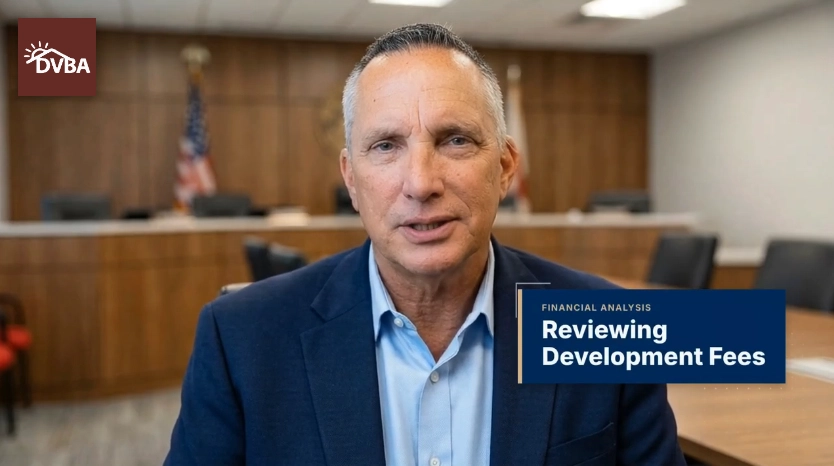
The new DVBA blog and video series is intended to make more of this process visible.
The first installment, “What Real Building Industry Representation Looks Like Behind the Scenes”, focuses on the government and public-affairs work that occurs before a project becomes visible to the public.
The second, “Development Fees Matter, But So Does How We Get There”, examines how infrastructure costs are calculated and allocated and why the methodology behind a fee can matter as much as the amount.
Future public-affairs discussions can provide a useful window into permitting, infrastructure, utilities, legislation and other issues that influence whether projects advance from concept to construction.
This information should matter beyond the development community.
Municipalities need investment to expand their tax base and accommodate housing demand. Employers need housing choices for workers. Contractors and suppliers need a viable pipeline of projects. Residents expect infrastructure and public services to keep pace with growth. Future homeowners need homes they can afford.
Those interests will not always align perfectly, and disagreement is inevitable.
But the most productive policy debates start with the same basic questions: What problem are we trying to solve? What does it actually cost? Who benefits? Who should reasonably pay? What does the law require? And what will the decision do to the next project that has not yet been built?
Good communities need functioning, effective and efficient government. They also need a development industry capable of producing housing, workplaces and infrastructure.
The goal should be to make both possible.

James Brownyard is the Executive Officer of Desert Valleys Builders Association, an association of building industry professionals, representing all levels of the construction industry and committed to ensuring that building of all types remains vibrant and strong in our region while protecting the natural beauty of the Coachella and Imperial Valleys.