As major freeway projects become harder to finance, regional transportation officials are exploring smaller changes to lanes, signals and ramps that could improve traffic flow while buying time for larger investments.
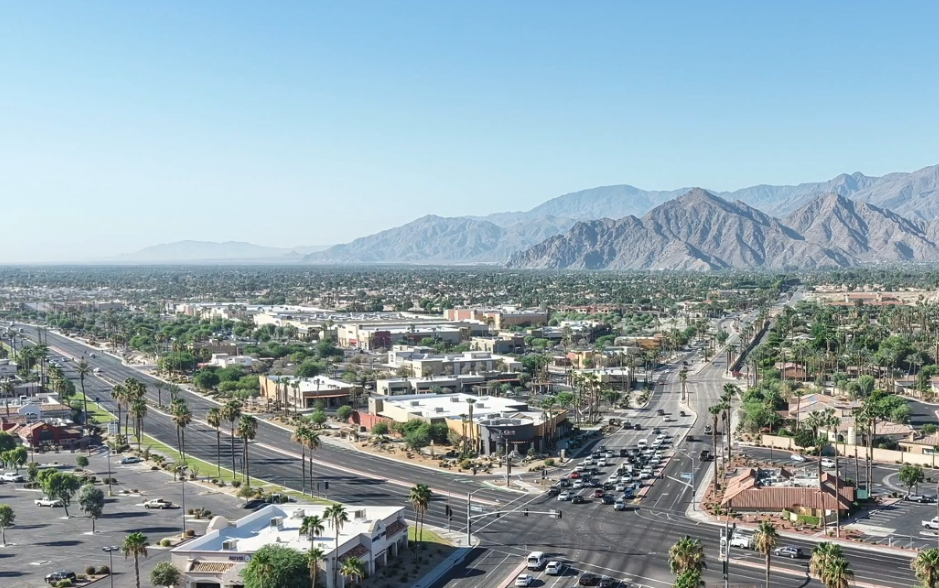
For years, the Coachella Valley’s answer to growing traffic volume along Interstate 10 has largely been an expensive proposition: rebuild the interchange.
Now, with the estimated cost of the region’s next seven interchange projects approaching $1.7 billion and insufficient state or federal money currently committed to pay for them, regional transportation officials are beginning to ask whether some of the valley’s most pressing congestion problems can be attacked another way.
The Coachella Valley Association of Governments (CVAG) is working with Caltrans to examine lower-cost improvements at I-10 interchanges that could include changes to lane configurations, restriping, traffic-signal timing and other relatively modest modifications within existing rights of way.
The initiative has emerged from a broader examination of CVAG’s transportation finances, where rising construction costs and an increasingly difficult funding environment are forcing the agency to reconsider how Greater Palm Springs builds, prioritizes and pays for regional infrastructure.
“We’re up close to $1.7 billion just to build this next seven,” Jonathan Hoy, CVAG’s director of transportation, recently told the agency’s Transportation Committee in describing updated cost estimates.
Instead of waiting for enough money to reconstruct every interchange, Hoy said, CVAG wants to determine whether operational changes can deliver meaningful improvements sooner.

“This isn’t the $1.7 billion interchange construction,” Hoy said. “This is something we can do in the interim to just help efficiency at the interchanges along I-10.”
The shift does not mean CVAG is abandoning major interchange projects. It reflects a growing financial reality confronting the regional agency responsible for coordinating the Coachella Valley’s largest transportation investments.
CVAG has been warning its member cities about transportation cash-flow pressures since at least 2020. Its March 2026 five-year projection showed the agency’s transportation fund balance falling more than $4 million below zero by the end of fiscal 2028-29, even after $50 million in additional state and federal funding secured in late 2025.
The overriding force behind this scenario is simply that the price of the infrastructure the valley hopes to build has climbed dramatically.
Seven Interchanges, a Very Different Price Tag
A presentation prepared for CVAG’s transportation discussions puts the funding problem into unusually stark terms.
The seven freeway interchange projects completed over the past decade cost about $410 million combined, with roughly 65 percent of the funding coming from outside sources and 35 percent from local sources.
CVAG’s latest estimate for the next seven interchange projects is approximately $1.7 billion.
Hoy’s presentation shows that virtually all currently secured funding for those future projects is local, underscoring how little state or federal money has been secured so far for the next generation of interchange construction.
The contrast is significant for Greater Palm Springs because the region has historically used local transportation dollars as leverage to attract substantially larger state and federal investments.

That model becomes much harder to sustain when construction costs rise faster than revenue and outside funding becomes scarcer.
CVAG has cited the planned I-10/Monroe Street interchange as one example of the cost escalation, saying its projected price has risen approximately 150 percent compared with the last interchange constructed in the region.
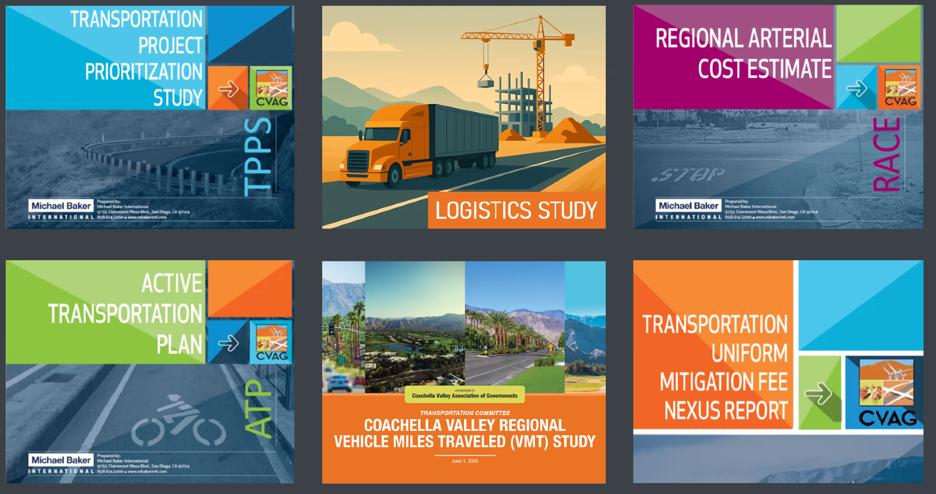
The squeeze has prompted CVAG to undertake a more comprehensive review of its transportation program, including updates to its Transportation Project Prioritization Study, Regional Arterial Cost Estimate, Active Transportation Plan and Transportation Uniform Mitigation Fee program (TUMF).
TUMF is the regional development-impact fee imposed on new residential and commercial development to help fund transportation improvements attributable to growth. Current fees range from $1,520 per 1,000 square feet of industrial development to $7,535 per 1,000 square feet of retail space, while a new single-family home carries a $2,900 fee.
The updated studies will help determine which projects should receive priority and how much new development should contribute.
A Search for Smaller Fixes
CVAG formed a transportation cash-flow ad hoc committee this year that met five times between May and August.
Representatives from the nine Coachella Valley cities, Riverside County and the Agua Caliente Band of Cahuilla Indians examined revenue, project costs and potential policy changes.
The discussions included potentially increasing fee revenue, changing regional and local cost-sharing arrangements, reconsidering project priorities and finding less costly ways of addressing transportation problems.
One idea quickly gained traction: before committing hundreds of millions of dollars to rebuild an interchange, determine whether the existing interchange can work better.
CVAG staff pointed to several examples.
At Cook Street, officials believe changes in striping, lane configurations and signal operations could potentially increase capacity without rebuilding the interchange.

Similar opportunities may exist at Washington Street.
At Date Palm Drive, Hoy described a configuration in which traffic approaching the freeway from eastbound Vista Chino moves from three lanes into a single lane before expanding again for freeway movements, creating what staff sees as a potential bottleneck.
“There are different choke points, different things where it seems like there could be a better way,” Hoy told the committee.
Those observations led CVAG to begin developing a valley-wide scope of work examining freeway interchange operations.
Rather than focus solely on major construction, the study would examine how traffic moves through ramps, intersections and adjacent arterial streets and identify improvements that could be implemented within the existing transportation footprint.
The analysis would also incorporate accident data.
CV Sync Could Become Part of the Solution
CVAG enters that effort with a tool the region lacked when many of its earlier freeway projects were designed.
Its CV Sync regional traffic-management program is creating a valley-wide network of interconnected traffic signals, fiber-optic communications and transportation-management technology.
CV Sync ultimately is intended to encompass more than 550 traffic signals, allowing local jurisdictions to coordinate traffic movement across city boundaries instead of operating individual signals largely in isolation.
That matters at freeway interchanges because congestion rarely ends at the freeway ramp.
Traffic backing up onto Cook Street, Washington Street, Date Palm Drive or another major arterial can affect surrounding intersections, while poorly timed local signals can contribute to congestion entering or leaving I-10.
CVAG says the regional system lets it evaluate how changes on the state highway network interact with local streets.
That opens the possibility that some congestion relief could come from coordinating the freeway interchange and surrounding arterial network as a single operating system rather than treating each as a separate project.
CVAG and Caltrans District 8 have now formed a working group to develop a scope of work for the effort.
The expected sequence is to define the study, issue a request for proposals and hire a consultant to evaluate potential improvements.
No construction program or project budget has yet been approved.
The Challenge Is Also One of Priority
There is another complication.
From Caltrans’ perspective, Coachella Valley interchanges are competing for attention and funding with some of the most congested transportation corridors in Southern California.
District 8 covers both Riverside and San Bernardino counties, including heavily traveled portions of Interstate 10, Interstate 15 and State Route 91.
CVAG Executive Director Tom Kirk told the Transportation Committee that state transportation officials do not necessarily view the desert’s interchange congestion with the same urgency as local officials.
For District 8, he said, the comparison is often with much more severe congestion in western Riverside County and San Bernardino County.
“These aren’t high priority projects for them,” Kirk said. “What I would encourage you to do every time you see them is remind them that they are high priority projects for us.”
Kirk said the smaller interchange improvements could potentially be completed within the next several years and at “a relatively modest cost,” although the specific projects, schedules and costs remain to be determined.
For a region confronting a multibillion-dollar infrastructure wish list, that distinction could become increasingly important.
Measure A Looms Over the Broader Discussion
CVAG’s financial deliberations are also unfolding as Riverside County voters prepare to decide the future of one of the region’s most important transportation funding sources.
The Riverside County Transportation Commission voted in June to place a renewal of Measure A, the countywide half-cent transportation sales tax, on the November 2026 ballot.
The existing tax, first approved in 1988 and renewed by voters in 2002, runs through 2039. The proposed renewal would continue the tax beyond 2039 without increasing the existing half-cent rate.
Measure A has become a core funding source for highway, local street and transit projects throughout Riverside County and has generated more than $2.9 billion since 2009.
CVAG’s ad hoc committee discussed the proposed renewal as part of its broader examination of transportation revenues, but even continued local sales-tax funding would not by itself erase the challenge posed by the region’s rising project costs.
CVAG previously estimated that updating its regional transportation project list from older cost assumptions could push the overall value of identified transportation improvements above $7 billion.
The agency’s task now is to determine which projects the region can realistically afford, how costs should be divided among CVAG and its member jurisdictions, what development should contribute through TUMF and how aggressively the valley should pursue alternatives to full-scale construction.
A more complete set of recommendations is expected to return to CVAG committees later this year.
In the meantime, the interchange-efficiency initiative represents one early indication of how the region’s transportation strategy may be changing.
The question is increasingly not simply what should be built.
It is what can be done with the infrastructure Greater Palm Springs already has.

Bob Marra is the CEO/Publisher of GPS Business Insider and GPS Market Intel. He has been studying, writing and giving presentations about business, economic and public affairs news and issues and the local economy in the Greater Palm Springs/Coachella Valley region for more than 20 years.