A missed construction-pricing milestone has triggered a formal cure process for one of Palm Springs’ longest-delayed developments, with financing due by the end of September and construction scheduled to start the next day.
After years of extensions, redesigns, financing challenges and repeated efforts to restart one of the city’s most prominent unfinished developments, Palm Springs has formally placed the developer of the Dream Hotel in default.
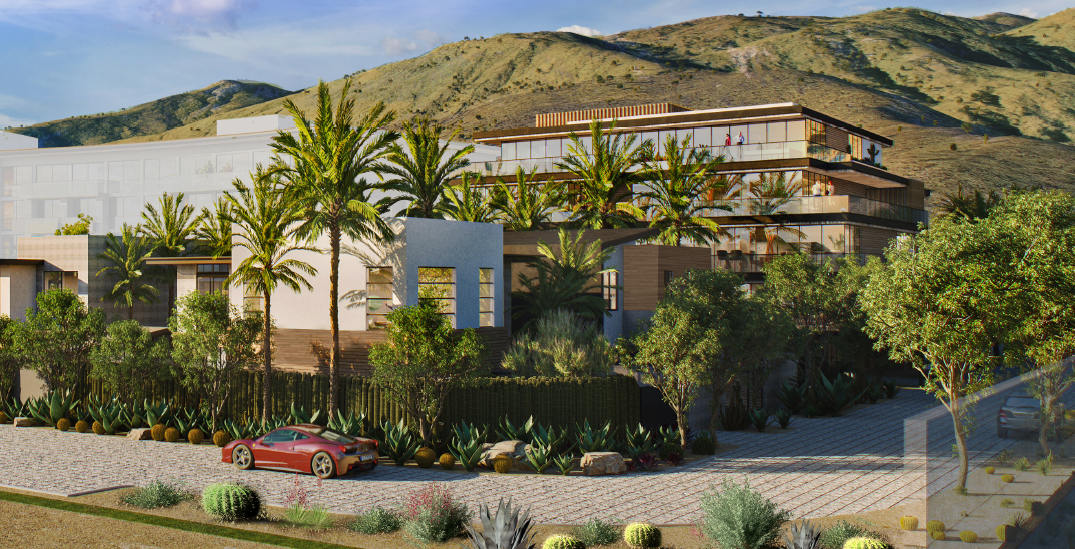
The action marks a significant escalation in the city’s dealings with Selene Palm Springs LLC, developer of a hotel and residential project planned on roughly 7.8 acres immediately north of Amado Road between Calle Alvarado and Avenida Caballeros, across from the Palm Springs Convention Center.
The immediate issue is a deadline that passed on July 30.
Under a development agreement revised by the City Council in March, Selene was required by that date to establish a Guaranteed Maximum Price (GMP) for construction. The developer did not do so.
On Aug. 3, an attorney representing Palm Springs sent Selene a formal Notice of Default by certified mail and email, beginning a contractual process that could ultimately allow the city to regain control of land it sold to the developer a decade ago.
The issue comes before the Palm Springs City Council on Sept. 9, when staff is asking council members to receive a detailed status report and provide direction.
For now, the distinction is important: the project agreement has not been terminated, and the city has not exercised its option to repurchase the property.
But for a prospective development that has spent much of the past two decades moving through successive versions, approvals and construction timetables, the default places considerably more pressure on what happens next.
Dream Hotel project gets a 30-day window, but an uncertain expiration date
The city’s default letter requires Selene to cure the violation within 30 calendar days after receiving the notice.
The cure specified by Palm Springs is not simply delivery of the missing GMP. Instead, the city is requiring the developer to submit an updated Schedule of Performance with new dates for each step necessary to complete the project.
That distinction could become important.
Any cumulative modification of more than 90 days to the project’s existing performance schedule requires City Council approval. That means a significant new extension could put the future timetable, and potentially the city’s willingness to continue with it, directly in front of elected officials.
The city’s letter is explicit about the stakes. If the default is not cured, Palm Springs says it will move to repurchase the property under the development agreement.
The GMP sits directly in the project’s financing path
A Guaranteed Maximum Price is more than another administrative milestone in this project.
It is a central component of the financing process.
Selene has said publicly that Suffolk Construction was selected as general contractor and has been pricing the project as construction documents advanced. Earlier this year, the developer described a sequence in which an interim construction price would allow a financing package to be circulated to prospective lenders and investors, followed by a final GMP that could be incorporated into definitive financing documents.
The developer’s public Dream Hotel project updates have repeatedly described the GMP as necessary to close the financing.
That makes the July 30 miss more consequential because the revised city schedule calls for financing to be completed by Sept. 30 and construction to begin Oct. 1.
Those dates have not been formally changed.
The March agreement also strengthened the city’s oversight of financing. Selene must provide regular written updates on its financing status and schedule, and a financing delay that prevents the development schedule from being met can itself constitute a default.
In practical terms, the project now has a sequence problem: the final construction price remains unresolved, financing is supposed to close within weeks, and construction is contractually scheduled to begin immediately afterward.
A project nearly two decades in the making
Few major Palm Springs developments have accumulated a history as long as the Dream Hotel.
The city first approved a mixed-use hotel and condominium project on the site in 2007. The concept changed repeatedly during the years that followed.

A groundbreak event, held several years ago, is another action along the way that culminating in inaction.
In 2013, Palm Springs entered into a purchase and sale agreement for the city-owned property as part of plans for what was then envisioned as a 200-room Dolce hotel. The eventual sale to Selene closed in 2016 for $2 million.
Dream Hotels was subsequently selected as the brand, and in 2017 the council approved a significant redesign calling for a 170-room hotel and residential condominiums.
Construction eventually began on the foundation and underground portions of the principal building, but work stalled.
The developer has attributed the interruption to the pandemic, financing disruption and the need to redesign and reprice the project as construction economics changed.
By 2023, Palm Springs and Selene had entered into a new Settlement and Development Agreement designed to resolve previous disputes and establish yet another path toward completion.
The city and developer returned to the agreement again this March.
As GPS Business Insider reported at the time, the amendment imposed a new series of deadlines, increased financing oversight and converted the project to a single construction phase.
The current plan calls for 150 to 160 hotel rooms, at least 40 residential units in the hotel tower eligible for short-term occupancy and generating transient occupancy tax, and at least 36 additional luxury villas that would not operate as short-term rentals.
The finished property is required to operate at a four-star level or better and include multiple restaurants, a bar or lounge, concierge and valet services, pools and other resort amenities.
The Dream Hotels brand itself is now part of Hyatt’s hotel portfolio after Hyatt acquired the Dream Hotel Group brand and management platform in 2023. Selene has said Hyatt is expected to manage the Palm Springs hotel under the Dream flag.
What a city repurchase could actually mean
The city’s repurchase rights are potentially significant because Palm Springs originally owned the site. But the agreement does not provide for the city simply to take the land back for the $2 million Selene paid in 2016.
Instead, the repurchase price would be the lower of two calculations.
One would start with the original property purchase price and add qualifying amounts paid by the developer for design, entitlements, construction and other documented hard and soft project costs. The other would be the fair-market value of the property and its existing improvements, based on an appraisal.
If the city exercises the option, the lower figure controls.
That means the cost to Palm Springs cannot be determined from the current staff report. The project already includes substantial underground and foundation improvements, and years of architectural, engineering, entitlement, and other expenditures could factor into the contractual calculation.
The agreement gives Palm Springs six months following a qualifying event to exercise the repurchase option. If an election is made, closing would occur between 60 and 180 days after the city serves its repurchase notice.
No such action is presently before the council.
The next decision may be about more than another extension
The Dream Hotel has survived multiple economic cycles, project redesigns, ownership and branding changes, revised construction schedules and years of neighborhood concern over the fenced and partially developed property.
Palm Springs has repeatedly signaled that it still wants the project to succeed.
Even the Aug. 3 default notice begins by saying the city remains enthusiastic about the development and appreciates the developer’s investment. It also points to Palm Springs’ expanded Hotel Operations Incentive Program as a potential source of support for hotel projects.
But the city’s tone has changed in another respect.
The March agreement converted broad expectations into specific dates. The July 30 GMP deadline was one of them. It was missed.
The Sept. 9 discussion therefore arrives at a different point than many previous Dream Hotel updates.
The question is no longer simply whether the project is moving forward.
It is whether the developer can produce a credible cure, resolve the remaining building-design issues, establish a construction price and close its financing quickly enough to keep a newly negotiated schedule from unraveling only six months after the City Council approved it.

Bob Marra is the CEO/Publisher of GPS Business Insider and GPS Market Intel. He has been studying, writing and giving presentations about business, economic and public affairs news and issues and the local economy in the Greater Palm Springs/Coachella Valley region for more than 20 years.