For decades, year-over-year population growth in Greater Palm Springs felt almost inevitable.
New subdivisions pushed deeper into the desert. Seasonal visitors became full-time residents. Retirees arrived from Los Angeles, Orange County, Seattle, Chicago, Canada and beyond.
During the pandemic, the pace accelerated dramatically as remote workers and affluent households sought space, sunshine, and relative affordability.
Now, new state population estimates suggest the region is continuing in a different phase, categorized by flat overall and reduced population numbers, depending on the city.
Some of the Greater Palm Springs cities are still growing very slightly in their permanent resident populations, but several have been losing small numbers of residents over the past two years. Riverside County is still growing. California remains home to nearly 40 million people. But the explosive momentum that defined much of the last quarter century has slowed sharply, reflecting major changes in migration, housing affordability, birthrates, and the broader U.S. economy.
The latest figures released this month by the California Department of Finance Demographic Research Unit (CDF) provide one of the clearest pictures yet of how the Coachella Valley is evolving after years of extraordinary expansion.
And for longtime residents who have watched the desert transform from a seasonal resort market into a much more year-round economic region, the numbers help explain why the pace of change now feels different.
A region that has more than doubled in modern memory
Twenty-five years ago, Greater Palm Springs was a much smaller region.
At the beginning of the 2000s, the Coachella Valley’s population stood at roughly 300,000 residents. Large portions of La Quinta, Coachella, Indio and Desert Hot Springs remained lightly developed.
Palm Desert had not yet emerged as the valley’s dominant retail and business center. Amenities like Acrisure Arena would have been clearly unviable. Interstate 10 traffic was lighter. Housing was substantially cheaper.
Today, the Greater Palm Springs region is home to almost 420,000 residents, according to the latest state estimates, which are in part tied to the US Census of 2020 but are much more detailed and accurate, as they closely track and update the official data every year with a much higher level of accuracy than the decennial Census and its very rough updated estimates on a five-year basis.
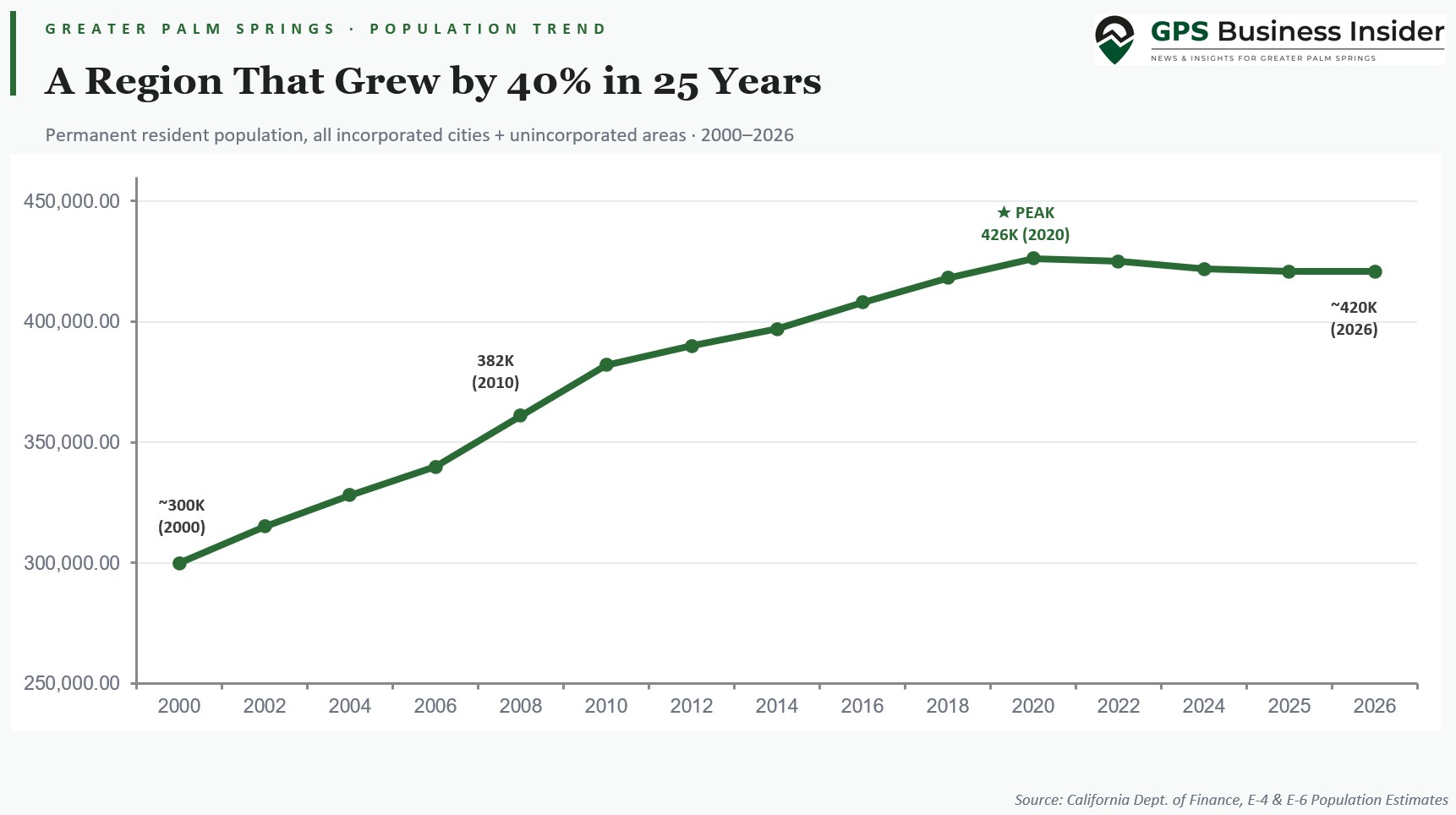
The long-term increase represents one of the most significant regional growth stories in California outside the coastal urban centers and the Inland Empire. Much of that growth occurred between 2000 and 2020, when the Coachella Valley added tens of thousands of residents every decade as retirees, working families, hospitality employees, and second-home buyers flowed into the region.
The pace was especially strong during the 2000s housing boom. Even after the Great Recession slowed development substantially, growth resumed steadily through the 2010s.
Then came the pandemic.
The pandemic changed the dynamic
Like much of the Inland Empire, Greater Palm Springs experienced a population surge during and immediately after COVID-19.
Remote work untethered many Californians from coastal offices. Wealthier households sought larger homes and lower-density communities. Our region became an attractive alternative to Los Angeles and Orange County, especially for buyers priced out of coastal housing markets.
The desert’s lifestyle advantages suddenly became economic advantages too.
Home values soared. Short-term rentals exploded. New residents arrived from across California and other states. Developers accelerated projects in Indio, La Quinta, Coachella, and Desert Hot Springs.
But the latest data shows that the surge has cooled substantially.
According to the new CDF estimates, as of January 1, 2026, the population of permanent residents across most of Greater Palm Springs remained flat over the past year, with some cities recording slight declines.
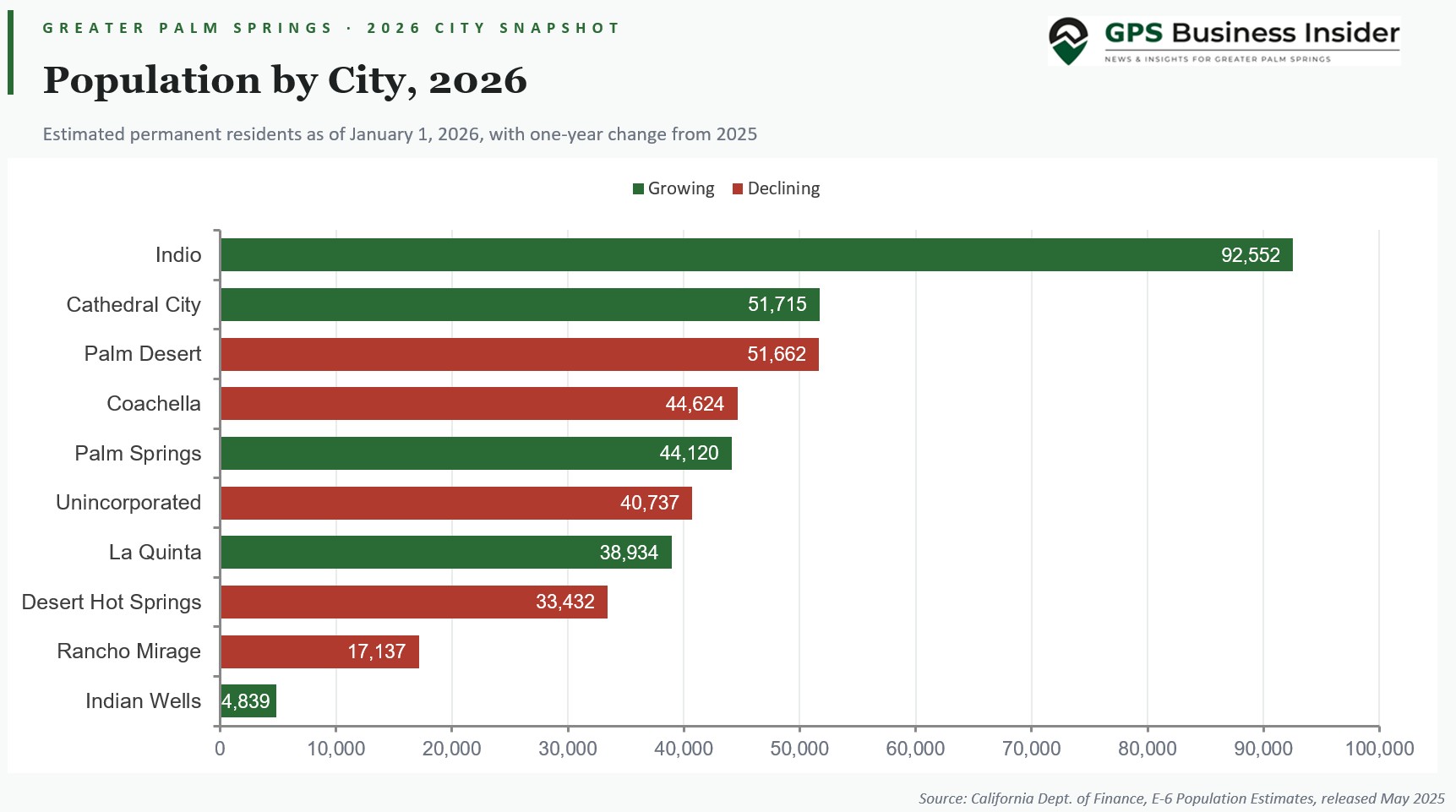
Some cities grew, though at more moderate levels than during the pandemic migration wave. Palm Springs increased by 0.5 percent to 44,120 residents. Cathedral City also increased by 0.5 percent to 51,715. La Quinta increased slightly to 38,934. Indio, still the valley’s largest city, was essentially flat at 92,552 residents, up 0.2 percent from the prior year.
Other cities slightly lost permanent residents. Palm Desert decreased 1.3 percent to 51,662 residents. Coachella lost 1.5 percent to 44,624. Rancho Mirage decreased by 1.1 percent, and Desert Hot Springs was down 0.6 percent. The unincorporated areas of Riverside County within the region (Bermuda Dunes, Thousand Palms, Mecca, Thermal, Desert Palms (Del Webb Sun City Palm Desert), Sky Valley, Vista Santa Rosa) collectively lost .6% of their combined population with a new total of 40,737.
The region’s mixed outcomes reflect a broader transition now underway throughout California.
California declines again
Statewide, California’s population declined slightly in 2025, falling by about 54,000 residents to 39.59 million people. The rate of decline was modest, just 0.14 percent, but notable because it ended three consecutive years of post-pandemic recovery.
According to the CDF, the biggest factor was a sharp drop in international migration caused by federal immigration policy changes.
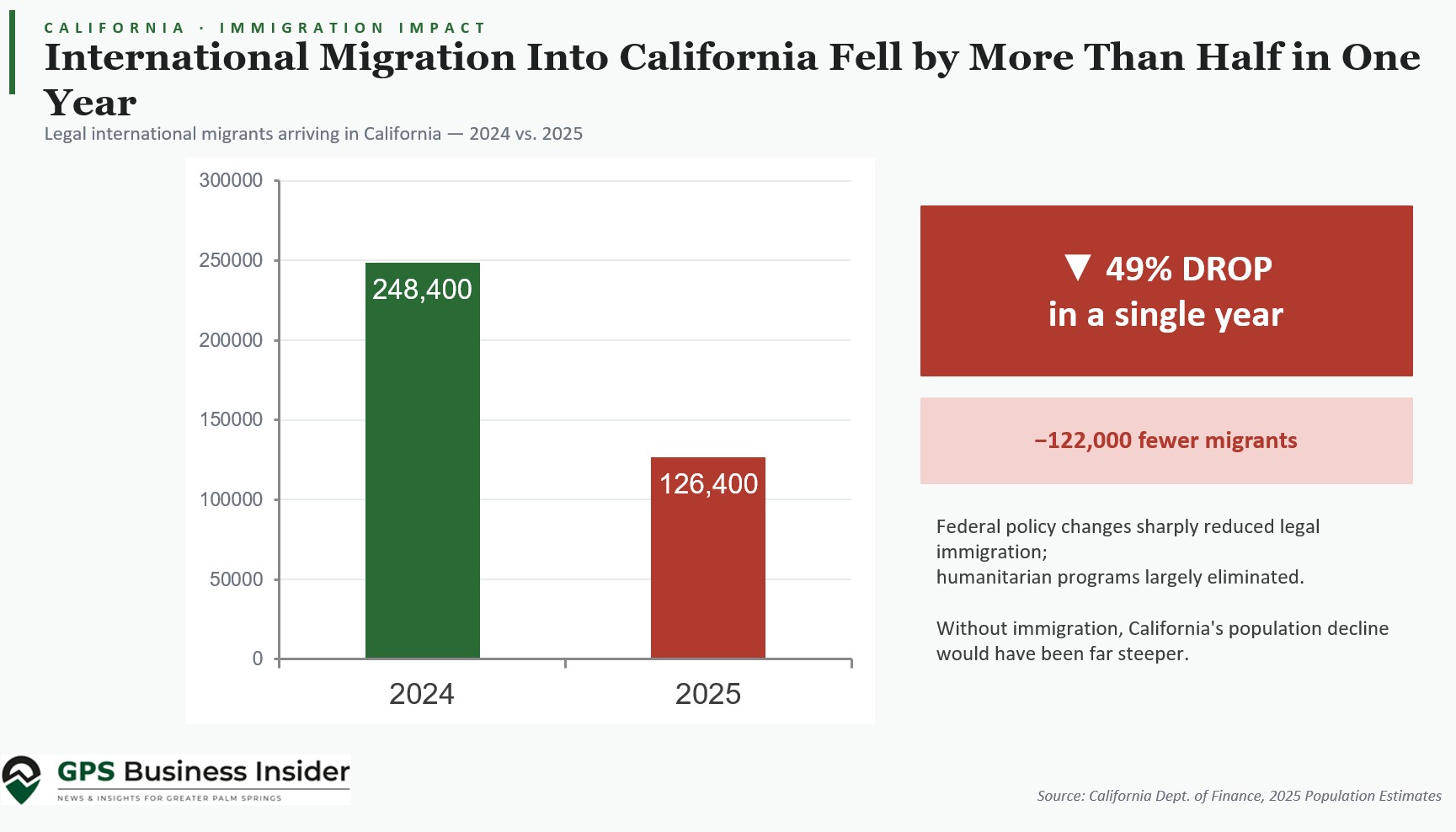
Legal international migration into California fell by more than half in a single year, declining from 248,400 people in 2024 to 126,400 in 2025. Humanitarian migration programs that had boosted population growth after the pandemic were largely eliminated, while immigration processing slowed substantially.
That matters because immigration has become increasingly important to California’s demographic stability.
For years, the state has lost more residents to other states than it gains. Birthrates have also fallen sharply across California and the nation. Immigration has effectively offset those losses.
Without international migration, California’s population would be shrinking more rapidly.
Natural increase, meaning births minus deaths, still added population in 2025, but even that trend is weakening. The state’s natural increase fell again this year, continuing a long decline tied to aging residents and lower birthrates.
Riverside County population growth stalls for the first time in decades
After consecutive annual population growth from 2000 through 2024, Riverside County lost roughly 9,000 residents in 2025, after reaching 2.5 million people the prior year. The total still makes it the fourth most populated county in California and one of the fastest-growing major counties in the state during the past 10 years.
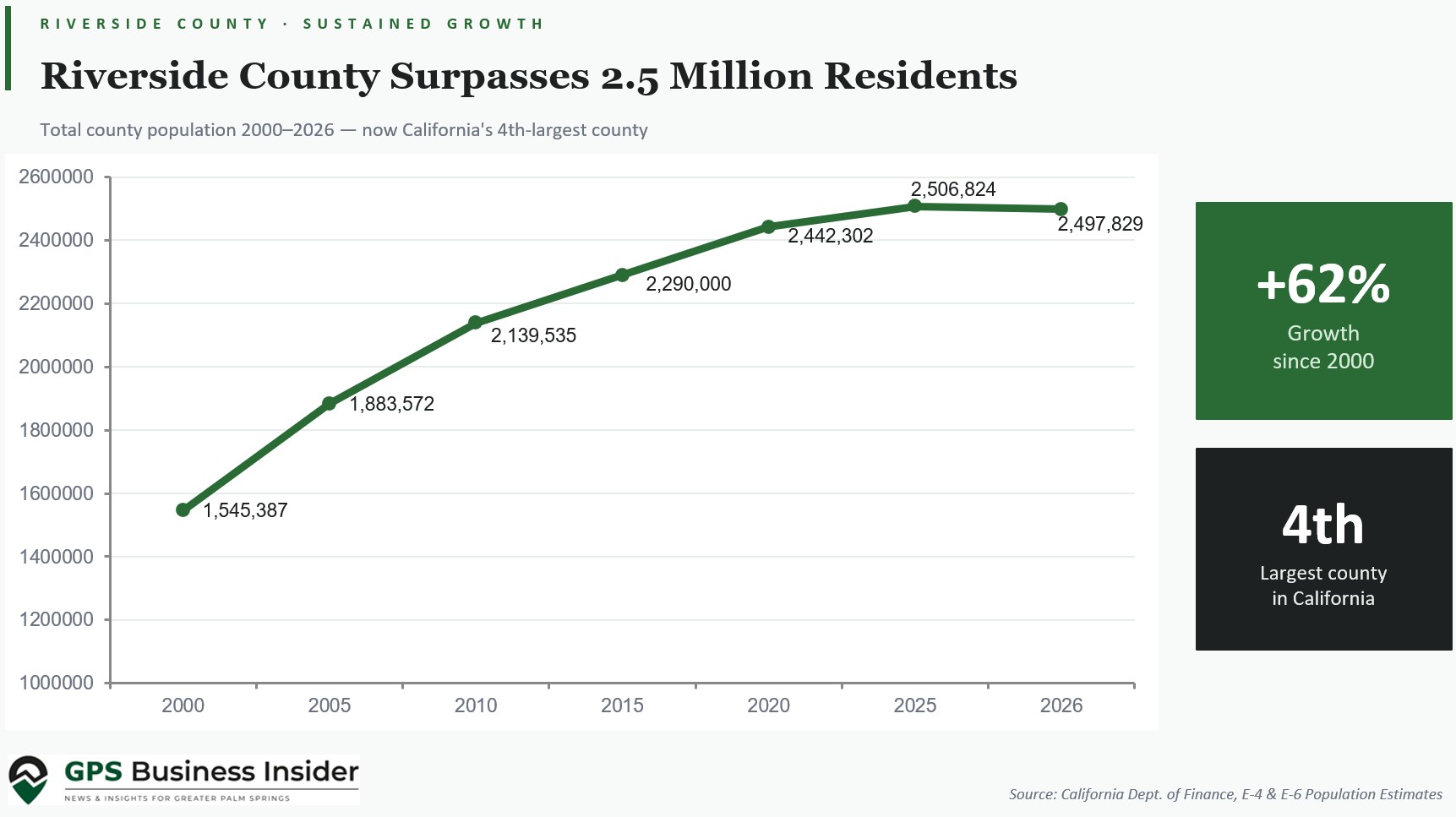
The Inland Empire’s (Riverside and San Bernardino County combined) long-running growth story remains largely intact because Riverside County still offers something increasingly rare in Southern California: relatively attainable housing.
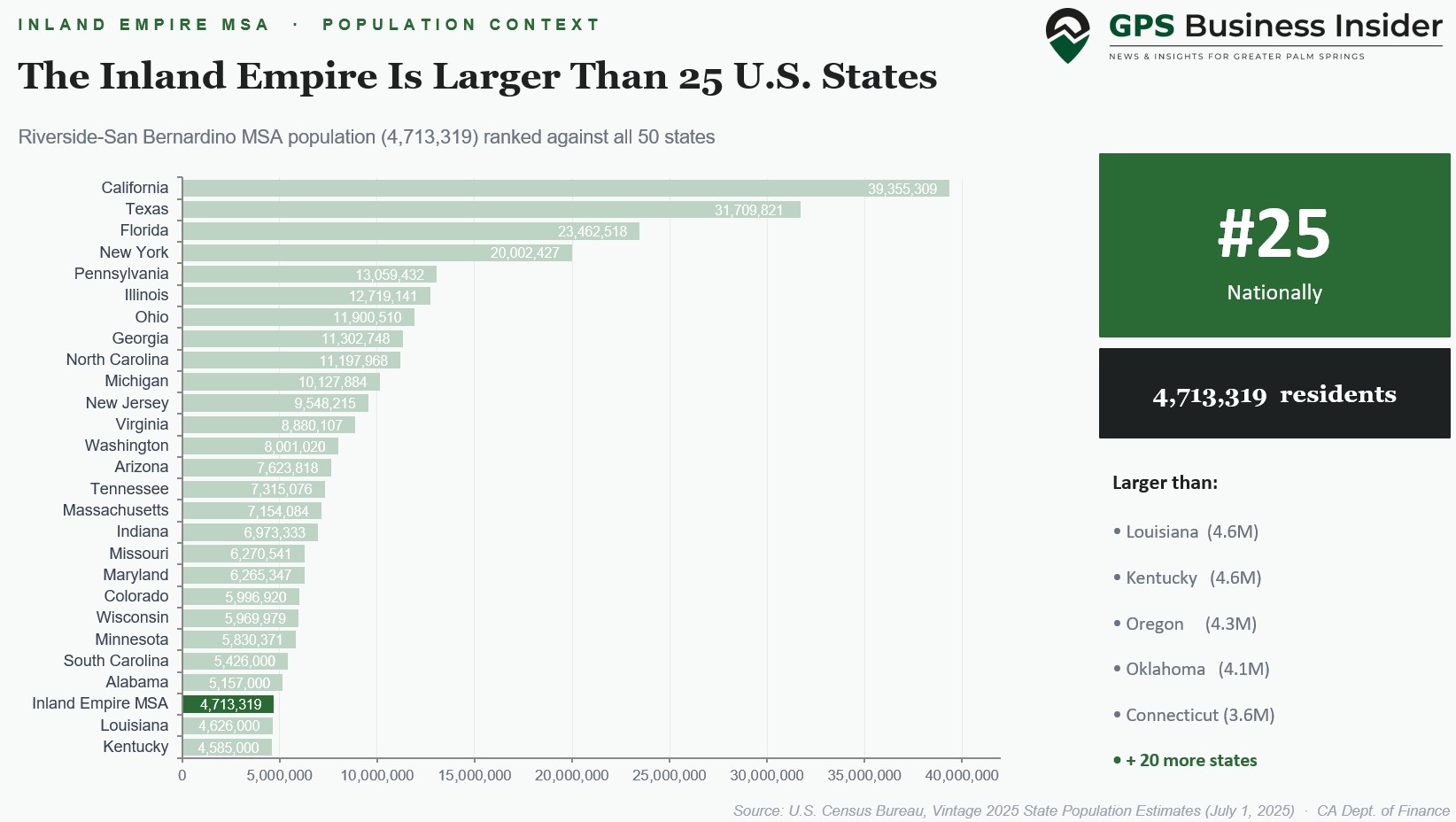
An interesting statistic to put the size of the Inland Empire into persective is that the population of the two-county metropolitan statistical area, at 4,713,319, would rank 25th if it were a state. It’s population is larger than Louisiana, Kentucky, Oregon and 26 other states.
Families priced out of Los Angeles and Orange counties continue moving eastward. Builders continue constructing both single-family homes and apartments across Riverside County. State data shows Riverside County also ranked among California’s leaders in housing growth, adding more than 1 percent to its housing inventory during the past year.
But even Riverside County is slowing compared to the rapid gains seen during the 2010s and pandemic years.
High mortgage rates have reduced affordability. Insurance costs have climbed. Construction costs remain elevated. Many younger Californians continue leaving the state entirely in search of lower costs elsewhere.
That has changed the growth tempo across the Inland Empire, including the Coachella Valley.
A very different America than 25 years ago
The demographic slowdown is not unique to California.
The latest intra-Census estimates from the U.S. Census Bureau show the United States grew by just 0.5 percent between mid-2024 and mid-2025, one of the slowest rates in modern American history.
The country added about 1.8 million residents during the year, bringing its population to approximately 341.8 million. But unlike earlier decades, population growth is no longer being driven primarily by births.
Americans are having fewer children than at any point in modern history. The population is aging rapidly. Immigration now plays an outsized role in maintaining workforce growth and economic expansion.
That shift is transforming states differently.
Fast-growing Southern states such as South Carolina, Texas, North Carolina, and Idaho continue to attract large numbers of domestic migrants because of lower housing costs, job growth, and, in many cases, lower taxes.
Meanwhile, high-cost coastal states like California, New York, and Illinois are growing far more slowly.
Greater Palm Springs sits at the intersection of those forces.
The region remains attractive because of the climate, lifestyle, tourism, healthcare infrastructure, and relative affordability compared to coastal California. But it is also increasingly expensive for younger workers and middle-income households, especially after the pandemic housing boom.
Why the slowdown matters
For business leaders, the changing growth rate matters almost as much as the growth itself.
For years, many assumptions about the Coachella Valley economy were built around rapid expansion. More residents meant more rooftops, more retail demand, more restaurants, more tourism workers, more healthcare demand, and more infrastructure pressure.
Those forces are still present, but they are moderating. That does not necessarily signal decline. In many ways, it signals maturation.
Greater Palm Springs today is no longer simply a retirement destination or seasonal resort economy. It has become a large regional marketplace with expanding healthcare systems, logistics growth, entertainment investment, and a more year-round population base than at any time in its history.
Projects like Acrisure Arena, downtown revitalization efforts, airport and convention center expansions, logistics facilities, and major housing developments continue to reshape the region.
But the easy-growth era appears to be fading.
Future growth will likely depend less on migration waves and more on long-term economic fundamentals such as housing affordability, workforce development, infrastructure investment, and the ability to attract younger residents and businesses.
A region still changing
For newcomers, the latest numbers may seem surprising given how much construction and traffic continue to reshape the valley.
For longtime residents, the slowdown may feel more intuitive.
The Coachella Valley of 2026 is dramatically larger, wealthier, and more economically complex than it was in 2000. Yet it is also confronting many of the same pressures as California and the nation: rising costs, declining birth rates, aging populations, and a more competitive fight for residents.
The region is still growing. Just not at the pace many had come to expect.

Bob Marra is the CEO/Publisher of GPS Business Insider. He has been studying, writing and giving presentations about business, economic and public affairs news and issues and the local economy in the Greater Palm Springs/Coachella Valley region for more than 20 years.