At first, it looked like a vote about banquet service.
But by the time the Palm Springs City Council unanimously approved a new five-year food-and-beverage agreement for the Palm Springs Convention Center, the issue had grown into something larger: a debate over how much financial risk City Hall should assume, how local businesses can participate in a publicly owned venue, and how one of the city’s signature cultural events would protect its independence inside a changing convention-center operation.
The contract, approved on June 30, gives Ovations Fanfare L.P., doing business as OVG Hospitality, responsibility for food and beverage service at the Palm Springs Convention Center. OVG Hospitality is part of the broader Oak View Group platform, whose footprint in Greater Palm Springs already includes Acrisure Arena and the city’s Convention Center management agreement.
The approval came only after a week of sharp questions, last-minute legal revisions and negotiations involving city staff and two city council members, OVG, longtime caterer Savoury’s Good Earth Cuisine and representatives of the Palm Springs International Film Society.
The result was a deal that city officials say gives Palm Springs more revenue potential, more operational flexibility and a modernized food-and-beverage structure as the city prepares for a $135 million Convention Center modernization and connectivity project.
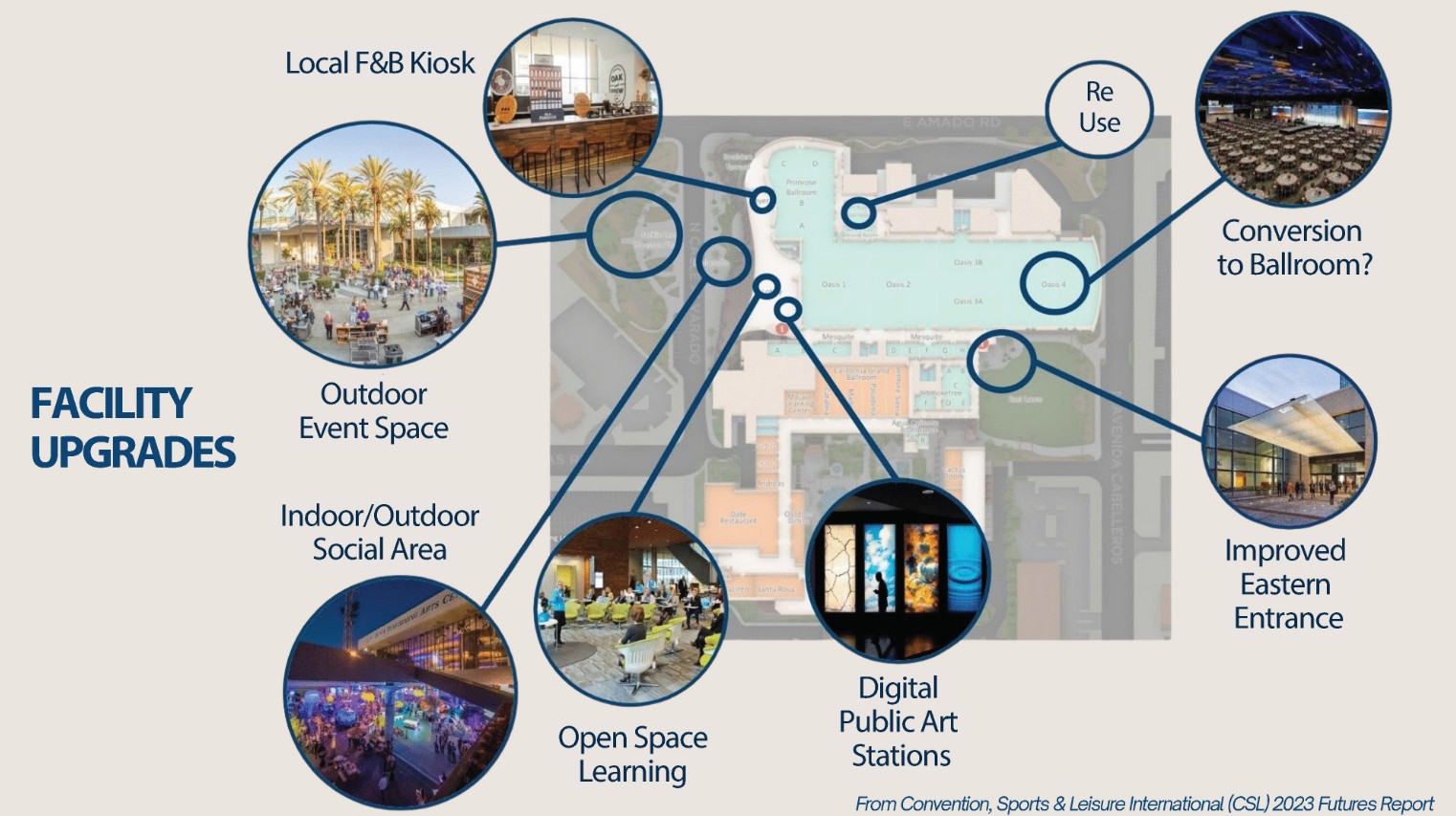
Some of the many upgrades planned for the convention center.
It also leaves unresolved questions that will return to the council after its summer break, including how much business OVG must steer to local restaurants and brands, and how much flexibility local nonprofit groups will have to bring food into the publicly owned facility.
“This is a different model,” Mayor Pro Tem David Ready said during a lengthy council discussion, pressing for clarity on whether the city could still be exposed to operating losses. His questions captured the central tension of the contract: Palm Springs is not merely changing caterers. It is changing its own role in the economics of the Convention Center’s food-and-beverage operation.
From Concession Model To Management Model
For decades, Savoury’s Good Earth Cuisine had been closely associated with the Convention Center’s banquet and catering operation. Under the prior structure, the food-and-beverage provider functioned more like a concessionaire, absorbing operating costs and remitting a share of gross receipts.
The new OVG agreement moves in a different direction.
Under the management-fee structure approved by the council, the city becomes the “economic principal” of the operation. Revenues and direct operating costs flow through the city-side economics. OVG is compensated through a management structure that includes a 7.5 percent gross-receipts commission and a 15 percent share of net profits, while the city receives a 7.5 percent gross-receipts commission and 85 percent of net profits.
In simple terms, Palm Springs is seeking more upside.
City staff and consultants told the council that the management model is projected to produce roughly $4 million more over the initial contract term than a commission-based approach. The agreement also includes a $2.5 million OVG capital investment, with up to $250,000 for transition services and the balance available for improvements to the Convention Center. The contract also contemplates a $350,000 annual contribution to a replacement reserve.
Palm Springs Mayor Pro Tem David Ready
But the model also requires the city to pay much closer attention to costs, invoices, budgets and the mechanics of the operation.
Ready repeatedly questioned whether the city could be responsible for expenses while receiving less guaranteed protection than some supporters of the contract were suggesting. That discussion led to a key clarification before the vote: the contract language was amended to state that the city’s annual minimum commitment would “net” at least $750,000, provided gross receipts meet the agreed-upon threshold.
The guarantee is not absolute. If annual gross receipts fall below $5.6 million, the $750,000 minimum does not apply for that year, and the parties must negotiate in good faith to reset the minimum commitment for the following accounting year.
That caveat matters because the Convention Center is about to enter a renovation period. The city’s modernization plan calls for major upgrades, expanded capacity, improved indoor-outdoor meeting space, better technology and stronger pedestrian connections to downtown and nearby hotels. The city has described the project as essential to keeping Palm Springs competitive in the regional and national convention market.
The food-and-beverage contract now sits directly inside that larger strategy.
Supporters see OVG as a partner with the scale to elevate the Convention Center during a generational investment. Critics worry the city is taking on a more complicated financial structure at exactly the moment when renovation-related disruption could affect event volume and revenue.
A Procurement That Raised Questions
The city issued its food and beverage RFP March 19. Three firms responded by the April 15 deadline: OVG Hospitality, RKCC Hospitality Group and The Magnolia Grille. The latter two were deemed nonresponsive, leaving OVG as the sole qualified bidder.
That outcome became one of the flashpoints.
Councilmember Ron deHarte, who had pushed for the item to be delayed at the prior June 24 meeting, argued that the original process had not adequately signaled to local businesses that they could realistically participate. He later said the revised version reflected significant work by councilmembers, staff and both companies.
Savoury’s, meanwhile, emerged not as the selected contractor but as a possible transition partner. According to the council discussion, Savoury’s and OVG had reached an agreement in principle for some form of collaboration, though no final signed agreement had been completed when the council voted.
The approved contract allows OVG to spend up to $150,000 per year on special advisory services as a direct operating cost. That provision was discussed in connection with a possible consulting role for Savoury’s. DeHarte asked that the city have some say over how that money is spent if no final Savoury’s arrangement materializes.
He also closed his remarks by praising Savoury’s long history in the building, calling the company “much more than a vendor.”
“We are grateful for what they have provided to Palm Springs for three decades,” deHarte said.
Film Festival Wins A Bigger Carve-Out
The most significant last-minute change involved the Palm Springs International Film Society and its International Film Awards & Gala, one of the city’s highest-profile annual events.

The Film Society produces the Palm Springs International Film Festival and ShortFest, and the Film Awards have become one of the most visible early stops of the Hollywood awards season. The Gala is held annually at the Convention Center and is not a typical banquet. It is a major fundraising, sponsorship, hospitality and brand-positioning event for the Film Society and for Palm Springs.
Early contract language gave the Film Awards Gala a limited exception for 2027 and 2028, allowing the Film Society to use a third-party caterer for food, while keeping alcohol service under OVG’s exclusive control.
That was not enough to resolve the Film Society’s concerns.
At the June 30 meeting, Assistant City Attorney Seth Merewitz said city representatives had met with Film Society leaders earlier that day and had worked through language intended to address their specific requests. The final council discussion produced several important changes.
The carve-out was extended to the full five-year initial term of the OVG agreement. The Film Society may use a third-party caterer for the Film Awards Gala. That caterer may use the kitchen and equipment starting up to 72 hours before the event at no cost. The Film Society’s caterer may also serve alcohol under its own temporary permit, rather than being required to use OVG’s license.
The alcohol language was especially important.
The beverage issue is not an abstract hospitality detail for the Film Society. Recent festival sponsors have included beverage-related partners in categories such as wine, spirits, water and hydration. Those relationships can involve product, brand visibility, cash sponsorship, guest experience or some combination of all of them. If OVG had retained full control over alcohol service, pricing and related logistics, the Film Society could have found itself with a food carve-out on paper while still lacking the flexibility needed to satisfy important sponsor commitments.
OVG initially expressed confidence that it could earn the Film Society’s trust over time.
“If I could just add that we believe that over the course of a couple of years, we would be able to earn the trust of the film festival,” OVG Hospitality Regional Vice President Chris Morgan told the council.
But when the question turned to whether the carve-out could be extended to five years, Morgan said OVG would agree.
“We are agreeable to the five years for the carve out for the film festival for five years,” he said.
That was a meaningful win for the Film Society. It did not defeat the OVG contract. It did something more precise: it secured written protection for a signature Palm Springs event inside the new operating framework.
Local Brands Still To Be Defined
If the Film Society issue was largely resolved before the vote, the local-business issue was not.
The revised contract includes language requiring OVG to use local products and vendors whenever reasonable. It refers to restaurants, food trucks and other offerings in the Greater Coachella Valley that are unique to Palm Springs and provide a “sense of place” that reflects the city’s diversity and culture.
That language is directionally important, but the specifics are still missing.
The contract calls for a future addendum to define objective requirements for OVG’s use of local brands, measured as a percentage of annual gross receipts. It is also expected to include a monetary remedy to encourage compliance.
In other words, the city has established a policy goal but not the enforcement mechanism.
The distinction matters. “Local brands” can mean many things. It could mean occasional vendor activations, branded kiosks, subcontracted restaurant concepts, local products integrated into menus, or a measurable share of food-and-beverage sales flowing to Coachella Valley businesses.
During the council discussion, officials clarified that local brands would mean Greater Coachella Valley businesses, not just Palm Springs businesses. The nonprofit framework, by contrast, was discussed in relation to Palm Springs-based nonprofit organizations.
The local-brand provisions are expected to return to the council on Aug. 26.
That future discussion could determine whether the local-business language becomes a meaningful economic-development tool or a broad statement of intent.
Nonprofit Access Also Delayed
The nonprofit issue follows a similar path.
The revised agreement contemplates a future addendum that would allow local and community nonprofit groups to provide food and beverages at the facility up to a certain dollar threshold per event. The idea is to avoid requiring nonprofit groups to activate the full OVG food-and-beverage operation for modest items such as coffee, donuts, bagels or similar refreshments.
But the threshold, rules and eligibility criteria were not finalized before approval.
Ready warned that nonprofit access could become a broader policy issue if many groups seek discounted or flexible use of the facility. City attorneys pointed to the existing facility-use framework, noting that food-and-beverage pricing is only one piece of how nonprofit use of the Convention Center is managed.
That issue, too, will come back after the council break.
Labor Clause And Business Conduct Draw Fire
Public comment reflected the broader unease around the contract.
Phillip Hodges questioned the labor-harmony clause, asking who added it, on whose authority, and where each councilmember stood on the issue. The names of two specific unions had been removed from an earlier version, but the broader clause remained.
Dan Gore, owner of Oscar’s in Palm Springs, raised a different concern. He said OVG had refused to collaborate with his business on events at the adjacent Plaza Theatre and had pressured him over business space connected to the theater.
“My question to this council is simple: Is this the kind of business conduct we want to reward with a million-dollar contract funded by the public?” Gore said.
Not all public testimony was critical.
Cliff Young, owner of Coachella Valley Coffee, said his company had worked with OVG at Acrisure Arena and described the relationship positively.
“They’re always looking for ways to promote my business at other venues they’re working at,” Young said.
Together, the comments underscored the central challenge for OVG in Palm Springs. The company is being asked to bring national-scale venue expertise to a city whose business community closely watches whether local operators are included or displaced.
A Vote To Move Forward
Councilmember Grace Garner made the motion to approve the contract as amended. She said the revised agreement gave the city benefits it would be unlikely to receive if Palm Springs restarted procurement, and she cautioned against trying to control every detail of OVG’s business relationships.
“We are making a huge investment in our convention center, and we need to be working with partners who are able to rise to that challenge,” Garner said.
The motion passed 5-0.
The vote resolved the immediate operational question. The Convention Center would have a food-and-beverage provider in place. Employees could transition. OVG could begin implementing the new model. The Film Society had secured a stronger carve-out for the Film Awards Gala.
But the vote did not end the public-policy debate.
Palm Springs has now entered a more ambitious and more complex food-and-beverage arrangement. The city may earn more from the Convention Center. It may also need to monitor, audit and govern more carefully.

Bob Marra is the CEO/Publisher of GPS Business Insider. He has been studying, writing and giving presentations about business, economic and public affairs news and issues and the local economy in the Greater Palm Springs/Coachella Valley region for more than 20 years.