A proposed Imperial Irrigation District tariff for large electricity users could reshape the debate over Coachella’s controversial data center proposal, adding a power-system test to a project already facing sharp public scrutiny over water, farmland, air quality and transparency.
The “large load” tariff, considered by the IID Board of Directors on May 15, would apply to customers seeking 20 megawatts or more of demand with a load factor above 85 percent. That threshold is aimed at customers that use large amounts of electricity nearly around the clock, a category that includes data centers.
For Coachella, the implications are direct. The proposed Coachella Valley Technology Campus has been described in public materials as a major east-side development that could require roughly 270-300 megawatts of electric capacity. The project is also tied to the city’s broader effort to create a municipal electric utility in potential growth areas in the eastern portion of the city, where power infrastructure is limited.
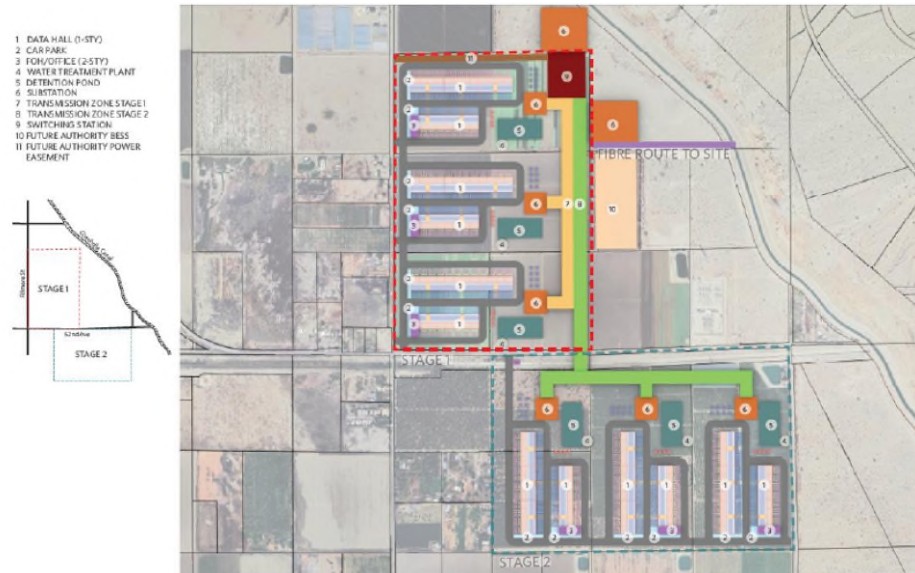
A site plan for the Coachella Valley Technology Campus data center development.
Until now, much of the public debate has centered on whether Coachella should embrace the data center campus as an economic development opportunity or reject it as a high-impact industrial project ill-suited to the eastern Coachella Valley.
IID’s proposed tariff raises another question: even if the city wants the project, can the power system support it on terms that are both financially and operationally acceptable and feasible?
That question may prove decisive.
IID is not the land-use agency deciding whether Coachella can approve a data center. But it does control a central question: whether and how a project of that scale can be served without threatening grid reliability or shifting costs to existing customers.
At the May 15 meeting, IID Power Department Manager Matthew Smelser told the board the district’s approach reflects what utilities around the country are now confronting as data centers and other large-load users seek access to the grid.
“Along with other power staff, I recently attended a data center conference in Scottsdale, and it was almost half and half of data center developers as well as utilities,” Smelser said. “After going through this, reviewing our tariff and our process, we are in line with industry standards.”
Aly Koslow, principal of Energy Nexus Strategic Consulting Group of Phoenix, Arizona, told the board that IID is not alone. Large-load tariffs are now being used or considered in many states as utilities try to protect ratepayers from subsidizing massive private power users.
“The timing really could not be more ripe for you all to be entertaining a large-load tariff,” Koslow said, citing national activity around data center regulation, ratepayer protection and grid reliability.
Could the sun be setting early for the Coachella data center based on the proposed IID large load tariff?
The proposed IID tariff would require large-load customers to pay for all studies, system upgrades, power supply, transmission costs, collateral, renewable compliance costs and other obligations needed to serve them. Customers would also have to sign long-term agreements, meet minimum energy and demand charges, and accept exit-fee provisions if they terminate service early or reduce contracted capacity.
One of the most consequential provisions is that service would be interruptible. IID could curtail large-load customers before residential or other existing customers during grid reliability events, which occur regularly in the summer months.
Koslow said that is deliberate.
“This is something where essentially we are going to only curtail in the event that there is going to be a grid reliability event, or to the extent that we see a grid reliability event pending,” she said. “What this tariff is saying is we are going to put these large-load customers first in line to be curtailed.”
That issue could be especially important for data centers, which are designed to operate continuously. If a data center cannot rely on firm grid power at all times, it may need additional backup generation, fuel cells, battery storage or other systems, which could raise costs and intensify environmental concerns.
The Coachella proposal has already prompted significant backlash from residents and advocacy groups. Critics have raised concerns about the loss of agricultural land, water use, air quality, public health and the city’s handling of the proposal. Some residents have called for a moratorium on data centers.
City officials have said no data center project has been approved. A May 11 town hall was organized to explain the proposed data center, the city’s broader municipal utility effort and how future approvals would be evaluated. The backlash by Coachella and nearby residents was massive and vocal.
But the IID tariff adds another layer of uncertainty. If Coachella’s municipal utility strategy depends on buying power from IID and reselling it to the data center, IID’s large-load framework could become a critical gatekeeper. The question would not be only whether Coachella wants the project, but whether the underlying power demand can satisfy IID’s requirements for reliability, cost recovery and financial security.

IID Board Chair, Karin Eugenio
IID Board Chair Karin Eugenio asked Koslow at the meeting to explain the district’s role as a regulated utility in California.
“We don’t have the liberty of deciding, sort of picking winners and losers in terms of projects,” Koslow said. “What we can do, however, is ensure that projects are not passing those costs on to other customers, that we are not subsidizing other rate classes and that we are protecting grid stability, reliability and affordability.”
IID Board Member Alex Cardenas pressed for strong financial protections, saying he wanted “ironclad financial agreements” for large-load customers.
Koslow said the tariff is designed with that in mind. Guarantees to proceed would be available only from highly creditworthy entities, she said, while most customers would need to post a letter of credit, on-demand surety bond or cash.
“Those are all very sturdy financial instruments that can be unilaterally exercised by the district in the event that you need to actually collect on that collateral,” Koslow said. “These are things that you can really take to the bank.”
Cardenas also raised concerns about avoiding boom-and-bust cycles, decommissioning costs, resource adequacy, summer peak demand and water impacts. Those questions closely mirror public concerns now being raised in Coachella and Imperial County, where another massive data center proposal has drawn intense scrutiny.
IID has emphasized that the tariff is not specific to Coachella. The district said it has received nine large-load proposals or inquiries at varying stages of review. The tariff is now out for public comment, and staff are expected to evaluate feedback before returning to the board with a final version.
Still, the timing is significant for Coachella.
The city’s data center proposal has been presented by supporters as a potential source of jobs, city revenue and new infrastructure. Opponents see it as an industrial-scale project that could deepen environmental burdens in the eastern Coachella Valley.
IID’s tariff changes the frame. It does not answer whether the project is good or bad for Coachella. It asks whether the power plan is financeable, realistically feasible considering the anticipated cost of energy, and insulated from public risk.
Eugenio said IID’s responsibility is to protect existing customers.
“We are not the siting authority,” she said. “We’re doing everything within our capabilities to protect our ratepayers.”
That may become the central issue in the next phase of Coachella’s data center debate.
The city can decide what kind of development it wants. Residents can press for answers about water, air quality, farmland and public process. But before the project can move from concept to reality, the power behind it will have to pass a much tougher test.
And IID is now writing the rules for that test.

Bob Marra is the CEO/Publisher of GPS Business Insider. He has been studying, writing and giving presentations about business, economic and public affairs news and issues and the local economy in the Greater Palm Springs/Coachella Valley region for more than 20 years.