An appellate court has ordered Imperial County to revisit key environmental findings for the high-profile Hell’s Kitchen project just as the broader Lithium Valley effort moves toward its most consequential stage. The outcome matters most to Imperial County, but the economic and environmental implications do not necessarily stop at the Riverside County line.
For years, Lithium Valley has existed somewhere between an extraordinary geological discovery and an economic development vision.
Beneath the southern Salton Sea lies one of the world’s largest known lithium resources, dissolved in superheated geothermal brine already being brought to the surface to generate electricity. California officials have envisioned an entire industrial ecosystem emerging around it: lithium extraction, geothermal energy, battery materials, manufacturing, logistics and potentially other energy-intensive industries.
Yet in August 2026, the defining fact about Lithium Valley is not that the promised new industry has arrived.
It is that the effort is entering a much more consequential phase in determining whether it actually can.
A California appellate court added a new complication this week, ruling that Imperial County must correct significant portions of the environmental analysis supporting Controlled Thermal Resources’ Hell’s Kitchen geothermal and lithium project, one of the projects widely expected to lead development of the region’s lithium resource.
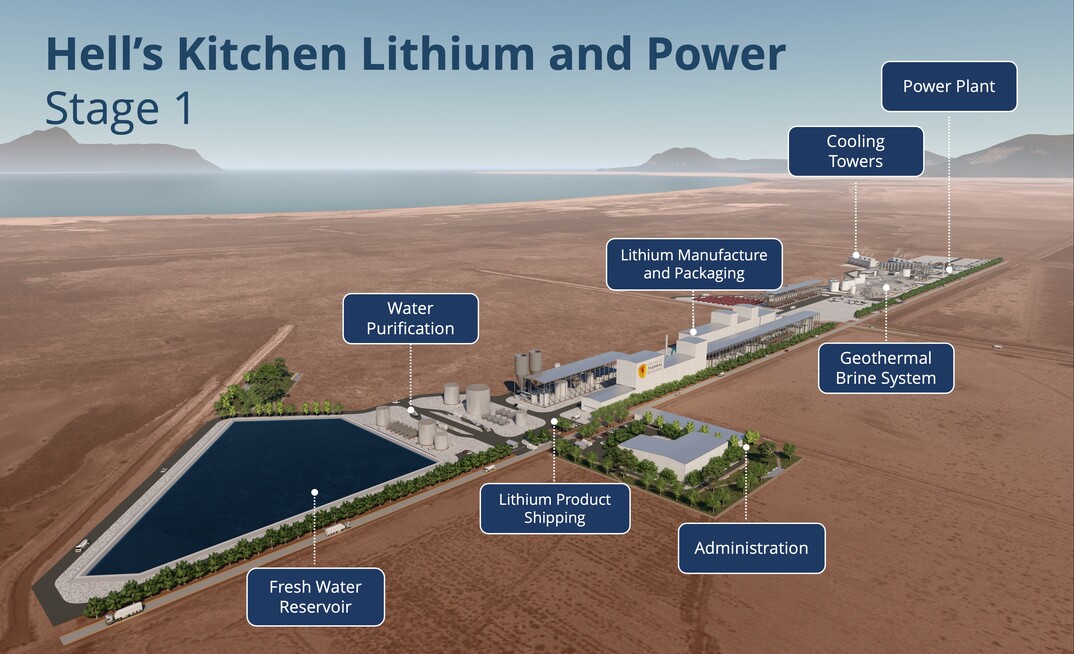
Controlled Thermal Resource’s Hell’s Kitchen site plan.
The ruling does not kill Hell’s Kitchen, nor does it amount to a rejection of lithium development. But it puts renewed scrutiny on two questions that could shape far more than a single project: whether enough water can be demonstrated to support large-scale lithium production over decades, and whether the cumulative environmental consequences of converting part of the Salton Sea region into a major industrial center have been adequately analyzed.
Those same issues are now hovering over Imperial County’s much larger Lithium Valley Specific Plan, which seeks to establish a land-use and environmental framework for roughly 51,600 acres along the southeastern Salton Sea.
That makes the court decision more than another chapter in a lawsuit. It arrives at a critical moment in the attempt to move Lithium Valley from concept to industry.
A court focuses on water
Imperial County approved the first phase of Hell’s Kitchen in January 2024, envisioning a project that would combine geothermal electricity generation with direct lithium extraction, or DLE.
Unlike conventional lithium mines that excavate rock or use vast evaporation ponds, the Salton Sea model begins with geothermal brine pumped from deep underground. Heat from the brine can generate electricity. Lithium and potentially other minerals can then be separated from the fluid before the remaining brine is reinjected underground.
It is a concept with potentially significant environmental and economic advantages, and one that the California Energy Commission has made central to its Lithium Valley strategy.
But the Court of Appeal concluded that Imperial County’s environmental review did not sufficiently substantiate the water supply on which Hell’s Kitchen would depend.
The project is expected to require approximately 6,500 acre-feet of water annually from the Imperial Irrigation District. The appellate court found that the administrative record did not contain sufficient evidence demonstrating that the supply would remain available over the project’s stated operating life.
The court also found shortcomings in the project’s treatment of foreseeable reductions in Colorado River supplies and in the mitigation that might be required if such reductions occur.
That issue has become increasingly important across the Southwest as states, water agencies and the federal government confront the long-term imbalance between Colorado River demand and supply.
The court went further.
It concluded that the environmental review had not sufficiently addressed how using water for the industrial project could reduce agricultural drainage reaching the Salton Sea, potentially exposing additional playa and worsening airborne dust.
That issue links lithium development directly to one of the Salton Sea’s existing public-health challenges.
The ruling did not go entirely against the county and CTR. The appellate panel upheld the county’s consultation with affected California Indian tribes over cultural resources.
Comité Civico del Valle and Earthworks, which brought the litigation, characterized the ruling as an argument for responsible lithium development rather than an effort to prevent it.
“This decision is not against lithium development,” Comité Civico del Valle Executive Director Luis Olmedo said. “It is about getting lithium development right.”
Imperial County struck a similar note from the other direction, saying it was reviewing the decision with legal counsel while remaining committed to responsible lithium and geothermal development that can generate jobs and lasting economic benefits.
The practical next steps will be important. The case is being returned to the Superior Court, where the deficiencies identified by the appellate court must be addressed.
The bigger project is Lithium Valley itself
Hell’s Kitchen is only one piece of a much larger plan.
Imperial County’s proposed Lithium Valley Specific Plan covers approximately 51,600 acres near Brawley, Calipatria and Niland on the southeastern side of the Salton Sea.
The proposed land uses extend well beyond lithium wells and processing plants. The plan contemplates green industrial development, geothermal and renewable energy, lithium and mineral extraction, battery-related manufacturing, logistics, solar generation, community opportunity areas, conservation and playa restoration.
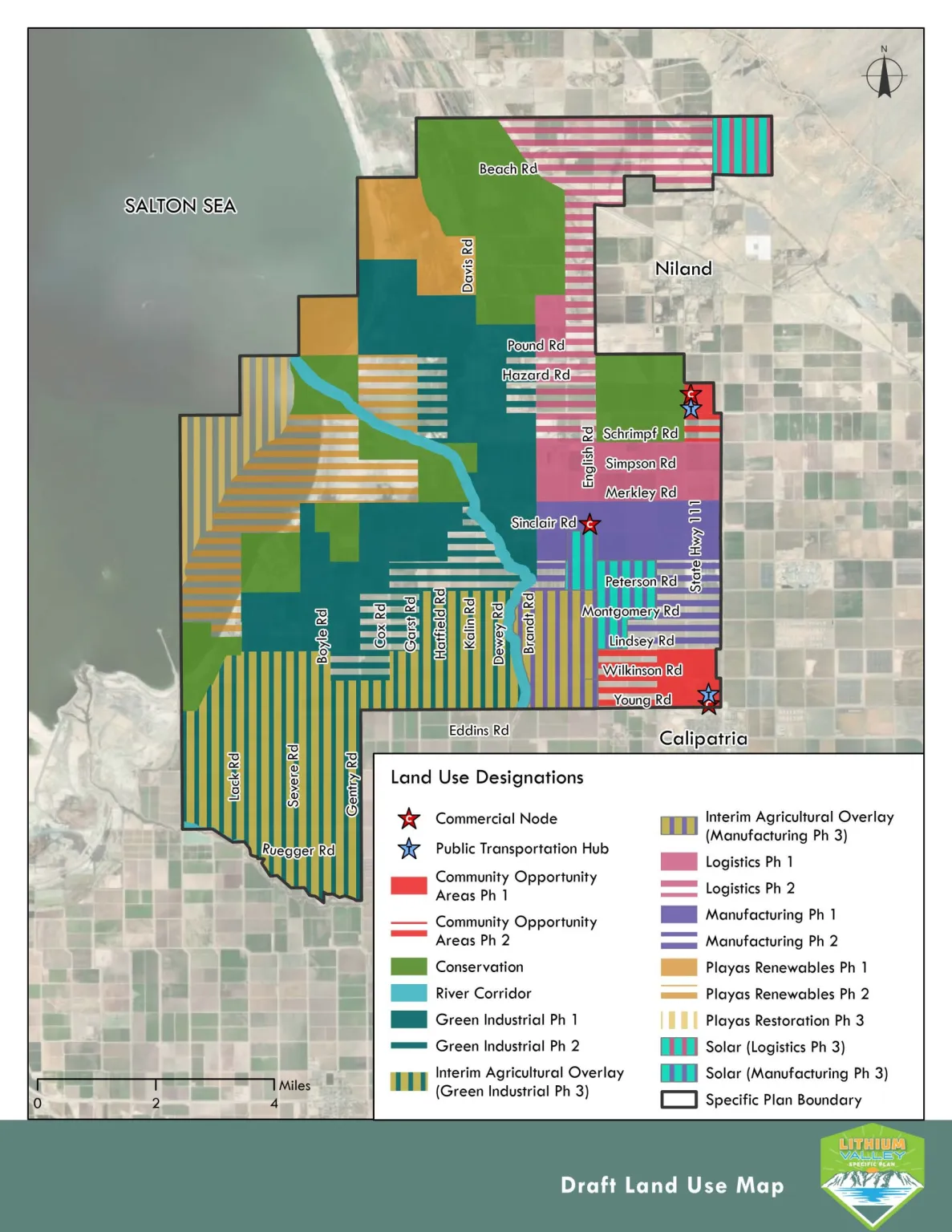
The current draft land use map of Lithium Valley.
In effect, Imperial County is planning not simply for a mining district, but for an industrial economy.
The public review period for the draft plan and its Program Environmental Impact Report closed April 17. The county is now working through comments and revisions before the documents move toward final consideration.
That timing gives the new appellate ruling unusual significance.
Many of the questions raised in the Hell’s Kitchen case, particularly long-term water availability, Colorado River uncertainty, air quality and Salton Sea impacts, are also relevant to the larger planning area.
The ruling may therefore become an important legal and analytical benchmark as Imperial County completes the broader plan.
County officials have simultaneously been attempting to build the framework for the economic benefits they hope will accompany development. In May, the Board of Supervisors adopted a Lithium Valley construction workforce ordinance intended to promote apprenticeship, workforce development, local hiring and local subcontracting in specified industries within the planning area.
The objective is clear: if billions of dollars ultimately flow into Lithium Valley, Imperial County wants more of the economic value to remain there.
Three companies, three paths toward commercialization
The resource itself is no longer seriously in question.
Research cited by the California Energy Commission indicates that the broader Salton Sea resource contains enough lithium to support hundreds of millions of electric-vehicle batteries.
Commercializing that resource is another matter.
Three major efforts illustrate both the potential and the challenge.
Controlled Thermal Resources remains perhaps the most visible. The company says its demonstration facility achieved lithium recovery rates of 95 to 97 percent and that long-lead equipment for the first commercial stage has been built.
CTR has agreements involving major automakers including General Motors and Stellantis. Earlier this year, the company announced an agreement to combine with Plum Acquisition Corp. IV in a transaction that would value the enterprise at approximately $4.7 billion. The proposed public listing is expected to provide approximately $300 million toward development of Hell’s Kitchen.
The company’s current timetable calls for an initial 50 megawatts of geothermal power in 2028 and approximately 25,000 metric tons of annual lithium production in 2029.
The appellate ruling now creates another permitting and timing issue that must be resolved along that path.
EnergySource Minerals is pursuing Project ATLiS alongside an existing geothermal plant. The U.S. Department of Energy announced a conditional commitment of up to $1.36 billion in financing for the project in January 2025.
ATLiS is designed to produce up to 20,000 metric tons of lithium hydroxide annually. Federal estimates associated with the project anticipated as many as 300 construction jobs and 71 permanent operating jobs.
EnergySource also helped establish a lithium industry training program with Imperial Valley College, an example of the workforce ecosystem that local leaders hope will develop around the new industry.
But ATLiS, too, has yet to reach commercial-scale production.
BHE Renewables (a Berkshire Hathaway company), which already operates 10 geothermal facilities in Imperial Valley, is taking a different approach. After earlier technological setbacks, BHE and Occidental subsidiary TerraLithium announced in June that they had successfully produced lithium chloride from Imperial Valley geothermal brine and converted it into battery-grade lithium carbonate, and had also demonstrated a process for producing lithium hydroxide.
The companies described those accomplishments as steps toward determining whether their system can work economically at commercial scale.
For all the attention Lithium Valley has generated, commercial-scale extraction from the Salton Sea’s unusually complex geothermal brine remains the threshold the industry has not yet crossed.
The economics are changing again
Technology and permitting are not the only variables.
Lithium itself has been through a punishing commodity cycle.
After soaring earlier in the decade, lithium prices collapsed amid rapidly expanding global supply and slower-than-expected growth in some electric-vehicle markets. That decline weakened the economics of new projects worldwide.
The market has strengthened considerably during 2026, helped by renewed demand expectations for electric vehicles and especially large-scale battery storage.
That is encouraging for Lithium Valley, but it does not eliminate the underlying risk.
A Salton Sea project must compete not only with other American lithium developments, but with established producers and processors in countries including Australia, Chile, Argentina and China. Commercial success will ultimately depend on whether geothermal DLE can deliver lithium reliably, at scale and at a globally competitive cost.
That is why the next stage matters much more than another announcement or demonstration project.
Someone has to prove it commercially.
What could this mean for the Coachella Valley?
There is a tendency to describe Lithium Valley as only an Imperial County story. In terms of the location of the major proposed extraction facilities, that is largely correct.
But geographically and economically, the dividing line is less absolute.
The California Energy Commission itself describes the Salton Sea lithium region as encompassing the Eastern Coachella Valley and Imperial Valley.
The distinction is important.
It does not mean lithium plants are about to appear across Greater Palm Springs. The known geothermal resource targeted by today’s developers and Imperial County’s industrial planning area are concentrated around the southern and southeastern Salton Sea.
Nor should Riverside County cities assume that Imperial County’s lithium tax revenues will automatically flow north.
Under California’s Lithium Extraction Excise Tax, most extraction-generated revenue goes to the county where the lithium is produced. For production in Imperial County, a portion must be directed toward communities there that are affected by the industry.
But 20 percent of Imperial County lithium tax revenue is directed to the Salton Sea Lithium Fund for restoration and community-related purposes around the Salton Sea.
That creates a legitimate Coachella Valley connection.
Environmental improvement at the Salton Sea does not stop at the Riverside-Imperial County line. Communities including North Shore, Mecca, Thermal and the broader Eastern Coachella Valley live with the consequences of a receding sea and airborne playa.
The appellate court’s emphasis on the relationship between water use, reduced inflows, exposed lakebed and air quality reinforces precisely why the Salton Sea must be viewed as a regional system.
The economic connection is less certain, but potentially significant.
If Lithium Valley develops into a multibillion-dollar industrial cluster, some spending would almost certainly extend beyond the project boundary. Engineering, construction, environmental consulting, professional services, equipment, transportation, hospitality and other business needs could create opportunities for companies based elsewhere in the desert region.
The Highway 86 corridor also directly connects the industrial areas of Indio and Coachella with the northern Imperial Valley and the Salton Sea geothermal field.
But those opportunities should not be overstated.
The highest-value prize for Imperial County is not simply extracting lithium. It is capturing the downstream economy: processing, battery materials, manufacturing, technology, research and the permanent jobs that accompany them.
If Imperial County succeeds in keeping those activities close to the resource, much of the direct economic benefit will appropriately remain there.
For the Coachella Valley, the more realistic opportunity may be participation in a larger desert clean-energy and critical-minerals economy rather than becoming a second lithium-production center.
Riverside County has already identified partnership with neighboring Imperial County and advancement of Lithium Valley economic opportunities as a legislative priority.
That may become increasingly important if the industry finally reaches commercial scale.
A more important year than it may appear
The story of Lithium Valley is sometimes told as though the discovery itself guaranteed the outcome.
It does not. The lithium exists. The geothermal industry exists. Global demand for energy storage and critical minerals exists.
Major corporations and government agencies have invested substantial money and political capital.
But the pieces still have to work together.
Extraction technology must perform continuously at industrial scale. Projects must be financeable through volatile commodity cycles. Water must be available under increasingly constrained Colorado River conditions. Environmental impacts must withstand regulatory and legal scrutiny. Communities must see enough economic benefit to maintain political support.
And the enormous gap between pilot-scale success and a functioning industrial ecosystem still has to be crossed.
GPS Business Insider examined that central tension previously. The events of 2026 have made the question sharper rather than resolving it.
Lithium Valley has not failed. Nor has it arrived.
The appellate ruling against portions of the Hell’s Kitchen environmental review is another delay, but it also represents something larger: a test of whether one of California’s most ambitious economic-development efforts can survive the scrutiny that comes with attempting to build an entirely new industry in one of the state’s most environmentally and economically sensitive regions.
For Imperial County, the stakes are enormous.
For the Coachella Valley, the stakes are different but still real. The most plausible benefits are regional rather than direct: Salton Sea restoration, business opportunities, infrastructure investment and participation in a clean-energy economy extending across southeastern California.
Whether those opportunities become tangible will depend on something Lithium Valley has been promising for years and has yet to deliver.
Commercial production.

Bob Marra is the CEO/Publisher of GPS Business Insider. He has been studying, writing and giving presentations about business, economic and public affairs news and issues and the local economy in the Greater Palm Springs/Coachella Valley region for more than 20 years.