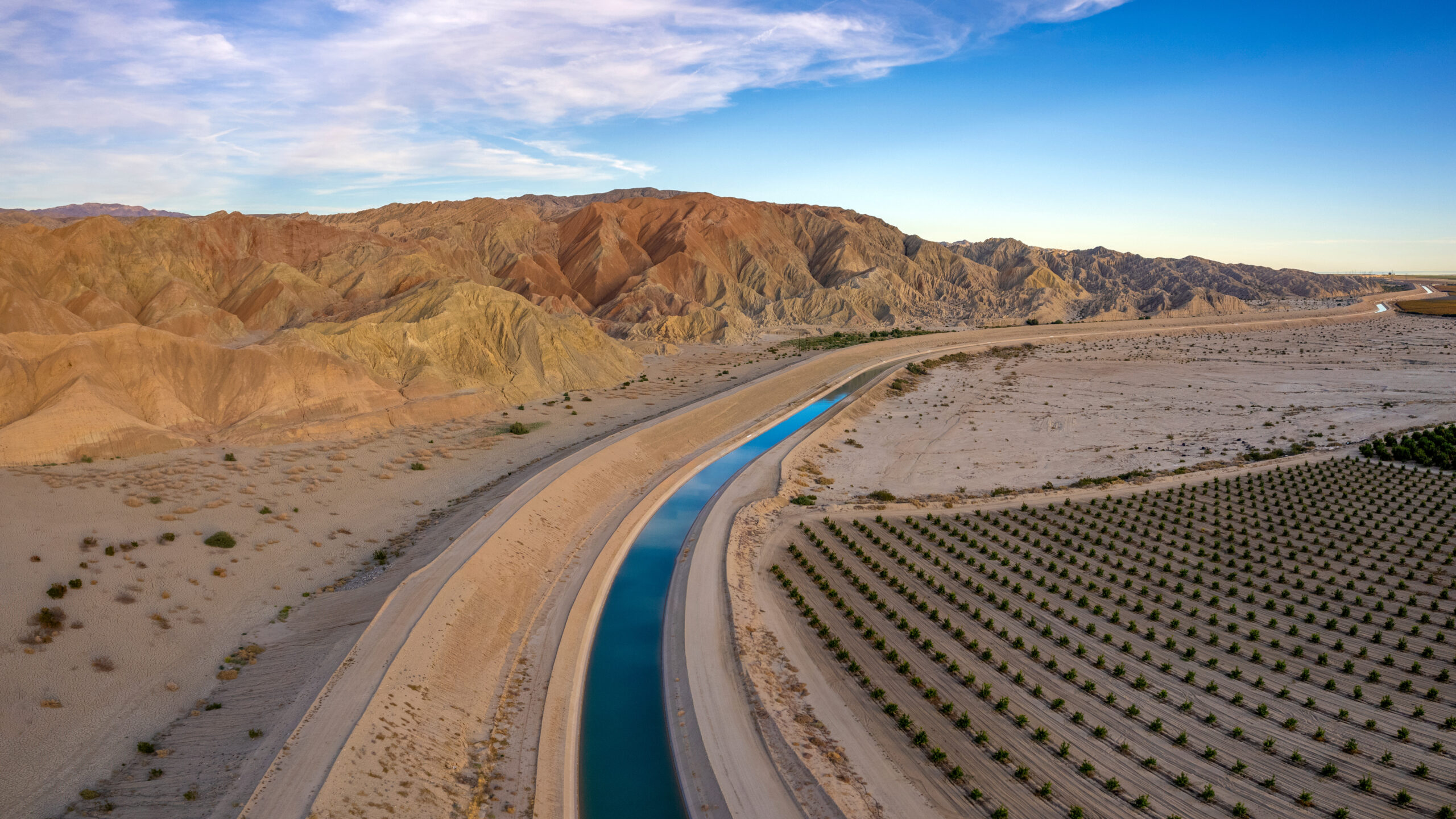
The Lower Basin proposal could save up to 3.2 million acre-feet through 2028, but local water agencies and Salton Sea advocates say conservation must be paired with water reliability, public health protections and long-term environmental planning.
The latest proposal to stabilize the Colorado River is not merely another round of basin-state negotiation. For the Southern California desert region, it is a test of whether emergency conservation can be paired with protection of senior water rights, agricultural production, reliable local water supplies and a credible long-term plan for the Salton Sea.
California, Arizona and Nevada have advanced a Lower Basin plan that would deliver up to 3.2 million acre-feet of water savings through 2028, an attempt to buy time for a river system strained by dry conditions, historically low reservoir inflows and the approaching expiration of the current operating guidelines for Lake Mead and Lake Powell.
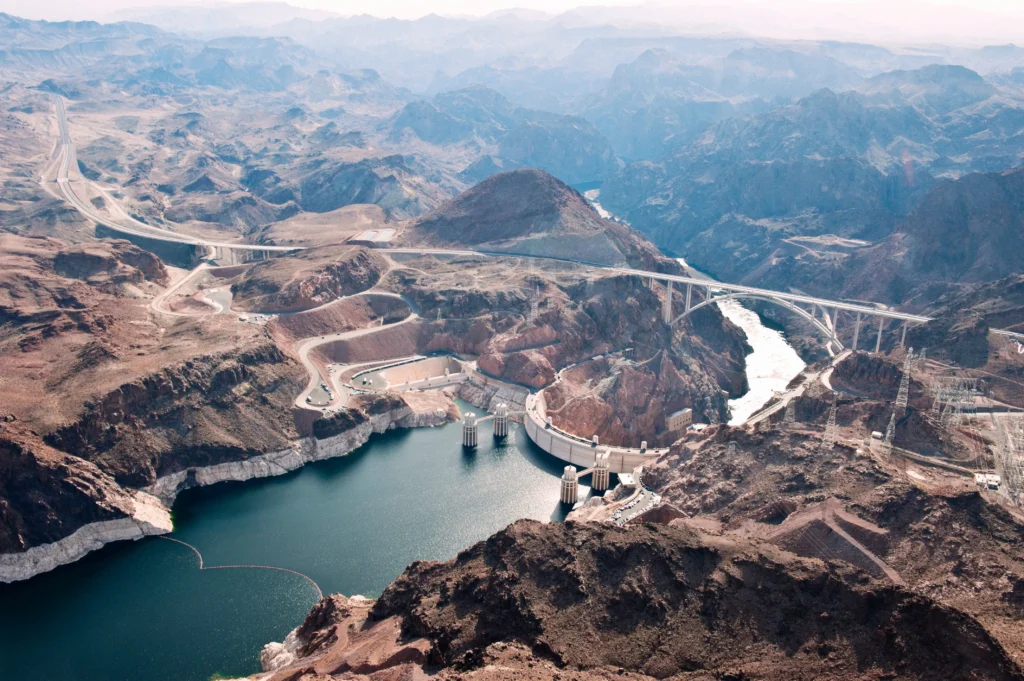
The approaching expiration of the current operating guidelines for Lake Mead and Lake Powell has heightened focus on getting conservation deals done, even when no one feels good about the ramifications.
The proposal, submitted for federal consideration through the National Environmental Policy Act process, comes as the seven Colorado River Basin states remain divided over how to manage a river that serves roughly 40 million people, irrigates millions of acres of farmland and underpins much of the modern economy of the American Southwest.
For the Coachella Valley, Imperial Valley and the broader Salton Sea region, the stakes are direct. Colorado River water supports farms, cities, tribes, tourism economies, landscaping, housing growth, groundwater replenishment and major public infrastructure across Southern California. In Imperial County, it is the foundation of one of the nation’s most productive agricultural regions. In the Coachella Valley, it remains a critical part of the long-term water portfolio, particularly for agriculture and groundwater basin replenishment.
A Short-Term Bridge For A River Under Stress
The Lower Basin proposal builds on an earlier commitment by Arizona, California and Nevada to reduce water use by 1.25 million acre-feet annually, with another 250,000 acre-feet in coordinated contributions from Mexico. The newly advanced framework adds an expanded system conservation program expected to generate at least 700,000 acre-feet of additional conserved water, and potentially up to 1 million acre-feet.
Together, the package identifies up to 3.2 million acre-feet of water contributions to the system through 2028.
That number is significant, but so is the plan’s structure. It is not a simple call for farmers, cities or water districts to use less. The Lower Basin states describe it as an integrated package involving coordinated operations at Lake Powell, use of Upper Basin Initial Units, Lower Basin reductions, system conservation supported by federal funding, infrastructure improvements and operational flexibility through Intentionally Created Surplus, a way for water managers to create incentives for water conservation and new contributions to Lake Mead.
In practical terms, that means the Lower Basin states are offering additional measurable savings, but only as part of a broader set of federal and basin-wide actions. The proposal is designed as a bridge, not a permanent settlement. It is intended to stabilize the system through 2028 while the states and federal government continue working on the long-term operating rules that will replace the current guidelines.
“With this proposal, the Lower Basin is putting forth real action to stabilize water supply along the Colorado River. We’re putting forward additional measurable water contributions for the system. Without that, the system will continue to decline,” said JB Hamby, chairman of the Colorado River Board of California.
Hamby’s statement reflects the Lower Basin’s effort to frame the proposal as an act of leadership at a time when negotiations among the seven states have been difficult. The Upper Basin states of Colorado, New Mexico, Utah and Wyoming have argued that the Lower Basin uses more water from the system and should bear the largest reductions. The Lower Basin states counter that every state must contribute measurable reductions as climate, hydrology and reservoir conditions worsen.
“This proposal is about moving from ideas to implementation,” said John Entsminger, general manager of the Southern Nevada Water Authority. “It pairs real measurable water contributions with sensible dry-condition operations at Lake Powell and across the Upper Initial Units. Now is the time for every water user in the Basin to double down on water conservation as we face historically dry hydrology.”
Local Water Agencies See A Need For Collaboration
The Imperial Irrigation District (IID), which holds some of the most senior and substantial Colorado River rights in the Lower Basin, said it supports California advancing the proposal. But IID also made clear that support for moving the framework forward should not be read as a binding commitment by the district.
“IID has been and will continue to be a leading voice in these discussions, always grounded in protecting our community and the agricultural economy that depends on the Colorado River,” said IID Board Chairwoman Karin Eugenio. “We recognize the urgency of the moment given the record-low hydrology and support advancing a framework that can stabilize the system while ensuring our water rights and local interests remain protected.”
Coachella Valley Water District (CVWD) also signaled support for the framework while emphasizing the connection between river operations, local water reliability and the region’s groundwater basin. In a statement for GPS Business Insider, CVWD said:
“Coachella Valley Water District supports a collaborative approach to Colorado River operations in addressing the impacts of record-low hydrology. We believe the framework outlined in the Lower Basin proposal provides a rational path forward to stabilize the river amid continued hotter, drier conditions. CVWD is committed to doing its part while also ensuring sustainable water sources for our community and groundwater basin.”
That statement places the Coachella Valley squarely within the broader Colorado River discussion. The issue is not only how much water is conserved across the Lower Basin, but how those conservation decisions affect local supply reliability, groundwater management, agricultural competitiveness and long-term planning in a fast-growing desert region.
The Salton Sea Question Moves Closer To The Center
The most difficult local issue may be the Salton Sea.
Federal environmental analysis of IID’s 2024-26 conservation programs has acknowledged that reduced inflows will accelerate Salton Sea decline, including earlier shoreline exposure and associated air-quality impacts. Those effects were characterized as temporary, based on an expectation that conditions would “eventually converge” with long-term baseline projections.
But the Salton Sea Authority has raised a broader concern: “Each conservation measure is typically evaluated on its own terms, without fully accounting for how successive actions interact over time or how performance on existing Salton Sea management commitments should factor into those assumptions,” said Salton Sea Authority Executive Director Patrick O’Dowd.
That issue becomes more urgent under the new framework because the Lower Basin proposal would extend conservation through at least 2028. As conservation actions accumulate, the assumption that near-term impacts will eventually converge with baseline projections deserves closer scrutiny, particularly for communities where the pace of shoreline exposure will directly affect public health.
For IID, the question cannot be separated from the Imperial Valley’s role in the food supply or the environmental consequences of reduced agricultural runoff. The district has repeatedly emphasized that voluntary conservation must come with funding, protection of water rights and meaningful attention to the Salton Sea.
“This is about making sure solutions work for the people who depend on this water every day,” said IID Director for Division 1, Alex Cardenas. “Imperial Valley agriculture feeds the nation, and any conservation efforts must be paired with real support, including funding, and appropriate consideration for the Salton Sea. We can be part of the solution, but it has to be done the right way.”
It will be interesting to see what IID’s action in “consideration for the Salton Sea” entail going forward, especially after the District withdrew its local financial support and role as a partner for the work of the Salton Sea Authority
A Federal Study Becomes More Important
Looking ahead, the Army Corps of Engineers Imperial Streams and Salton Sea Ecosystem Restoration Feasibility Study is emerging as a central federal vehicle for evaluating long-term, cost-shared solutions tied to Colorado River operations. The Salton Sea Authority plays a critical role as a signatory to the agreement and as a joint local sponsor, along with the California Department of Water Resources.
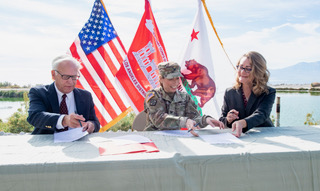
Patrick O’Dowd formalizes the SSA partnership in the Army Corps of Engineers Feasibility Study with representatives of the Corps and the California Department of Water Resources.
That study will become increasingly important as near-term conservation decisions shape long-term environmental and public health outcomes around the Salton Sea. If new conservation programs reduce inflows faster than restoration and dust-suppression projects advance, the scale and cost of the eventual solution may increase, along with the burden on nearby communities and the potential loss of economic development opportunities.
The Salton Sea Authority’s position is not that conservation should stop. The river’s hydrology makes clear that conservation is necessary. The concern is whether conservation decisions are being evaluated in a broad enough context, especially when reduced inflows, shoreline exposure, air quality, habitat loss and public health are not separate issues for the people who live near the Sea.
That changes the policy question. The issue is no longer only whether the Lower Basin can produce enough conserved water to stabilize Lake Mead and Lake Powell for the next several years. It is whether the region can do so while honestly accounting for the consequences of shifting water away from landscapes and communities that already carry a disproportionate share of the system’s environmental burden.
A River Governed By Old Rules And New Realities
The Colorado River has long been governed by a complicated framework known as the Law of the River, a collection of compacts, statutes, court decisions, treaties and operating agreements. But that legal structure was built around assumptions about river flows that have not held up in the modern era.
The Congressional Research Service, in its updated report on Colorado River management, notes that the basin covers more than 246,000 square miles across seven states and two countries. The river supports municipal and industrial water supplies for roughly 40 million people, while a majority of basin water supplies are used to irrigate 5.5 million acres of land.
The same report underscores the imbalance that now defines the system. Natural flows in the basin averaged about 14.6 million acre-feet annually from 1906 to 2024, but flows from 2000 to 2024 averaged about 12.4 million acre-feet. The 2000 to 2022 period was identified by the Bureau of Reclamation as the driest 23-year period in more than a century of Colorado River recordkeeping and among the driest in the past 1,200 years.
That long-term decline has forced a difficult question: how much water can the system reliably provide, and who must reduce use when the river cannot meet all demands?
The Local Economy Is Part Of The Equation
The Imperial Valley can achieve significant water savings due to the scale of its agricultural use and the seniority of its water rights. But conservation in the valley is not abstract. It can change cropping decisions, farm economics, labor demand, canal operations, community stability and the inflows that have historically sustained the Salton Sea.
In the Coachella Valley, Colorado River management affects the cost and reliability of long-term water supplies, agricultural competitiveness in the eastern valley, groundwater replenishment, growth planning and the broader regional economy. Any significant shift in the river’s operating regime will eventually show up in local land-use decisions, infrastructure planning and the cost of doing business.
The Lower Basin proposal also comes with political and procedural hurdles. It requires federal partnership, particularly for funding and implementation of expanded system conservation. It remains subject to approval by the Arizona Legislature and the governing boards of relevant California and Nevada water agencies. IID emphasized that any district participation would require authorization by its board.
The Lower Basin states said the proposal preserves legal accountability under the Colorado River Compact, including Upper Basin delivery obligations, while keeping open the possibility of a broader seven-state agreement. They also said they recognize the Upper Basin’s call for mediation and are open to that process, but argue that current conditions require immediate and measurable reductions from every state.
The Hard Part Is What Comes Next
The Lower Basin plan is best understood as a near-term pressure valve. It does not resolve the larger conflict over post-2026 river operations, nor does it answer all questions about future shortages, Upper Basin participation, tribal water rights, Mexico’s role, federal funding or the long-term health of the Salton Sea.
But it does signal that the Lower Basin states are willing to put additional water on the table before a larger compact is reached. For Southern California’s desert region, the challenge will be to ensure that the burden of stabilizing the river does not fall disproportionately on the communities, farms and workers most dependent on it.
The Colorado River crisis is often discussed in terms of reservoirs, elevations and acre-feet. In the desert communities of Southern California, it is also about livelihoods, food production, public health, groundwater reliability and the future shape of growth.
That is why this proposal matters. It could help prevent further decline in the river system. But it also places a sharper focus on the conditions that must accompany any meaningful conservation: federal support, protection of senior water rights, sustainable local water supplies, agricultural viability, environmental stewardship and a more complete accounting of the Salton Sea.

Bob Marra is the CEO/Publisher of GPS Business Insider. He has been studying, writing and giving presentations about business, economic and public affairs news and issues and the local economy in the Greater Palm Springs/Coachella Valley region for more than 20 years.