The Salton Sea Authority (SSA/Authority), at its March 19 board of directors meeting, adopted a new five-year strategic plan intended, among other important strategies, to reposition the agency as a stronger governing force in the increasingly complex effort to protect human health, revitalize the environment and facilitate economic opportunities tied to the Salton Sea. But the meeting did not end there.
Immediately after accepting the plan as presented, the board took a second consequential step. On a 5-2 vote, directors agreed to reorganize the SSA leadership months before the normal officer transition, arguing that the agency should be led by officials from member organizations that intend to remain at the table as the Imperial Irrigation District (IID) prepares to leave the joint powers authority. Yes, IID is ending its official role as a partner in the Salton Sea Authority.
Taken together, the two actions underscored a central theme that ran throughout the meeting: the SSA is working to redefine and empower itself at a moment of institutional change, rising pressure for public health action, and growing scrutiny over who will lead the region’s restoration agenda for the Salton Sea.
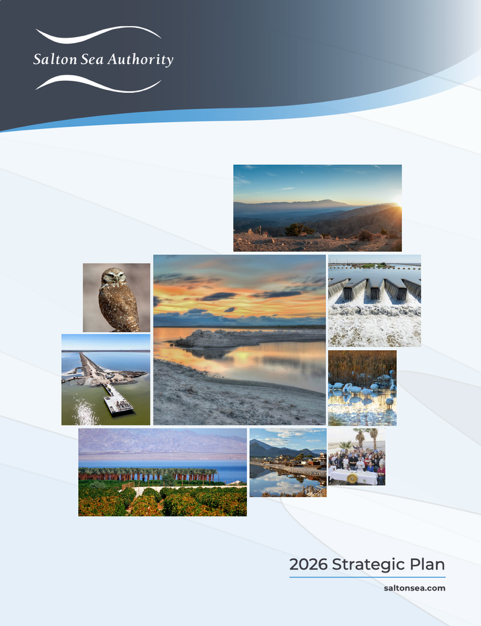
The newly adopted strategic plan, prepared in conjunction with the board by Coachella Valley-based CV Strategies, is designed to guide the SSA through 2030. Its framework rests on governance as a foundational priority, with three main pillars: stakeholder collaboration, funding, and public health. The document calls for the SSA to strengthen its organizational structure, sharpen its role among overlapping agencies, pursue more durable funding streams and place air quality and environmental health more squarely at the center of restoration efforts.
Local expertise facilitates local strategy
Amid a notable recent wave of local public agency strategic plan development, it is refreshing to see a highly informed, regionally engaged Coachella Valley-based consultancy chosen to help lead the process. The scope of work for several recent agency plans has required out-of-region consultants, some as far away as New York, to spend local taxpayer and ratepayer dollars to get up to speed on our facts, figures, and issues. Not in this case.
In reference to their work for the Authority, Palm Desert-based CV Strategies provided the following statement: “Governance. Collaboration. Funding. Public health. These are big issues, tackled with focus, alignment, and intention. This Strategic Plan was shaped by the Board, and it now provides a clear, actionable roadmap to lead with purpose and deliver results. It was an honor for CV Strategies to support the Board through this process and help translate their vision into a practical tool they can use to govern effectively.”
Insights into the strategies
In an interview with GPS Business Insider, SSA Executive Director and General Manager Patrick O’Dowd summarized the key points of the strategy, saying, “This plan is intended to evolve the Authority from a convening body to a governance powerhouse capable of coordinating large-scale restoration investment in an evolving regional governance landscape while strengthening internal alignment and partnerships, and providing a practical guide for long-term stability, results and accountability.”
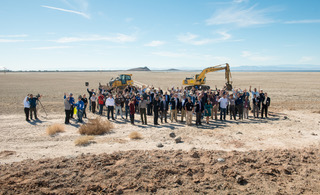
Meaningful forward progress at the Salton Sea will require an alliance of willing partners taking action in a coordinated, sustained effort.
That governance emphasis is woven through the plan, putting it at the center of the SSA’s strategy through 2030, above the three major pillars of stakeholder collaboration, funding and public health. The document argues that without clearer authority, accountability, and coordination, efforts to restore funding, improve public health, and advance economic development will fall short, as will interagency alignment.
In practical terms, the plan seeks to give SSA a clearer lane as the Salton Sea governance landscape becomes more crowded. The Authority has long presented itself as the only federally recognized local sponsor of Salton Sea restoration efforts, and the plan repeatedly argues that a key element of its value lies in coordination, alignment and continuity across jurisdictions. It also stresses the importance of SSA’s critical role as joint local sponsor, with the California Department of Water Resources, of the U.S. Army Corps of Engineers feasibility study tied to long-term restoration planning.
The Salton Sea Conservancy enters the scene
The strategic plan itself says the SSA must adapt as board membership changes and as the Salton Sea Conservancy (Conservancy) emerges as a new state-level player. The Conservancy was established through Senate Bill 583 in fall 2024 to help coordinate conservation and restoration work in the region. In the Authority’s view, it should become a complementary partner rather than a competing center of power.
That question surfaced directly at the March 19 meeting, when Coachella Valley Water District Director John Aguilar asked about a metric in the plan that calls for a memorandum of understanding with the Conservancy by the end of this year. O’Dowd replied that the SSA cannot control outside entities but said an MOU would help establish “clarity and direction with respect to their lane,” adding that “we don’t need to do everything. We need to do what we can do well and how we can best serve to foster the success of these efforts at, and around, the sea.”
In our interview, O’Dowd described the Conservancy question in even broader terms. He said the idea of a conservancy originally grew out of the practical question of who would eventually operate and maintain large restoration projects once they are built.
“Why not create a conservancy to handle these finished projects?” he said, arguing that operations and maintenance will become a massive challenge over time. He said the SSA’s view is that the Conservancy should be a complementary tool, not a replacement for every other institution in the Salton Sea arena. “The question to us is not whether the Conservancy should exist, but how the SSA and Conservancy can function effectively as complementary partners rather than competing entities,” the strategic plan says.
O’Dowd also made clear that he sees the Authority’s core value in local coordination, federal alignment and keeping public confidence in a long, politically complicated process.
“The Authority is a multi-jurisdictional joint powers agency,” he said. “My job is to ensure that we are focused like a laser on the most important part of the most important part.” He added that none of the member agencies have the Salton Sea as their single top priority, but all understand the sea’s regional importance and the need to keep moving.
Human health and economic opportunity are key to the solution
O’Dowd was especially emphatic that the sea’s challenges can no longer be framed only as an environmental issue.
“I think the real driver now is the unknown, unquantified risk to human health,” O’Dowd said in the interview, arguing that for too long the public conversation has focused more on narrative than measurable accountability. “The reasonable expectation that we have of knowing with assurance that the changes taking place at the sea are not causing or increasing community health risks is something we should know after 23 years post-QSA implementation. But you can talk to any public agency that’s responsible in this space, and they can’t give you that assurance, because they’re not doing the testing right.”
That public health emphasis is central to the plan, which elevates air quality, environmental exposure and health-agency coordination as major strategic priorities. O’Dowd told the board he has already had discussions with public health agencies about forming a broader framework for assurance, though he said the concept remains resource-constrained.
During our discussion, he broadened the SSA’s case even further, tying the Salton Sea not only to health and habitat, but also to long-term economic opportunity in the eastern Coachella Valley and Imperial Valley.
“I often say that the Salton Sea Authority has three priorities, health, habitat and opportunities,” O’Dowd said. “I call opportunities jobs, housing, schools, retail, and more.” Without that economic engine, he said, “the rest of this vision is not going to work.”
The meeting shifts from strategy to governance
The SSA board meeting then turned from strategy to governance.
The board addressed organizational strategies, considering IID’s impending exit as a financial partner and board member of SSA at the beginning of the next fiscal year, starting on July 1, 2026 – a move IID announced last December.
O’Dowd said the discussion had grown out of questions over whether the board’s current leadership structure is still best positioned to advance the Authority’s interests in Sacramento, Washington and elsewhere as membership changes.
IID has said its shift away from the Authority and toward the Salton Sea Conservancy is intended to “strengthen alignment among state and federal agencies and facilitate project operations and management.” IID General Manager Jamie Asbury called that move “a turning point,” saying the conservancy “brings everyone, local, State, and federal representatives and stakeholders, under one umbrella” and is “the most effective way to continue and expand Salton Sea progress and long-term planning responsibilities.”
O’Dowd does not share anyone’s notion that the Authority has become secondary.
“It was a little disappointing when IID, for reasons that are personal to them, decided to no longer associate with the Authority as a member,” he said. “But I just don’t think the rest of the member agencies have missed a beat.” He added that the Authority will now have to work with IID “in a bit of a different manner.”
He also defended the Authority’s federal standing.
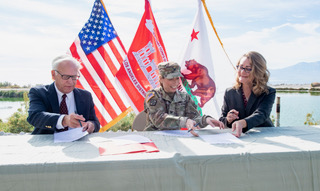
Patrick O’Dowd formalizes the SSA partnership in the Army Corps of Engineers Feasibility Study with representatives of the Corps and the California Department of Water Resources.
“The Authority is a joint local sponsor with the state on the Army Corps project,” he said of the Army Corps of Engineers feasibility study. “Regardless of what the Conservancy does, they can’t take that away from us because we secured it. We are at the table. We are a signatory to the agreement.” He said the larger objective is to produce a long-range framework for what is actually “reasonable, feasible and achievable” over the next 20 to 50 years.
SSA board member, Supervisor V. Manuel Perez, argued that if a partner has decided to move on, the organization should be led by someone who will remain fully identified with and accountable to it going forward. He said the “face” of the agency should be someone positioned to speak for it as it navigates the next phase of restoration work.
Board member Castulo Estrada, also a director of the Coachella Valley Water District, made a similar case, saying the SSA has important relationships to manage ahead with the Army Corps of Engineers, legislators and other partners, and that leadership should transition now rather than later in light of IID’s departure. He said the issue was not personal and praised then-Chair Gina Dockstader’s work, but argued the agency needed continuity that extended beyond an outgoing member agency.
The result effectively triggered an early leadership transition and altered both the chair and vice chair structure ahead of the normal bylaws timetable. That may seem procedural, but it carries broader significance for an agency that remains indispensable even as one of its long-term members departs and a new state-led conservancy enters the field.
Moreover, as IID and other Colorado River stakeholders negotiate the terms of future Colorado River water use, which will affect the Salton Sea one way or another, the SSA will continue to emphasize its mission to protect human health and revitalize the Salton Sea’s environment and the surrounding economy.
GPS Business Insider will continue to study and report on all these important matters, hoping that collaboration and goodwill will lead to the urgent solutions that the people and wildlife of our region deserve.

Bob Marra is the CEO/Publisher of GPS Business Insider. He has been studying, writing and giving presentations about business, economic and public affairs news and issues and the local economy in the Greater Palm Springs/Coachella Valley region for more than 20 years.