The City of Palm Desert is taking a serious look at what could become one of the most significant economic development and recreation projects in Greater Palm Springs: a super-regional indoor sports complex designed to serve both local residents and a rapidly growing sports tourism market.
At the February 12 City Council study session, Assistant City Manager Richard Cannone outlined an early-stage concept developed by Visit Greater Palm Springs, emphasizing that the discussion was exploratory and focused on direction rather than approval. “The purpose of today’s study session is threefold,” Cannone told the Council. “One is to present preliminary concepts for an indoor sports complex, share market context and comparable examples, and ultimately receive Council feedback. This is for discussion only. We’re not requesting any formal action this afternoon.”
A Facility Designed for Community and Tourism
The proposed facility would be a large, climate-controlled, multi-use indoor sports complex capable of hosting local leagues during the week and regional and national tournaments on weekends. It would support basketball, volleyball, pickleball, wrestling, futsal and potentially indoor turf sports, along with camps, clinics and special events.
Cannone explained that these facilities have evolved far beyond traditional gymnasiums. “Many of them also include food services, climbing walls, bowling alleys, and redemption game areas. We’re even starting to see some that incorporate eSports,” he said.
Importantly, the concept also includes hosting adaptive sports tournaments, positioning Palm Desert as a destination for athletes of all abilities.
According to the feasibility work conducted for Visit Greater Palm Springs, the data strongly supports development of an indoor hardcourt facility in the Coachella Valley, with unmet demand from both local users and non-local tournament organizers. The study concluded that an indoor complex offers the highest return in terms of utilization, revenue, and economic impact per square foot.
Strong Market Fundamentals
Palm Desert’s location is one of its greatest assets.
Within a 60-minute drive, the population approaches 1.9 million. Within 120 minutes, that number exceeds 14 million, and within a 300-minute, or five-hour drive, the population climbs to more than 32 million. The updated executive summary emphasizes that the reach of a true tournament-caliber facility should extend to the 300-minute “super-regional” market, which includes only a few comparable competitors.
That reach is critical. Sports tourism is one of the fastest-growing segments of the travel industry, and destinations with similar facilities host roughly 69 events annually, with nearly 3,000 attendees per event.
The original feasibility study projected that, once stabilized, an indoor sports complex in Greater Palm Springs could generate approximately:
- 561,500 annual attendee days
- 213,200 non-local attendee days
- 34,300 annual hotel room nights
- $46.3 million in annual economic output
- 598 full- and part-time jobs
- Approximately $384,600 in annual operating profit before debt service
The estimated annual direct and indirect economic impact approaches $50 million.
Cannone underscored why that matters for Palm Desert. “For us, most important, it increases hotel stays and visitor spending, and really functions as an economic development anchor,” he said, adding that cities are increasingly looking beyond traditional retail development to attract tourism dollars.
Filling the Summer Gap
One of the most compelling aspects of the proposal is its potential to help stabilize hotel occupancy during the summer months, when desert visitation always dips substantially.
Because the facility would be climate-controlled, Cannone noted, it could provide tournaments and events during periods when outdoor facilities are less viable. That gives hotels and restaurants an opportunity to capture business in shoulder and off-peak seasons.
The region already boasts more than 14,600 hotel rooms across 54 major lodging properties, along with vacation rentals and other accommodations, making it well-positioned to support tournament traffic.

Scott White, President/CEO, Visit Greater Palm Springs
Scott White, CEO of Visit Greater Palm Springs, addressed how a Tourism Business Improvement District (TBID) could help fund the project. In response to a question from Councilmember Gina Nestande, White said that a 1% TBID assessment in Palm Desert could generate roughly $2 million annually. If structured as a multi-city collaboration, that figure could grow to $3 million or more, with hotels closer to the complex paying a higher percentage and those farther away paying less.
White emphasized that a regional approach would ensure shared costs and benefits across valley cities.
Why Palm Desert?
Staff identified the University Neighborhood Specific Plan (UNSP) in its North Sphere area as a promising site. The city controls approximately 140 to 170 acres of vacant land in that area, which is currently undergoing a planning update.
The site offers proximity to Interstate 10, nearby resort hotels, and the opportunity to integrate the sports complex into a broader mixed-use development concept that complements, rather than replaces, the planned regional park.
The feasibility study also emphasizes that successful sports complexes are typically located within 15 to 20 minutes of hotel clusters and major roadways, a criterion Palm Desert can meet.
Council members asked pointed questions about funding, governance, partnership structures and potential fiscal risk. Staff made clear that no financing structure or development partner has been identified, and that any project would proceed in deliberate phases, with full financial analysis returned to Council before commitments are made.
Learning from Comparable Cities
Staff presented examples in Henderson, Nevada, and Williamsburg, Virginia, where large-scale indoor sports facilities are under construction.
The Henderson West Fieldhouse, a 160,000-square-foot facility on 18 acres, includes courts, turf fields, event space and family entertainment components.
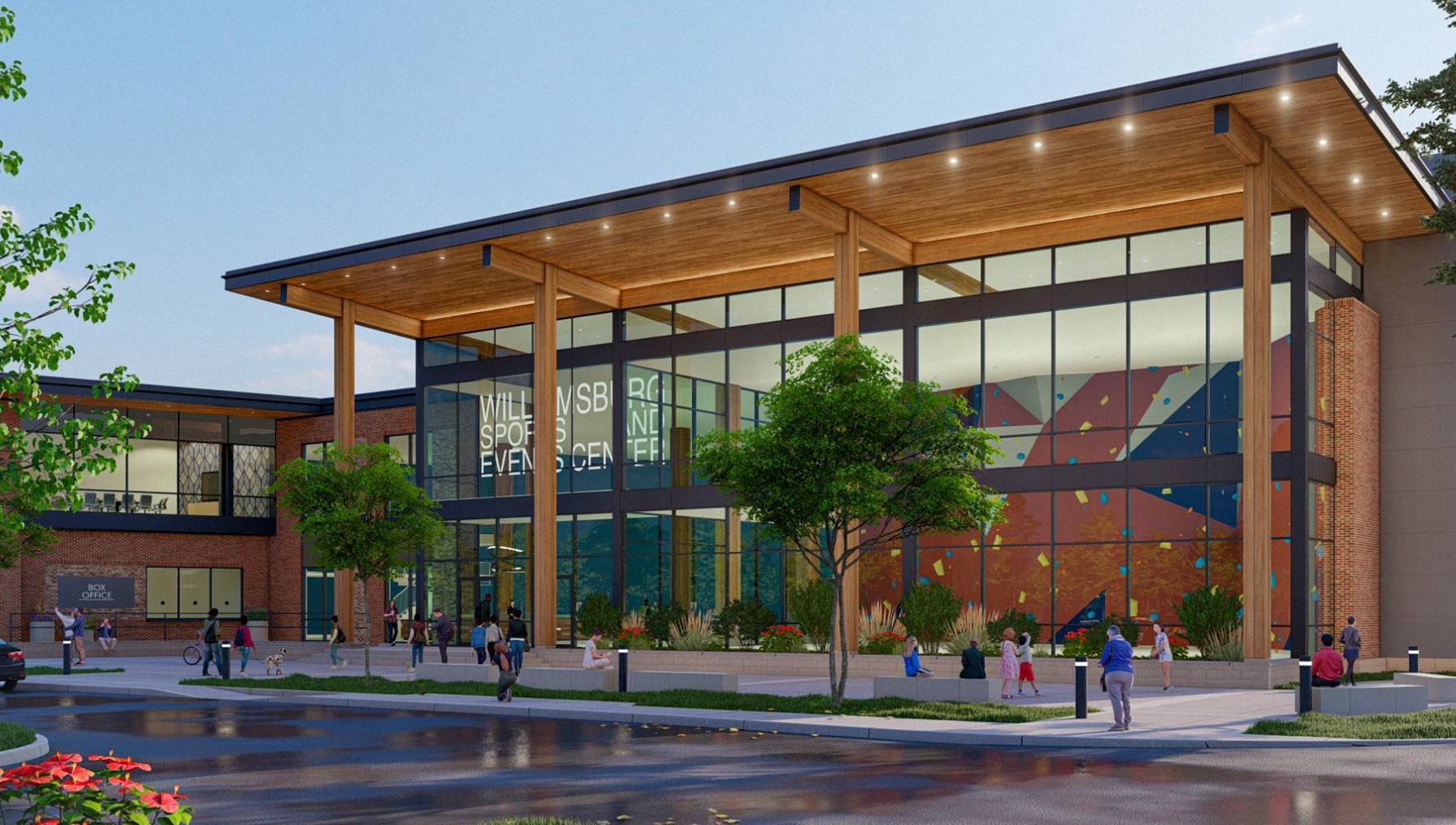
A rendering of the Williamsburg Sports Complex which is currently under construction.
The Greater Williamsburg Sports & Events Center is even larger, at 200,000 square feet, and is designed to host local programming during the week and regional and national tournaments on weekends.
Palm Desert’s concept could range from approximately 140,000 to 200,000 square feet, with estimated capital costs of $50 million to $80 million, depending on scope and amenities.
Governance and Partnership Model
The feasibility analysis recommends a hybrid public-private ownership model, with public ownership, contracted private management, and an oversight board representing public and private stakeholders.
This structure would allow the city to retain policy control while leveraging professional operators experienced in maximizing bookings, sponsorships and revenue streams.
Cannone stressed that staff would examine public-private partnerships, municipal lease structures, and TBID funding models as part of any next phase of analysis.
Council Direction: Measured, Phased Next Steps
At the conclusion of the study session, Councilmembers signaled interest in further evaluation while emphasizing fiscal prudence.
Staff outlined a deliberate set of next steps, subject to Council support:
- Enter into a non-binding Letter of Understanding with Visit Greater Palm Springs to formalize cooperation and information sharing.
- Issue a Request for Proposals (RFP) to identify and vet qualified development and operations partners.
- Conduct a detailed evaluation of capital costs, operating projections, funding strategies and fiscal impacts, and return to Council with a proposed deal structure if viable.
- Confirm Palm Desert as the lead agency for coordinating the evaluation process.
- Identify Palm Desert as the proposed site location for feasibility analysis, subject to land use, environmental and financial review.
A Strategic Opportunity
The broader feasibility analysis concludes that a new indoor sports complex could provide not only quantifiable economic benefits but also qualitative impacts, including enhanced quality of life, increased recreational access, and the potential to anchor future development.
For Palm Desert, the proposal offers an opportunity to leverage its central location, hospitality infrastructure, and available land to become a super-regional sports tourism hub – one that supports local youth and adult recreation while attracting tens of thousands of visitors each year.
As Cannone told the Council, the question now is whether the city wants staff to continue exploring the opportunity and, if so, how to shape it to balance community benefit with long-term fiscal responsibility.
If the project advances through due diligence and partnership vetting, Palm Desert could soon become the center of a new kind of destination where championship tournaments, community leagues, and adaptive sports events fill courts year-round, driving both pride and prosperity across Greater Palm Springs.

Bob Marra is the CEO/Publisher of GPS Business Insider. He has been studying, writing and giving presentations about business, economic and public affairs news and issues and the local economy in the Greater Palm Springs/Coachella Valley region for more than 20 years.