Pacific Retail outlined low-rise housing, new restaurants and a public plaza at a Nov. 12 study session. Council members welcomed the direction while questioning its fiscal impact and how much of the mall’s regional role it would preserve.
Updated November 13, 2026
The owners of Palm Desert’s mall want to turn stretches of asphalt into a neighborhood. City Council members want to know whether that neighborhood can revive the property’s commercial vitality while generating enough revenue to support its new residents.
That question emerged as a central issue at the council’s Nov. 12 study session on transforming The Shops at Palm Desert into The Village at Palm Desert, a mixed-use district that would retain the shopping center’s commercial core while adding housing, restaurants and gathering spaces.
Pacific Retail Capital Partners described housing generally no more than about three stories, discussions with homebuilders and plans to sell residential parcels beginning in 2028. The informational session produced no project approval, construction commitment or public funding agreement.
“I like what I’m seeing,” Mayor Evan Trubee said, calling the mall’s future one of the questions he hears most often from residents.
What the Palm Desert Mall Redevelopment Would Include
Pacific Retail’s proposal would change both the uses surrounding the mall and the reasons people visit it. The company envisions a place where residents could walk to restaurants, shops, fitness businesses and everyday services, while a public plaza would accommodate community events and informal gatherings.
Oscar Parra, a Pacific Retail principal, said the proposed name change reflects that broader role.
“We want to create a village that has primarily residential and retail uses, among other potential uses,” he said.
The planning framework identifies a 34.34-acre existing mall area, a 9.18-acre northern area called the Center Neighborhood and several additional areas that could accommodate commercial or residential development. Commercial uses would remain along Highway 111, where the company hopes to add new buildings that make activity on the property more visible from the road.
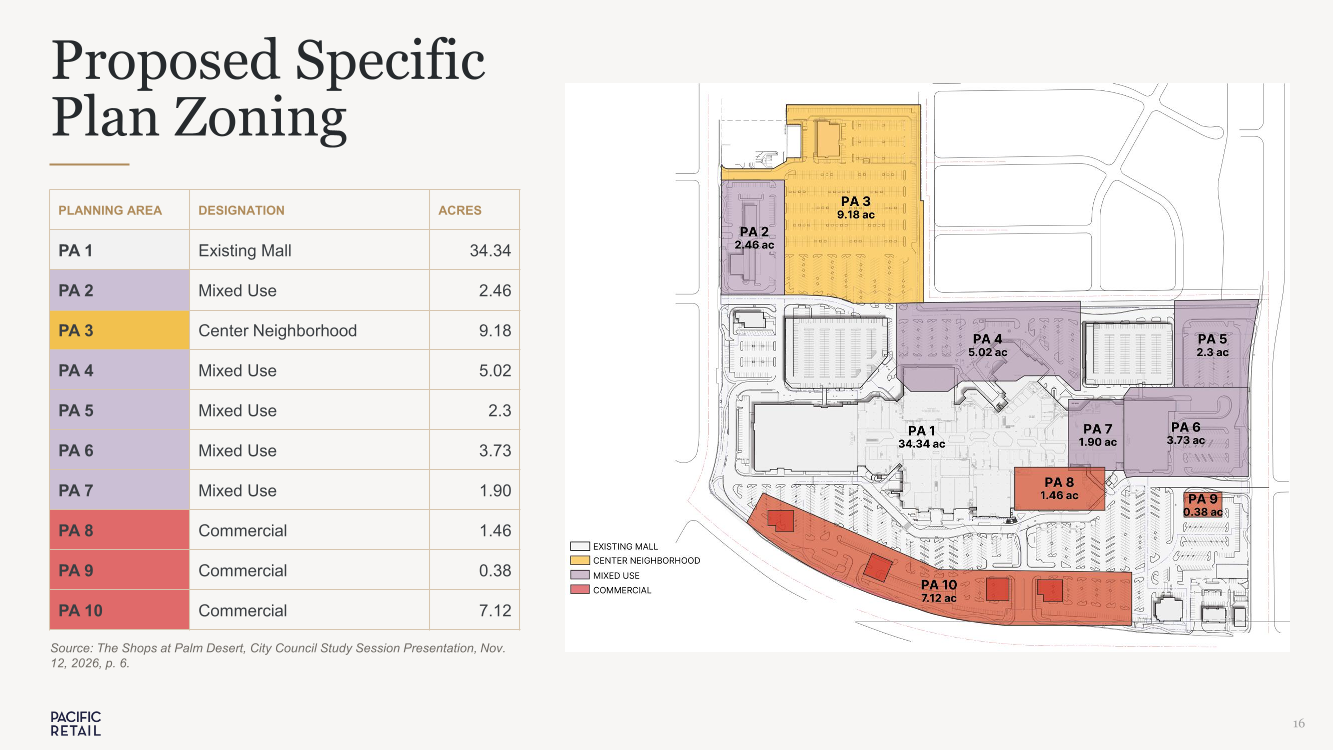
Pacific Retail’s proposed Specific Plan zoning divides the mall property into ten planning areas. The existing mall would remain a 34-acre commercial core, ringed by five mixed-use areas, with new commercial pads along Highway 111 and a 9.18-acre Center Neighborhood on the north parking fields set aside for future housing. Source: Pacific Retail Company presentation, Palm Desert City Council study session, Nov. 12, 2026.
Lemore Czeisler, Pacific Retail’s vice president of development, described lower-density housing toward the back and somewhat greater density nearer the mall, generally two to three stories, with attention to mountain views. Those are preliminary concepts, not approved height limits.
Parra said housing would probably be predominantly market-rate. No unit count, affordable-housing commitment or final residential design was announced.
Czeisler said the point of bringing residents onto the property is partly to improve its appeal to prospective retailers. Homes would create customers within walking distance and help demonstrate that the redevelopment is moving beyond a concept.
“They don’t believe anything until it starts,” she said of prospective retail tenants.
Why the Mall’s Transformation Has Taken Years
Pacific Retail acquired the mall in November 2023 after receivership. Parra said it assumed the mortgage, stabilized operations and secured funding for entitlement and rezoning work in 2024. That funding does not establish financing for construction.
Pacific Retail controls roughly two-thirds of the approximately 64-acre site, Parra said. Macy’s, JCPenney and the city own separate properties. Major tenants also have contractual protections for parking, access and visibility.
Czeisler said the company had to examine hundreds of pages of agreements before developing a workable concept.
“So we cannot wave a magic wand and just develop wherever we like,” she said.
Parra said discussions with other owners began early in 2026 and that they were generally aligned on mixed-use redevelopment. Individual restrictions still need to be resolved.
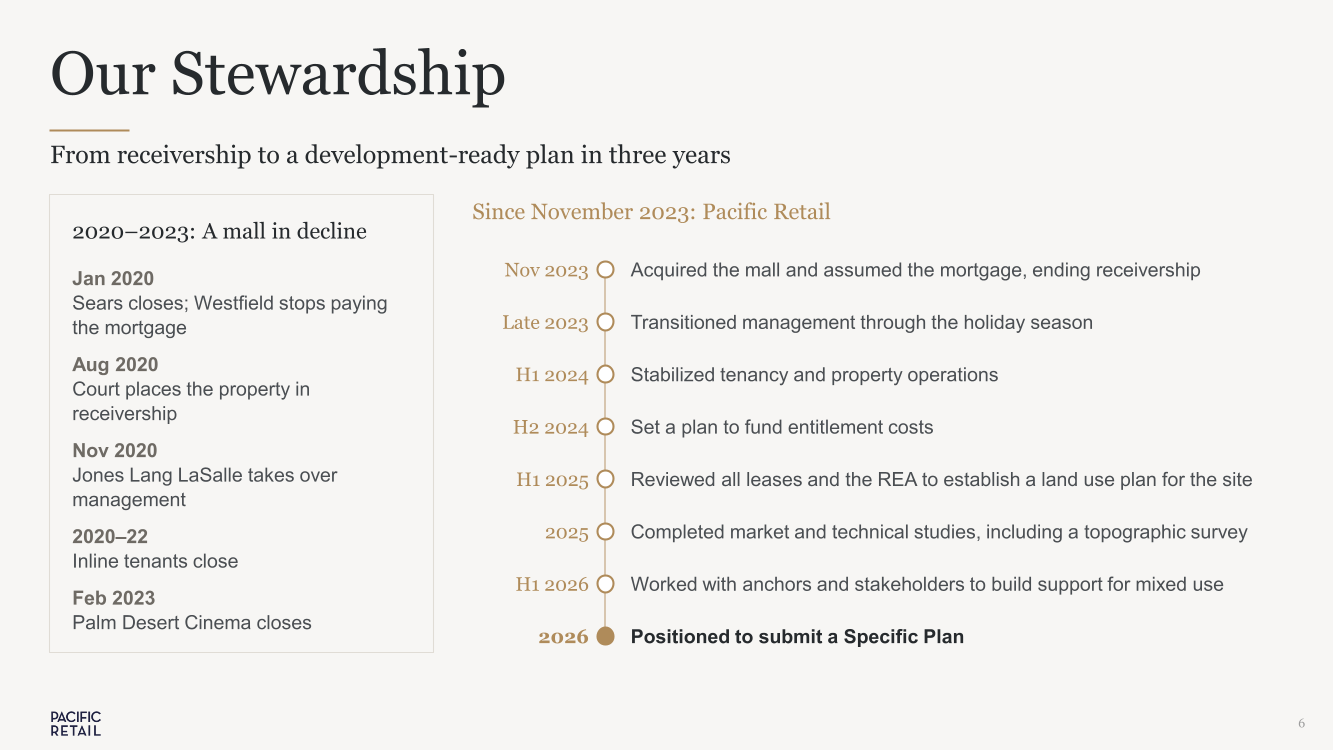
Pacific Retail reviewed highlights of its work since acquiring the mall in 2023.
One obstacle is the former Sears Auto Center. Pacific Retail owns the land, but Sears’ successor, Transformco, holds a ground lease that the presentation identifies as expiring in 2101. Parra said the company was exploring solutions with city staff but lacked a clear path to resolution.
New Restaurants on Highway 111 Draw Questions
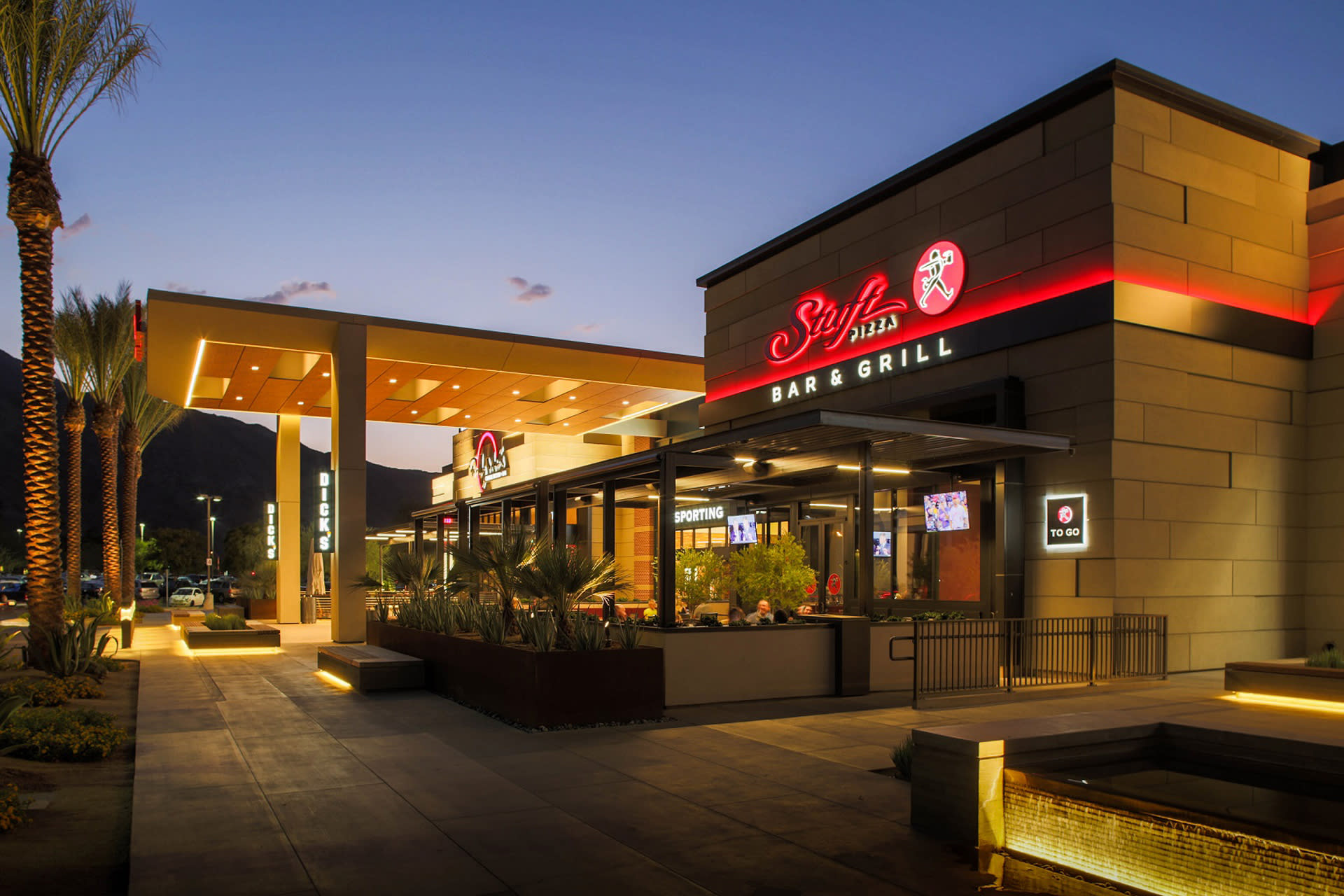
Pacific Retail is talking with restaurant operators, from fast casual to more upscale concepts, about new buildings along Highway 111. Parra said visible patio dining could help attract visitors across the parking fields and into the property.
Councilmember Jan Harnik questioned whether those buildings would draw customers farther into the mall and protect existing businesses’ visibility.
“I do question the line of sight that was brought up,” Harnik said.
Parra said feedback from Macy’s and other owners had influenced building locations, which could shift further to protect sightlines. He cited experience elsewhere and Placer.ai traffic measurements as reasons to expect more activity, but offered no quantified Palm Desert forecast.
Temporary Stores Help Fill Space While a Larger Plan Takes Shape
General Manager Molly Doyle said the specialty leasing program had brought in 32 temporary stores over roughly the past two and a half years. Those operators use short-term license agreements to test whether their businesses work in the center, with the goal of converting successful concepts into permanent tenants.
“The hope is to turn those temp tenants into permanent tenants, and we’ve had some success with that,” Doyle said.
The presentation reported that 28 percent of leasable space was vacant or under temporary arrangements. That is not a vacancy rate: It combines empty storefronts with occupied space, without separating the two.
Doyle also described maker markets and other events as a way to introduce entrepreneurs to the property. A business might first participate for a weekend, then consider a kiosk or an inline storefront.
Parra said traffic tracking showed increases when the circus visited the property. Harnik offered her own example of activity inside the mall, describing a visit during bingo when the building felt full of energy.
“It must generate revenue,” Harnik said. “We depend on it in this town.”
Council Members Press for a Fiscal Case
Council member Joe Pradetto pressed the owner’s representatives on a fundamental trade-off: Would a neighborhood built around the mall generate enough additional revenue to pay for the city services its residents would need, particularly if the property’s retail business became more local and less regional?
He framed his question around the concern that property taxes from new housing generally do not cover the full cost of serving those homes, leaving cities dependent on other revenue, including sales taxes. The mall had historically helped fill that role by drawing shoppers from outside Palm Desert. A development serving more residents on-site, he suggested, might create new spending while also increasing the city’s obligations and changing the source of its retail revenue.
If those revenues and costs failed to balance, Pradetto warned, the shortfall could become a request for public money. “You guys don’t do anything for free,” he said. “That gap typically comes in the form of, ‘Hey, city government, can you pitch in?”
Parra’s response focused on the property’s current performance rather than its historical role as a retail destination. Sears is closed, he noted, and some other parts of the mall generate limited sales. Pacific Retail argues that adding housing and businesses could make those areas more productive, increasing spending on a site that already has substantial unused commercial potential.
“We believe that if you were to densify the site, those areas will generate more sales,” Parra said.
He pointed to potential new commercial pads, including two on the city-owned Sears parcel and three on Pacific Retail’s property, as another source of economic activity. Combined with tenants oriented toward everyday needs, those additions could increase sales and help offset the net cost of serving the proposed housing, he said. That was an argument for greater revenue from the existing property, not a claim that residential property taxes alone would cover the costs.
The city-side response added a benchmark for evaluating the proposal: Sales-tax generation should be the baseline, with success measured by how that revenue grows over time. The objective, as expressed in the discussion, would be more than adding housing, which itself carries service costs. Redevelopment would also need to strengthen the property’s contribution to the city’s finances.
The exchange sharpened the fiscal test without resolving it. No projections showed how much additional taxable spending the housing and commercial pads would generate, what serving the new residents would cost, or whether the resulting revenues would leave a surplus or a gap. Nor did the exchange request or quantify a city subsidy. Those calculations will be central to evaluating whether the proposed village can improve the mall’s economics while also paying its way for Palm Desert.
Palm Desert has a direct financial stake and a regulatory role. It acquired the former Sears building and its 7.46-acre parcel in December 2022. The city’s mall redevelopment solicitation sought a developer capable of working within the property’s complicated ownership and agreement structure.
The staff report prepared for the study session said the city had engaged a qualified developer to attract a replacement anchor after completing the state process allowing a sale. It did not identify that developer or a prospective tenant. A disposition and development agreement would return to the council as part of a future transaction.
The city’s 2026 council work plan also contemplates evaluating infrastructure improvements and potential incentives associated with mall redevelopment. Those possible contributions would require their own scrutiny; the study session did not authorize them.
An Indoor Gathering Place Still Matters in the Desert
Harnik urged the owner to preserve an advantage that an enclosed mall has in the Coachella Valley: air conditioning.
“A closed building is a great asset,” she said, describing the mall as a place that could serve both Palm Desert residents and people from across the region during extreme heat.
Czeisler said shade and landscaping would be central to pedestrian connections between housing, retail and the plaza. Elevation changes, leases and department-store parking requirements complicate the plaza’s location, but the team believes it can accommodate a space open to the broader community.
“People need to connect,” she said. “That is just basic human need.”
What the 2028 Redevelopment Timeline Actually Means
The 2028 target concerns land transactions and further development work, not completed homes. Pacific Retail is talking with builders and intends to obtain entitlements before selling residential parcels, and may participate in some joint ventures.
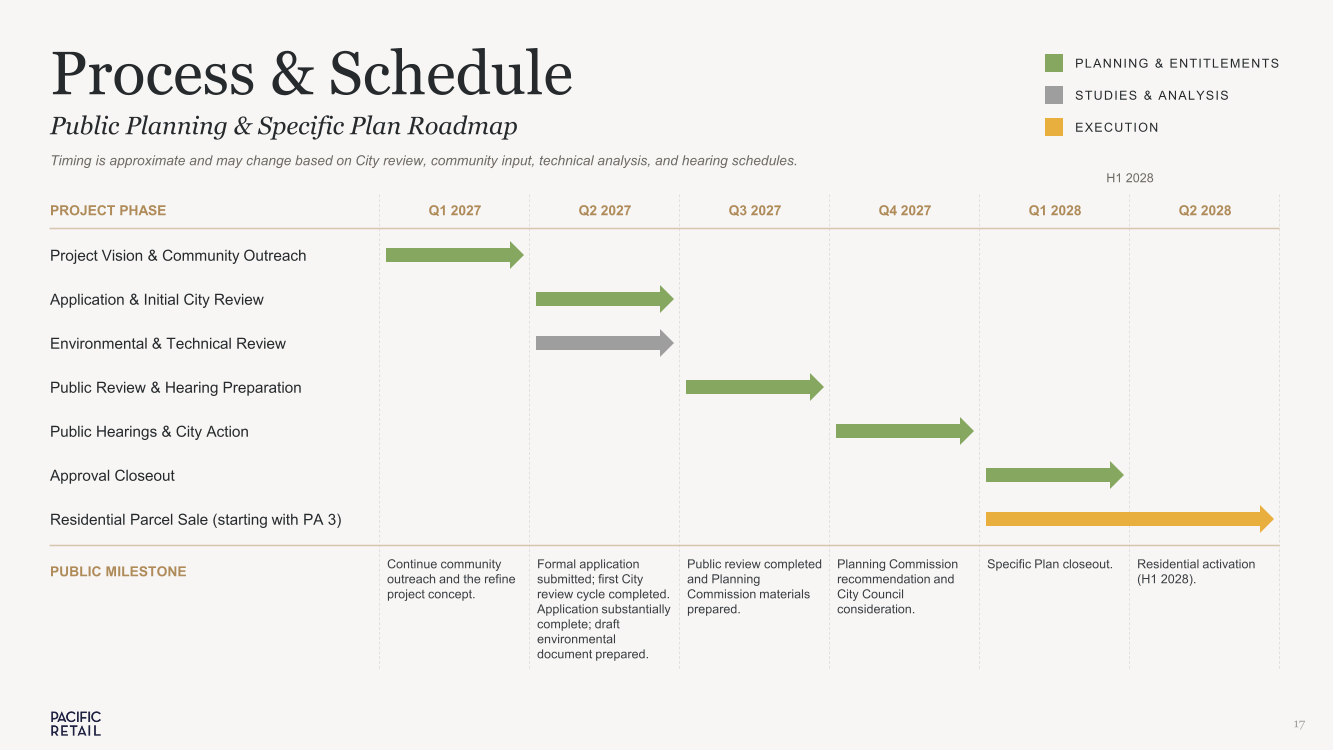
After purchasing land, those developers would approach the city with detailed plans, he said. Pacific Retail expects that process to begin in 2028. The northern Center Neighborhood is the intended first residential parcel because, Czeisler said, it is comparatively removed from other tenants’ parking and contractual rights.
The timing of the next planning submission remains less precise. City staff described a formal submission in early spring 2027, while Czeisler said the team hoped to begin the process in January. Trubee closed the session by saying he looked forward to seeing the representatives again in January.
The written roadmap anticipates outreach and review during 2027, hearings later that year, approval closeout in early 2028 and an initial residential parcel sale in the first half of 2028. Dates remain subject to city review, technical work and public input. Construction financing and a firm groundbreaking date have yet to be announced.

Bob Marra is the CEO/Publisher of GPS Business Insider and GPS Market Intel. He has been studying, writing and giving presentations about business, economic and public affairs news and issues and the local economy in the Greater Palm Springs/Coachella Valley region for more than 20 years.