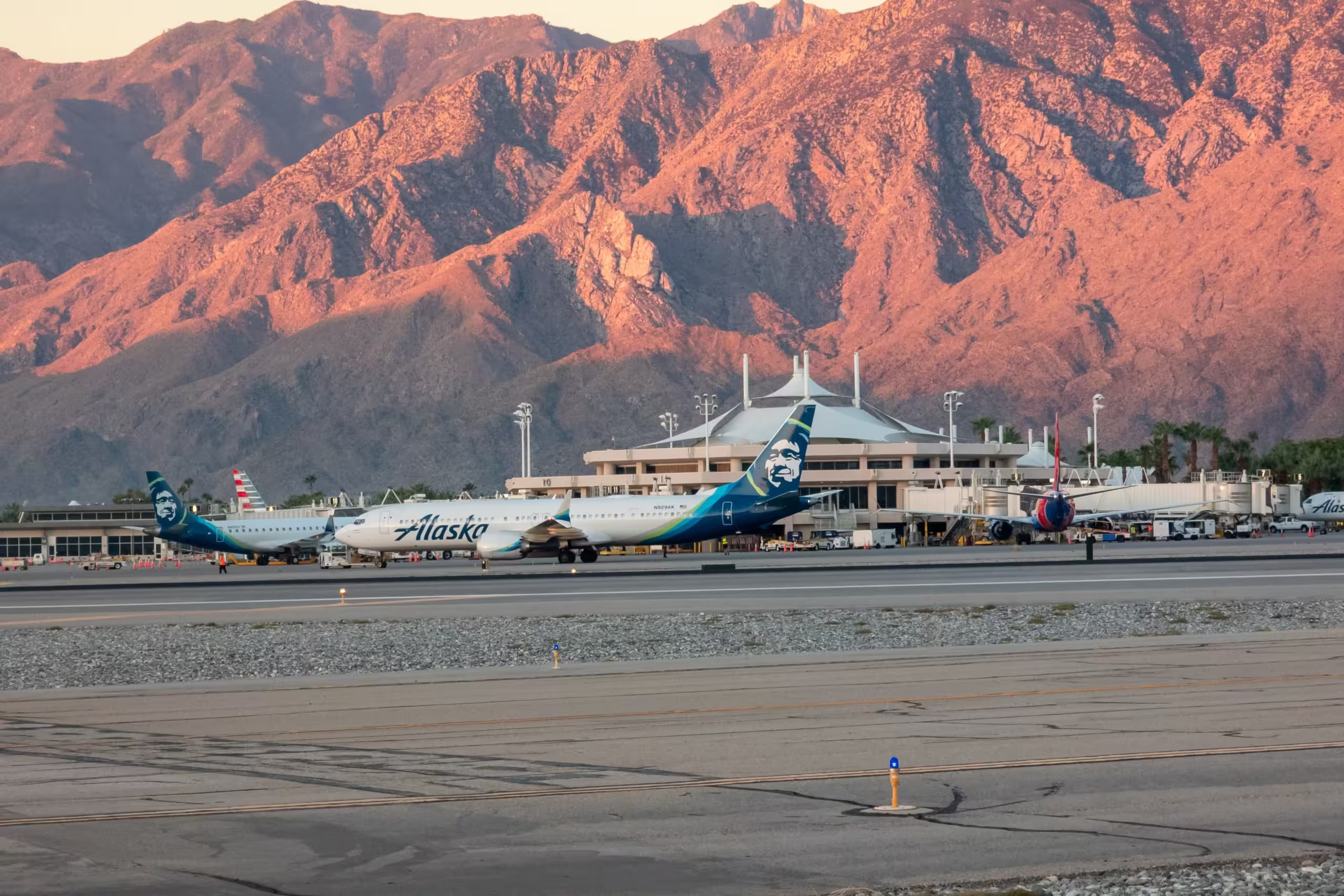
The summer slowdown at Palm Springs International Airport was barely a slowdown at all.
Passenger traffic slipped modestly in July and August compared with the same months a year earlier, but the airport is heading into its critical fall and winter season with traffic still near historic highs, an expanding seasonal flight schedule and a growing list of construction projects intended to prepare the region’s airport for what comes next.
The numbers presented to the Palm Springs Airport Commission this month show 124,354 passengers moved through the airport in July, down just 0.6 percent from July 2025. August traffic totaled 119,071 passengers, a 2.5 percent decline.
Combined, July and August produced 243,425 passengers, only about 1.5 percent below the same two months last year.
More important for the longer view, Palm Springs International Airport handled 2.21 million passengers through August. That is roughly 3 percent below last year’s all-time record pace, but still the second-highest January-through-August passenger total of the past six years.
For an airport still heavily influenced by the Coachella Valley’s seasonal tourism economy, the numbers point more to stabilization near a much higher post-pandemic traffic level than a material retreat.
And now the busy season is beginning.
The seasonal ramp-up has already started
The first wave of returning seasonal flights began earlier this month.
Alaska Airlines restarted nonstop service between Palm Springs and Santa Rosa on Sept. 10, more than six weeks earlier than last year. Delta Air Lines brought back Minneapolis service Sept. 12, followed by Sun Country’s Minneapolis service on Sept. 17.
The next significant step comes Sept. 24, when United Airlines is scheduled to resume seasonal flights to both Houston and Chicago O’Hare.
From there, PSP’s seasonal service schedule builds steadily into winter.
Southwest Airlines is scheduled to restore San Jose service Oct. 1. WestJet returns to Edmonton on Oct. 3. American Airlines resumes Chicago O’Hare on Oct. 5.
Canadian service expands later in the month, with Air Canada scheduled to return to Vancouver and Toronto on Oct. 25, followed by WestJet’s Winnipeg service on Oct. 27.
November brings another substantial wave. Alaska is scheduled to return to New York’s JFK Airport and Everett, Wash., on Nov. 1. Delta brings back Atlanta, Austin and Seattle on Nov. 9. Alaska resumes Boise on Nov. 20, followed by Southwest’s Austin service on Nov. 21.
United’s Washington Dulles service is scheduled to return Dec. 3, with Newark following Dec. 17. American’s Charlotte route and Southwest’s Chicago Midway service are scheduled to return Feb. 13, 2027.
Several of those routes are coming back substantially earlier than they did last season.
Delta’s Minneapolis service began 24 days earlier. United’s Houston route is returning 38 days earlier. Alaska’s Boise service is scheduled 49 days earlier. Southwest’s seasonal Austin service is moving forward by 106 days.
“Seasonal service is starting earlier at PSP, and that means more options for our travelers for more of the year,” Interim Executive Director of Aviation Victoria Carpenter said when the airport announced the schedule this month.
That movement matters beyond simply adding destinations to a route map. Earlier seasonal starts effectively lengthen the period in which Greater Palm Springs has nonstop access to important business, leisure and connecting markets.
Winter capacity is nearly holding its ground
The airport’s forward-looking capacity numbers also suggest a relatively stable winter despite some softness earlier in the year.

Scheduled airline seats for October through December are currently about 0.8 percent below the same period in 2025, while flights are projected to be down about 0.7 percent.
But the quarter improves as it progresses.
October seat capacity is projected to be down 4.5 percent from a year earlier and November is down 3.5 percent. December turns positive, with scheduled seats up 4.5 percent as holiday and peak-season demand builds.
The schedule’s composition is changing as well.
Airport data identify San Francisco as the largest growth market for the fourth quarter, with 11,276 additional seats compared with last year. Phoenix follows with 9,868 additional seats, Austin with 9,428, Houston with 6,900 and Boise with 5,016.
That gives the airport a somewhat different profile than the headline quarterly capacity number might suggest. Overall seats are essentially flat, but airlines are reallocating capacity and extending service in markets where they see opportunity.
PSP is also preparing operationally for the seasonal surge. At its September 16 Airport Commission monthly meeting, staff told commissioners they are increasing volunteer Navigator staffing, coordinating airline schedules with the Transportation Security Administration, adding baggage support, refreshing airfield and landside markings, and conducting preventive maintenance on heavily used equipment before the peak months.
Construction becomes part of the airport story
Travelers arriving for the season will also encounter an airport in the middle of a significant infrastructure cycle.

The new outbound baggage handling system is well under construction and expected to open in 2028.
The most consequential project now under construction is the new outbound baggage handling system, a multiyear overhaul intended to increase capacity, improve reliability and modernize checked-bag screening and processing.
Temporary-building installation, concrete-pad construction and utility relocation were underway as of the September commission meeting, and the first phase of equipment deliveries was expected to begin this month.
The project is scheduled for completion in the fourth quarter of 2028.
The Palm Springs City Council also accepted another federal grant in August providing up to $10.5 million toward the baggage handling system’s in-line screening work, adding to the federal support already secured for the project.
It is one of several improvements happening at the same time.
Both aging escalators leading to the Sonny Bono Concourse have been removed and replaced, with the project expected to wrap up by the end of September.
Permits have been approved for shade structures at the airport’s rideshare pickup area, with installation targeted for the fourth quarter. The project is intended to make the ground transportation area more comfortable during the region’s hottest months.

The new Bono Concourse escalators are scheduled to open by the end of this month.
Work is also underway on a new airport administration building, and staff are expected to move in by mid-October.
Meanwhile, PSP is beginning implementation of a new parking access and revenue control system designed to replace aging equipment and make parking more automated and easier to use. Airport staff told commissioners that mobilization was expected to begin this month, with completion targeted around the end of the year. PSP’s broader smart parking program calls for features including license-plate recognition, mobile payment options and improved parking information.
Inside the terminal, another proposed upgrade would replace the existing seating in the Bono Concourse.
Airport staff received a $650,000 proposal for 459 new seats incorporating 210 charging stations. The airport previously had $500,000 allocated for the project and is seeking another $150,000 in Measure J funding to complete the replacement.
That work joins a wider passenger-experience program already underway or in planning. PSP’s Progress PSP capital project tracker includes restroom renovations and expansion, parking improvements, landscaping, airfield work and other projects alongside the baggage system.
The planned restroom renovation and expansion program is particularly substantial, with improvements contemplated for the Bono Concourse and courtyard areas.
Planning beyond the projects travelers can see
The construction underway today represents only part of the airport’s longer capital agenda.
Airport staff and consultants have begun developing a new five-year capital improvement roadmap, reviewing project priorities, costs and schedules against projected airport revenue and available funding.
That exercise will help determine how quickly PSP can move from near-term modernization projects into larger capacity expansion.
Among the longer-range concepts already publicly identified is Phase 1 of a terminal expansion that envisions a new North Concourse with seven gates, a rental car center adjacent to baggage claim and a future Federal Inspection Services facility capable of supporting expanded international operations.
Those projects do not yet have firm construction schedules or final costs. But their presence in the airport’s planning pipeline underscores the larger transition underway at PSP.
For much of its history, Palm Springs International Airport could function like a highly seasonal regional airport, absorbing a dramatic winter increase in travelers and operating at a much quieter pace through the summer.
That pattern has not disappeared. But the gap has narrowed considerably.

Bob Marra is the CEO/Publisher of GPS Business Insider and GPS Market Intel. He has been studying, writing and giving presentations about business, economic and public affairs news and issues and the local economy in the Greater Palm Springs/Coachella Valley region for more than 20 years.