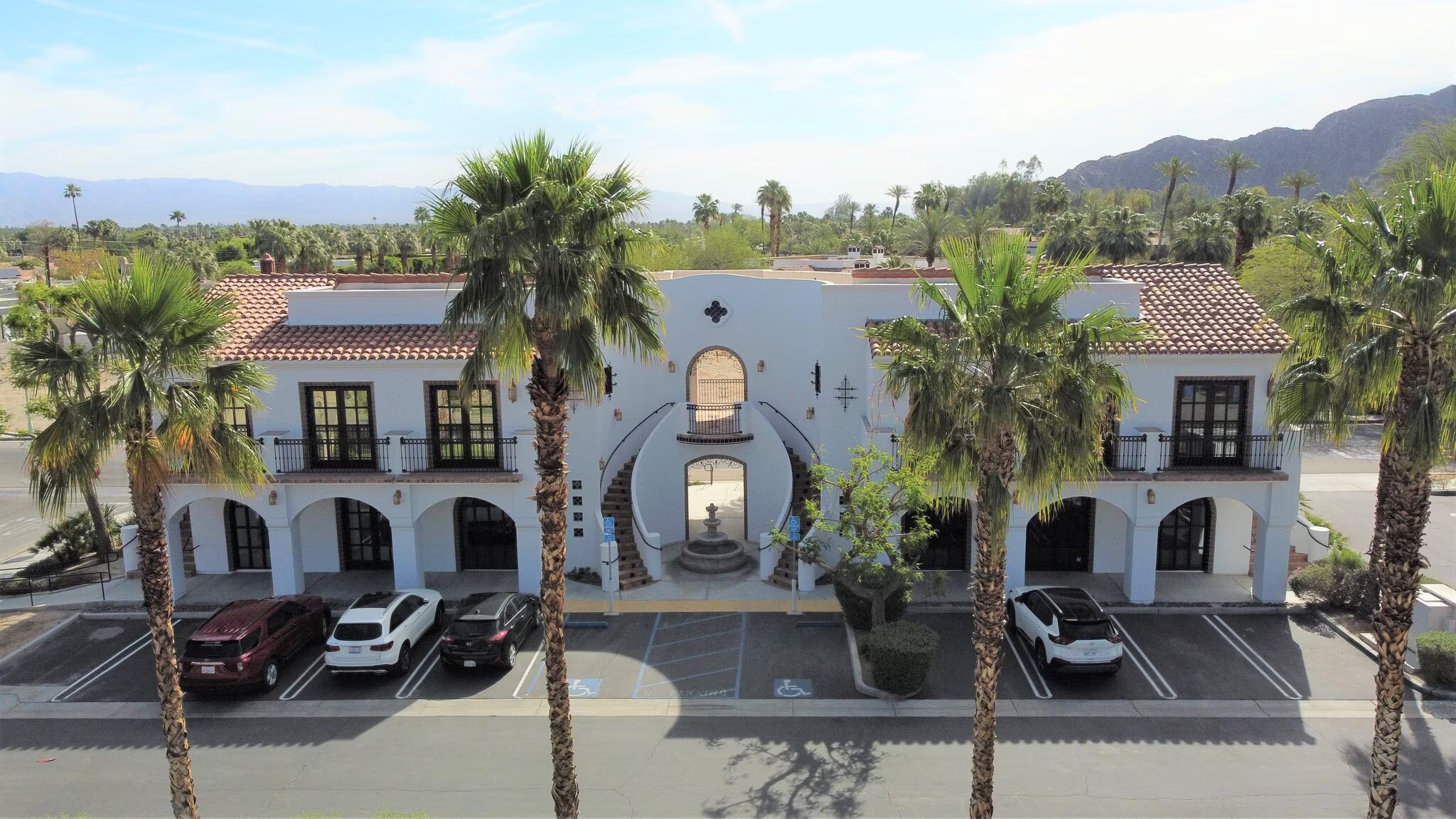
As borrowing costs rise, land and commercial property owners are using financing terms to help close the gap between asking prices and what buyers can afford.
A property sale can stall even when the buyer likes the asset and the seller is ready to move on. The obstacle is often the financing: borrowing costs can make a deal difficult to justify at the price the owner expects.

Kate Rust, Partner, Meade Commercial.
For some Coachella Valley sellers, carrying part of the purchase price helps revive negotiations. Seller financing allows the buyer to make a down payment and repay the balance to the owner under terms the parties negotiate.
Kate Rust, a partner at Meade Commercial in Rancho Mirage, said owner financing has become an early topic in her conversations with sellers of land and commercial properties. She is seeing it advertised more often on commercial listing platforms and using it to advance transactions when conventional terms haven’t brought the parties together.
The appeal is flexibility. A seller may accept a lower purchase price in exchange for interest income over time, while a buyer may gain a lower borrowing cost or more time to prepare a property for development. In return, the seller gives up immediate access to part of the sale proceeds and takes on the risk of being a lender.
Borrowing Costs Reshape the Deal
On September 16, 2026, the Federal Reserve raised its benchmark target range by a quarter percentage point to 3.75 percent to 4 percent, citing elevated inflation. By October 1, Freddie Mac’s weekly survey put the average 30-year fixed residential mortgage rate at 7.28 percent, compared with 7.03 percent a week earlier.
Residential mortgage rates are not quotes for commercial buildings or vacant land. Those loans depend on the borrower, property, income and repayment plan. But higher debt costs affect the same basic calculation: how much a buyer can pay while still earning an acceptable return.
Rust said land financing she encounters can carry rates of 10 percent to 12 percent. A seller willing to finance at 7.5 percent can change that calculation substantially. These figures reflect her transaction experience, rather than a published average for local land loans.
Banks have not uniformly pulled back. The Federal Reserve’s July lending survey found that domestic banks eased standards for some commercial property loans during the second quarter, while construction and land-development standards were largely unchanged. Commercial real estate standards nevertheless remained relatively tight by historical measures. The survey preceded September’s rate increase.
How the Terms Can Work
In arrangements Rust described, buyers often make substantial down payments, sometimes 50 percent. The seller carries the balance for three or four years, receives quarterly interest-only payments and collects the principal in a balloon payment at maturity.
The down payment, rate, payment schedule, collateral and maturity date are negotiated. That flexibility can help a buyer acquire a property that does not fit conventional lending requirements, but a large down payment means seller financing is not necessarily a solution for buyers with limited cash.
Consider a hypothetical $2 million sale with $1 million down and a $1 million seller-financed loan at 7.5 percent for four years. Interest-only payments would total $75,000 annually, or $18,750 each quarter. The full $1 million principal would remain due at maturity.
If all payments arrived as agreed and the loan was not paid off early, the seller would receive $2.3 million in total, before taxes and costs. The sale price would still be $2 million; the additional $300,000 would be interest earned on the loan over four years.
At 10 percent, interest on the same balance would cost $100,000 annually. The 7.5 percent rate would save the buyer $25,000 a year, before differences in fees or other terms. This is an illustration, not a reported transaction or current loan offer.
A Local Transaction Moves Forward
Rust described a roughly 15,000-square-foot commercial space that had been difficult to lease. Prospective tenants offered rents the owner would not accept, leading to a different approach: offering the space for sale.
An initial buyer withdrew late in the process. A subsequent agreement combined a price reduction with seller financing, helping the parties reach terms. As of October 5, Rust said the property was in escrow, and the buyer had removed contingencies, although the sale had not closed.
Financing helped move the transaction forward alongside the pricing adjustment and the decision to sell. Its ultimate success still depends on closing and, over time, the buyer’s ability to repay.
Land Buyers Need Time as Well as Capital
For undeveloped land, financing costs can accumulate before a property generates any income. Buyers may be paying interest and taxes while commissioning studies, pursuing entitlements and arranging utility service.
In the eastern Coachella Valley, Rust said prospective developers are weighing multiyear approval schedules alongside anticipated waits for electrical service. A seller-financed acquisition can give a buyer time to advance that work, but cannot guarantee approvals or a power connection.
That makes the maturity date critical. If approvals or utility service take longer than expected, a buyer can face a balloon payment before the project is ready for construction financing.
The Seller Must Think Like a Lender
An owner who carries financing needs to assess the buyer’s ability to repay, the property’s value and any existing liens. The California Department of Real Estate’s guide to trust deed investments emphasizes those factors and the protection provided by equity. A substantial down payment offers a cushion, but does not eliminate the risk of loss.
Rust said protecting the seller’s lien position is an important consideration. A seller behind another lender can face additional exposure if the buyer defaults. Loan documents also need to address servicing, taxes, insurance, defaults and later financing that could affect the seller’s security.
Recovering the property is not a simple undoing of the sale. Enforcement can take time and money, and the property may return in a different physical or financial condition.
Seller financing may also offer tax-timing benefits. Under IRS installment-sale rules, qualifying sellers generally recognize gain as principal payments arrive. Interest is taxed as ordinary income, and required depreciation recapture is reported in the year of sale. The treatment depends on the assets and transaction structure.
The repayment plan matters as much as the interest rate. Interest-only payments leave the principal intact, and refinancing depends on the property’s value, income and lending conditions when the loan comes due. A shortfall may require additional cash, a sale or an extension the seller is not obligated to grant.
For Coachella Valley owners and buyers, seller financing can turn a stalled negotiation into a workable agreement. The strongest arrangements pair flexible terms with a realistic path to repayment, giving both parties a reason to be confident beyond the closing date.

Bob Marra is the CEO/Publisher of GPS Business Insider and GPS Market Intel. He has been studying, writing and giving presentations about business, economic and public affairs news and issues and the local economy in the Greater Palm Springs/Coachella Valley region for more than 20 years.