Greater Palm Springs continues to draw visitors who are not only relatively affluent and highly satisfied but also deliberate in planning trips, inclined to return and willing to spend across hotels, restaurants, retail and experiences, according to a new annual visitor-tracking study commissioned by Visit Greater Palm Springs. and conducted by Downs & St. Germaine Research.
The 2025 report offers a detailed look at who is coming to the Coachella Valley tourism market, why they are visiting and how they are behaving once they arrive. The findings point to a destination with deep repeat appeal, a strong drive market, healthy air access through Palm Springs International Airport and a tourism profile that increasingly blends leisure, events, arts, dining and wellness.
For local businesses, hotels, restaurateurs, attractions and city leaders, the study provides fresh evidence that tourism remains the region’s most important economic engine and that the visitors fueling it are staying long enough and spending enough to matter well beyond the resort sector.
The study, conducted from Jan. 1 through Dec. 31, 2025, included 2,740 visitor interviews gathered in person across the region, along with surveys collected through online panels and social media campaigns. Its margin of sampling error was ±1.87 percentage points at the 95% confidence level.
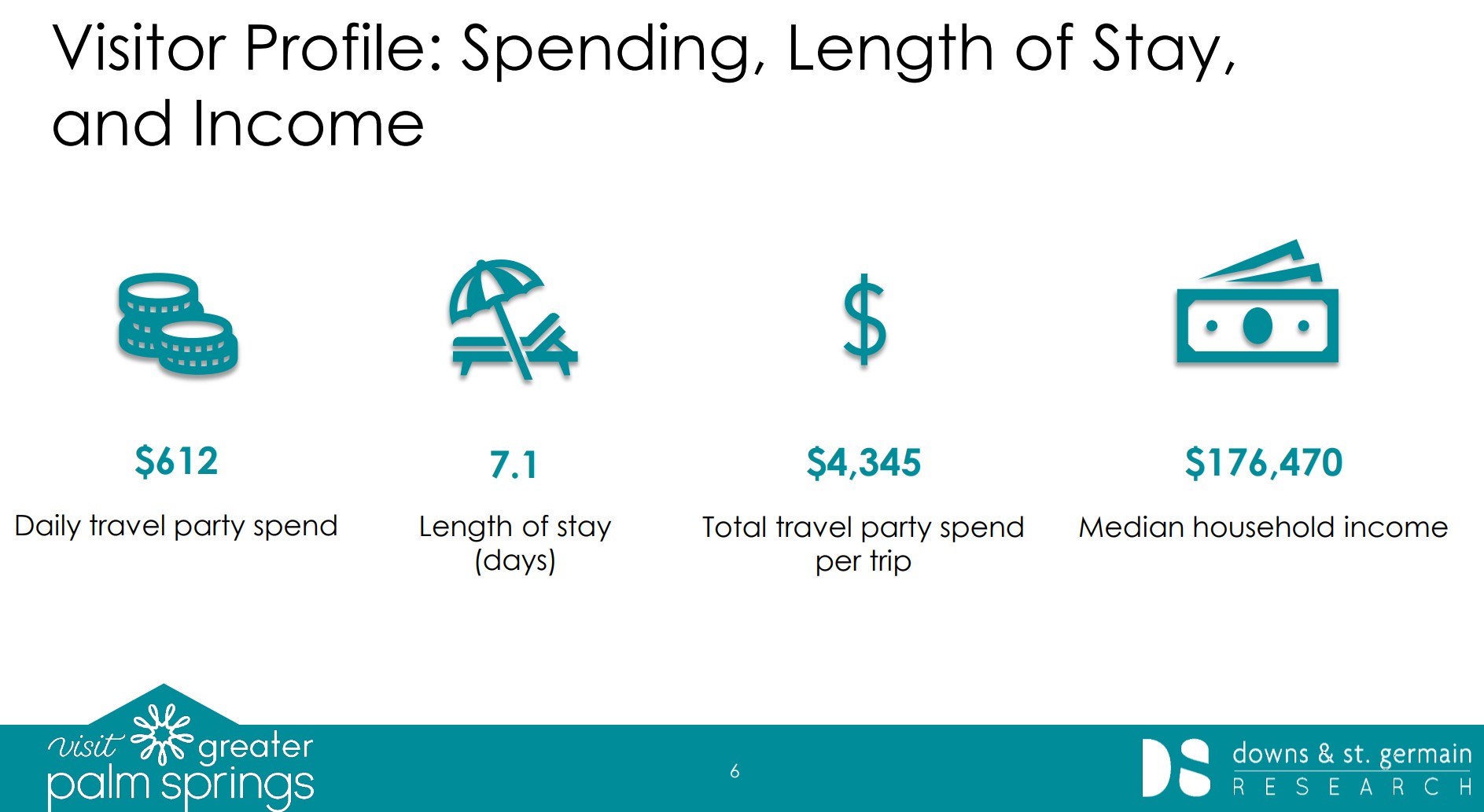
The topline figures are substantial. The median visitor age was 50. The typical travel party size was 3.3 people. Median household income came in at $176,470. Average daily travel party spending reached $612, while total spending per trip averaged $4,345. The average length of stay was 7.1 days overall, including 4.1 days for hotel stays and 9.7 days for short-term vacation rentals.
That combination suggests a destination that is still functioning as a meaningful stayover market, not simply a quick weekend escape. It also reinforces how spending circulates through multiple sectors of the local economy, from lodging and food service to shopping, recreation and cultural institutions.
The report shows that 52% of visitors identified vacation as a top reason for coming to Greater Palm Springs. But the destination’s appeal was far from one-dimensional. Outdoor recreation came next at 29%, followed by arts and culture at 18% and special events at 14%. Health and wellness, business travel, festivals, visiting friends and family and shopping all played notable roles in bringing people to the area.
Those findings help explain why Greater Palm Springs has become a broader tourism product than its traditional resort identity alone might suggest. Visitors are not coming only for sunshine, pools and golf. They are also coming for museums, events, food, scenery, outdoor amenities and the region’s mix of leisure and lifestyle experiences.
That was reflected in travelers’ reported spending of time. Dining out ranked first among activities at 67%, followed by relaxing or unwinding at 59%, shopping at 40%, relaxing by a pool at 39%, visiting museums at 35% and visiting natural attractions at 32%.
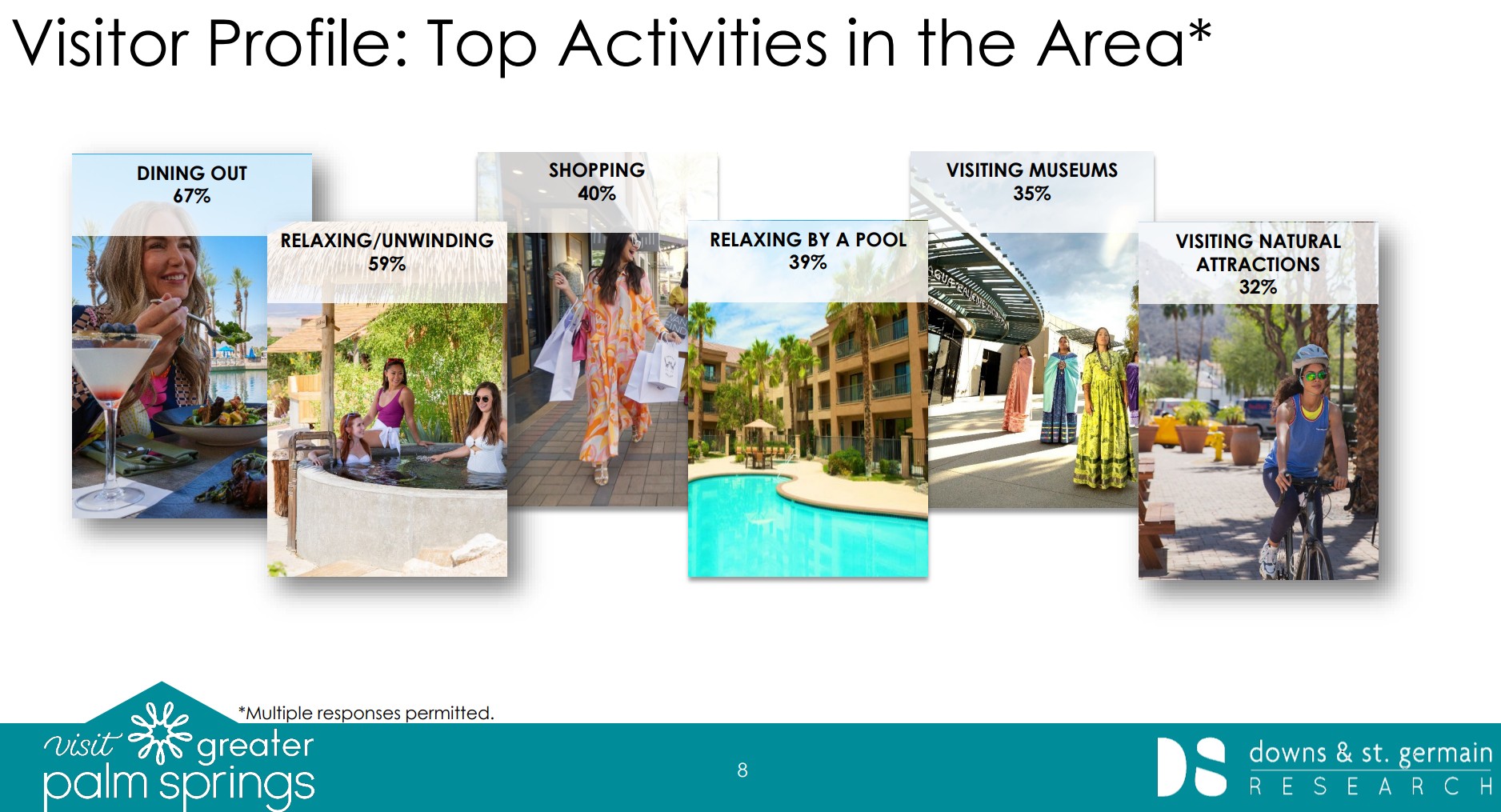
For businesses across the valley, that pattern matters. It suggests that visitor spending is distributed across a wide range of commercial categories rather than being concentrated only on accommodations. It also underscores the continued economic value of walkable districts, downtown cores, cultural destinations and experiential businesses that benefit from discretionary visitor spending.
One of the clearest themes in the report is that Greater Palm Springs is still powered heavily by repeat business. Only 29% of visitors were first-timers. Previous visits were the top trip-planning source at 42%, and prior experience was also the most influential factor in deciding to return, cited by 39% of those asked. Recommendations from friends, relatives and co-workers, along with friends and family already living in the area, were also among the leading drivers.
That is a significant signal for local tourism marketers and hospitality operators. It means the region is benefiting from an installed base of travelers who already know the product, trust it and are likely to advocate for it. In practical terms, that reduces some of the friction associated with attracting a brand-new visitor and raises the value of visitor satisfaction, loyalty programs, return-trip messaging and post-visit marketing.
The study also suggests these visitors are planning ahead. The typical planning window was 93 days, while the typical booking window was 59 days. The largest shares of visitors said they planned trips one to two months in advance, three to four months ahead, or more than six months in advance. Booking patterns followed a similar arc.
For the region’s tourism and events economy, that longer planning horizon has operational implications. It means seasonal promotions, airfare marketing, event packaging and hotel campaigns need to reach consumers well before travel dates. It also reinforces the importance of long-lead marketing around major events, shoulder-season travel and summer demand-building efforts.
The report offers a useful reminder that Greater Palm Springs remains as much a drive market as an air market. Half of the visitors said they drove to the destination, while 42% flew into Palm Springs International Airport. Another 5% arrived through LAX or John Wayne Airport in Orange County and drove here.
Los Angeles was by far the top origin market at 21.4%, followed by the San Francisco-Oakland-San Jose region at 7%, Seattle-Tacoma at 5.1% and San Diego at 4.3%. New York City and Chicago also ranked among the leading feeder markets. California accounted for 36.8% of origin overall, while international travelers represented 16.4%.
That geographic mix reinforces the region’s dual identity. Greater Palm Springs is both a powerful regional getaway market for Californians and a nationally, even internationally, recognized destination. That matters for airlines, airport planners, hoteliers and destination marketers because it points to resilience through diversified feeder markets.
It also aligns with broader air travel momentum at Palm Springs International Airport, which recently reported more than 3.3 million passengers in 2025, up roughly 2.4% from 2024 and marking another record year. That continued passenger growth supports the region’s ability to compete for higher-spending travelers and maintain relevance in the national travel marketplace.
Business travel, while not the dominant motive for visiting, remains an important piece of the picture. Eleven percent of all visitors came to the area for business, according to the study, and 32% of business travelers said they extended their trips for leisure. Another 17% said they were unsure whether they would do so.
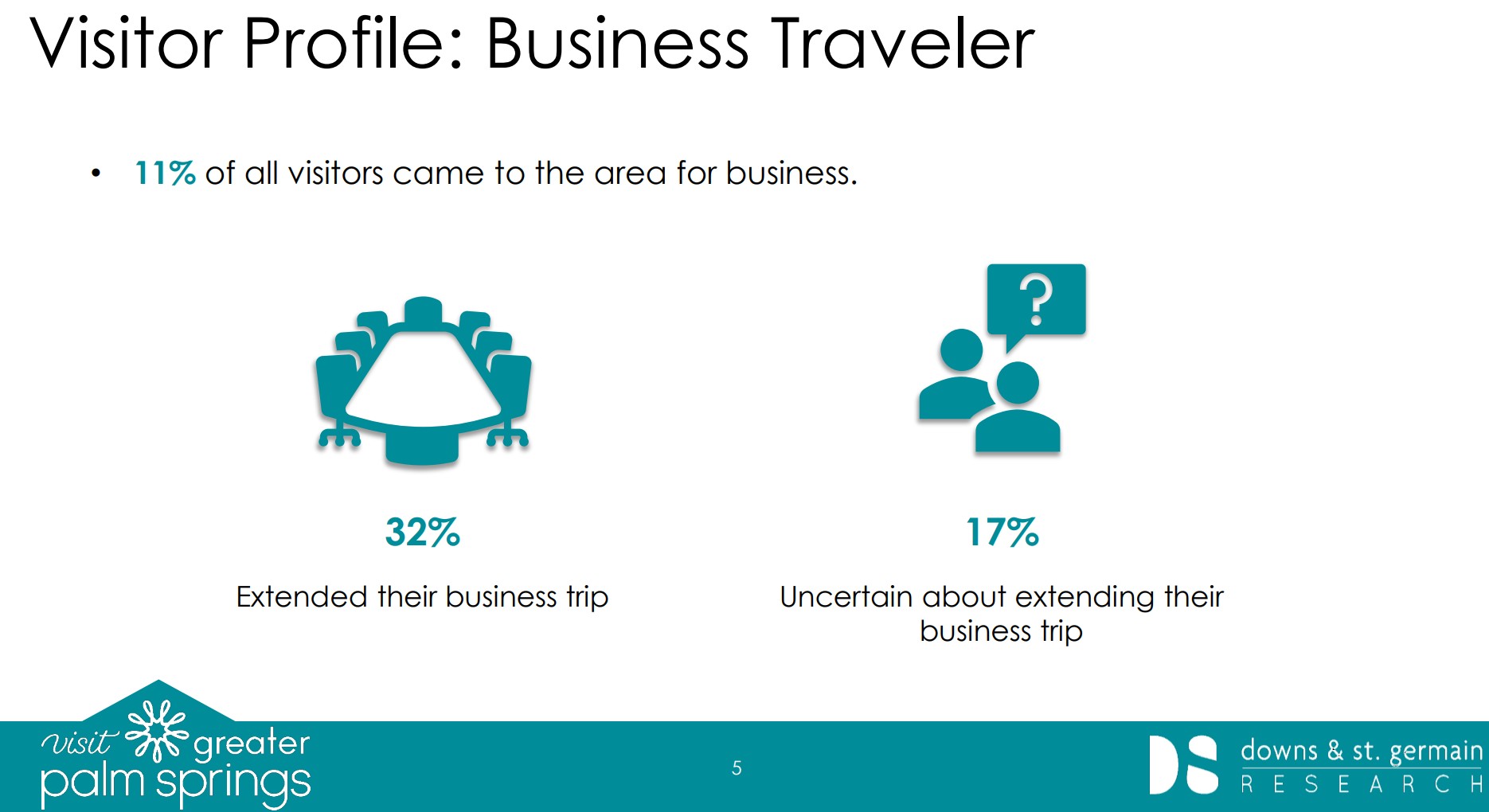
That reinforces a long-standing local advantage in the meetings and conferences segment. Greater Palm Springs is not just attracting convention and group business. It is also converting part of that travel into additional leisure spending through what the industry often calls bleisure. For hotels, attractions, restaurants and destination marketers, that means there is continued upside in packaging post-meeting experiences, weekend extensions and add-on activities for business visitors.
The visitor experience scores were also strong. Seventy-five percent of respondents said they were very satisfied with their visit. Seventy-three percent said they would highly recommend the area. Seventy-four percent said they were very likely to return.
When asked why they were especially satisfied, visitors most often pointed to the overall experience, the peaceful and relaxing atmosphere, friendly people and local hospitality, and the weather and climate.
That finding may sound familiar to anyone who follows the regional tourism economy, but it is still important. A destination’s strongest brand attributes often are the simplest ones to state and the hardest for competitors to replicate. In Greater Palm Springs, the mix of climate, setting, hospitality and emotional escape continues to register with travelers at a high level.
The report also highlights several specialized segments worth watching. Fourteen percent of visitors identified as LGBTQ+, reflecting the region’s longstanding strength as an inclusive destination. Fourteen percent said they had additional support needs, underscoring the importance of accessibility and visitor readiness. Four percent of visitors said they were staying in a second home, a small share overall but one that returns frequently and tends to cluster in peak months. The report also pointed to a resilient Canadian visitor base, even with some midyear softness.
Taken together, the findings describe a tourism economy that remains both broad and durable. Greater Palm Springs continues to benefit from repeat travelers, strong word-of-mouth, relatively high visitor incomes and a trip profile that extends across leisure, culture, dining, events and business-related stays.
That matters because tourism is not a side story in the Coachella Valley economy. Visit Greater Palm Springs says the industry supports one in four local jobs, and the organization reports that the region welcomed 14.5 million visitors in 2024, generating $9.1 billion in total economic impact.

Bob Marra is the CEO/Publisher of GPS Business Insider. He has been studying, writing and giving presentations about business, economic and public affairs news and issues and the local economy in the Greater Palm Springs/Coachella Valley region for more than 20 years.