In a region long defined primarily by tourism, hospitality and real estate, an emerging Palm Springs company is building something less expected and potentially far more consequential for the local economy: advanced streetlight and utility infrastructure designed for a hotter, more disaster-prone world.
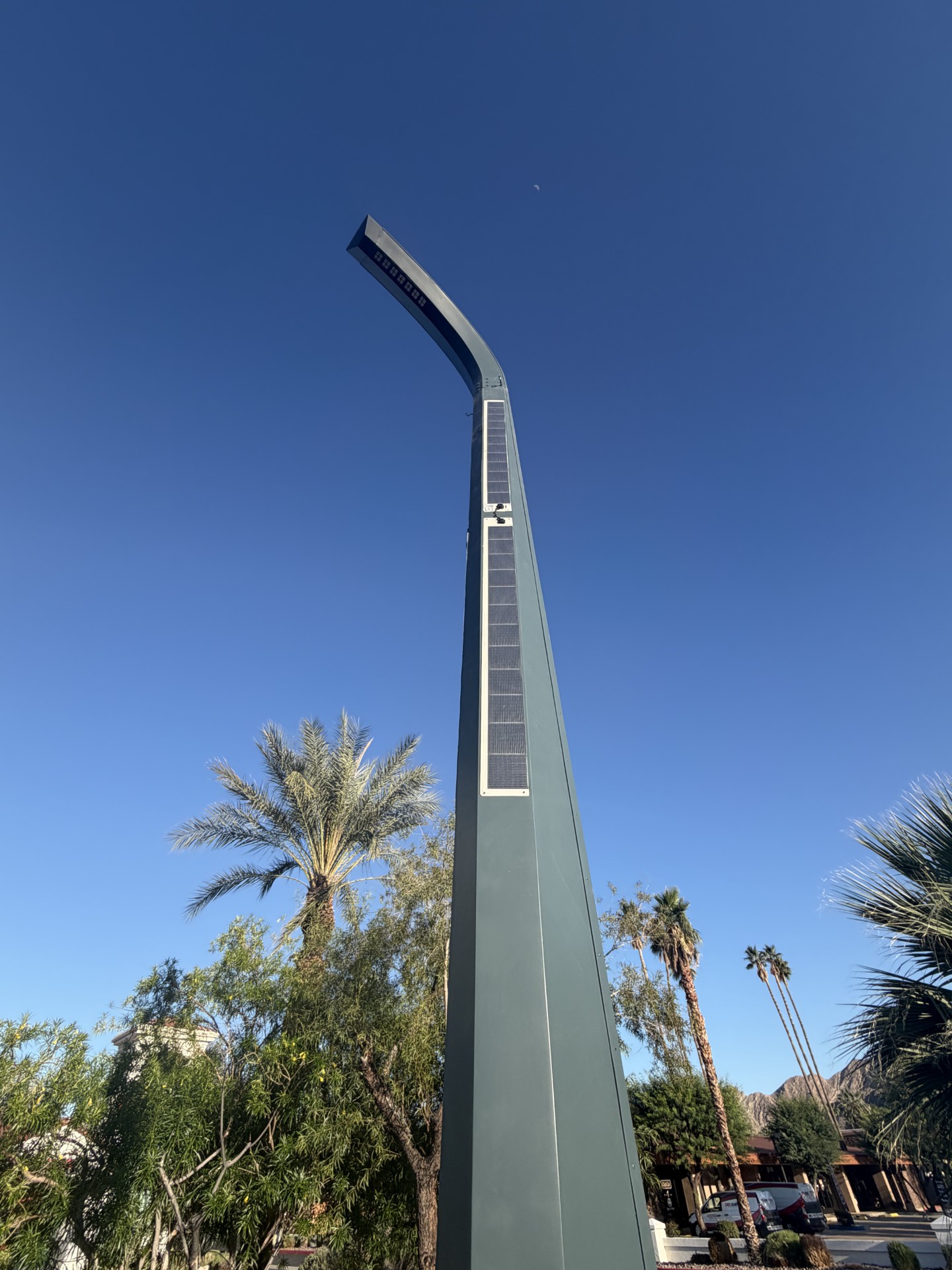
BASEstud.io, led by Chief Executive Officer Heidi Adams, is developing and manufacturing a next-generation pole system in Palm Springs that combines lighting, solar power, battery backup, Wi-Fi capability and curbside electric vehicle charging. The company’s pitch is that a streetlight can be much more than a streetlight. It can become a resilient piece of civic infrastructure, a source of recurring revenue, and, in emergencies, a local energy asset.
For Greater Palm Springs, the significance goes beyond one startup’s technology. BASEstud.io is also becoming a proof point for a larger regional ambition: that Greater Palm Springs can deepen its economy through innovation, manufacturing and climate-focused industries, rather than continuing to rely overwhelmingly on visitor-serving sectors.
That broader message was reinforced this week when BASEstud.io emerged as one of the two top winners in the Greater Coachella Valley Innovation Showcase, the April 21 pitch competition tied to Riverside County Innovation Month, which brought together entrepreneurs, investors, business leaders and community partners at the Palm Desert Entrepreneurial Resource Center (ERC) on Cook Street for an evening where emerging ventures competed live for funding, recognition and advancement.
The Palm Desert ERC, anchored by the Randall W. Lewis Center for Entrepreneurship and Randall W. Lewis School of Entrepreneurship and Innovation, is a regional business resource center, providing training and counseling services to small businesses and entrepreneurs, as well as co-working and incubation space. Top tier RLCE programs such as the Coachella Valley Women’s Business Center (CVWBC) are a key driver of providing the business support services on a daily basis.
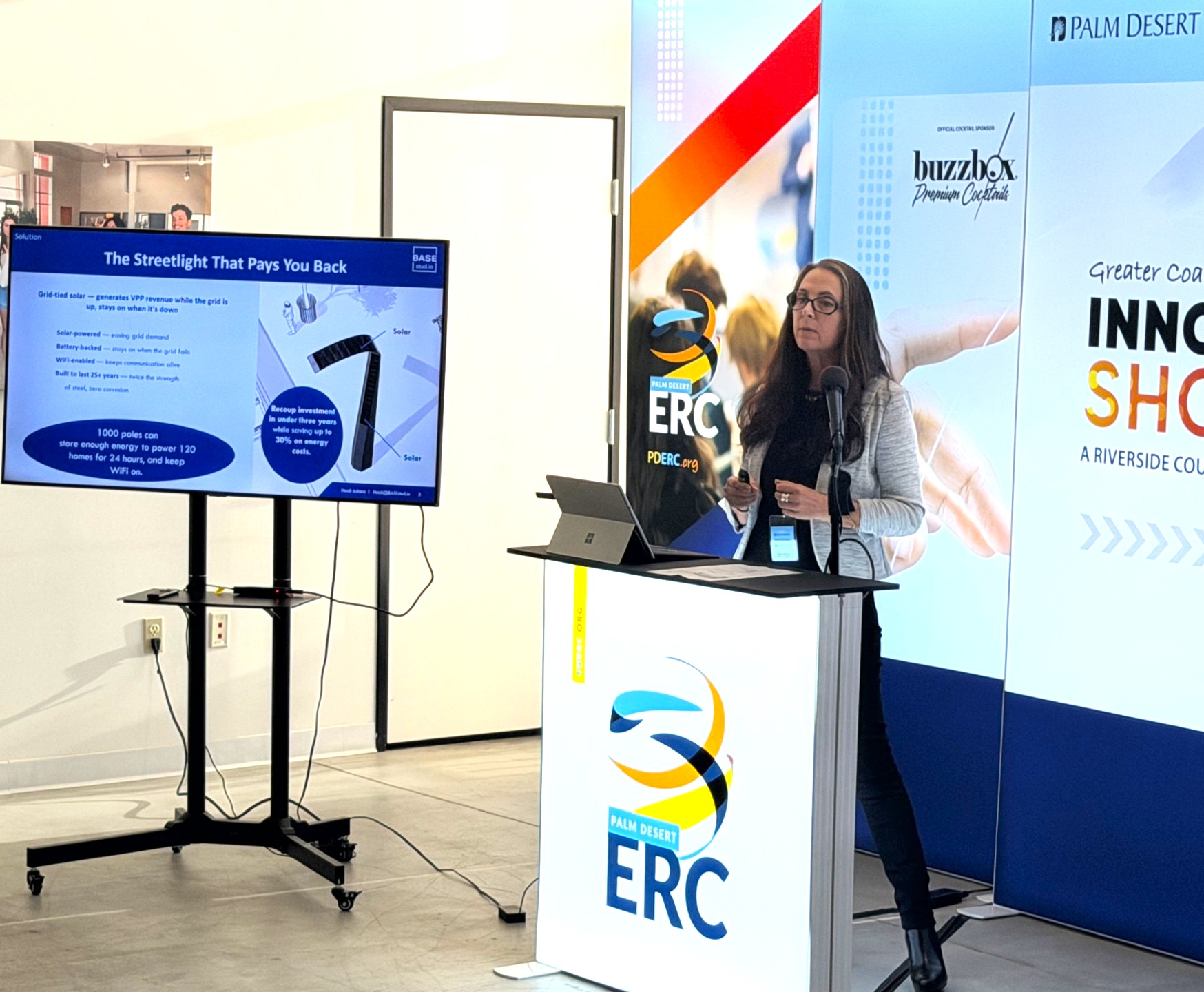
BASEStud.io CEO Heidi Adams gives the winning pitch at the Innovation Showcase competition on April 21.
The recognition at the Innovation Showcase gave fresh visibility to the BASEstud.io’s business model, but it also highlighted another story regional leaders want told more often: that the Greater Palm Springs Economic Development team is actively out in the community identifying promising firms, connecting them to resources and trying to turn isolated entrepreneurial successes into part of a larger economic strategy.
For Adams, BASEstud.io’s roots are intensely personal.
She traces the company’s origin to the 2018 Woolsey Fire, when she found herself trapped in an evacuation gridlock in Malibu and saw firsthand how quickly infrastructure can fail when people need it most.
“That’s when I really started looking at how our infrastructure fails when we need it most,” Adams said. “Our essential infrastructure is not built to survive through any of these disaster scenarios, and those are the situations when you need your infrastructure to be there for you.”
That experience led her to rethink one of the most overlooked pieces of the built environment: streetlight and utility poles. From there, she entered a Los Angeles street-lighting design competition in 2020, became one of five finalists and effectively launched the company.
Five years later, Adams said BASEstud.io has filed six patents, won three U.S. Department of Energy grants during the prior administration, secured a Caltech Rocket Fund grant and refined its product around advanced composite materials rather than conventional steel or cast aluminum.
The company argues those materials offer a critical advantage as cities and utilities confront more extreme heat, wildfire, flooding, storms and grid instability. On its website, BASEstud.io says its composite poles are stronger than steel, corrosion resistant and designed to withstand fires, floods and storms, while also integrating solar generation, battery storage, Wi-Fi and EV charging into a single platform.
For Adams, Palm Springs and the broader desert are not incidental to that work. They are central to it.
“Climate change is definitely pushing everyone to look at extreme heat and extremes of all sorts of climate, and the desert is one of those places that is important to build in,” she said. “To be out here building in it really does change how you make choices.”
Adams and her husband had been visiting the desert for years before buying a home in Palm Springs three years ago. She said what drew them was not simply an escape from Los Angeles, but what she described as the beauty, quiet, darkness, energy and community of the desert. Over time, Palm Springs also became the logical place to continue developing the company.
The manufacturing connection mattered. Adams said she shifted from cast aluminum to advanced composites after connecting with Antonio Carvajal, now a manufacturing partner in northern Palm Springs.
Carvajal’s Palm Springs-based company, Carvon Corp, founded in 2012, is another gem in the region. It specializes in building prototype and concept vehicles for automotive manufacturers. The company brings a broad in-house capability set to that work, including program management, mechanical engineering and design, sheet metal forming and fabrication, machine shop services, advanced composites and paint services. Adams said that Carvon’s approach allows for smaller-scale local production rather than the kind of huge, centralized factory investment often associated with infrastructure manufacturing.
That point is especially important in a region where local officials and business advocates have talked for years about the need to diversify the economy with more year-round, higher-wage employment in sectors such as health care, clean energy, logistics, technology and light manufacturing.
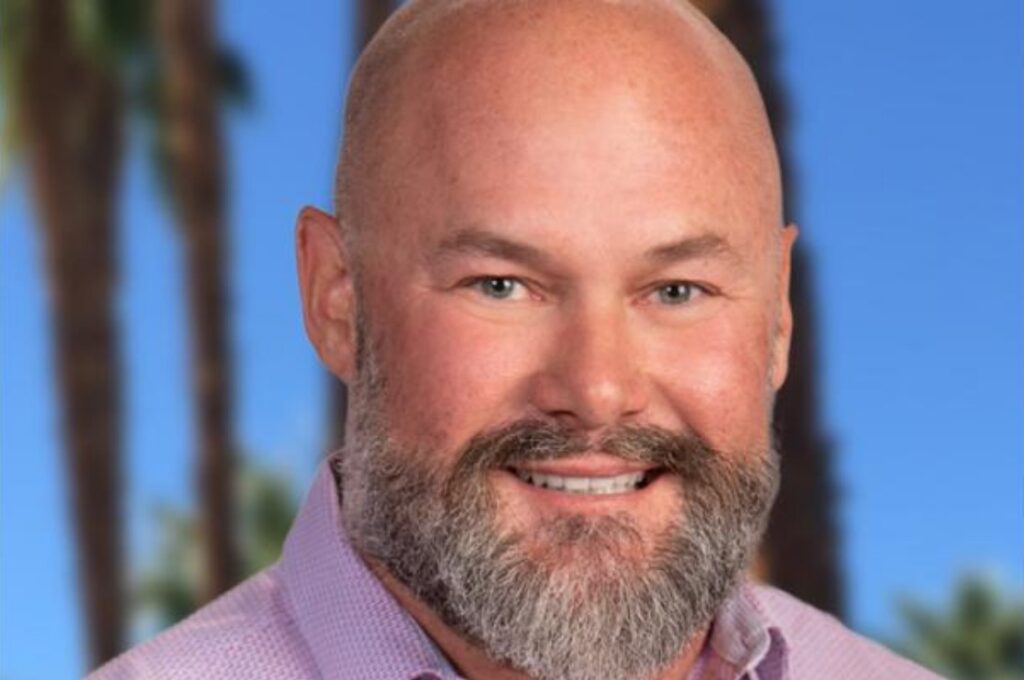
Sean Smith, director of economic development, Greater Palm Springs Economic Development.
Sean Smith, director of economic development for Greater Palm Springs Economic Development, said the agency learned about BASEstud.io almost by accident at a Palm Springs Chamber of Commerce event, where a staff member met Adams and urged her to connect with the economic development team.
“This was something that completely happened by chance,” Smith said. “We were very interested in this because to have another great example at this level for us, it means a lot because it’s showcasing something that’s already here.”
That kind of discovery is becoming part of the agency’s mission. Greater Palm Springs Economic Development, an initiative of Visit Greater Palm Springs, launched in 2025 to support regional growth and investment, works with the nine valley cities, Riverside County and tribal communities to promote business investment, innovation, job creation and long-term economic resilience.
Its public-facing economic development platform describes the region as a place “where innovation, opportunity, and quality of life converge,” and emphasizes a shared regional strategy across nine cities. That is a notable expansion for Visit Greater Palm Springs, an organization historically more closely associated with tourism marketing than with direct business attraction.
Smith said that as the team has expanded its outreach, it has found more existing firms in the valley doing sophisticated work than many people might assume.
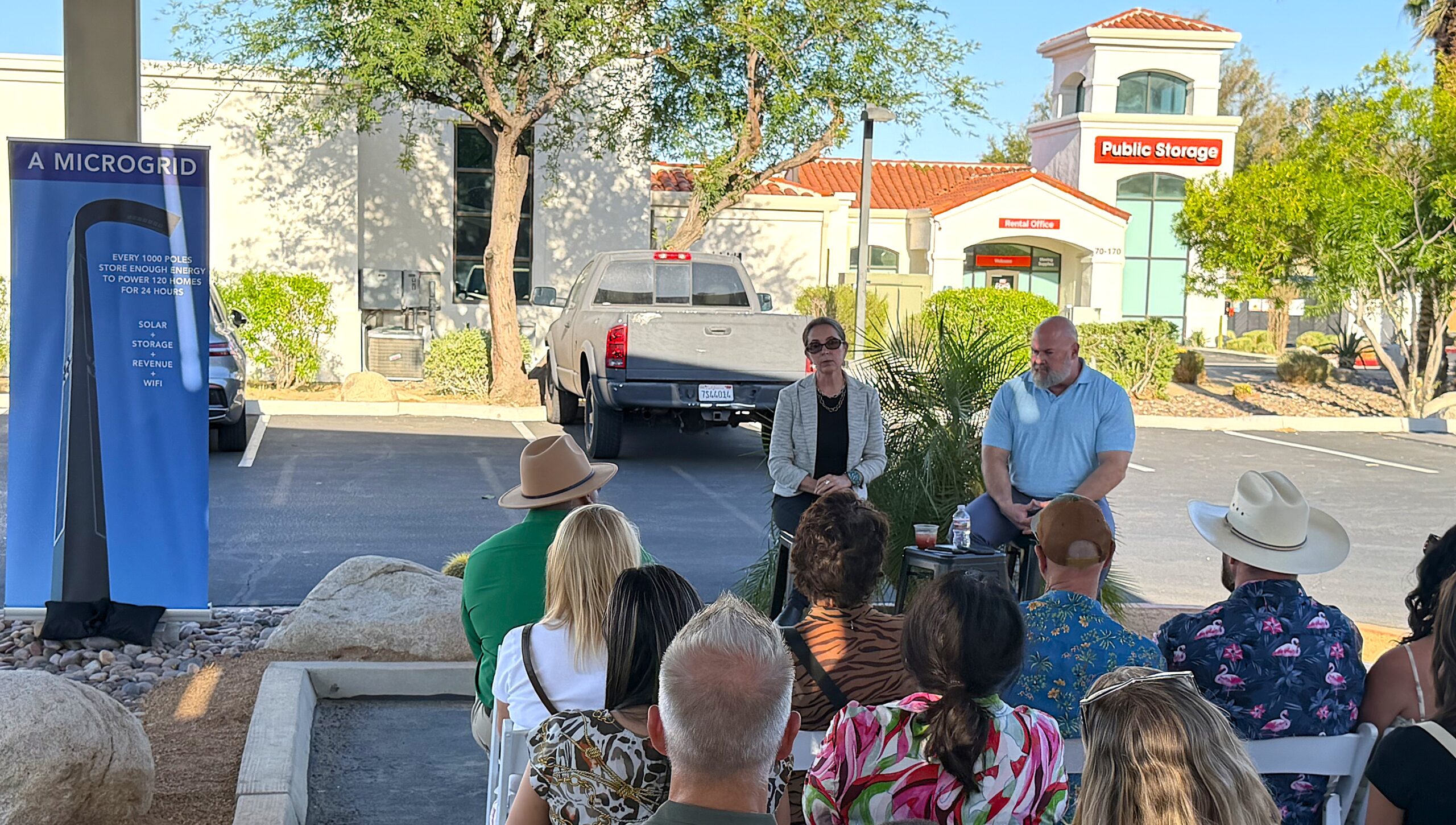
Sean Smith of Greater Palm Springs Economic Development and his colleagues organized a demonstration and discussion to introduce Heidi Adams to a cross section of local leaders to help build awareness of BASEStud.io.
“As we spend more time out in the business community, we’re realizing there are more and more companies here already doing outstanding work in diverse industry sectors,” Smith said. “For us to be able to partner with them, get them introduced to valuable comparable business and public sector networks and support them in their growth makes it easier, because they’re already here.”
That matters strategically. Economic development business attraction campaigns often struggle when they are selling only aspiration. They become more credible when they can point to real firms already operating successfully in the market.
BASEstud.io and Carvon Corp give the region two more of those examples.
BASEstud.io’s product proposition is unusual and innovative enough to attract significant attention. Adams said a fully equipped pole can include solar energy generation, EV charging, Wi-Fi handoff capability, and battery capacity to help keep systems running during outages. She said the revenue-producing features are intended to make the infrastructure more accessible to communities that most need upgrades but often struggle to pay for them.
“The whole pole is designed to generate revenue too because, as we know, infrastructure changes can be expensive,” Adams said. She said the goal is to help communities recoup investment costs while building resilience.
She added that the technology is not limited to streetlights. The longer-term roadmap includes utility poles and traffic signals, an important distinction especially in places vulnerable to blackouts, heat-driven grid stress and emergency evacuations.
The company’s timing also intersects with growing public concern about infrastructure resilience after destructive fires in California and storm-generated grid failures in other states. Adams argued that too often damaged systems are rebuilt with the same materials and assumptions that failed before.
For Greater Palm Springs, BASEstud.io is more than an interesting startup story. It places Palm Springs inside a larger national conversation about climate adaptation, distributed energy, advanced materials and infrastructure modernization.
It also gives local leaders something they badly want more of: a company that chose the desert, is making a product here and has the potential to grow from here.
Smith said that pattern is one the region hopes to repeat.
“The quality of life that we offer here in Greater Palm Springs is unmatched,” he said. “It’s even nicer to see that manifest in people deciding to locate their companies here, to live here and to grow companies and be successful in doing so here in our region.”
For now, BASEstud.io is in robust commercialization mode and looking for strategic partners, expansion capital and broader deployment opportunities to fuel its momentum. But even at this stage, the company offers something the valley’s economic development advocates have been seeking for years: tangible evidence that Greater Palm Springs can be a place where innovative products are not just imagined, but designed, built and advanced into the marketplace.
That is why this story matters beyond one competition win.
It is about a startup with a climate-era product, yes. But it is also about whether Greater Palm Springs can steadily build an economy that is more inventive, more durable and more locally rooted than the one outsiders often assume it has.
Bob Marra is the CEO/Publisher of GPS Business Insider. He has been studying, writing and giving presentations about business, economic and public affairs news and issues and the local economy in the Greater Palm Springs/Coachella Valley region for more than 20 years.