

Coachella, Indio and Desert Hot Springs have halted new data center development amid concerns over power, water and public health. Yet the region’s electricity costs may be an even more formidable barrier to the hyperscale projects sweeping other parts of the country.
Within a matter of weeks, three Coachella Valley cities moved to close their doors, at least temporarily, to one of the fastest-growing and most controversial forms of industrial development in the country.
Coachella imposed a moratorium on data centers after months of community backlash over a proposed hyperscale campus and has since extended the prohibition while city officials prepare a possible permanent ban.
Indio followed with a temporary moratorium of its own, even though no data center application was pending in the city. Officials said the pause would provide time to evaluate possible regulations, a longer moratorium or a permanent prohibition before a proposal arrives.
Desert Hot Springs also adopted a moratorium and extended it for up to two years while studying whether data centers should be allowed, where they might belong and what rules would be needed to address their extraordinary demands for electricity, cooling, infrastructure and around-the-clock operations.

The actions reflect concerns that have become familiar in communities across the country: enormous power consumption, water use, backup generators, air quality, noise, heat, uncertain job creation and the possibility that existing utility customers could bear some of the cost of serving private technology companies.
But the three cities’ decisions raise another question that has received far less attention:
Would large data centers have been economically viable in the Coachella Valley in the first place?
The region has many of the characteristics that can attract large industrial projects. Land is comparatively abundant. Major transmission corridors cross the desert. Solar generation is extensive. Interstate 10 provides access to Southern California markets. Local governments have historically welcomed economic development that can expand the tax base and create new infrastructure.
Yet data centers are different from most real estate projects. Their most important location requirement is not inexpensive land or freeway access. It is access to very large quantities of dependable electricity at a competitive long-term price.
On that measure, the Coachella Valley begins with a significant disadvantage.
Most of the western and central valley is served by Southern California Edison, where electricity costs are among the highest in the country. The eastern valley, including Coachella and Indio, is served by the Imperial Irrigation District, which generally offers lower rates than Edison but remains expensive compared with many of the low-cost power markets that have attracted major data center development.
The result is a paradox. Local cities are imposing moratoriums to keep data centers from arriving before regulations are ready. At the same time, electricity prices may already be discouraging many of the largest and most mobile projects from seriously considering the region.
The moratoriums may be guarding the front door of a market that power economics had already made difficult to enter.
For Data Centers, Electricity Is the Business
A data center is essentially a factory that converts electricity into computing capacity.
Unlike many commercial and industrial businesses, it does not use power primarily for lighting, air conditioning or equipment that runs only during business hours. Electricity is a core production input consumed continuously, often at very high load levels, for decades.
For large artificial intelligence and hyperscale data centers, site selection generally begins with several questions:
Can the utility deliver the required megawatts by the date the project needs them? What will the all-in electricity cost be over 15 or 20 years? Will the power supply be reliable and redundant? Can the customer expand?
Only after those questions are answered do land prices, permitting, taxes, water, fiber connectivity and other considerations fully enter the calculation.
The scale makes even small rate differences consequential.
A data center drawing 100 megawatts at a 90 percent annual load factor would consume approximately 788 million kilowatt-hours of electricity each year. At that level, every 1-cent difference in the price of electricity changes annual operating costs by nearly $7.9 million.
A 5-cent difference means roughly $39 million a year.
A 10-cent difference approaches $79 million.
Those costs recur year after year. A discounted parcel of land or a one-time tax incentive can quickly become insignificant when compared with a permanent electricity disadvantage measured in tens of millions of dollars annually.
According to the U.S. Energy Information Administration, California’s average industrial electricity price was approximately 19.87 cents per kilowatt-hour in April, compared with a national average of about 8.66 cents. Industrial prices averaged roughly 6 to 7 cents in Texas, Iowa and Washington, states that have attracted substantial data center investment in part because of comparatively inexpensive power.
Those statewide averages are not quotes for individual data centers. Large users often negotiate specialized agreements, connect at transmission voltage, finance their own substations or obtain power through arrangements that differ substantially from ordinary commercial service.
Still, the comparisons explain why California can be eliminated early in a national site search for a large, location-flexible computing campus.
The issue is becoming more consequential as demand grows. The U.S. Department of Energy has projected that data centers could account for between 6.7 percent and 12 percent of total U.S. electricity consumption by 2028.
In Desert Hot Springs, the Market Was Already Difficult
The electricity question is especially significant in Desert Hot Springs, which is served by Southern California Edison.
SCE’s average bundled industrial electricity price was 20.57 cents per kilowatt-hour in 2024, according to federal utility-level electricity data. That is not the rate a new hyperscale data center would necessarily pay. A very large transmission-level customer could face a different rate structure.
But as a benchmark, the figure illustrates the size of the challenge.
A 100-megawatt facility operating at a 90 percent load factor would spend about $162 million annually at an effective electricity price of 20.57 cents per kilowatt-hour. At 7 cents, annual electricity expense would be about $55 million.
The difference is approximately $107 million every year.
No serious developer would assume those precise numbers without a detailed utility study and negotiated power plan. But the order of magnitude matters. Cheap land, expedited permitting and economic incentives would have difficulty overcoming a recurring operating-cost gap of that size.
That makes Desert Hot Springs’ moratorium unusual.
Unlike Coachella, the city was not responding to a highly visible, advanced proposal backed by a developer and connected to a new municipal power strategy. The moratorium was more proactive, giving officials time to evaluate whether existing rules adequately address the location, scale, utility demand, water use, cooling systems, backup generation, noise and environmental performance associated with data centers.
High SCE electricity costs may already make a conventional hyperscale AI campus difficult to justify. But electricity markets change. Developers can pursue dedicated generation, direct energy procurement, battery storage, on-site power systems or other specialized arrangements.
The moratorium gives Desert Hot Springs time to decide what it would require if a developer found a way around the conventional power-cost problem.
Indio Chose To Act Before A Project Arrived
Indio’s situation is different from both Coachella and Desert Hot Springs.
The city had no active data center application when its City Council unanimously adopted a 45-day moratorium. According to the city’s announcement, the pause was intended to provide time for public review and policy development before an applicant could seek approval under rules that were not written with large data centers in mind.
The timing was significant.
Indio acted after public controversy over the Coachella proposal had demonstrated how quickly questions involving power demand, water use, air quality, land use and transparency could become politically charged.
Rather than wait for a project, Indio chose to establish policy first.
Electricity economics may already provide a substantial barrier. Indio is served by IID, whose rates are generally lower than SCE’s but remain high compared with many leading data center markets.
IID’s posted Large General Service rate structure provides a useful illustration. The district’s 2025-2028 rate information shows a 2026 energy charge of 13.89 cents per kilowatt-hour for Large General Service. Using that rate and the applicable demand charge, a continuously operating 100-megawatt facility at a 90 percent load factor could face approximately $125 million annually in major energy and demand costs, an effective rate near 15.9 cents per kilowatt-hour before certain taxes, surcharges, infrastructure costs or customized contract terms.
At 7 cents per kilowatt-hour, the same illustrative load would cost about $55 million annually. The difference is roughly $70 million a year. Those figures are not an estimate of what a specific Indio project would pay. A hyperscale facility would likely require a specialized large-load agreement.
But the comparison suggests that Indio is not necessarily facing an imminent wave of projects. Its moratorium is largely precautionary, allowing officials to establish standards before an applicant proposes an unusual power structure or other arrangement that could alter the economics.
Coachella Was the Exception
Coachella’s experience demonstrates why electricity rates alone cannot replace land-use policy.
A developer did come forward.
As GPS Business Insider previously reported, the proposed Coachella Valley Technology Campus was described in public materials as a large east-side development that could require roughly 270 to 300 megawatts of electric capacity. The project was tied to the city’s broader effort to establish a municipal electric utility in undeveloped growth areas where existing power infrastructure is limited.
The data center was not merely another prospective customer. It was envisioned as the anchor customer that could help make the new utility financially possible.
That changed the economics.
Under the concept advanced by the city and its private-sector partners, the proposed municipal utility would finance and develop new electric infrastructure, purchase power through wholesale arrangements and resell electricity to customers within its service area. Dedicated microgrids, fuel cells, battery storage and other project-specific systems were expected to provide part of the data center’s power needs.
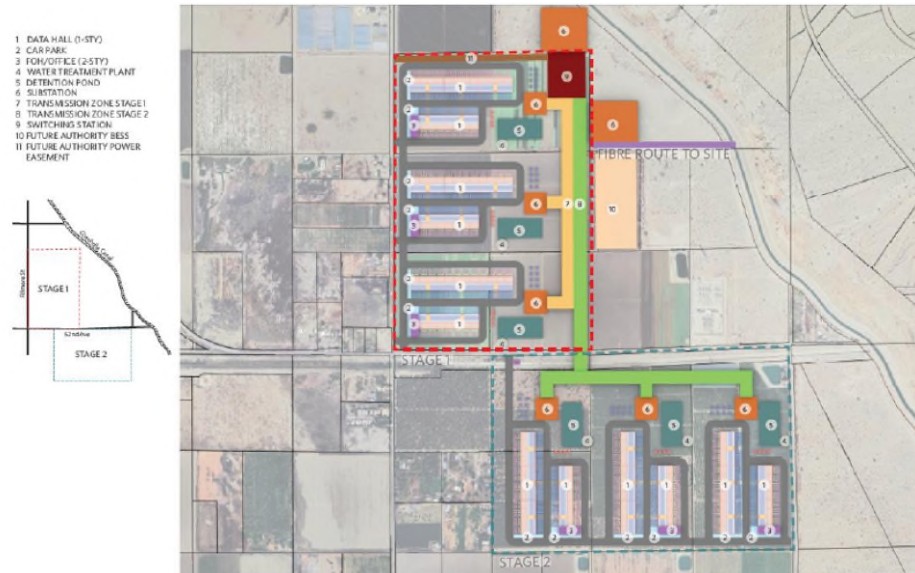
A site plan for the Coachella Technology Campus data center development.
The concept represented an attempt to create a different path around the constraints of ordinary retail utility service.
Instead of asking whether a 300-megawatt data center could afford IID’s posted commercial rate, the more relevant question became whether Coachella could obtain wholesale power, combine it with dedicated infrastructure and on-site resources, and resell it at a price attractive enough for the data center while still covering financing, operations and long-term system costs.
That is a much more complicated proposition.
Residents raised concerns about water, agricultural land, air quality, backup power, public health and whether the city had moved too far into utility and development agreements before the community fully understood the proposal.
City officials emphasized that no data center had received final approval. But after contentious public meetings and a community town hall, the City Council imposed a moratorium, ended its agreement with the project team and moved toward a possible permanent prohibition.
The city’s action mattered because it interrupted an actual effort to create a specialized power structure that might have made an otherwise difficult project possible.
Coachella was not waiting to see whether standard electricity rates would discourage a data center. It was participating in an effort to change the power equation.
IID’s Large-Load Rules Could Have Been A Bigger Test
Even before Coachella halted the project, another obstacle was taking shape.
IID developed a proposed large-load tariff for customers seeking at least 20 megawatts of demand and expecting to use that capacity more than 85 percent of the time.
The framework was not written solely for Coachella. IID had already confronted large data center interest in Imperial County and in December adopted districtwide large-load principles intended to protect grid reliability and prevent new projects from shifting costs to existing customers.
The tariff was designed to require major users to pay the full costs associated with power supply, transmission, infrastructure and reliability.
Under the framework, large customers could be required to fund studies, interconnection facilities, system upgrades, renewable-energy compliance and other project-related costs.
They would face a minimum 15-year contract, minimum energy and demand obligations, exit fees and extensive collateral requirements intended to protect IID if a project failed, reduced its load or left the utility with long-term power commitments.
Service would also be interruptible. IID could place large-load customers ahead of residential and other customers for curtailment during a grid reliability event.
During the IID board discussion, consultant Aly Koslow said the district could not simply decide which eligible projects it liked or disliked.
“We don’t have the liberty of deciding, sort of picking winners and losers in terms of projects,” Koslow said.

IID Board Chair, Karin Eugenio.
“What we can do, however, is ensure that projects are not passing those costs on to other customers, that we are not subsidizing other rate classes, and that we are protecting both grid stability, reliability and affordability.”
IID Board Member Alex Cardenas called for “ironclad financial agreements” and questioned how the district could protect customers from speculative projects and boom-and-bust risks.
IID Board Chair Karin Eugenio emphasized the boundary between local land-use authority and the district’s utility responsibilities.
“We are not the siting authority,” she said. “We’re doing everything within our capabilities to protect our ratepayers.”
For Coachella, that distinction was critical.
The city could approve land use. It could create a municipal utility structure. It could negotiate with a developer. But if the utility needed large quantities of wholesale power from IID and access to IID’s transmission system, the project still had to satisfy IID’s requirements.
The municipal utility could not make hundreds of megawatts appear simply by creating a new agency.
Do The Moratoriums Really Matter?
The answer is yes, but perhaps not for the reason most people assume.
The moratoriums do not necessarily stand between the Coachella Valley and a long line of hyperscale data center developers. Under ordinary utility pricing, the region may already be a difficult location for the largest, most price-sensitive projects.
In SCE territory, high electricity costs could eliminate many projects during an early site-selection review.
In IID territory, the economics may be better but still unfavorable compared with low-cost national markets unless a developer secures a customized agreement, dedicated energy resources or another structure that materially lowers and stabilizes the delivered cost of power.
But moratoriums matter because extraordinary projects do not always follow ordinary rate schedules.
Coachella’s proposal is evidence of that. The developer and city were not simply accepting the existing electricity market. They were trying to build a new municipal utility around an anchor customer large enough to justify major infrastructure investment.
Indio’s decision reflects an effort to establish rules before facing a similar proposal.
Desert Hot Springs is doing the same in an even more expensive utility environment.
Cities also have responsibilities that utility rates cannot address.
Electricity prices do not determine whether agricultural land should be converted. They do not regulate noise, air emissions, water demand, setbacks, backup generators, emergency response or decommissioning. They do not decide whether a project creates enough jobs or public revenue to justify its impacts.
Those are policy decisions. Electricity prices cannot make them on a city’s behalf.
Two Barriers, Not One
The Coachella Valley now has two filters standing between the region and large data center development.
The first is political and regulatory. Coachella, Indio and Desert Hot Springs are responding to an industry that can transform land, infrastructure and resource use.
The second is economic. Large data centers seek enormous quantities of low-cost, reliable power, and the region does not naturally offer the electricity prices that have helped fuel growth in Texas, Iowa, Washington and other major markets.
For Desert Hot Springs, the economic barrier may already be more restrictive than the moratorium for a conventional hyperscale project.
For Indio, IID rates improve the comparison but may still leave the city at a substantial disadvantage against lower-cost markets. Its moratorium is primarily a chance to establish policy before a project arrives.
For Coachella, the moratorium was more consequential because a developer had proposed an unusual municipal utility structure intended to overcome the region’s power limitations and make a very large project possible.
Whether that structure could have worked remains unanswered.
The city stopped the process before the public saw a final wholesale power agreement, an all-in electricity price, completed IID system studies or a definitive allocation of financial risk.
The Coachella Valley may have ample land, abundant sunshine and an interest in attracting new industries. But for a large data center, the power strategy is the project strategy.
Until a developer can show that hundreds of megawatts can be delivered reliably, competitively and without shifting costs or risks to existing residents, electricity economics may remain a more formidable barrier than any city ordinance.
The moratoriums ensure that if a developer finds a way past that barrier, Coachella, Indio and Desert Hot Springs will have rules waiting on the other side.

Bob Marra is the CEO/Publisher of GPS Business Insider. He has been studying, writing and giving presentations about business, economic and public affairs news and issues and the local economy in the Greater Palm Springs/Coachella Valley region for more than 20 years.


