CVAG has approved the formula for dividing a $22.4 million local share among Coachella Valley jurisdictions, moving one of the region’s highest-priority transportation projects closer to construction.
For years, the Monroe Street interchange has embodied a familiar Coachella Valley problem: growth arriving faster than the infrastructure built to carry it.
The interchange is one of Indio’s principal gateways from Interstate 10, serving established neighborhoods and commercial areas while opening onto a part of the eastern valley expected to absorb substantial new development. Yet the current configuration, built around narrow bridges, constrained ramps and limited roadway capacity, has become a bottleneck at one of the region’s most important freeway access points.
Now, after nearly two decades of planning, environmental review, engineering, right-of-way work and the pursuit of outside funding, the project is approaching its most consequential stage.
The Coachella Valley Association of Governments (CVAG) Executive Committee voted unanimously on June 29 to accept a new cost-sharing study for the Interstate 10/Monroe Street interchange. The action establishes the methodology for dividing an estimated $22.4 million local contribution among the valley’s nine cities and unincorporated Riverside County.
The vote does not authorize construction or lock cities into final dollar amounts. Those commitments are expected later, after Riverside County awards a construction contract and the actual project cost becomes clearer.
But the action resolves a critical question that has followed the project for years: How much should Indio pay for an interchange located within its borders, and how much should the other communities whose residents, workers, visitors and businesses also use it pay?
Under the approved formula, Indio would carry nearly 65 percent of the local cost, or about $14.5 million based on the current estimate.
The decision moves a project now estimated at nearly $181 million closer to construction starting in 2027 and completion in 2029.
A freeway gateway that no longer fits the traffic
The Monroe Street interchange is located about two miles east of the Jefferson Street interchange and one mile west of the Jackson Street interchange.
Its importance extends well beyond the freeway ramps themselves.
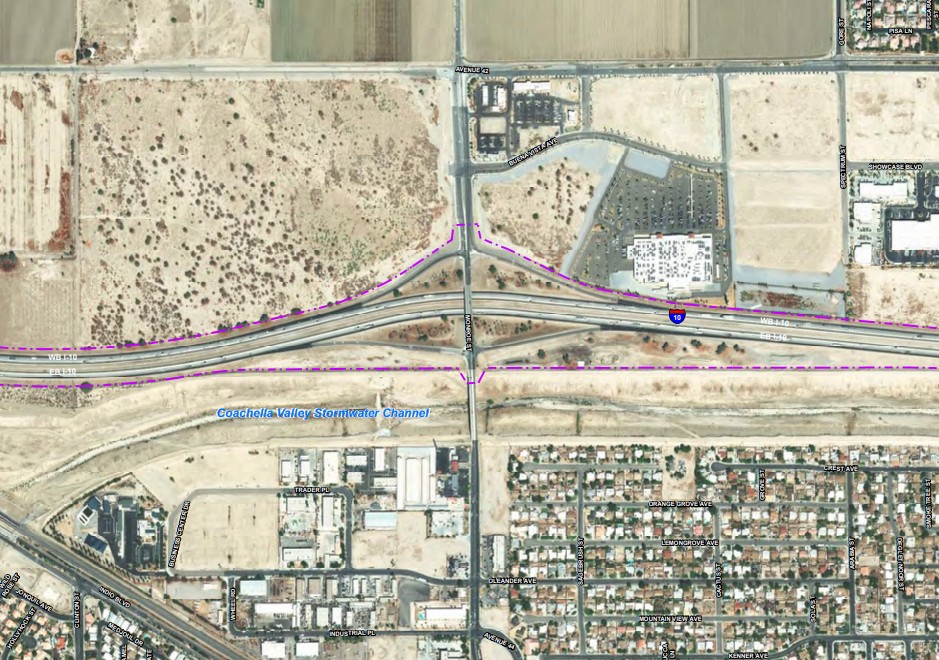
Site of the Monroe Street/I-10 interchange where major expansion is critical to serve the growing residential communities in Indio’s northern sector along with important future business/industrial developments zones nearby.
Monroe Street is a major north-south route connecting Interstate 10 with central Indio, Highway 111, residential neighborhoods, employment areas and the city’s broader commercial and entertainment districts. The interchange also provides access to existing and planned development north and south of the freeway.
Regional transportation planners have rated the interchange at Level of Service F, the lowest operating grade, indicating significant congestion and delay. It is tied with the Avenue 50 corridor from Jackson Street to Van Buren Street as the Coachella Valley’s highest-ranked transportation priority.
The project is much more extensive than a conventional ramp improvement.
Plans call for Monroe Street to be widened from two to four through lanes between the Coachella Valley Stormwater Channel and Avenue 42. The existing overcrossings above Interstate 10 and the stormwater channel, commonly associated with the Whitewater River corridor, would be replaced with larger bridges capable of accommodating additional travel and turn lanes.
Freeway on- and off-ramps would be reconstructed and widened to two or three lanes near Monroe Street. An eastbound auxiliary lane would be built between Monroe and Jackson streets, while westbound acceleration and deceleration lanes would be extended to improve merging and traffic flow.
The project is also designed as part of the valley’s broader multimodal transportation system.
New pedestrian facilities and separated bicycle infrastructure are planned, along with accommodation for CV Link, the regional pathway serving pedestrians, bicyclists and low-speed electric vehicles, including golf carts.
Those elements make the project different from earlier generations of freeway construction. Its purpose is not only to move more automobiles through the interchange but also to connect the freeway crossing to a regional transportation network that provides alternatives to conventional vehicle travel.
County and city officials say the improvements are expected to reduce congestion, remove a longstanding bottleneck, improve safety and provide additional capacity for future residential and commercial growth.
A project nearly two decades in the making
CVAG has been a funding partner in the Monroe Street project since 2007, when its Executive Committee created a $10 million Interchange Preparation Fund to advance planning for major freeway improvements.
The city of Indio approved the original project funding agreement that year. Additional agreements followed as the project progressed through environmental review, engineering, final design and right-of-way acquisition.
Riverside County eventually assumed the role of lead agency, working in cooperation with Indio and Caltrans.
Environmental clearance was completed in 2020, and the final project report was approved by Caltrans in December 2021. Final engineering and property acquisition work continued as the project team assembled the funding necessary to move toward construction.
Over the past five years, CVAG, Riverside County, Indio and the Riverside County Transportation Commission have secured nearly $90 million from outside sources.
At the same time, the cost has risen substantially.
Riverside County’s public project webpage continues to list an estimated cost of $134.6 million and a construction period beginning in July 2027 and ending in July 2029. The more recent CVAG project report estimates the total at $180.97 million and states that the county expects to advertise the project for bids in August 2026, with construction anticipated to begin in January 2027.
How a $181 million project is being financed
The financing structure reflects the interchange’s regional importance.
The current funding plan includes approximately $91.5 million from outside programs and previously committed project funding. Those sources include state transportation funds, federal Surface Transportation Block Grant funding, California’s Local Partnership Program, federal community project funding, repurposed transportation funding and an Active Transportation Program award supporting bicycle and pedestrian improvements.
After those funds are applied, approximately $89.5 million remains subject to CVAG’s regional and local cost-sharing policy.
Under that policy, CVAG pays 75 percent of eligible costs through regional transportation revenue, including Measure A sales-tax funds and Transportation Uniform Mitigation Fee revenue collected from development.
The remaining 25 percent becomes the local share.
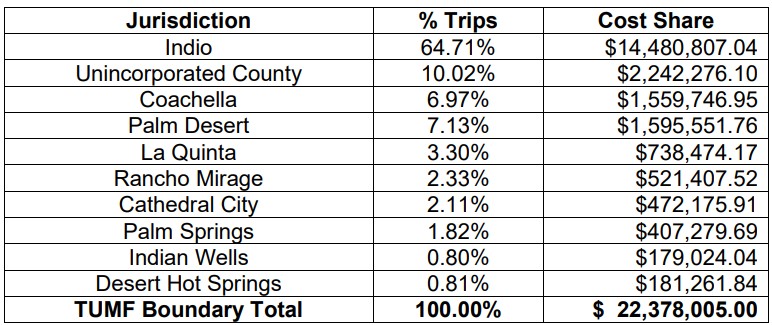
Applying the revised percentages from the Interstate 10/Monroe Street Interchange Project Proportionate Share Study and using the current estimate of $22.4 million for the Local Share, the cost shares by jurisdiction are shown above. The final proportionate share amount for each jurisdiction will be determined once the construction contract is awarded by the County.
For Monroe Street, the regional contribution is currently calculated at approximately $67.1 million and the local contribution at approximately $22.4 million.
Including earlier project funding, CVAG has authorized approximately $68.6 million for the interchange. In April, the Executive Committee approved more than $56.5 million for the construction phase, providing the financial commitment needed before the county begins seeking bids.
The structure illustrates how large transportation projects are increasingly assembled from multiple funding programs rather than paid for by a single city or agency.
It also reflects a longstanding regional policy: An interchange may be located within one city, but its economic and transportation benefits extend across municipal boundaries.
Why Indio will pay most of the local bill
CVAG established its interchange cost-sharing policy in 2003.
The approach previously was used for improvements at the Ramon Road/Bob Hope Drive, Indian Canyon Drive, Palm Drive/Gene Autry Trail and Jefferson Street interchanges.
Rather than dividing local costs according to city population or distance from the project, CVAG estimates the share of interchange traffic associated with each jurisdiction. A community generating a larger percentage of the trips using the interchange is assigned a larger percentage of the local cost.

Bob Marra is the CEO/Publisher of GPS Business Insider and GPS Market Intel. He has been studying, writing and giving presentations about business, economic and public affairs news and issues and the local economy in the Greater Palm Springs/Coachella Valley region for more than 20 years.