The unusual commercial real estate offering would transfer the landlord’s interest in the arena site and decades of lease-related income. It would not amount to a conventional sale of the Firebirds, the concert business or day-to-day control of the arena.
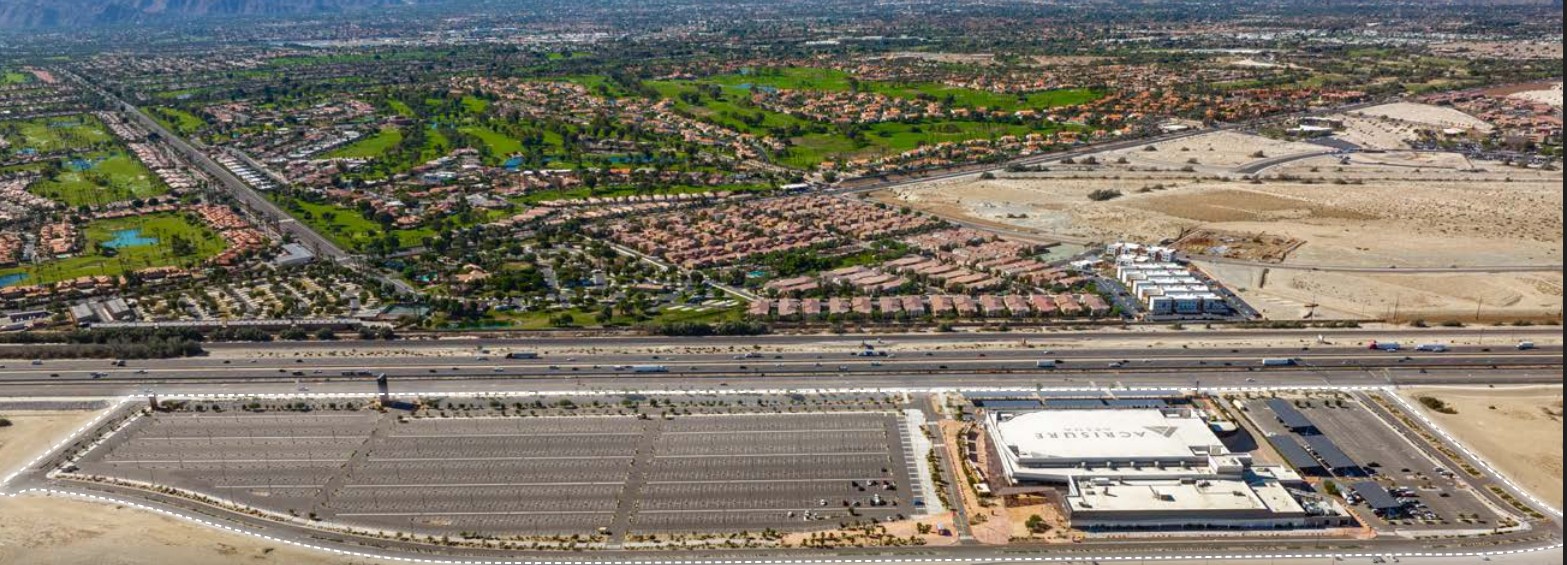
From Interstate 10, Acrisure Arena presents itself as one of Greater Palm Springs’ most permanent new landmarks.
Its broad roof and illuminated signs rise beside thousands of parking spaces near Cook Street, framing a venue that has brought professional hockey, major concert tours, nationally recognized entertainers and high-profile sporting events to the center of the Coachella Valley.
Yet beneath the crowds, the suites and the ice is a quieter asset that most arena patrons never consider: a large tract of land, a long-term ground lease and a series of contractual payments expected to continue for decades.
That investment has been brought to market.
CBRE is offering what commercial real estate professionals call the “leased-fee interest” in the Acrisure Arena property, an uncommon transaction tied to one of the most prominent developments built in the Coachella Valley in a generation.
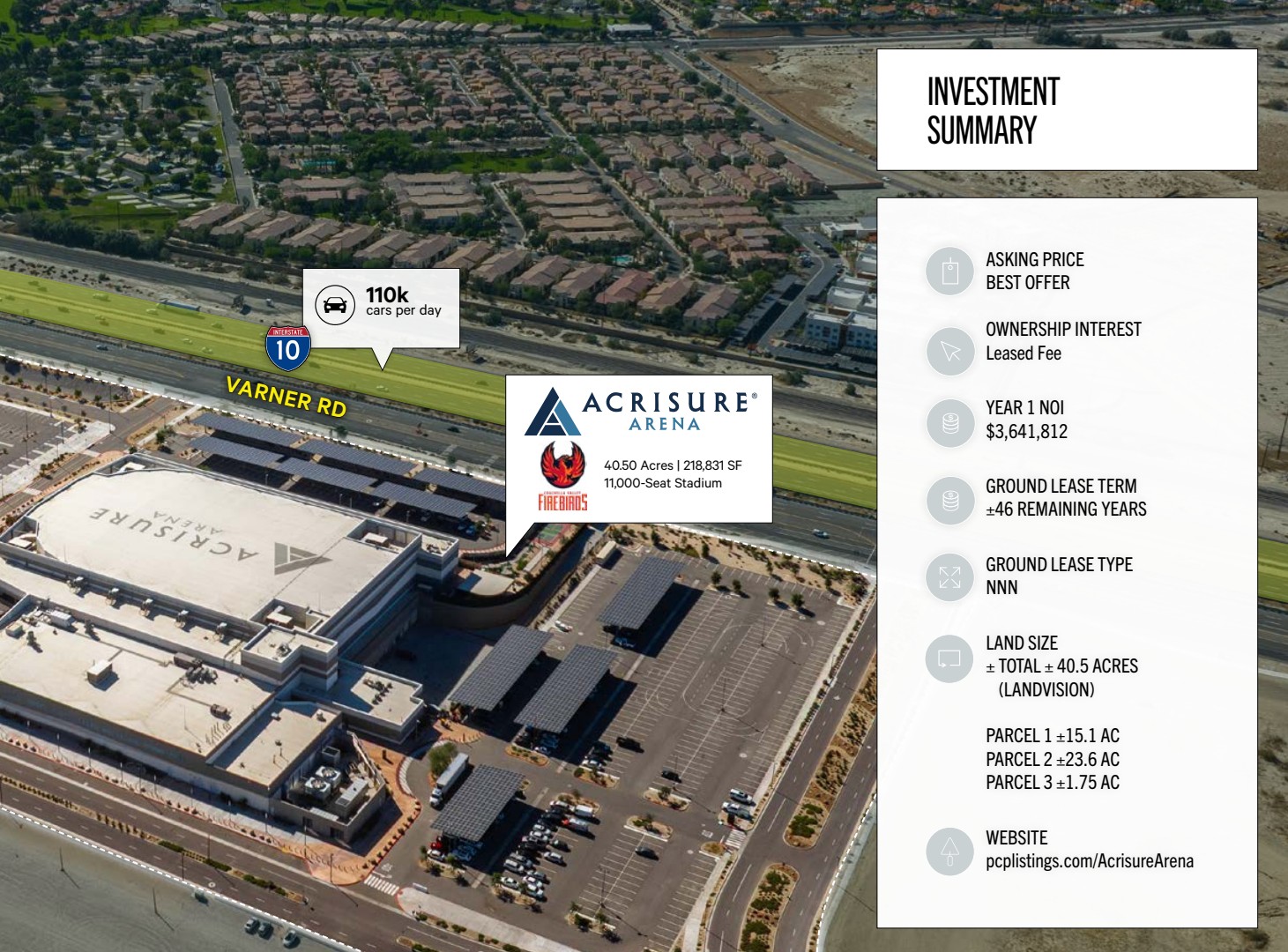
The offering memorandum describes approximately 40.5 acres, an arena with more than 11,000 seats and nearly 46 years remaining on a ground lease. No asking price has been established. The property is being marketed on a “best offer” basis.
But the transaction is not a conventional sale of Acrisure Arena as most people would understand it.
The buyer would not be acquiring the arena, the Coachella Valley Firebirds, Oak View Group’s arena-management operation, the venue’s concert-booking business or the right to take over the box office. There is no indication that arena employees, existing events, premium memberships, naming rights or the public experience at the venue would change.
Instead, the purchaser would become the landlord.
The investment being sold is the H.N. and Frances C. Berger Foundation’s position under a long-term lease, including the right to receive ground rent and other contractual payments from the arena tenant, along with whatever ownership and residual rights are attached to the underlying real estate.
For the public, the arena would probably look and operate much as it does today. Behind the scenes, however, one of Greater Palm Springs’ most consequential pieces of real estate could have a new owner.
A sale that is not what it seems
The terminology used in the offering memorandum is precise within the commercial real estate industry but potentially confusing outside it.
When a landowner leases land to a tenant, the owner retains what is known as the leased-fee interest. The tenant receives a leasehold interest, meaning the contractual right to occupy and use the property for the duration of the lease.
In this case, the offering memorandum identifies “SoCal Arena” as the tenant under a ground lease that began Jan. 1, 2023, and is scheduled to expire Dec. 31, 2071. The tenant also holds an option to extend the lease for an additional 10 years.
The purchaser would step into the position now occupied by the Berger Foundation. It would collect the payments required under the lease and obtain the landlord’s considerable contractual rights, while the arena tenant would remain in possession.
Put more simply, the buyer would become the owner and landlord of the leased real estate, not the concert promoter, hockey-team owner or arena manager.
Those descriptions are not necessarily contradictory. Ground-lease developments often divide ownership, control and economic rights among multiple parties. One entity can own the land while another owns or controls the buildings, operates the business and possesses the property under a long-term lease.
The offering memorandum, however, does not include the full ground lease, deeds or title documents. It therefore does not definitively explain who holds legal title to the arena improvements during the lease, what portions of the complex are included in the offering, or precisely what happens to the arena building when the lease ultimately ends.
Those details could materially affect the long-term value of the investment.
The foundation beneath the arena
The Berger Foundation has played a central role in the arena project from its beginning.
When Oak View Group shifted its arena plans away from downtown Palm Springs in 2020, the Palm Desert-based private foundation made land available near Interstate 10 and the Classic Club golf course in the unincorporated area of Thousand Palms.
The arena opened in December 2022 following an investment of nearly $300 million. It quickly became home to the Firebirds, the American Hockey League affiliate of the Seattle Kraken, while establishing itself as a regular stop for concert tours and other entertainment events.
The arena’s sports profile is now expanding.
The Los Angeles Lakers announced in April that their NBA G League affiliate will relocate from the Los Angeles area to Greater Palm Springs and become the Coachella Valley Lakers. The team is scheduled to begin playing its home games at Acrisure Arena during the 2026-27 season.
That announcement came after the offering’s original call-for-offers date.
The addition of another professional sports tenant does not necessarily increase the fixed contractual payments owed to the landowner. But it may strengthen the broader investment story by adding events, increasing use of the arena and reinforcing the venue’s position as the region’s leading year-round sports and entertainment facility.
More than ground rent
The broker offering document also provides an unusually detailed view into the financial relationship between the arena operation and the property owner.
CBRE projects approximately $3.64 million in net operating income during the first year of its investment analysis.
That figure should not be confused with Acrisure Arena’s total revenue or operating profit. It does not represent the money generated by concerts, hockey games, concessions, sponsorships, premium seating or the arena business as a whole.
It is the modeled income flowing to the property owner under the ground lease and related agreements.
The largest single component is not the ground rent itself.
The offering identifies the current annual ground rent of approximately $1.15 million. The remainder of the projected income comes from several additional payment streams associated with the arena:
- Annual parking-related revenue is projected at approximately $993,000.
- Ticket-fee payments total $1 million.
- An additional $250,000 is identified as a ticket-fee reserve payment.
- Revenue associated with three marquee signs contributes another $250,000.
Together, those payments produce the projected first-year net operating income of approximately $3.64 million.
The financial model assumes no operating expenses for the property owner because the ground lease is an absolute net lease. In such an arrangement, the tenant generally assumes responsibility for property taxes, insurance, maintenance, operating expenses and many other costs that would ordinarily be borne by a landlord.
That structure is intended to make the investment mostly passive.
The buyer would not be expected to manage concerts, maintain the arena, operate parking lots or supervise the venue’s day-to-day business. Instead, the investment would function more like a long-duration contractual income asset backed by significant real estate.
But passive does not mean risk-free.
The ultimate value would depend on the tenant’s financial strength, the enforceability of the lease, any parent-company guarantees, the condition of the property, the treatment of the arena improvements, and the long-term value of the site.
For an institutional buyer, that could be one of the most important questions in the transaction.
Why sell now?
The offering materials do not explain why the leased fee interest has been placed on the market.
Nothing in the memorandum indicates that the sale is related to financial difficulty at the arena. The document instead presents the property as a rare, stable investment supported by a newly constructed venue, a long-term lease, scheduled payment increases and the continued growth of the Coachella Valley.
For the Berger Foundation, a sale could represent a portfolio decision.
Selling a long-term income-producing property can allow an owner to convert decades of future payments into a large amount of capital today. Proceeds could be reinvested, diversified or used to support other objectives.
But the Foundation has not publicly stated its motivation, and it would be premature to assume how any proceeds might be used.
The question carries particular local significance because the Foundation is not simply a conventional real estate investor.
For decades, it has provided financial and real estate support to nonprofit organizations throughout the Coachella Valley, particularly in education, health and social services. Its real estate holdings have helped support its philanthropic mission.
The sale could therefore become more than a commercial real estate transaction. Depending on the Foundation’s plans, it could also affect the future structure of one of the region’s most influential charitable organizations.
An arena at the center of a larger vision
CBRE’s marketing materials place substantial emphasis on the property’s location within a larger planned entertainment and mixed-use district.
The offering describes a future area combining the arena and Classic Club with potential hotels, housing, lifestyle retail, wellness uses and research and development facilities.
The arena has already altered perceptions of the Interstate 10 corridor.
What was once viewed largely as open land between established communities now includes a major entertainment venue, a professional hockey franchise, a community ice facility and the future home of a Lakers-affiliated basketball team.
Residential development has also expanded nearby, particularly around University Park in Palm Desert.
Still, the broader entertainment-district vision remains separate from the leased-fee offering.
The relationship between a new arena landowner and future neighboring development could nevertheless become important.
Hotels, restaurants, retail businesses and additional entertainment uses could increase activity around the arena and enhance the site’s value. At the same time, access, parking, signage, infrastructure and development rights could require coordination among multiple owners.
The visible arena may stay the same
Acrisure Arena was built to fill a longstanding gap in the Coachella Valley’s economy and quality of life.
Before its opening, the region could host major outdoor festivals and resort events but lacked a modern indoor arena capable of supporting professional sports and large touring productions throughout the year.
In less than four years, the venue has become a recognizable part of Greater Palm Springs.
The leased-fee offering does not appear designed to change that role.
Instead, it reveals a less visible layer of the arena’s structure: the separation between the land, the building, the operating business and the contractual income that connects them.
For the eventual buyer, the attraction may be decades of predictable payments attached to a nearly new arena in a growing resort market.
For the Berger Foundation, the transaction may represent an opportunity to unlock the present value of a major real estate investment.
For the public, the most important fact may be the simplest one.
The arena is not being sold in the conventional sense. The Firebirds are not changing hands. The concert business is not being transferred. Oak View Group is not leaving.
What may change is the ownership of the land and landlord rights beneath one of Greater Palm Springs’ most important new institutions.
The arena’s lights, crowds and events would remain highly visible.
Its new owner might not be.

Bob Marra is the CEO/Publisher of GPS Business Insider and GPS Market Intel. He has been studying, writing and giving presentations about business, economic and public affairs news and issues and the local economy in the Greater Palm Springs/Coachella Valley region for more than 20 years.