Overall hospitality asset sales have slowed, but distinctive boutique properties are attracting cash buyers willing to pay premium prices for design, history, privacy and an experience that cannot easily be replicated.
In the Palm Springs hospitality market, the smallest hotels increasingly operate by a different set of investment rules.
They are businesses, but some buyers view them as collectible real estate. They are lodging properties, but their value may depend as much on architecture, atmosphere and history as on conventional measures of income. They may contain only 10 or 20 rooms, yet their scarcity can produce per-room prices comparable to those of much larger luxury hotels.

Kate Rust and Joe Pradetto, agents with Meade Commercial
Joe Pradetto and Kate Rust, commercial real estate agents with Meade Commercial, have focused closely on this specialized corner of the local hospitality sector, analyzing the economics of small independent hotels, the motivations of their buyers and the financing challenges associated with properties whose appeal can extend beyond documented cash flow.
Their market knowledge was recently put to work when a client asked them to find a boutique hotel with approximately 13 rooms or fewer in Palm Springs or Desert Hot Springs. The buyer wanted an operating property that could generate enough income to support financing through the U.S. Small Business Administration.
The assignment illustrated a market Pradetto and Rust already understood to be unusually tight. Few appropriately sized hotels were available, and the strongest candidates attracted cash buyers who were not necessarily evaluating the properties by the same standards as an owner-operator dependent on debt.
“We started with a very specific assignment for our client, but the search highlighted a much broader market story,” Pradetto said. “There are not many hotels of this size available, and the strongest properties typically attract cash buyers before a financed buyer has enough time to complete underwriting.”
That broader story is one of the more intriguing contradictions in Greater Palm Springs commercial real estate.
Hotel transaction volume has fallen sharply. Financing has become more difficult. Buyers are scrutinizing labor, insurance, utility and renovation costs. Yet when a distinctive small hotel reaches the market, it can attract considerable interest and command a price that appears disconnected from the slowdown affecting hospitality real estate overall.
A small but distinct investment sector
Boutique hotel is an imprecise industry term. Pradetto and Rust generally use it to describe independent properties with fewer than 50 rooms, although the most competitive portion of the market can involve hotels with fewer than 15.
These properties differ fundamentally from larger flagged hotels.
A nationally branded hotel can draw upon a reservation system, loyalty program, centralized marketing operation and standardized operating procedures. Its investment value is usually analyzed through room revenue, expenses, franchise requirements, management costs and projected returns.
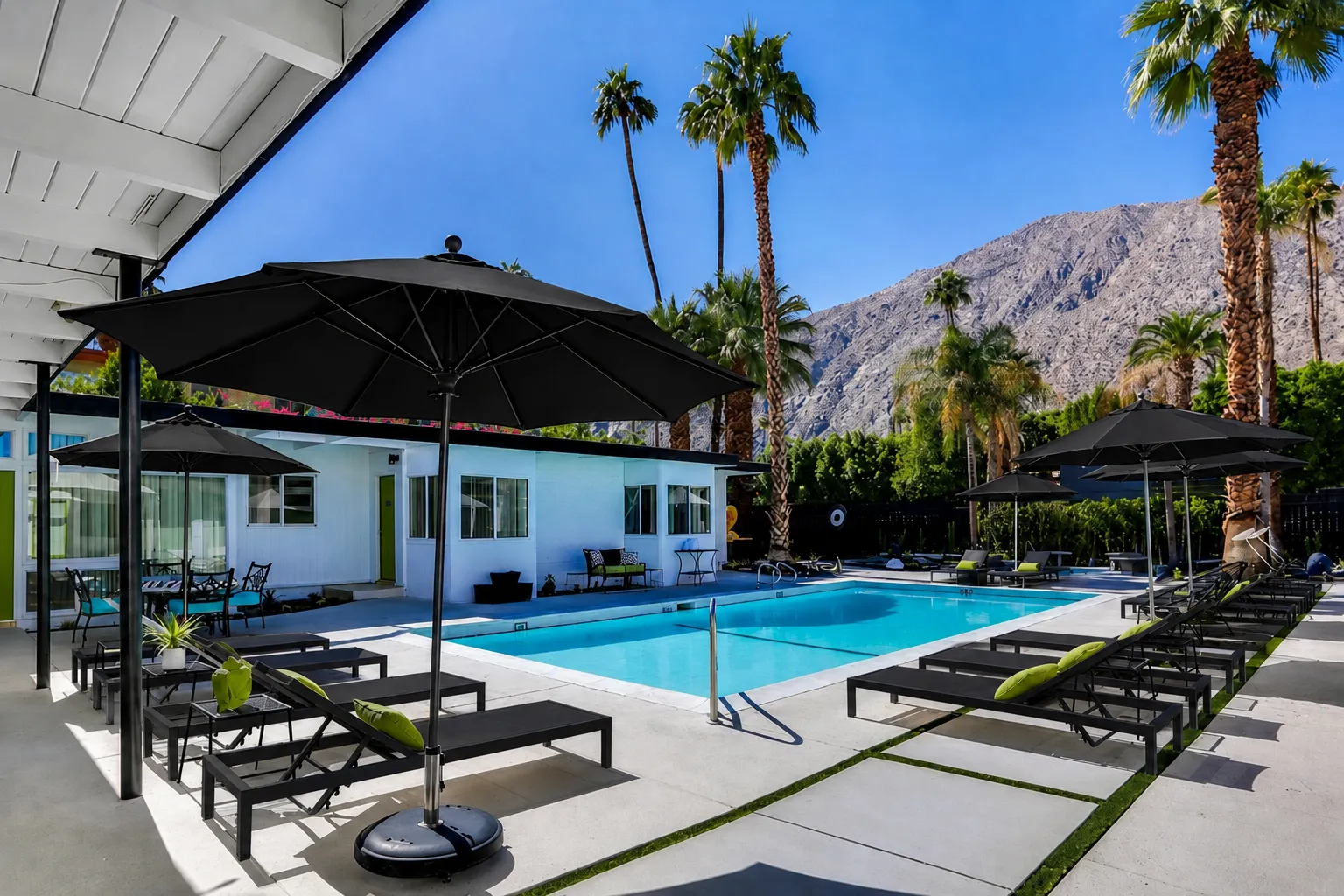
A small Palm Springs hotel must be evaluated through many of those same measures, but buyers also consider its courtyard, pool, landscaping, architectural pedigree, neighborhood, privacy and potential for exclusive use.
The strongest properties sell an experience as much as a room.
Palm Springs has a deep inventory of independent hotels built during the 1940s, 1950s and 1960s, many associated with the city’s midcentury architecture and Hollywood history. Their low-rise configurations, outdoor gathering areas and enclosed pools create an environment that can be difficult to reproduce through contemporary construction.
“The numbers can be surprising until you consider what is actually being purchased,” Rust said. “A buyer is not simply acquiring 10 rooms. The buyer may be acquiring a private courtyard, a recognizable design, a history, a reputation and a guest experience that would be extremely difficult to reproduce today.”
That helps explain why the smallest hotels can remain competitive even when the broader transaction market slows.
Fewer sales, higher prices for select properties
Hotel investment volume in the Palm Springs hospitality submarket totaled approximately $37.5 million during the 12 months ending in mid-2026, according to a CoStar market report prepared for Meade Commercial.
That was barely half the recent three-year average of $71.3 million.
Elevated financing costs and conservative lender underwriting have reduced the number of sales. Some owners have chosen to hold their properties rather than sell into an uncertain market, while institutional buyers have remained cautious about valuations, refinancing risk and operating margins.
The limited transaction activity, however, has included two revealing sales involving hotels with only 10 rooms.
The Three Fifty Hotel at 350 S. Belardo Road sold in April for $3.35 million, or $335,000 per room. The Weekend at 111 S. Via Las Palmas sold in July for $3.125 million, or $312,500 per room.
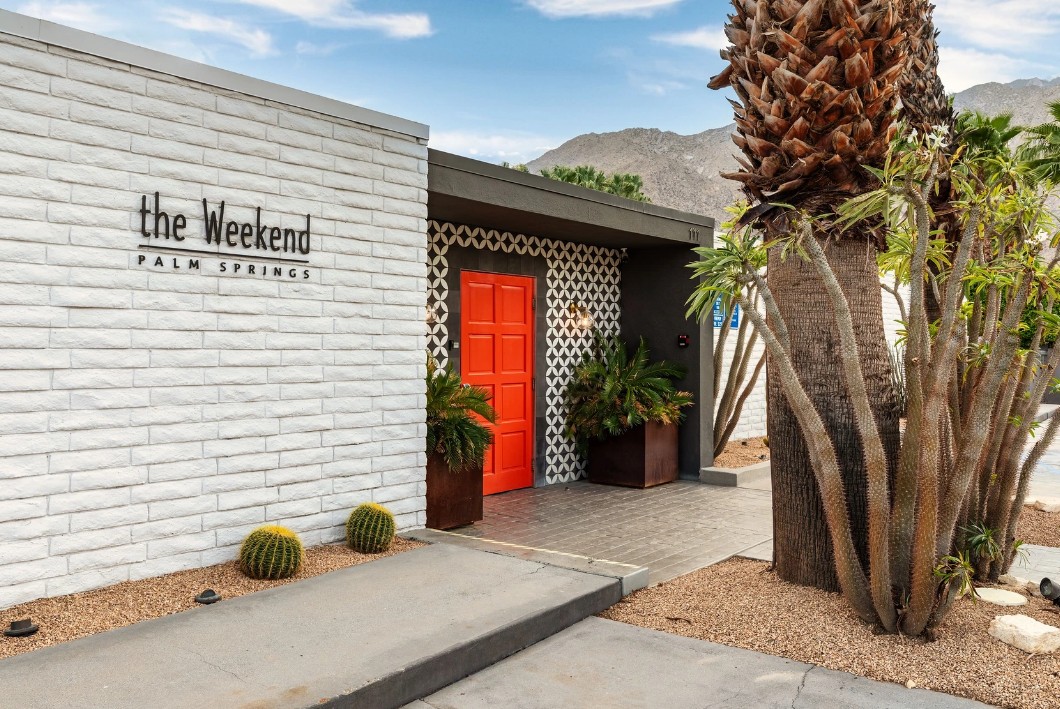
The Weekend Hotel, was sold for $3.125 million in July.
Together, the properties represented approximately $6.5 million in sales volume. They averaged $323,750 per room and produced an average cap rate of approximately 4.5 percent, according to the report.
Two sales cannot establish a market wide value. Per-room prices vary depending on land value, location, physical condition, amenities, redevelopment potential and operating history.
Still, the transactions demonstrate that buyers may assign substantial value to a scarce, intimate hotel in a desirable Palm Springs setting.
They also reveal the limits of conventional hotel valuation metrics. A 10-room property sold for more than $300,000 per room may not produce the operating efficiencies of a larger resort. But it may offer privacy, personal use, tax considerations, repositioning potential or exclusivity that is difficult to quantify through current income alone.
Buyers do not always pursue the same return
The Palm Springs boutique hotel market attracts several types of buyers.
Some are traditional owner-operators seeking an operating business that can produce income and long-term real estate appreciation. Others are hospitality investors planning renovations, improved management or a new brand identity.
There also are high-net-worth buyers who may treat a hotel partly as a lifestyle asset. A small property can provide accommodations for family, friends, corporate retreats or private events while continuing to operate commercially during the remainder of the year.
Such a buyer may accept a lower financial return than an investor using significant debt. The hotel may represent one part of a larger portfolio rather than a stand-alone business expected to achieve a specific yield.
That creates a difficult competitive environment for an SBA-financed buyer.
An owner-operator relying on debt must determine whether verifiable income can support loan payments, expenses, capital improvements and seasonal fluctuations. A cash buyer can move more quickly and may be less concerned about existing revenue if the longer-term objective is renovation, repositioning or partial personal use.
“In a limited-inventory market, timing becomes part of the price,” Pradetto said. “A buyer who does not need financing contingencies can give a seller greater certainty. Even when a financed buyer has a strong business plan, the cash offer may be more attractive because there are fewer steps between the agreement and closing.”
The financing challenge
SBA financing can provide an important route to hotel ownership for entrepreneurs who intend to operate the business themselves. Depending on the structure and borrower’s qualifications, it can reduce the equity requirement compared with some conventional commercial real estate loans.
But an SBA-backed hotel purchase remains an income-dependent transaction.
The lender generally must review operating statements, tax returns, occupancy history, room rates, payroll costs and capital expenditures. An appraisal must support the price, and the property must demonstrate sufficient debt-service coverage.
That can become complicated when a hotel’s historical financial performance does not reflect its potential.
An owner may have blocked rooms for personal guests, operated seasonally, underinvested in marketing or managed the property primarily as a lifestyle business. The hotel may have substantial upside under a more disciplined operator, but lenders generally cannot base their decisions entirely on projected improvements.
The financed buyer may therefore see an opportunity that cannot yet be supported by the documented income. A cash buyer does not face the same constraint.
This helps explain why a boutique hotel can generate intense interest while still appearing difficult to finance at its asking price.
However, as Joe and Kate have experienced firsthand, SBA financing can be successfully obtained for the acquisition of a non-operational hotel when supported by a well-prepared business plan, strong financial qualifications, and a clear operational strategy for reopening and stabilizing the property.
Scarcity does not eliminate operating risk
Premium prices do not make small hotels easy to operate.
A 10-room property has fewer revenue-producing units over which to spread insurance, maintenance, technology, landscaping, pool service, housekeeping and management expenses. A major repair, several cancellations or a weak month can quickly affect profitability.
Older Palm Springs properties also may require investment in plumbing, electrical systems, roofs, air conditioning and accessibility improvements.
Buyers must distinguish between architectural character and deferred maintenance. A vintage hotel can possess substantial marketing value, but the cost of preserving that character while modernizing essential systems can be considerable.
Location also remains critical. Walkability, neighborhood character, parking, zoning, permits, liquor licensing, online reviews and proximity to downtown can materially affect value.
“A premium sale price does not eliminate the need for operating discipline,” Rust said. “The most compelling properties combine a memorable guest experience with clean financial records, strong rate management and a realistic plan for the slower months.”
Strong rates meet intense seasonality
The broader Palm Springs hospitality market continues to command premium room rates.
During the 12 months ending in May, the submarket recorded occupancy of 60.4 percent, an average daily rate of $229 and revenue per available room of $139. RevPAR increased 2.6 percent, driven primarily by room-rate growth.
Performance was stronger during the first part of 2026. Year-to-date occupancy reached approximately 69.8 percent, while the average daily rate approached $285 and RevPAR reached nearly $199.
Palm Springs’ ability to sustain those rates reflects its position as a resort destination with a large concentration of luxury, upper-upscale and independent hotels. More than half of the submarket’s rooms fall within the luxury and upper-upscale categories, and more than one-third of its hotels operate independently.
The annual averages conceal pronounced seasonality.
Occupancy typically peaks between February and April, when favorable weather coincides with the Palm Springs International Film Festival, Modernism Week, the BNP Paribas Open, The American Express golf tournament and the Coachella Valley Music and Arts Festival.
During those months, occupancy can range from 72 percent to 82 percent. In summer, it can fall below 55 percent.
Small hotel operators must earn a substantial share of their annual income during the peak season. They use dynamic pricing, private buyouts, direct booking strategies and specialized programming to maximize revenue when demand is strongest.
Palm Springs financial data shows that the sector is not experiencing uninterrupted growth. During the first half of the city’s 2025-26 fiscal year, transient occupancy tax revenue from hotels with 49 rooms or fewer declined approximately 7 percent compared with the same period a year earlier. Revenue from large hotels declined 9 percent, while group-meeting hotels recorded an increase.
The figures reinforce the dual nature of the market. Long-term scarcity can support property values, while short-term operations still require close scrutiny.
New construction will not replenish the smallest hotels
Approximately 440 hotel rooms are entitled, but have not begun construction, across the Palm Springs hospitality submarket, representing about 2.3 percent of existing inventory.
The projects include the 156-room Dream Palm Springs near the Palm Springs Convention Center, a planned 154-room hotel at the future SilverRock Resort in La Quinta and the 129-room hotel entitled for the DSRT Surf development in Palm Desert.
If developed, those hotels would add upscale and luxury rooms, but they will not materially increase the supply of intimate hotels with 10, 15 or 20 rooms.
The economics of building such a property are difficult. Land acquisition, entitlement, construction, parking and operating costs must be supported by a very small number of revenue-producing units. A new operator also must create the identity and guest loyalty that an established property may have developed over decades.
Existing boutique hotels therefore benefit from structural scarcity. Many occupy locations where comparable projects would be difficult or impossible to build today.
Scarcity does not guarantee profitability, but it can reinforce the long-term investment appeal of well-located and thoughtfully maintained properties.
What the market means for sellers and buyers
For owners of small boutique hotels, the slowdown in overall transaction activity may create an opening.
With fewer properties available, a distinctive hotel can receive greater attention. Owners considering a sale can strengthen their position by preparing complete financial statements, documenting capital improvements and resolving permitting or licensing issues.
For financed buyers, preparation is especially important. Loan discussions, equity requirements and underwriting expectations should be addressed before an attractive property reaches the market. In a sector where cash offers can emerge quickly, a buyer who starts the financing process only after identifying a hotel may already be at a disadvantage.
Buyers also must avoid assuming that rarity justifies any price. A low capitalization rate leaves little room for operating mistakes, and projected upside should not be confused with proven income.
Yet the market distinction is becoming increasingly clear.
Palm Springs hotel sales may be slow overall, but the smallest and most distinctive properties occupy a specialized investment sector shaped by scarcity, lifestyle appeal and buyers whose motivations may extend beyond conventional hotel returns.
“This is not a broad-based hotel buying boom,” Rust said. “It is a highly selective market in which the right small property can command exceptional interest because buyers know another comparable opportunity may not appear for a long time.”

Bob Marra is the CEO/Publisher of GPS Business Insider. He has been studying, writing and giving presentations about business, economic and public affairs news and issues and the local economy in the Greater Palm Springs/Coachella Valley region for more than 20 years.