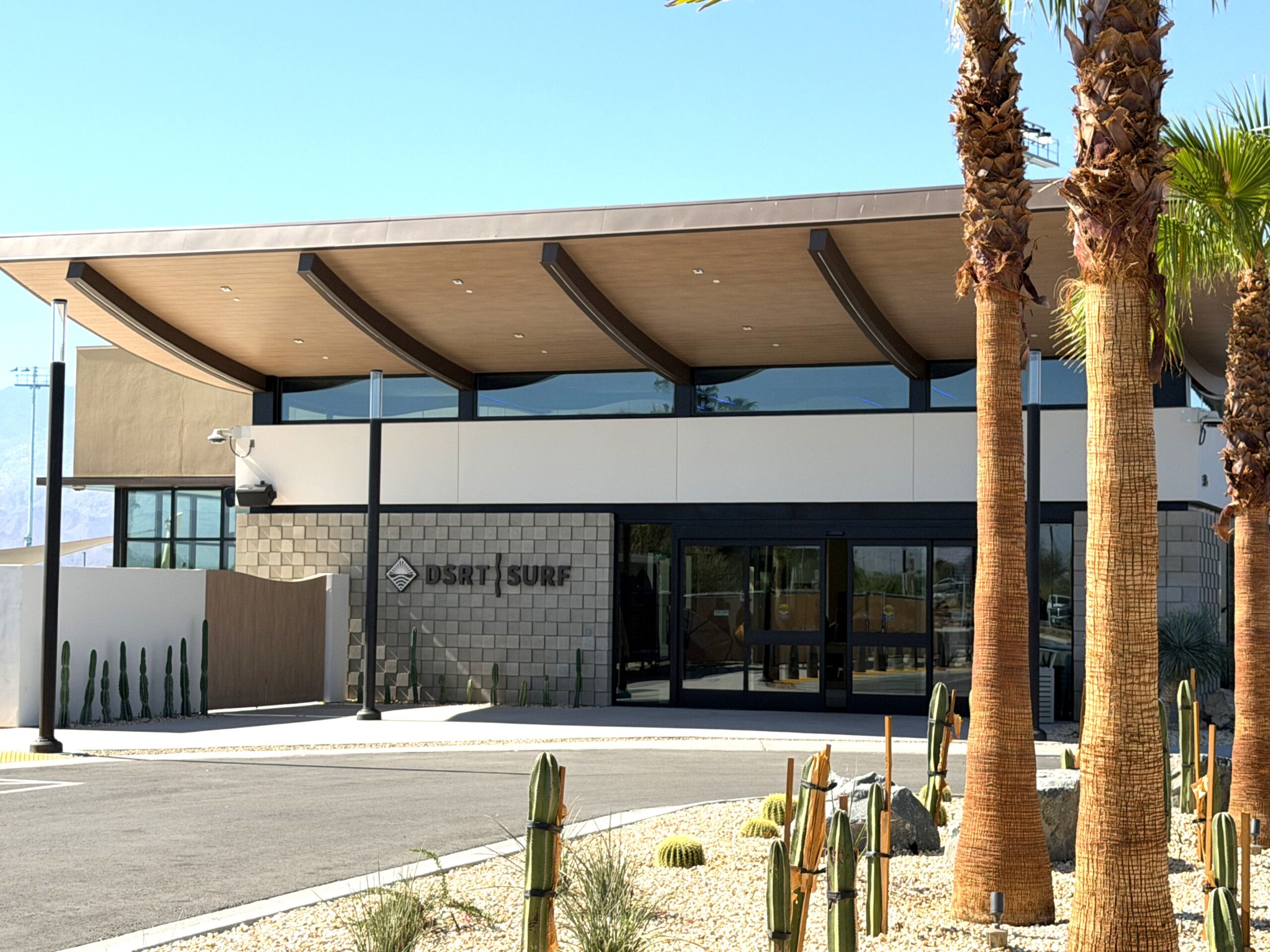
Hotel demand and revenue strengthened through June, group bookings recovered sharply to full goal numbers, and the region continued to absorb a deep pullback in Canadian travel without losing its broader momentum.
By several measures, Greater Palm Springs should be feeling more strain than it is.
Political tensions have discouraged travel from Canada, the region’s largest international market. Consumers remain watchful about prices. Businesses are scrutinizing travel budgets. Geopolitical uncertainty has made forecasting more difficult throughout the tourism industry.
Yet Greater Palm Springs entered the second half of 2026 with higher hotel occupancy, rising room rates, increased room revenue and a meetings pipeline that regained its footing after a hesitant start to the year.
The results do not suggest an industry untouched by economic pressures. They show something more consequential for the Coachella Valley: a tourism economy large and diverse enough to absorb substantial headwinds while continuing to generate demand.
For a region in which tourism supports roughly one in four jobs, that strength carries implications far beyond hotel balance sheets. It affects restaurant traffic, retail sales, convention business, municipal tax revenue, workforce demand and the pace of investment across the nine-city destination.
June provided clear evidence of the tourism sector’s impressive performance
Greater Palm Springs hotels recorded a notably strong June.
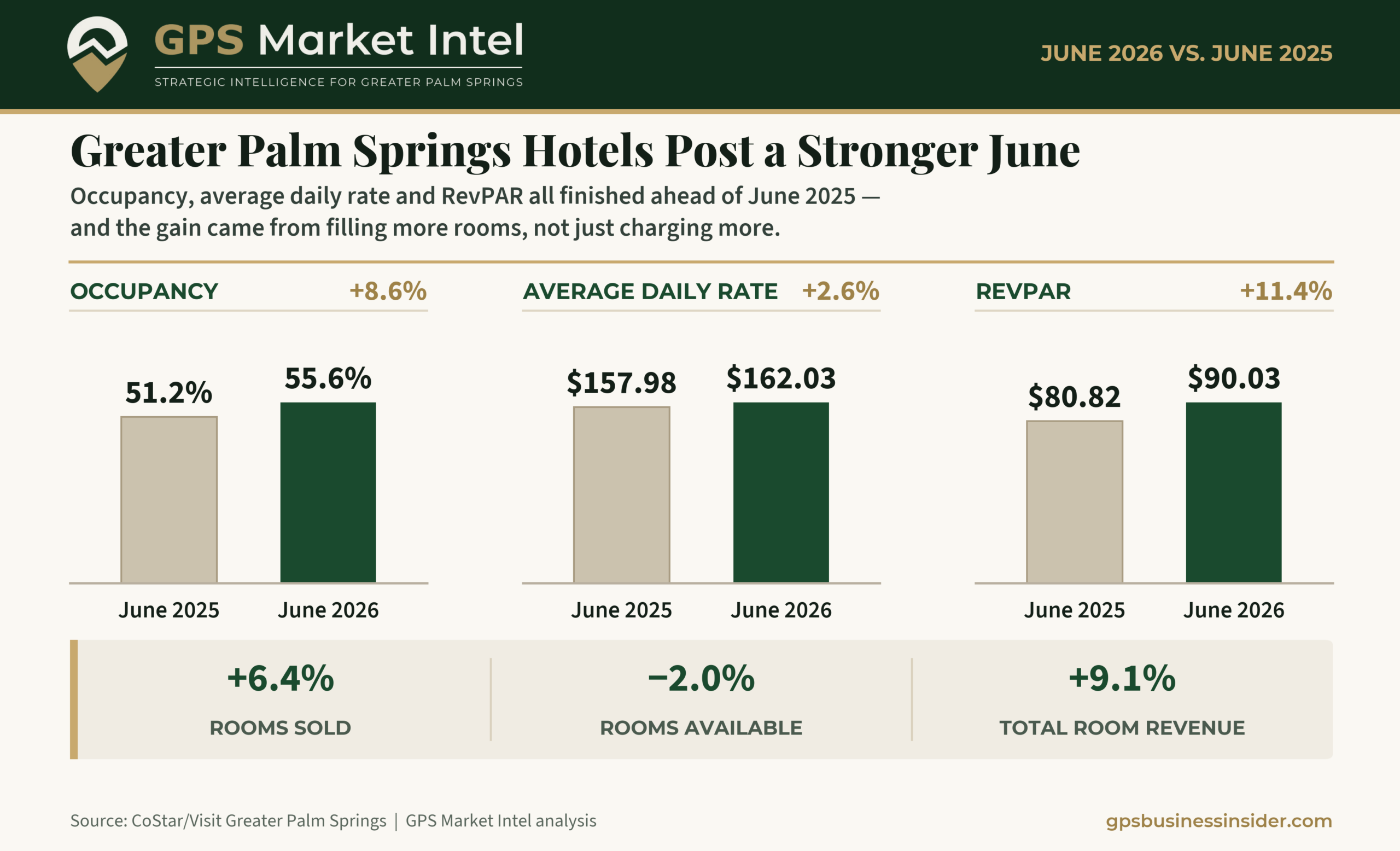
According to data from CoStar cited by VGPS, occupancy reached 55.6 percent, compared with 51.2 percent in June 2025. The average daily room rate rose 2.6 percent to $162.03, while revenue per available room, the industry benchmark known as RevPAR, increased 11.4 percent to $90.03.
The improvement was not simply the result of hotels charging more. Rooms sold increased 6.4 percent even as the number of available rooms declined 2 percent. Total room revenue rose 9.1 percent.
Greater Palm Springs’ RevPAR (revenue per available room) growth outpaced such destinations as Phoenix, Scottsdale, Tucson, Napa County, Monterey, Long Beach and the San Diego-La Jolla market.
The year-to-date results through June were steadier but still encouraging.
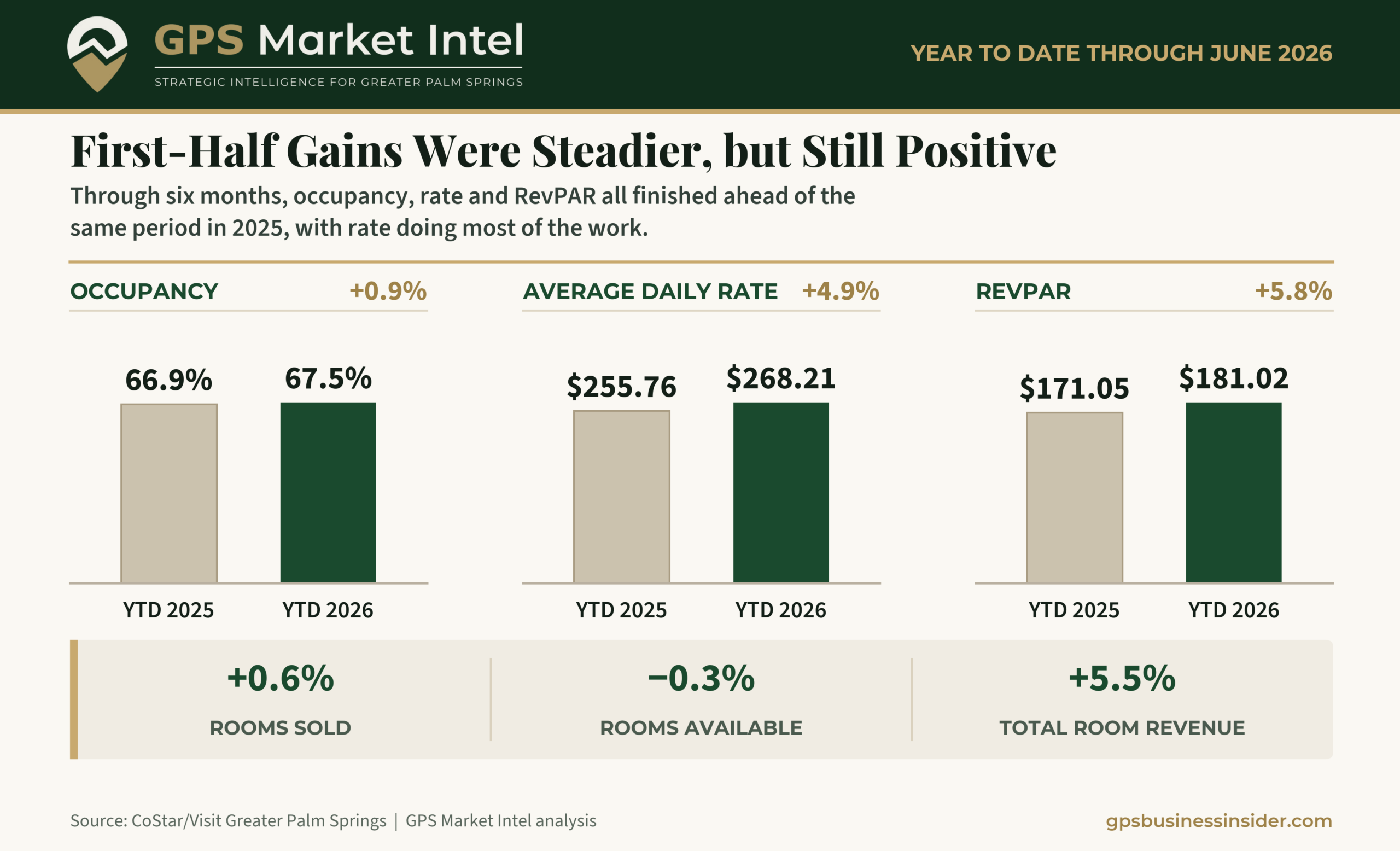
Occupancy reached 67.5 percent, up from 66.9 percent during the first half of 2025. The average daily rate increased 4.9 percent to $268.21, and RevPAR rose 5.8 percent to $181.02. Room revenue was up 5.5 percent, while rooms sold increased 0.6 percent.
Those figures show that the region retained meaningful pricing power while continuing to sell slightly more rooms. In other words, the gains were not produced by discounting rooms to manufacture occupancy.
The larger acceleration in June is particularly significant because summer has traditionally been the region’s most difficult tourism period. Sustaining that momentum through July, August and September would provide evidence that Greater Palm Springs is making progress toward becoming a more balanced, year-round destination.
Travel is still winning the household budget

Scott White, President/CEO, Visit Greater Palm Springs
Scott White, president and chief executive officer of Visit Greater Palm Springs (VGPS), believes one of the most important changes in consumer behavior began during the pandemic, when travel became less of an optional indulgence and more of a personal priority.
“The tourism economy is strong in part because people have really become hooked on the experiences, taking that trip and spending time with friends and family,” White said .“That became the priority.”
Travel remains discretionary in the strictest financial sense. But White said many households increasingly appear willing to defer purchases of products in order to preserve a trip or shared experience.
“People are making the decision to say, ‘I’m going to take a trip and have that experience,’ versus buying that television, watch or whatever it is,” he said. “I thought that was going to wean away a little bit over time, but it hasn’t. It has remained strong.”
That shift is helping hotels, although White cautioned that lodging results do not always tell the entire story.
He said tourism executives in larger markets such as Orlando, New York and Los Angeles have reported softness at major attractions (mostly the expensive theme parks), with some consumers apparently continuing to book trips while reducing spending on entertainment, restaurants or shopping.
“They’re doing the trips, they’re booking hotels, but I think they’re reducing their ancillary spend,” White said.
He emphasized that he has not yet seen data establishing the same pattern in Greater Palm Springs. For our region, it is a trend to watch rather than a local conclusion.
That distinction matters. A visitor economy can produce strong room revenue while restaurants, retailers and attractions experience a more uneven benefit. The second half question will not be limited to whether visitors come, but how broadly their spending circulates through the regional economy.
Group business regains its pace
Meetings, conventions and organized groups have become another important source of stability.
Visit Greater Palm Springs reported that its sales team had generated 117,951 booked room nights through mid-June. At that point, the organization was at 94 percent of its pace-to-date goal, while lead distribution, new leads and new bookings were near or above their respective targets.
By late July, White said group business had moved above 100 percent of its year-to-date calendar goal.
The recovery followed a difficult opening quarter, when uncertainty surrounding federal policies and the broader economy caused some organizations to delay decisions.
“The first three months of the year were a little bit chaotic with what was coming out of Washington, D.C.,” White said. “A lot of the groups were holding back and waiting to make decisions.”
Many of those organizations eventually concluded that indefinitely postponing meetings was not a practical strategy.
“A lot of the groups that were tentative closed,” White said. “We really bridged the gap in April and May and caught up in June. We feel like we’re in a good spot.”
The forward calendar also appears favorable.
“There’s a lot of business in the funnel,” White said. “We feel really good about short-term business for the rest of 2026, and certainly we see a lot going into 2027 and 2028.”
The local experience is consistent with the national outlook. U.S. Travel Association forecasters expect domestic group travel spending to increase in 2026, supported by the continued value businesses and associations place on in-person meetings.
Greater Palm Springs is well positioned for that market because it combines large resorts, meeting facilities, recreation, dining and relatively easy access from Southern California population centers. Group visitors also help fill rooms during weekdays and shoulder periods that can be more difficult to serve through leisure travel alone.
Canada remains the clearest headwind
The resilience of the local hotel market is more notable because of what has happened in Canada.
Canadian visitors have historically represented Greater Palm Springs’ largest international market, particularly during the winter season. But travel from Canada to the United States dropped sharply beginning in early 2025 amid political tensions, currency pressures and changing attitudes toward U.S. travel.
Canadian-resident return trips from the United States fell more than 25 percent in 2025 compared with 2024, according to Statistics Canada.
Conditions began improving on a year-over-year basis during the spring of 2026, but largely because comparisons were being made against already depressed 2025 levels. Canadian trips returning from the United States increased 3.2 percent in June compared with June 2025, yet remained nearly 29 percent below June 2024. Canadian air travel from the United States was also still down from both years.
Visit Greater Palm Springs anticipated the weakness in its 2026 marketing plan. Its response includes continued conversations with Canadian airlines, cooperative campaigns, targeted media, loyalty-program partnerships and messaging built around wellness, signature events and extended stays.
The organization is not treating Canada as a market that can simply be replaced. It is working to preserve long-standing relationships while broadening the destination’s domestic and international visitor base.
The positive hotel results suggest that other segments, including Southern California drive visitors, domestic fly markets and organized groups, are helping compensate for some of the Canadian decline.
That diversification may be one of the most important reasons Greater Palm Springs has held up as well as it has.
Turning summer into a growth season
Visit Greater Palm Springs generated more than 6.7 billion marketing impressions between March and May, according to White’s June report to the organization’s board of directors.
Following the conclusion of its “Escape Your Ordinary” campaign, the organization launched “Play for Days,” a summer initiative running across television, digital, social, video and outdoor advertising in drive and fly markets.
The campaign promotes Greater Palm Springs as more than a winter escape. It emphasizes pools, resorts, spas, dining, family activities, nighttime experiences and indoor attractions that can compete for visitors during warmer months.
Visit Greater Palm Springs has been supplementing that effort with a VRBO campaign, Restaurant Week, the second annual Spa Month and partnerships designed to place the destination before influential national and international audiences.

But White said marketing alone cannot solve the region’s seasonality. Greater Palm Springs also needs more experiences, facilities and events capable of creating reasons to travel during the summer.
“How do we drive more group business during those need periods, that June-through-September time period?” White said. “That’s key.”
One of the most closely watched proposals, which has been led by VGPS, is a climate-controlled indoor sports complex that could attract basketball, volleyball, cheer, fencing and other tournament business during months when outdoor competition becomes difficult.
Visit Greater Palm Springs’ planning documents estimate that such a facility could generate approximately 34,300 hotel room nights and $46.3 million in annual economic activity. Whether the project advances will depend on securing a site, development partners and financing.
No single attraction or facility will eliminate the summer slowdown, White said. The larger objective is to build a collection of experiences that, together, produce dependable off-season demand.
“The more that we can figure out the summertime and make us truly a year-round destination, in some way, shape or form from an economic standpoint on the tourism side, that is one of our top priorities,” he said.
PSP’s modest retreat from a record is not a warning signal

Southwest Airlines continues to make a major impact on air travel via Palm Springs International Airport.
Palm Springs International Airport handled 1.96 million arriving and departing passengers through June, approximately 3.4 percent fewer than during the record-setting first half of 2025.
That comparison should be viewed with perspective.
PSP served more than 3.3 million passengers in 2025, the busiest year in its history and a 2.4 percent increase from 2024. The airport set five monthly passenger records during the year.
Passenger traffic through June 2026 remained slightly above the corresponding period in 2024. The June decline also narrowed to 1.2 percent after a 7.8 percent decrease in May.
“Everybody wants a record year every year,” White said. “It’s not going to happen. You have record years, and then it stabilizes.”
The more important indicators, he said, are whether airlines retain key routes, maintain seat capacity and demonstrate a willingness to extend seasonal service. On those measures, White sees reasons for confidence.
Alaska Airlines, for example, is bringing back its Palm Springs to Santa Rosa service more than six weeks earlier than last year. PSP has also announced earlier seasonal service to Houston, Boise, Minneapolis and Austin.
“I think there are a lot of positive indicators that the airport is still doing very well in the eyes of the airlines,” White said.
The first-half passenger figures therefore look more like normalization following an exceptional year than a fundamental weakening of demand.
An industry learning to manage strength
According to a new economic impact analysis conducted by national experts, Tourism Economics, Greater Palm Springs welcomed about 15 million visitors in 2025. Those visitors supported 52,350 jobs, generated an estimated $9.6 billion in total economic activity and produced approximately $943 million in state and local tax revenue.
Those figures establish the scale of what is at stake.
The challenge is no longer simply to attract more visitors during the region’s strongest months. It is to distribute demand more evenly across the calendar, generate broader spending at local businesses, maintain the workforce needed to serve visitors and continue developing the experiences that will keep Greater Palm Springs competitive.
The first half of 2026 did not eliminate the risks facing tourism. Canadian travel remains well below earlier levels. Consumers may become more selective about what they purchase after arriving. Group planners are taking longer to commit. Economic and geopolitical conditions can change quickly.
But the evidence through June is largely favorable.
Hotels are earning more revenue. June room demand strengthened. Group business recovered. Marketing visibility remains substantial. Airport traffic is still near historic levels. And the region’s tourism economy is demonstrating that it can withstand pressures that would have produced far greater disruption in an earlier era.
Greater Palm Springs is not merely waiting for uncertainty to pass. It is adapting around it.

Bob Marra is the CEO/Publisher of GPS Business Insider and GPS Market Intel. He has been studying, writing and giving presentations about business, economic and public affairs news and issues and the local economy in the Greater Palm Springs/Coachella Valley region for more than 20 years.